In brief
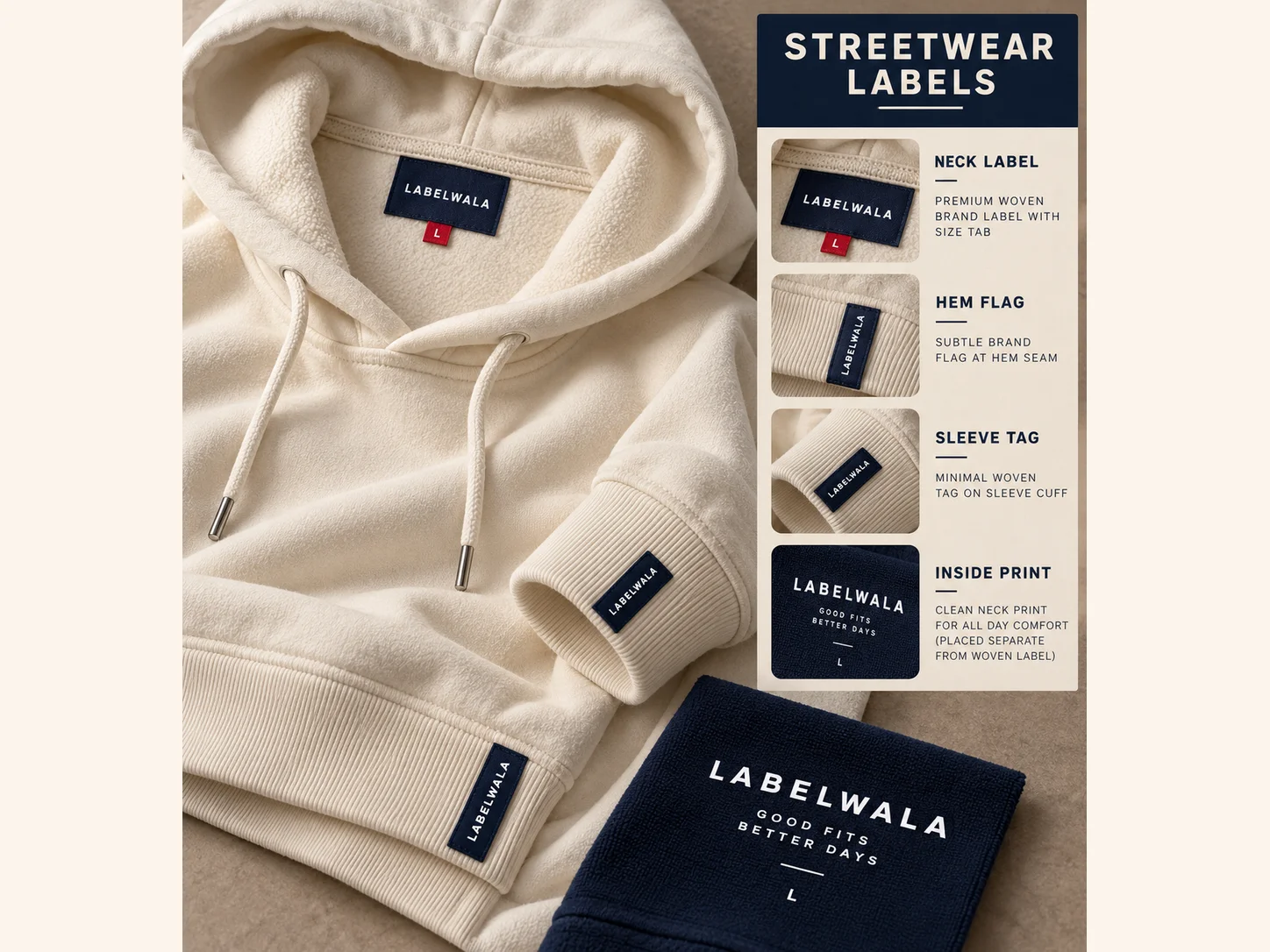
A streetwear brand usually runs four label positions: a woven neck label (or a printed inside-neck on tagless hoodies), a size tab, a small folded hem flag on the body or sleeve cuff, and a care label in the side seam. Woven damask suits the neck and hem flag, printed satin or heat transfer suits care and inside-neck, and every piece should be sampled on the actual fleece before the bulk order.
Streetwear is a label-led category. On a formal shirt the label is found by the buyer; on a hoodie it is part of the design. The hem flag shows when the garment is worn, the neck label is the first photo in a product listing, and a sleeve tag or a woven patch on the chest can be the only branding on an otherwise plain piece. That is why streetwear brands tend to order more label designs per garment than any other segment we work with, and why getting the set right matters more than it does on a kurta or a school uniform.
The fabric raises the bar too. Fleece, French terry and heavy loopback knits are thick, brushed and stretchy. A label that behaves on a 160 GSM T-shirt can curl, scratch or sink into a 400 GSM hoodie. This guide goes position by position, with the sizes, folds and materials we see working on heavyweight garments, and the checks to run on a sample before you commit to a drop.
The four positions on a hoodie
Most hoodies and oversized tees carry labels in four places. Not every brand uses all four, but every brand should decide on each one deliberately rather than leaving it to the garment factory.
| Position | Job | Usual construction | Material |
|---|---|---|---|
| Back neck | Brand mark, listing photo, authenticity | End-fold woven label, or a tagless print | Woven damask, or heat transfer |
| Size tab | Size at a glance, under or beside the neck label | Centre fold or loop fold, 15 to 20 mm | Same as neck label |
| Hem flag / cuff flag | Visible brand mark when worn | Centre fold caught in the side seam or cuff seam | Woven damask |
| Care label | Fibre, wash symbols, origin, declarations | Loop fold or flat sew-in, left side seam | Printed satin or taffeta |
Two optional positions come and go with trends: a sleeve tag (a small flat label on the upper sleeve or at the cuff) and a chest patch (a woven or embroidered patch sewn or heat-sealed onto the body). Both are branding rather than information, so they follow the same rules as the hem flag.
The job of each position decides its material. Where the label is a brand mark that will be seen, woven wins on texture and durability. Where it carries information that has to stay legible in small type, print wins on sharpness. Our woven vs printed vs satin comparison goes deeper into that trade-off.
Neck labels on fleece: go bigger than a tee
The most common mistake we see from streetwear founders is ordering a T-shirt neck label for a hoodie. A 45 x 15 mm label looks right on a lightweight tee and disappears into the neck of a 350 GSM hoodie, where the rib is wider and the hood seam adds bulk right where the label sits.
| Garment | Finished neck label size | Fold | Notes |
|---|---|---|---|
| Oversized tee, 220 to 280 GSM | 50 x 20 mm to 60 x 25 mm | End fold | Rib is wider than a regular tee, so the label can grow with it |
| Hoodie or sweatshirt, 300 to 400 GSM | 60 x 25 mm to 70 x 30 mm | End fold | Keep the top edge at least 5 mm below the hood seam |
| Oversized or drop-shoulder hoodie | 70 x 30 mm to 80 x 35 mm | End fold | Check the smallest size in the range still clears the shoulder seams |
| Zip hoodie or varsity jacket | 70 x 35 mm to 90 x 40 mm | End fold or four-side stitch | Often sewn onto a facing or a lining panel rather than a rib |
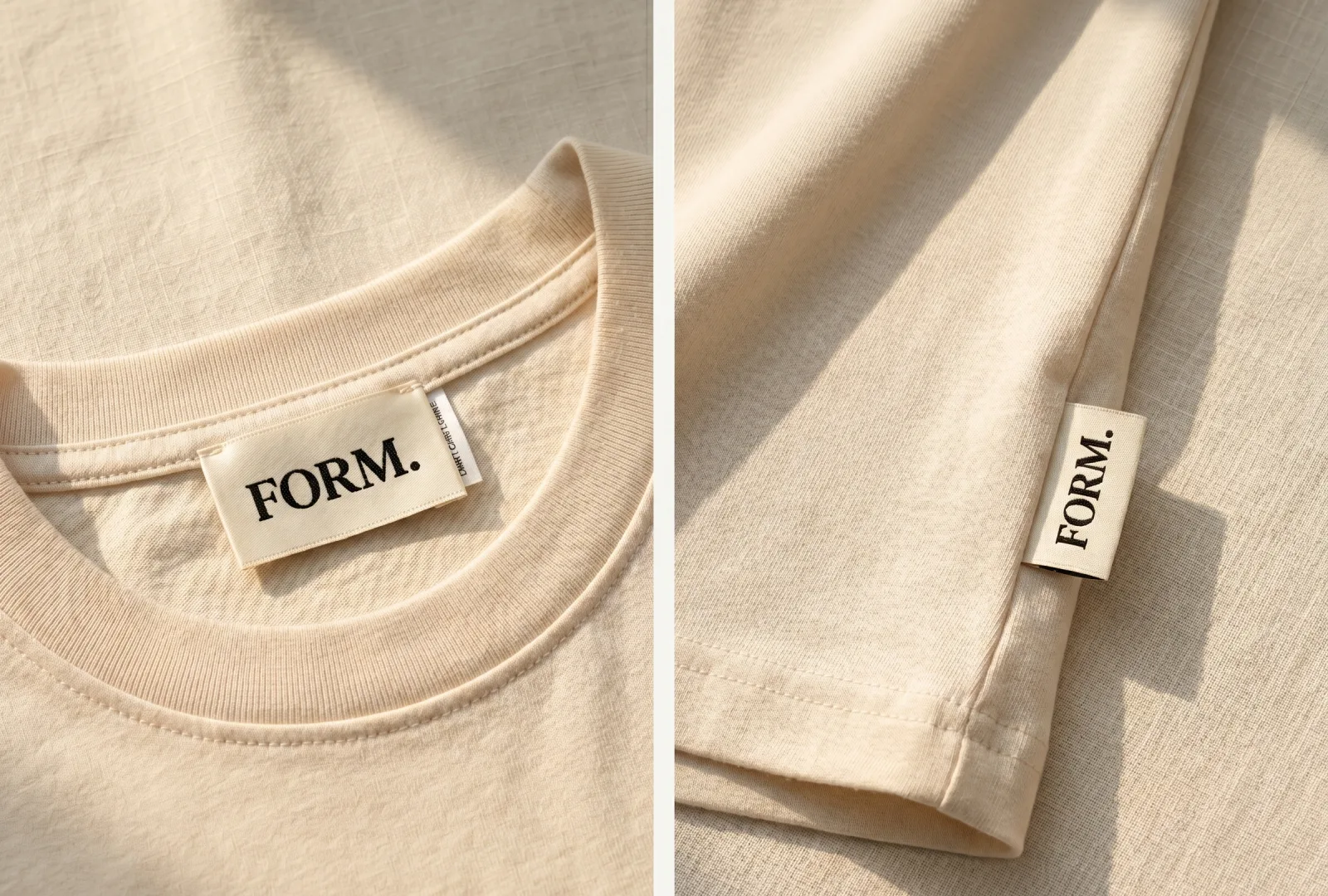
End fold is the standard construction here. The two short ends turn under and the label is stitched at left and right, so it lies flat against the rib and the top and bottom edges are free. On a hoodie that matters, because a four-side stitched label on thick fleece puckers when the neck stretches over the head.
Woven damask is the material to specify. It is the densest weave, so a logo at this size comes out sharp, and the finished label is soft enough to sit against the back of the neck without a cover. Taffeta is cheaper but stiffer, and on brushed fleece the hard edge of a taffeta label is exactly what customers complain about. If you want the detail of the two compared, see damask, satin and taffeta explained.
Try the size on screen first. The free label designer draws your neck label at true millimetre scale on the fold you choose, with the hoodie presets built in, and warns when type drops below what a loom can weave.
The hem flag: the streetwear signature
A hem flag is a small woven label folded in half and caught in the side seam, so that one half sticks out like a little flag. On a hoodie it usually sits at the hem on the left side; on a tee it can sit at the hem or the sleeve cuff. It is the detail that tells a stranger what brand you are wearing, and it is cheap to produce because the label itself is tiny.
- Flat size: 20 to 25 mm wide and 40 to 60 mm long, folded to a visible flag of 20 to 30 mm.
- Fold: centre fold. Both raw ends go into the seam, so the visible edge is a clean fold rather than a cut.
- Artwork: one mark, one or two colours. A monogram, a short wordmark or a small icon. The fold line runs through the middle of the flat label, so keep both faces clear of it by at least 3 mm.
- Both faces: the back face of the flag is visible too. Either repeat the mark, run a plain colour, or put a second detail there (a year, a city, a drop number).
- Placement: 15 to 25 mm up from the finished hem on the left side seam, or centred on the cuff seam. Tell the factory the exact height so the whole drop matches.
Specify woven damask, in the same thread colours as the neck label, and ask for the edges to be heat-cut or ultrasonically cut rather than loom-cut. A hem flag is handled every time the garment is worn, and a frayed flag ages the whole hoodie. Our guide to woven label edge finishes explains what each cut looks like.
One practical point: because a hem flag is sewn into a seam that is closed on an overlock machine, it has to be placed before the seam is sewn, not after. Confirm the factory knows the flag is coming and has the labels before they start the side seams. We have seen entire drops go out flagless because the labels arrived after the bodies were closed.
Tagless inside-neck prints
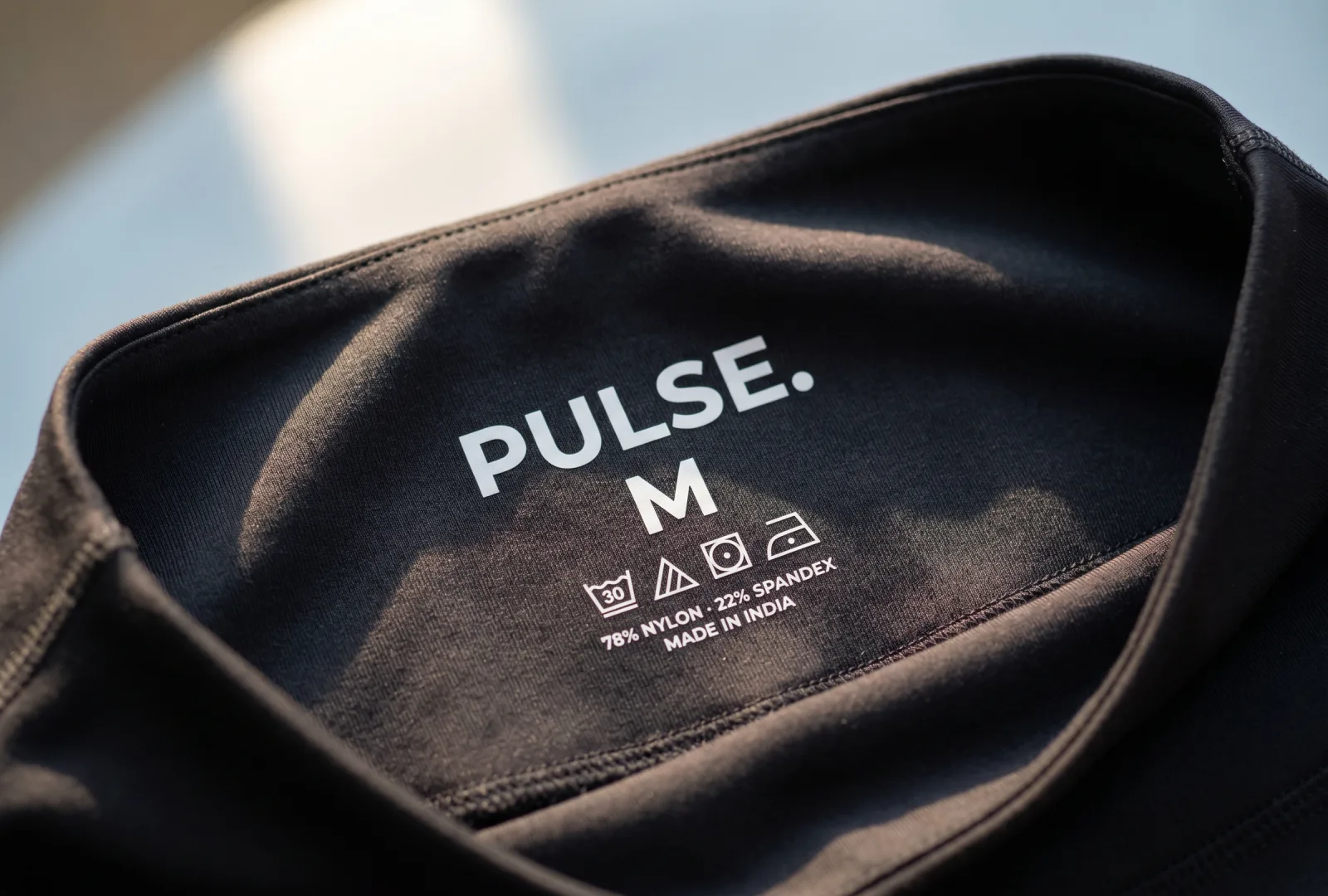
Many hoodie brands skip the woven neck label and print the brand mark and size directly onto the inside of the neck with a heat transfer. The result is a soft, label-free neck, which is a selling point on garments worn against bare skin.
A heat transfer behaves differently from a woven label and needs its own decisions:
- Colours: one or two flat colours print cleanest. Gradients and photographic logos are possible but tend to crack earlier on stretchy rib.
- Size: 60 to 80 mm wide is typical on a hoodie neck. Smaller than 50 mm and the care text becomes unreadable.
- Content: the print has to carry everything the label would have: brand, size, and either the full care block or a pointer to a separate care label in the side seam.
- Base fabric: brushed fleece and loopback need a transfer formulated for cotton-rich knits. The same film that works on a polyester jersey may lift from a cotton fleece after a few washes.
- Application: the factory presses the transfer; get the time, temperature and pressure from the transfer supplier and make sure they reach the line.
The honest trade-off is durability. A woven label outlasts the garment; a transfer slowly fades. For a core range that is worn and washed weekly, many brands print the brand and size inside the neck and still put a small printed care label in the side seam, so the legal information survives even when the print softens. Our tagless heat-press guide covers the process in more depth.
Care labels for hoodies: side seam, not neck
Put the care label in the left side seam, 100 to 150 mm up from the hem, folded as a loop so it hangs free. Two reasons. The neck is where the brand label lives and a second label crowds it; and a long printed care label against the back of the neck on a hooded garment is where the itch comes from, because the hood seam already presses on that spot.
What the care label must carry does not change because the garment is streetwear. For garments sold in India it needs the fibre content, the wash-care symbols, the country of origin and the declarations required on retail packaging and on marketplaces. Our care label requirements guide lists what goes where, and the marketplace requirements guide covers what Amazon, Flipkart and Myntra check before a listing goes live.
Two hoodie-specific details are worth adding to the care text. Cotton fleece shrinks more than jersey, so "wash cold, do not tumble dry" is honest advice rather than caution. And garments with a dyed or printed graphic should say "wash inside out", which also protects your hem flag and neck label from abrasion against the drum.
Printed satin is the usual choice for the care label because it holds small symbols and several lines of text sharply. On heavyweight hoodies, taffeta is acceptable because the label hangs in the side seam rather than touching the neck, and it costs less. Set the symbols to ISO 3758 and size the label from the longest text block you need, not the shortest. See our care label size guide for the widths that fit different amounts of text.
Size tabs on oversized fits
Oversized streetwear brings an extra problem: the size on the label and the size the customer expects are often different things. An "M" that fits like an XL confuses buyers, and the confusion ends up in your returns rate.
- Put the size tab under the neck label, centre or loop folded, 15 to 20 mm visible. Keep the letter height at 5 mm or more so it reads on dark fleece.
- If the fit is oversized by design, say so on the hang tag and the listing, not on the size tab. The tab stays as the size code.
- Consider dual coding on the tab for export: "M / 40" or "L / 42" covers both alpha and chest sizing on one piece.
- Order size tabs in the real split. Streetwear drops skew heavily to M, L and XL; equal quantities across the range guarantees waste at both ends.
Make the tab in the same material and ground colour as the neck label so the two read as one set. Our size label guide has the full table of tab sizes against code lengths.
Colour and artwork on dark fleece
Most streetwear is black, charcoal, washed grey or deep earth tones, so most streetwear labels are light-on-dark. That is the harder direction for a woven label. Light letters are made of threads sitting on a dark ground, and thin strokes vanish into it.
- Use weight, not size. A bolder letter reads cleanly where a larger thin one still does not. Avoid hairline type and ultra-light weights on woven labels.
- Two or three colours. Each colour is a separate weft thread. One cream or white mark on black is the classic streetwear neck label for a reason: it weaves cleanest and costs least.
- Keep the counters open. The holes in letters like 8, a, e and R close up at small sizes once the fabric relaxes after washing. The designer's print check flags text below the weavable floor for each material.
- Match the thread, not the screen. Woven colour comes from a card of pre-dyed threads. Ask to see your brand colour on thread before approving; a saturated red or a neon green may land on the nearest available shade. Our Pantone to thread guide explains how matching works.
- Tone-on-tone is a photo trick. Black-on-black and grey-on-grey labels look expensive in a studio shot and are unreadable in a shop. If you want it, do it on the hem flag, where the shape carries the brand, and keep the neck label readable.
For the full set of rules a loom imposes, read woven label design rules before you finalise the artwork.
Garment washes, enzyme finishes and your labels
A lot of streetwear is washed as a finished garment: enzyme wash for a soft hand, acid or pigment wash for a faded look, or a simple garment wash to pre-shrink. The labels go through that process too, and it is where most surprises come from.
- Dye bleed. A black or red woven label can bleed into a light fleece during a hot garment wash. Ask for colourfast threads if the garment will be washed after sewing, and test a sample through the actual wash.
- Dulling. Acid and pigment washes can take the sheen off a satin print and lighten a woven ground. If the washed look is the point, choose a matte woven label and accept that it will soften with the garment.
- Shrinkage mismatch. Cotton fleece shrinks; a polyester label does not. On a heavily pre-shrunk body a long flat-sewn care label can pucker. A loop fold label hanging in the seam avoids this.
- Order of operations. Some factories attach labels after the wash. If so, the labels never see the process and you have no problem, but the hem flag then has to be sewn into an already-closed seam, which is not possible. Decide this before production.
The fix for all of these is the same: sample on a washed garment, not a raw one. Our guide to label shrinkage and wash testing explains how to run that test properly.
Patches and sleeve tags
A woven or embroidered patch on the chest or sleeve gives you a third brand mark without printing on the body. For streetwear the choice usually comes down to this:
| Option | Look | Best for | Watch out for |
|---|---|---|---|
| Woven patch, heat-cut edge | Flat, sharp detail, slim | Wordmarks, fine logos, small chest or sleeve placement | Needs a merrow or heat-cut edge to stop fraying on fleece |
| Embroidered patch | Raised, textured, heavy | Bold emblems, crests, varsity styling | Thick backing shows through thin tees; weight pulls on loose knits |
| Flat sleeve tag | Minimal, a small label stitched on four sides | Year, city, drop number, secondary mark | Four-side stitch puckers on stretchy rib; place on the body panel, not the cuff rib |
Patches can be sewn or heat-sealed. Sewing is the more durable route on fleece, which flexes constantly; a heat-sealed patch on a hoodie that is washed weekly will begin to lift at a corner. Our patch comparison and patch size guide go into dimensions and backing options.
How many designs, and how many of each
A typical streetwear label set is three to four designs: neck label, hem flag, care label and size tab. Minimum order quantities apply per design, so a brand planning a 300-piece first drop has a real quantity problem. The usual way to handle it:
- Order the neck label and hem flag custom. These are the brand. One design each, reused across every garment and every drop, so the minimum is used up over a season rather than one drop.
- Use stock size tabs and care labels for the first drops. They carry no branding, so a plain stock tab is indistinguishable from a custom one. Our stock label guide explains what is available.
- Move the care label to custom once you have a stable fibre composition and a volume that uses the minimum. Changing the fleece supplier changes the care text, and a custom care label ordered too early becomes waste.
Plan the hem flag quantity at garment count plus 5 to 8 percent. Flags get sewn in the wrong seam, trimmed by accident and lost in the overlock, and a drop that runs short of flags cannot be fixed after the seams are closed. The MOQ guide covers how minimums are built and where there is flexibility.
Getting streetwear labels made at Labelwala
We make woven and printed labels in Ahmedabad, Gujarat, and we have been doing it for 25 years. Hoodie neck labels and hem flags are among the most common things we quote for new Indian brands.
- Minimum order: 1,000 pieces per design. A neck label and a hem flag are two designs.
- Quotes: we usually reply within 2 hours on a working day.
- Production: 7-10 days once artwork is approved. Rush jobs run 3-5 days.
- Care symbols: set to ISO 3758 on every care label we print.
- Delivery: we ship across India and export worldwide.
Send us the GSM and fabric of the hoodie along with your artwork. The fabric weight changes the label size we recommend and whether we suggest damask or a transfer for the neck, and knowing it up front saves a round of samples. If the garments will be garment-washed after sewing, say so, and we will sample on that basis.
We are rated 5.0 on Google from 27 reviews. Ask for a physical sample of the neck label and hem flag together when you request a quote, so you can see the set on your actual fleece.
Common mistakes
- Ordering a T-shirt neck label for a 350 GSM hoodie and finding it disappears into the rib.
- Four-side stitching a label onto stretchy neck rib, so it puckers every time the hood goes over the head.
- Specifying taffeta for a neck label on brushed fleece and getting complaints about scratching.
- Delivering hem flags after the side seams are closed.
- Hairline type in light thread on a black ground.
- Approving a sample on raw fabric when the garments are enzyme-washed after sewing.
- Putting the care label in the neck of a hooded garment.
- Ordering equal quantities of every size tab.
- A woven neck label next to a printed hem flag, so the set looks like two suppliers.
- Tone-on-tone labels that photograph well and cannot be read in a shop.
Sample checklist
Approve the set on a finished, washed hoodie from your actual production fabric, not on a swatch or a proof.
- Does the neck label clear the hood seam by at least 5 mm on the smallest size?
- Does the label lie flat when the neck is stretched over a head and released?
- Is the hem flag at the agreed height, on the agreed side, on every sample?
- Does the back face of the hem flag look intentional?
- Do the neck label and hem flag match in material, ground colour and thread colour side by side?
- Is the light-on-dark type still crisp after one wash?
- Has a dark label bled into a light fleece after the garment wash?
- Can the care symbols be read at arm's length in normal light?
- Is the side-seam care label hanging free rather than puckering the seam?
- Does the inside-neck transfer (if used) survive one wash without lifting at the edges?
What to send your supplier
- Garment type, fabric and GSM, and whether it is garment-washed after sewing.
- Vector artwork for the neck label and hem flag, fonts outlined.
- Finished sizes in mm for each label and the fold for each.
- Ground and thread colours, with Pantone references if you have them.
- Full care text: fibre composition, wash instructions, country of origin and declarations.
- Size codes and the quantity split across sizes.
- Quantity per design, with the hem flag padded for wastage.
- Where each label goes, so the factory and the label maker agree.
A brief that works: "Hoodie, 380 GSM cotton fleece, enzyme washed. Neck label 70 x 30 mm end fold woven damask, black ground, cream logo. Hem flag 25 x 50 mm flat, centre fold, same colours, heat-cut. Care label 30 x 70 mm loop fold printed satin, text attached. Size tabs S to XXL in attached split."
What we would recommend
For a first streetwear range: a 70 x 30 mm end-fold woven damask neck label in one light colour on a dark ground, a 25 x 50 mm centre-fold hem flag in the same threads with heat-cut edges, a printed satin care label loop-folded into the left side seam, and stock size tabs until your volume justifies custom ones. Keep the artwork to one bold mark, sample the whole set on a washed garment, and make sure the hem flags reach the factory before the side seams are sewn.
That set covers everything a buyer, a marketplace and a stranger on the street need to know about your brand, and it is built from four pieces that reorder cleanly drop after drop.