In brief
Sportswear uses four label types: sublimation printed into 100 per cent polyester, heat-press vinyl lettering for names and numbers on any fabric, tagless heat-press neck labels and woven patches for club crests. A tagless neck label costs ₹3 to 5 and heat-press production takes 3 to 5 days against 10 to 14 for sublimation.
Sportswear labels have a job description no other label has: survive sweat, stretch with the fabric, not chafe at high heart rates, and look good on Instagram after a 60°C wash. A cotton woven label that works perfectly on a kurta will peel off a polyester jersey by week 3. Sportswear needs a different toolkit.
Which four label types are used in sportswear?
Different parts of a jersey use different label tech. Each has trade-offs:
- Sublimation print: the design is dyed directly into the polyester fabric. Zero hand-feel, unlimited colours, can't peel. Only works on 100% polyester or high-poly blends. Most professional jerseys use sublimation for player name, number, sponsor logos and team graphics.
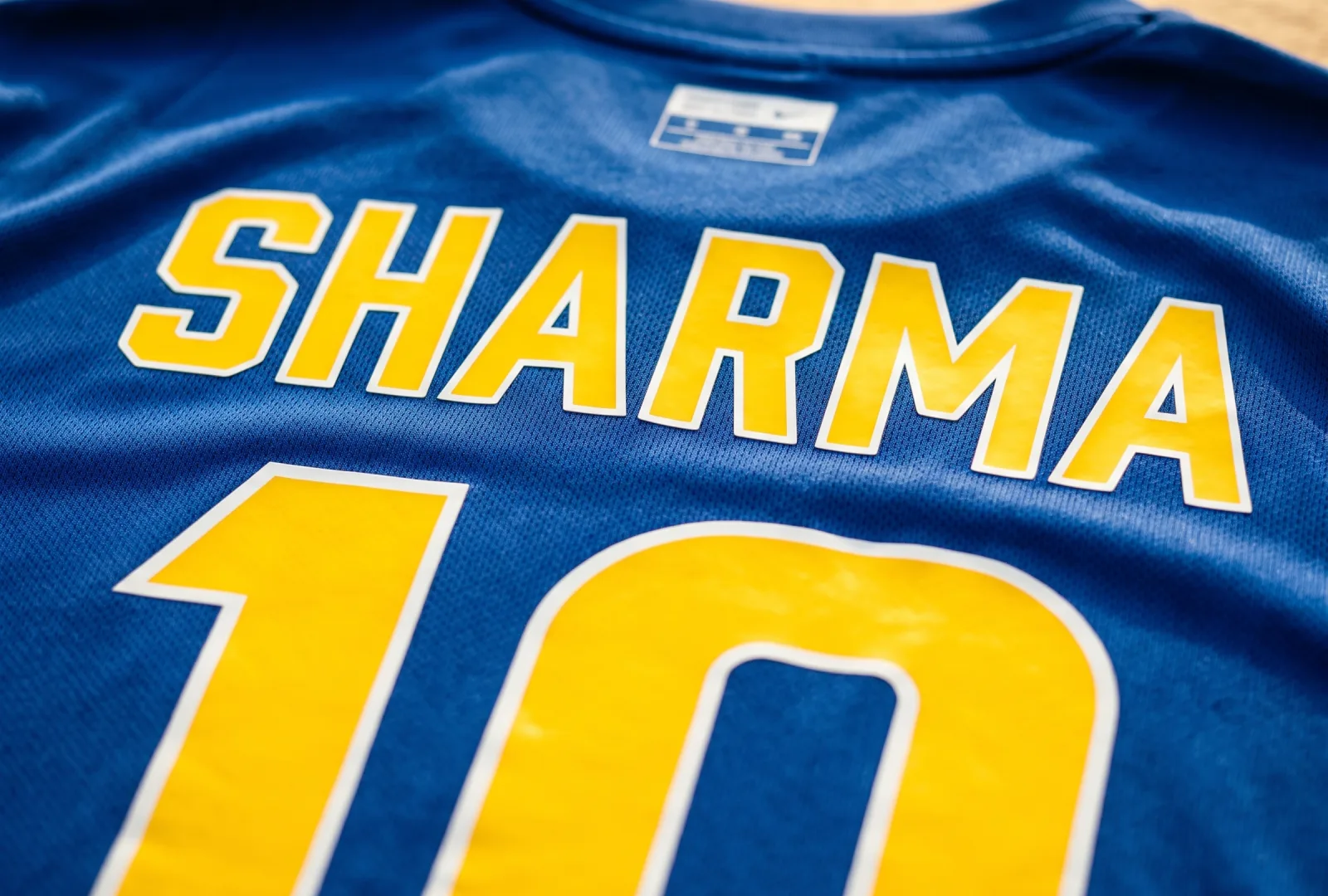
- Heat-press vinyl / lettering: pre-cut letters or graphics pressed onto the finished garment. Works on any fabric. Slight raised feel. Best for player names and numbers on cotton or fleece kits.
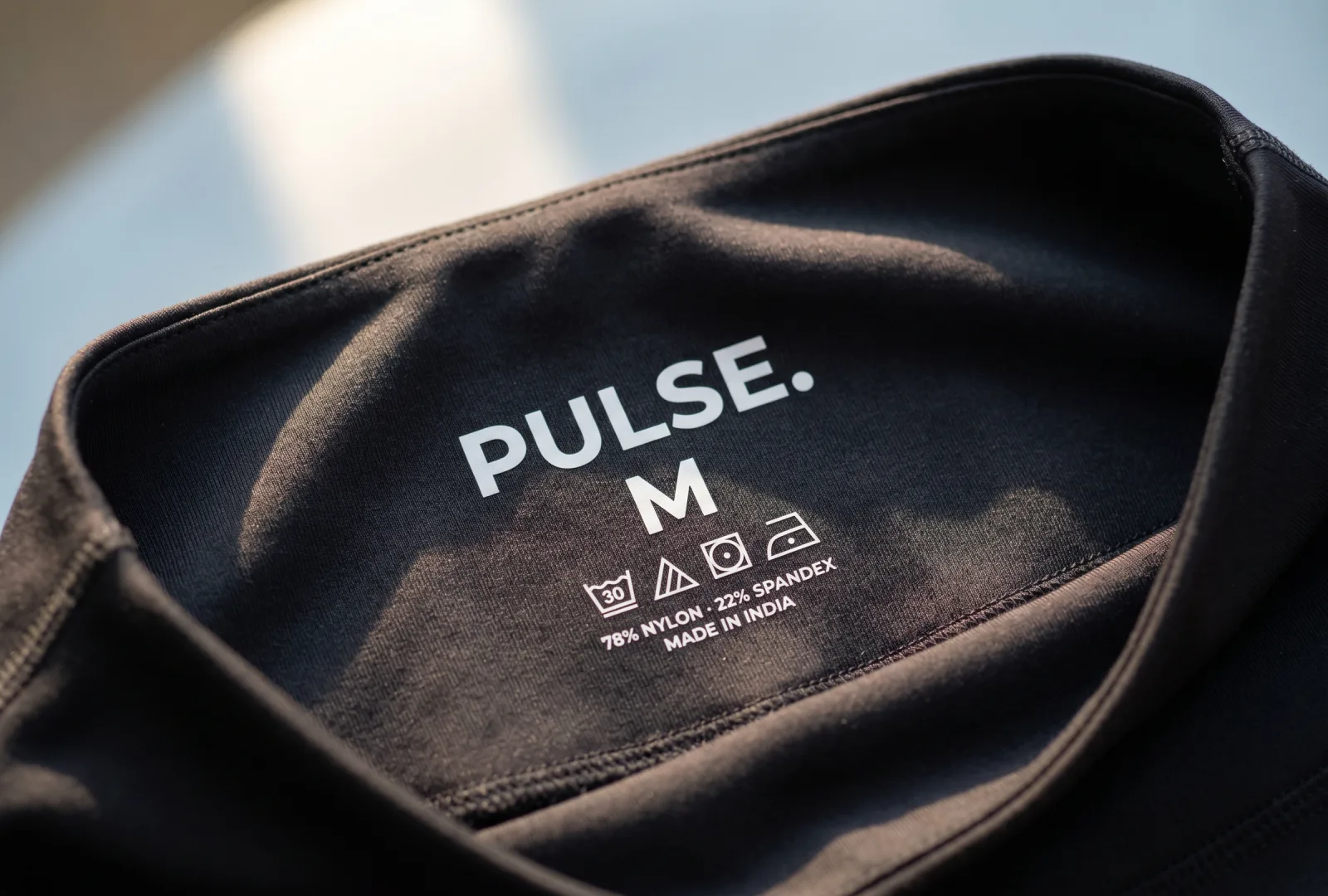
- Tagless heat-press labels: small printed labels at the inside neck instead of a sewn tag. No itch during play. Standard for premium activewear.
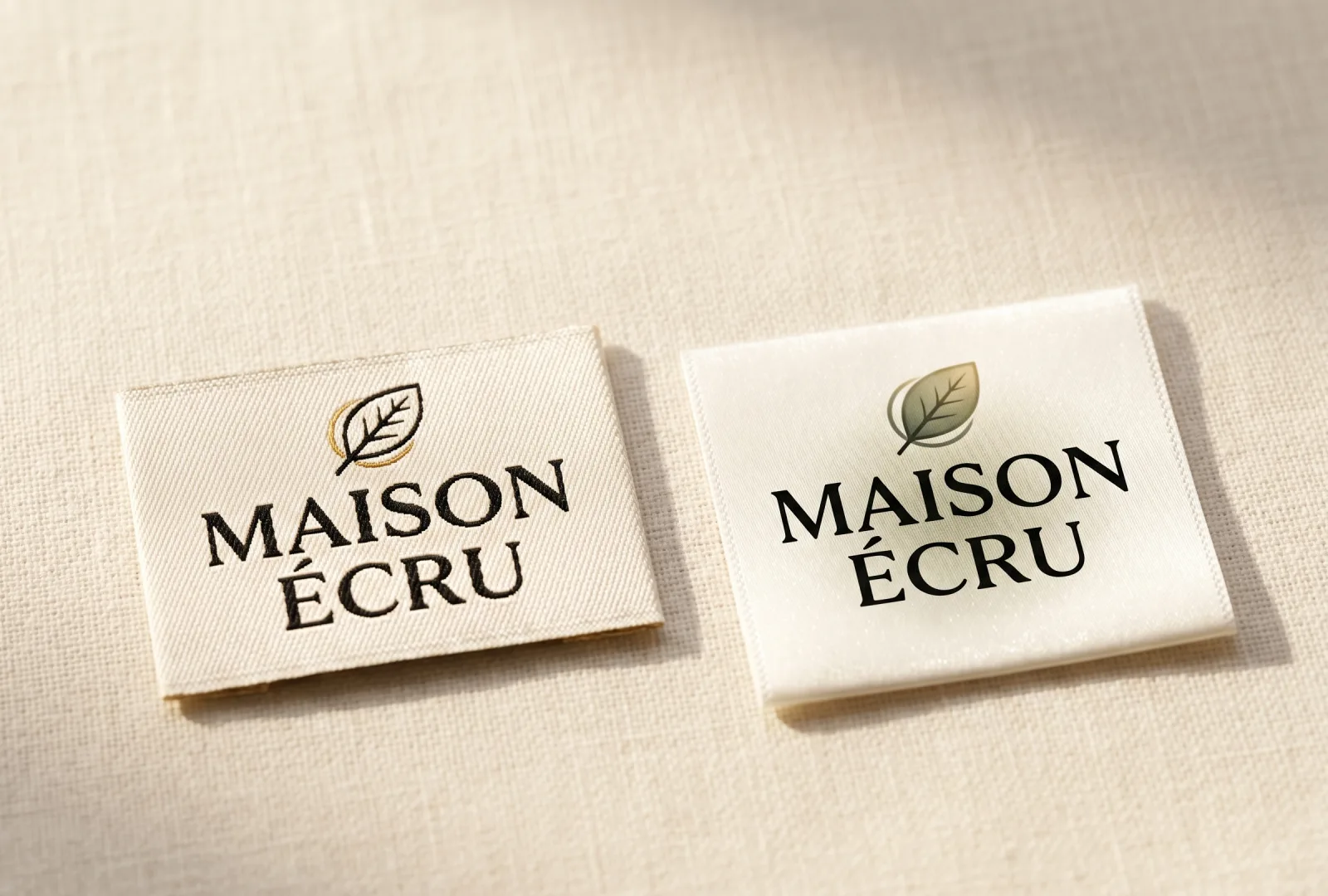
- Woven patches: for club crests, sponsor logos, qualification badges. Sewn or iron-on to the garment. Used when you want a premium, embroidered feel.
A typical team jersey uses 3 of these: sublimated body (or heat-press numbering), a tagless heat-press neck label and a woven club crest patch.
Sublimation or heat-press: when should you use which?
Pick sublimation if: you're producing 50+ jerseys from blank polyester, want photo-quality graphics, and have 10+ days lead time.
Pick heat-press if: you have pre-made jerseys you want to add names/numbers to, are doing small batches (1-30 pieces), or need rush turnaround for a tournament.
The player name + number workflow
Most team orders are for player customisation on already-printed jersey bodies. The workflow:
- Collect the team list: full name, kit number, size (S/M/L/XL/XXL). One Google Sheet, one source of truth.
- Lock the font + colour: block-style fonts (Stencil, Impact, custom team font) hold up best. Avoid thin scripts, they crack at heat-press edges.
- Confirm spelling: chase each player for correct spelling before going to production. The single biggest cause of rework: "Suriyanaarayanan" vs "Suryanarayan".
- Produce + press. Letter sheets are cut on a plotter, pressed onto each jersey at 150°C for 15s. 20-30 jerseys takes 1-2 days.
For tournaments with substitutes, order 2-3 extra blank numbered jerseys for replacements.
What do sportswear labels realistically cost?
Indicative per-piece pricing for common sportswear label needs:
Sublimation pricing is per full jersey body, not per label, typically ₹250-400 per jersey from blank polyester at 50+ pieces (includes all body graphics, sponsor logos, numbers in one print run).
What is the MOQ for sports teams and clubs?
Unlike fashion brands, sports clients often order in small (team-sized) batches but repeat every season. The first order does the spec work; restocks are fast.
Sport-specific label considerations
- Cricket: large back numbers (300mm tall), player name in 50mm arc above. Front pocket logo. Sublimated jerseys are standard at club / corporate level; heat-press for casual teams.
- Football / soccer: back number (250mm), back name in 75mm arc, front chest number (100mm). League rules sometimes mandate fonts and sizes. Check before ordering.
- Basketball: both front and back numbers, large (300mm back). Player name optional. Tank tops use sublimation almost universally.
- Marathon / running bibs: separate digital-printed paper bibs with safety pins, not heat-press. Different supply chain.
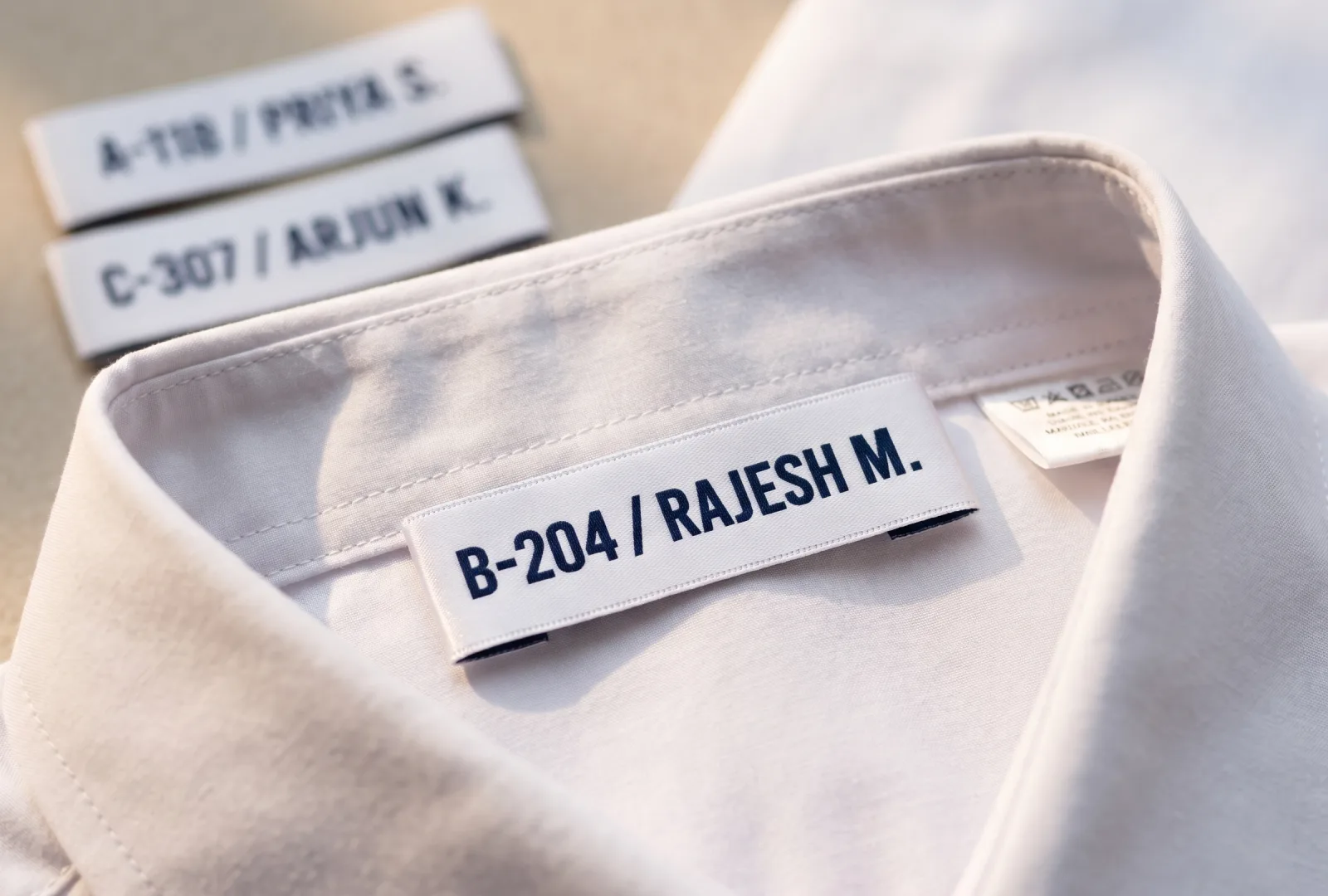
- School sports day: heat-press house colours + house name on PE t-shirt. Often combined with pre-made name labels for boarding-school kids (see our name & number labels page).
Common sportswear label mistakes: applying woven satin labels to stretchy polyester (label warps and pops stitches); using thin script fonts for player names (cracks on heat-press edges); ordering a team kit without locking the player list first (one wrong spelling costs the whole jersey).
Lead time for sportswear orders
Name + number + size, single source
Per-jersey + total, mockup image · 2h
Heat-press: 3-5 days · Sublimation: 10-14 days
1-3 days transit India-wide
For tournament rush: send the team list at least 7 days before match day for heat-press kits, 15 days for sublimated.
Where does each element go on a jersey?
Placement matters more here than on most garments, because a jersey has fewer places that are neither stretched nor against skin.
- Neck: tagless print, roughly 20 to 30 mm below the seam. Nothing physical, because this is the point of highest contact during effort.
- Player name and number: heat-press or sublimation on the back panel, away from side seams and any panel join.
- Club crest: woven patch on the left chest, on a flat panel rather than across a seam or a stretch insert.
- Sponsor marks: sublimated where the fabric allows, since there is no film to crack.
- Care and composition: printed in the tagless block or on a small tab low in a side seam, out of contact.
The rule that governs all of them: keep prints and patches off seams, bindings and elastic. A press platen cannot apply even pressure across a step in thickness, so straddling a seam means one side is crushed while the other never bonds. That is the single most common reason an edge lifts later.
Check every placement on the smallest size in the range, not just the sample size. A crest sized for an XL can run into a seam on an S, because the panel got narrower and the artwork did not.
Care instructions that protect performance fabric
Sportswear care is not just about the garment surviving. It is about the fabric keeping the properties the customer paid for.
The elastane dictates everything, however small its percentage. Five per cent in an otherwise polyester jersey removes hot washing and tumble drying, because heat breaks the fibre and the garment never recovers its stretch. That is the single most common reason performance kit is returned as gone baggy after a season.
Three text lines matter more than any symbol, and none of them has an ISO 3758 equivalent:
- No fabric softener. It coats moisture-wicking yarn and destroys exactly the property that makes the fabric technical.
- Wash inside out. Protects printed numbers and logos, and reduces pilling on the face of the fabric.
- No bleach. It attacks elastane directly, and there is elastane in very nearly everything in this category.
Say them in text, because none of the three has a symbol and they will not otherwise appear anywhere on the garment.
Polyester also holds odour in a way cotton does not, and the customer’s instinct is a hotter wash. A clearly stated maximum temperature, backed by a line of text, does more to prevent that than the symbol alone.
Common mistakes
- Ordering a generic heat transfer for a fabric with a high elastane content.
- Approving a print on one colourway and assuming the rest of the range behaves the same.
- Skipping the two-week migration test because it needs calendar time.
- Using a rigid film on a panel that stretches and recovers.
- Sewing a conventional woven label into a stretch neck.
- Firing a barb or stitching a patch across a seam or a stretch panel.
- Judging neck comfort by hand instead of by wearing the garment while warm.
- Permitting a hot tumble dry on a garment whose elastane cannot take it.
What actually breaks sportswear labels?
Sportswear fabric is the hardest surface in apparel to label, because everything that makes it perform also makes it difficult.
Dye migration. On a coloured polyester garment the fabric’s own dye gasses into the transfer at press temperature. A white logo on a red jersey comes out white, ships, and turns pink in the box a fortnight later. It is not a printing defect and it does not show in the sample approved on the day. Ask which of the three fixes your supplier uses: a low-temperature film, a blocker layer, or a fabric dyed to resist sublimating.
Stretch. A panel that stretches and recovers will destroy a rigid film. It crazes, then splits along the widest part of the logo. The answer is an elastic film matched to the fabric, and the test is to stretch the sample hard by hand fifteen times and look at it in raking light.
Elastane and heat. Spandex is broken by sustained heat rather than weakened gradually, and once broken the garment never recovers its stretch. That caps the press temperature, which is why low-temperature films exist and why a generic transfer is the wrong specification for performance fabric.
Test it the way it will be used
A jersey label has to be judged under conditions a desk cannot reproduce.
- Stretch the print hard across its width, repeatedly, and check for crazing in raking light.
- Wash at the temperature the care label permits, several times, and check the edges rather than the face.
- Leave a dark coloured sample somewhere warm for two weeks to catch dye migration. This is the test that needs calendar time and the one that gets skipped.
- Wear it for a few hours. Comfort at the neck simply cannot be judged between finger and thumb, and damp skin makes anything stiff more noticeable.
- Test every single colourway, not merely the easiest one. A print approved on black proves nothing about the red.
One swatch answers more than a page of specification here. Send a piece of your actual fabric along with the enquiry wherever you can. In this category a swatch settles the film choice, the press temperature and the migration risk together, and it answers more questions than a specification sheet does.
Ordering sportswear labels from Labelwala
Woven and printed labels, made by us in Ahmedabad, Gujarat, for 25 years.
- Minimum order: 1,000 pieces, counted per design rather than per order.
- Production: 7-10 days once artwork is approved. Rush jobs run 3-5 days.
- Care symbols: set to ISO 3758.
Tell us the exact composition including the elastane percentage, and every colour in the range. Migration is colour-specific, so the colour list matters as much as the fabric. Send the darkest shade in the range first, since that is the one that will show a migration problem soonest.
We are rated 5.0 on Google from 27 reviews.
What separates a club kit from a professional kit
The label spec. A casual club kit has heat-press numbers that might peel by season 2. A semi-pro kit has sublimated numbering that lasts the life of the jersey, paired with a woven club crest patch and a tagless heat-press neck label. The cost difference at 25 jerseys: roughly ₹100-150 per jersey. The perception difference: the team looks like it plays a level higher than it does.
For corporate-sponsored teams and school first XIs, the upgrade is worth it. For casual weekend leagues, heat-press only is fine.
Ready to spec your team kit? See the full labels for sportswear brands page, or browse printed labels, woven patches and name & number labels. For pricing, use the price calculator or send a brief via quick quote.