In brief
A tagless label is printed directly onto the inside of the garment by heat transfer or sublimation, so there is no fabric edge to chafe when stretch fabric sits tight against sweaty skin. Properly applied heat transfer survives 50 to 80 wash cycles, and sublimation on polyester lasts as long as the garment.
There's a specific moment every yoga-wear customer has had: tag itching mid-pose, hand reaching back to scratch, fingers find a stiff woven label, mental note to cut it out the moment they get home. For activewear brands, that one moment is a return waiting to happen, and it's why tagless heat-press labels exist.
What does "tagless" actually mean?
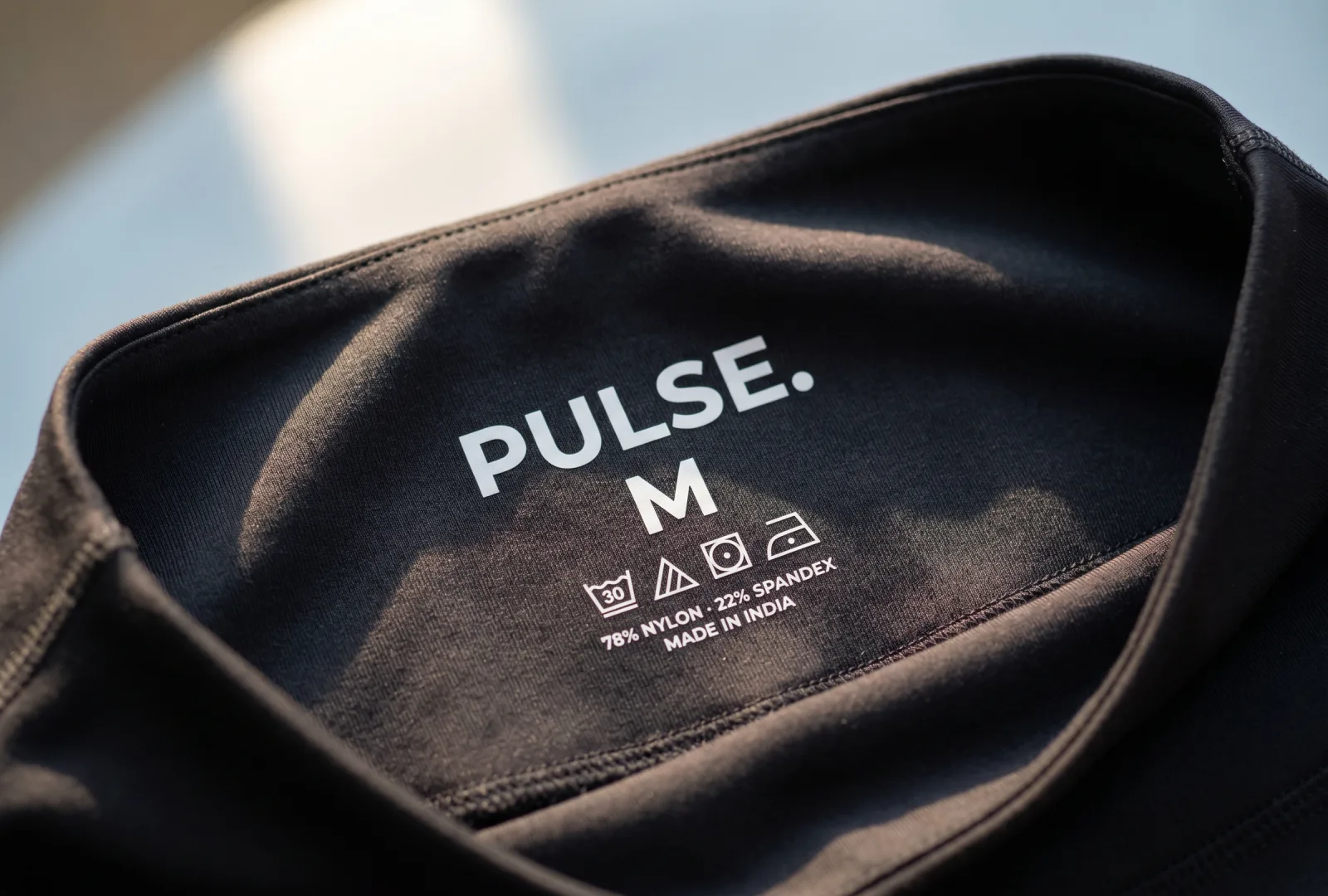
A tagless label isn't a label at all in the traditional sense. It's printed directly onto the inside of the garment, usually with heat-transfer or sublimation. There's no fabric tag, no edge to chafe, no thread to scratch. The brand mark, size and care symbols all live on the fabric itself.
Two main techniques produce tagless labels:
- Heat-transfer (HTV), vinyl applied with heat and pressure. Works on cotton and most blends.
- Sublimation: dye fused into polyester fibres at high temperature. Works only on polyester or majority-polyester fabrics.
The difference matters more than it sounds. Heat transfer puts a film on top of the fabric; sublimation puts dye inside it. A film can lift, crack or peel because it is a separate layer. Sublimated dye cannot, because there is no layer to lose, but it only bonds to polyester, and it cannot print white or any light colour on a dark garment.
Which three press settings decide whether it lasts?
Almost every tagless failure traces back to the press, not the artwork. Three variables have to be right together, and getting two of them right is not close enough:
- Temperature. Run it cool and the adhesive never fully activates, which gives you a print that looks flawless on the day and lifts at the corners within a few washes. Run it hot and you glaze the face of the fabric or cook the elastane in it.
- Pressure. This is what pushes the adhesive down into the weave rather than leaving it on top. Too little and the bond is only skin deep; too much and the platen prints its own shine box around the design.
- Dwell time. How long the platen stays down. Short dwell is the most common shortcut on a busy line, and it is invisible until the garment has been washed.
There is a fourth setting people forget: the peel. Films are specified as hot peel, warm peel or cold peel, and peeling a cold-peel film while it is still hot pulls the print off the garment in the operator's hand. It is a fast way to lose a batch.
Ask your supplier for all four in writing, temperature, pressure, dwell, peel type, and keep them with the artwork. A reorder six months later gets pressed by whoever is on shift that day, and a written setting is the only thing that makes the second run match the first.
How do the four transfer types compare?
"Tagless" covers several different processes with genuinely different economics and results. Suppliers rarely volunteer which one they are quoting.
| Type | Best for | Watch out for |
|---|---|---|
| Screen-printed transfer | Volume runs, one to three flat colours. The cleanest hand-feel and the lowest cost per piece at scale. | Screen setup per colour, so short runs are expensive and small edits are not free. |
| Digital / DTF transfer | Full colour, gradients, photographic marks, short runs. No screen setup at all. | Slightly heavier hand than a screen transfer. Quality varies widely between suppliers. |
| Cut vinyl (HTV) | Samples, very small batches, simple bold shapes. | Thickest option and the most plasticky. Not suited to fine detail or small type. |
| Sublimation | Polyester and recycled polyester. No layer at all, so nothing can peel. | Polyester only, and it cannot print white or light colours on a dark garment. |
For activewear specifically, screen-printed transfers and sublimation carry most of the volume. Cut vinyl is generally a sampling method that ends up in production because it was what the supplier had, and it is usually the one behind a "the print feels plasticky" complaint.
Why does the fabric decide the method?
Activewear fabric is the hardest surface in the garment industry to heat-press, because everything that makes it perform also makes it heat-sensitive.
Dye migration is the big one. On a coloured polyester garment, the garment's own dye turns to gas at press temperature and passes up into the transfer film. A white logo on red leggings comes out white, ships, and turns pink in the box a fortnight later. It is not a printing defect and it does not show up in the sample you approved on the day.
Three things prevent it: a low-temperature transfer film, a blocker or barrier layer under the print, or a garment dyed to resist sublimating. Ask which one your supplier is using. "We have not had that problem" is not one of the three.
Elastane is the other constraint. Spandex is damaged by sustained heat, so a fabric at 20% elastane cannot take the temperature a cotton tee shrugs off. The symptom is a permanently glazed or flattened patch around the print where the fabric has lost its recovery. Low-temperature films exist precisely for this, and any supplier quoting activewear should raise them before you do.
Nylon behaves differently again. It is smooth and low-energy, so adhesives that grip cotton slide off it. Nylon needs a film specified for nylon, not a general-purpose one.
Why do tagless prints crack on stretch fabric?
A legging panel can stretch forty per cent and return. A rigid transfer film cannot. Put one on the other and the print crazes into fine lines, then splits, usually across the widest part of the logo first.
The fix is an elastic film chosen for the fabric's stretch, not the cheapest film that passes a flat wash test. This is worth testing directly: stretch the sample hard across the print, by hand, ten or fifteen times, and look at it in raking light. Cracking that will appear in month three is visible in that test on day one.
Why activewear specifically needs them
Three reasons stretch and sweat make traditional labels a problem:
- Stretch. A woven label stitched into stretch fabric creates a stiff zone. The fabric stretches; the label doesn't. Customer feels it during every move.
- Skin contact. Sports bras and leggings hold tight to skin. Tag chafing is amplified when fabric isn't loose.
- Sweat. Damp fabric makes traditional tags stiffer and more itch-prone.
Tagless solves all three because there's no physical tag to feel.
Where tagless works (and where it doesn't)
- Yoga leggings, tights, joggers (high-stretch)
- Sports bras, crop tops, racer-backs (skin-contact)
- Gym tees, training shirts, performance polos
- Any stretch + skin-contact + sweat environment
- Outerwear, jackets, premium woven adds value
- Heritage / boutique. Label is part of the brand
- Garments washed above 60°C, adhesive softens
- Anywhere woven satin would feel right
How durable is tagless compared with woven?
Sublimation on polyester is the most durable: dye fuses into the fibre and lasts as long as the garment itself. Most activewear brands run tagless inside (leggings, sports bras) + woven outside (jackets, gym bags). Best of both.
What goes on a tagless label
Same content as a traditional label set, but consolidated into one print:
- Brand logo / wordmark.
- Size (XS / S / M / L / XL).
- Fibre composition (e.g. "78% Nylon, 22% Spandex").
- Wash care symbols (3-5 ISO icons).
- Country of origin ("Made in India").
Layout typically runs in two columns or a stacked block, sized roughly 30×60mm or 40×80mm. Logo on top, size in big bold below, then care symbols, then composition and origin in smaller text.
Because it is one print, everything is locked together. A woven label set lets you reorder neck labels in bulk and swap only the size tab; a tagless print means one artwork per size, and changing your address or a care symbol means new artwork for every size in the range. That is the hidden cost of consolidating, and it is worth knowing before you commit a range to it.
Artwork rules that are specific to tagless
A transfer is not a printed label. Fine detail behaves differently, and artwork that prints beautifully on satin can fall apart on fabric.
- Keep line weights above about 0.5 mm. Anything finer sits on top of the weave rather than in it, and thin strokes are the first thing to lift.
- Avoid fine serif and hairline logos. The thin joints in a serif face are exactly the weak points a stretch cycle finds.
- Set care and composition text no smaller than about 5 pt, and check it on the actual fabric colour rather than on screen.
- Keep the colour count honest. On a screen-printed transfer every colour is a screen and a cost. Two colours usually looks better than four anyway.
- Send vector artwork with fonts outlined, at final size. See our label artwork setup guide.
- Cut to shape, not to a rectangle. A visible square of film around the print is the single clearest sign of a cheap job.
Where it goes on the garment
Centre back neck, roughly 20 to 30 mm below the seam, is the standard and it is standard for a reason: customers look there, and it is a flat area a platen can reach.
The rule that matters is keep it off seams, bindings and elastic. A press platen applies even pressure only across an even surface. Straddle a seam and the thick side gets crushed while the thin side never bonds properly, which is what produces a print that lifts on one edge only. On leggings, that pushes the label to the inside waistband panel or a side seam panel rather than the waistband elastic itself.
Check placement on your smallest size. A print sized for an XL waistband can run into the seam on an XS, because the panel got narrower and the artwork did not.
Cost reality
Indicative per-piece pricing for tagless heat-press on cotton or poly-cotton:
Sublimation on polyester is similar at low volumes, slightly cheaper at high volumes. Tagless costs 20-30% more than equivalent printed labels at low volumes; gap closes at scale.
Quality red flags
- Edges peeling on sample. Indicates wrong heat or pressure curve. Walk away.
- Print feels stiff/plasticky. Cheap thick HTV. Modern thin-vinyl HTV is barely perceptible.
- Visible white box around the print. Indicates the supplier is using full-square HTV instead of cut-to-shape. Looks unprofessional.
The hybrid play: many activewear brands use tagless heat-press inside (skin contact) + woven hem tag outside (visible branding). Best of both, soft inside, premium signal outside.
For sustainable / eco brands
Heat-transfer vinyl is plastic-based: which can clash with organic / eco brand positioning. Three eco-friendly alternatives:
- Water-based screen prints: directly on cotton, biodegradable inks.
- Sublimation on recycled poly, dye-fused, fits "recycled performance" positioning.
- Soft cotton-tape labels: not tagless, but extremely soft. Works for less stretch-heavy yoga garments.
If your brand is GOTS-certified or sustainability-positioned, default to water-based screen on cotton or sublimation on recycled poly.
Test the sample before you commit
A tagless print cannot be repaired. There is no unpicking it and no replacing it, a failed print means a failed garment. That asymmetry is the reason to spend a week on samples before a bulk order.
- Wash it repeatedly, at the temperature your care label actually permits, and check the edges each time. Edges lift before centres do.
- Stretch it hard across the print, fifteen or twenty times, and look for crazing in raking light.
- Rub it with a dry cloth after washing, which is roughly what a gym bag does to it.
- Leave a coloured sample in a warm place for two weeks and look for dye migration. This is the one test that needs calendar time, and the one people skip.
- Feel it against skin on a real body, not a table. Stiffness that is imperceptible in the hand is obvious under a sports bra band.
Do all five on the fabric you are actually going to use, in the colour you are actually going to sell. A print approved on a black sample tells you very little about the same print on red.
What to send your supplier
- Exact fibre composition, including the elastane percentage.
- Fabric colours, all of them, since dye migration is colour-specific.
- Vector artwork with fonts outlined, at final size.
- The finished print size in mm, and where on the garment it goes.
- Number of colours, and whether you want cut-to-shape.
- Quantity per size, since each size is its own artwork.
- Whether the garment is washed above 60°C at any point.
The elastane percentage and the full colour list are the two that get left out, and they are the two that change the film. A supplier quoting without them is quoting a general-purpose transfer and hoping.
Getting tagless labels made at Labelwala
We make woven and printed labels in Ahmedabad, Gujarat, and we have been doing it for 25 years. Activewear brands usually come to us for a set, a tagless print inside plus a woven hem tag outside, rather than one or the other.
- Minimum order: 1,000 pieces. Tell us your split across sizes and colours when you ask.
- Quotes: we usually reply within 2 hours on a working day.
- Production: 7-10 days once artwork is approved. Rush jobs run 3-5 days.
- Care symbols: set to ISO 3758, which is what marketplace QC checks against.
- Delivery: across India, with timelines depending on destination and consignment size.
Send a piece of your actual fabric with the enquiry if you can. Activewear is the one category where a swatch answers more questions than a specification does, it settles the film choice, the temperature and the dye-migration risk in one go.
We are rated 5.0 on Google from 27 reviews. Ask for a pressed sample on your own fabric before committing to a run.
What we would recommend
For leggings and sports bras, go tagless inside and put your visible branding on a woven hem tag outside. That combination gives you a neck with nothing to scratch and a garment that still reads as a brand on the shelf.
Pick a low-temperature elastic film, ask for the press settings in writing, and test on the darkest and brightest colours in the range rather than the easiest one. Most of what goes wrong with tagless is a film chosen for a fabric it was never meant for, and that decision is made before anything is pressed.