In brief
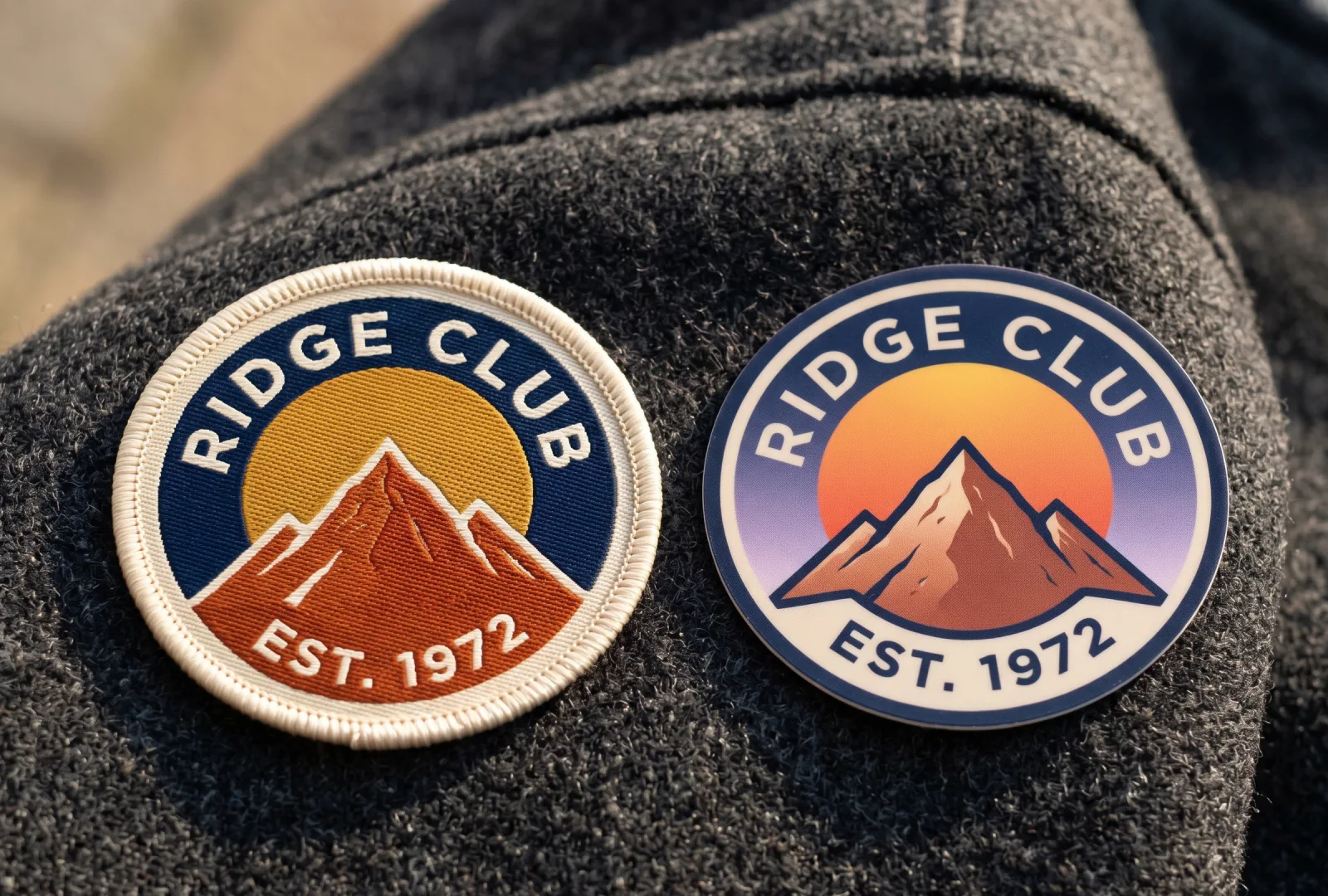
Pick woven patches for designs with 2 to 8 solid colours that get washed often and need a raised, textured feel, such as club crests, varsity letters and uniform badges. Pick printed (sublimated) patches for gradients, photographic artwork, more than 8 colours or fine small text; they are about 30 per cent cheaper at 50 pieces.
Patches show up on jackets, jerseys, caps, backpacks, uniforms and varsity wear. The decision between woven and printed comes down to four things: how detailed your design is, how durable it needs to be, what hand-feel you want, and how many you're ordering. Here's the full comparison.
The 30-second answer
- Pick woven if your design has 2-8 solid colours, the patch goes on something that gets washed often, and you want a slightly raised, textured feel. Best for club crests, varsity letters, military/security badges.
- Pick printed if your design has gradients, photo elements, more than 8 colours, or fine detail like small text. Best for promotional patches, gaming logos, illustrated artwork, photo-style designs.
If you only read this section, you have 80% of the decision. The rest of the article is the "why" behind it.
How is each patch type made?
Woven patches are produced on a loom. Coloured threads are woven into a flat patch, with the design forming part of the fabric itself. Think of it like a tiny piece of fabric where the pattern IS the weave, not a print on top. The edges are heat-cut or merrow-stitched. Backing is added (twill, felt, or adhesive) for attachment.
Printed (sublimation) patches are produced by dye-sublimation: ink is heat-pressed into a polyester base patch. The dye becomes part of the fabric fibres (not a layer on top), giving sharp colours and zero hand-feel. Edges are laser-cut or heat-cut. Same backing options as woven.
Side-by-side comparison
How do woven and printed patch prices compare?
Indicative per-piece pricing for a 60×60mm patch with sew-on backing:
Adders to plan for (apply to both types):
- Iron-on heat-activated backing, +₹2-3 per piece
- Velcro hook-and-loop backing, +₹4-7 per piece
- Merrow-stitched edge (vs heat-cut), +₹3-5 per piece on woven
- Metallic gold / silver thread, +20-25% on woven (no equivalent for printed)
Which patch type wins for each use case?
- Varsity / college jackets, Woven. The textured feel is part of the aesthetic.
- Cricket / football club crests, Woven. Lasts the life of the jersey, looks more premium.
- Military / police / security uniforms, Woven (with velcro backing). Regulatory and durability requirements.
- Caps and trucker hats: Woven if your logo is simple (≤6 colours); printed if it has a gradient or photo.
- Backpacks and tote bags, Either works. Printed is cheaper for one-off promotional batches.
- Gaming / pop-culture / illustrated patches, Printed. Colours pop, fine detail survives.
- Tournament / event swag, Printed. Lower cost, faster turnaround, single-use is fine.
- Boy Scouts / Girl Guides badge collections, Woven. Traditional, durable, collected for years.
What are the MOQ and minimum sizes for patches?
Below 25mm, woven loses detail because the thread density needed is impractical on a loom. Printed handles smaller sizes because dye doesn't have that physical constraint.
Backing options, same for both
- Sew-on, Default. Most durable. Used on jackets, jerseys, club wear. Patch is sewn around the edge by the garment maker or your tailor.
- Iron-on (heat-activated adhesive): Pressed onto the garment with a household iron at 150°C for 30 seconds. Good for casual use, not industrial-laundry survivable.
- Velcro hook-and-loop, Two parts: hook on the patch, loop sewn onto the garment. Allows swapping patches. Used on military, security, scout uniforms.
- Adhesive sticker, One-time peel-and-stick. Cheap, not washable. Used for event promo only.
Common patch mistakes: ordering a 20×20mm woven patch with 5 colours (impossible, too small for thread density); using iron-on backing for sports kit (peels in industrial wash); picking woven for a photo-realistic illustrated design (looks pixelated); skipping the sample preview because "it's just a patch" (most errors happen in patch orders, not labels).
What to send for a patch quote
- Design file, vector preferred. PNG works if 300+ DPI.
- Size, width × height in mm. Send a rough sketch on a ruler photo if unsure.
- Quantity, even rough.
- Backing type: sew-on / iron-on / velcro / adhesive.
- Where it goes, garment type + position. Influences edge style and durability.
- Colour count: count the unique colours in your design. We use this to pick woven vs printed.
Why do edges and borders change the look so much?
Two patches in the same design and the same process can look completely different depending on how the edge is finished. This is the decision buyers most often leave to the supplier and then wish they had made themselves.
- Merrow border: the thick overlocked rope edge you see on club crests and varsity patches. Traditional, hard-wearing, and only workable on simple outlines, since the machine cannot follow a tight corner.
- Heat cut: the edge is melted as it is cut, leaving a firm sealed border. Cheap, reliable, and it allows shapes a merrow cannot.
- Laser cut: a cleaner sealed edge and the option for genuinely custom outlines with notches, points and internal curves.
- Stitched border: a satin-stitch outline in a chosen colour, which frames the design and reads as a deliberate finish.
Decide the border alongside the artwork, not afterwards. Merrow in particular is the one to think about early, because it constrains the shape. If the design is a circle, a shield or a rounded rectangle it works beautifully. If the outline has fine points or tight internal angles, the merrow machine cannot follow them and you are choosing between simplifying the shape or changing the edge.
How does backing decide the way a patch is attached?
Backing is easy to leave to the supplier and worth deciding yourself. The patch and its backing are separate choices, and the backing has a bigger effect on the finished product than most buyers expect.
- Sew-on (no backing or twill): the most durable attachment by a wide margin, and the only one that reliably survives industrial laundry. Standard for uniforms and workwear.
- Iron-on adhesive: convenient, quick, and the weak link over time. Heat and repeated washing soften the glue, and edges lift first. Good for consumer patches, poor for anything laundered hard.
- Velcro: removable, which is the point. Used where a patch changes with role, rank or event.
- Adhesive sticker backing: temporary, for events and promotions.
- Felt backing: adds body and a slightly raised feel, common on varsity and heritage patches.
The common mistake is treating iron-on as equivalent to sew-on because it is easier. It is not, and on a garment that gets washed weekly the difference shows within months. A workable compromise many uniform programmes use is iron-on for positioning plus a stitched perimeter for security, which gets the speed and the durability together.
Size, and what the design can carry
Patches are usually specified by width, and the size decides how much design survives. The limits are physical rather than a matter of supplier skill.
- Under 50 mm: a simple mark only. Small text will not read on a woven patch at this size.
- 50 to 75 mm: the workhorse range. A crest with a short word around it works well.
- 75 to 100 mm: room for a proper crest, a date and a motto.
- Over 100 mm: back patches, where almost any design holds.
On woven patches the same rule as woven labels applies: below roughly 4 mm of letter height the gaps inside characters close up, and below 0.5 mm a stroke drops out. Printed patches handle fine detail far better, which is often the deciding factor for an illustrated or text-heavy design regardless of the durability trade.
Check the size against the garment, not just against the artwork. A 90 mm chest patch that looks balanced on a men's large can dominate a small, and on a fitted garment it can cross a seam or a dart, which puckers.
Placement deserves the same thought as the patch itself. A crest sits differently on a chest, a sleeve and a cap, and a design proportioned for one of those rarely transfers cleanly to the others. Where a range uses the same mark in several positions, expect to need more than one size, and check each against a real garment before ordering all of them.
Common mistakes
- Choosing merrow border on an outline the machine cannot follow.
- Specifying iron-on for uniforms that go through industrial laundry.
- Putting small text on a woven patch below about 4 mm letter height.
- Sizing the patch for the largest garment in the range.
- Placing a rigid patch across a seam, a dart or a stretch panel.
- Sending a gradient design for a woven quote.
- Leaving the backing choice to the supplier without saying how it will be attached.
- Approving a patch flat instead of applied to the actual fabric.
One more decision worth making deliberately: patches are usually ordered per design, so a range with four crests is four setups. If several designs share a size, a border style and a backing, quoting them together as one job is meaningfully cheaper than quoting them one at a time, and it keeps the set visually consistent.
Before you approve the sample
Ask for the patch applied to the actual fabric, not supplied loose. A patch that looks right in the hand can pucker the moment it is attached.
- Does the patch lie flat on the panel, without distorting the fabric around it?
- Is the border even all the way round, with no thin or bunched sections at corners?
- Is the smallest text readable at arm’s length in normal light?
- Are curves smooth, or visibly stepped?
- Does the backing suit how it will really be attached and laundered?
- Does the size work on the smallest garment in the range, not just the largest?
- Does the patch clear any seam, dart or stretch panel underneath it?
- Has it been through a wash while attached, rather than loose?
That last check is the one that separates a patch that survives from one that lifts at a corner in month three, and it takes a day to run.
Send the artwork as vector where you can, and say which of the four borders you want. Those two answers settle most of the quote, and the border in particular is difficult to change once the design has been drawn around it.
Ordering patches at Labelwala
Labelwala has been making woven and printed labels in Ahmedabad, Gujarat, for 25 years.
- Minimum order: 1,000 pieces, counted per design rather than per order.
- Production: 7-10 days from artwork approval, or 3-5 days on a rush job.
- Delivery: across India, depending on destination and consignment size.
Tell us the design, the finished width, the garment it goes on and how it will be attached. The attachment answer changes the backing, and the garment answer decides whether a rigid patch is workable at all. Say whether the person attaching it is a factory operator or the customer, because that changes the backing more than the design does.
We are rated 5.0 on Google from 27 reviews.
The simple decision rule
If you can sketch your design with a 6-pack of crayons and it still looks right, pick woven. If your design has shading, photo elements or more colours than you can name, pick printed. Match the technique to the design, not the other way around.
Ready to order patches? See full specs on woven patches and printed patches. For mixed jersey + patch kits, see labels for sportswear brands. For pricing, use the price calculator or send a brief via quick quote.