In brief
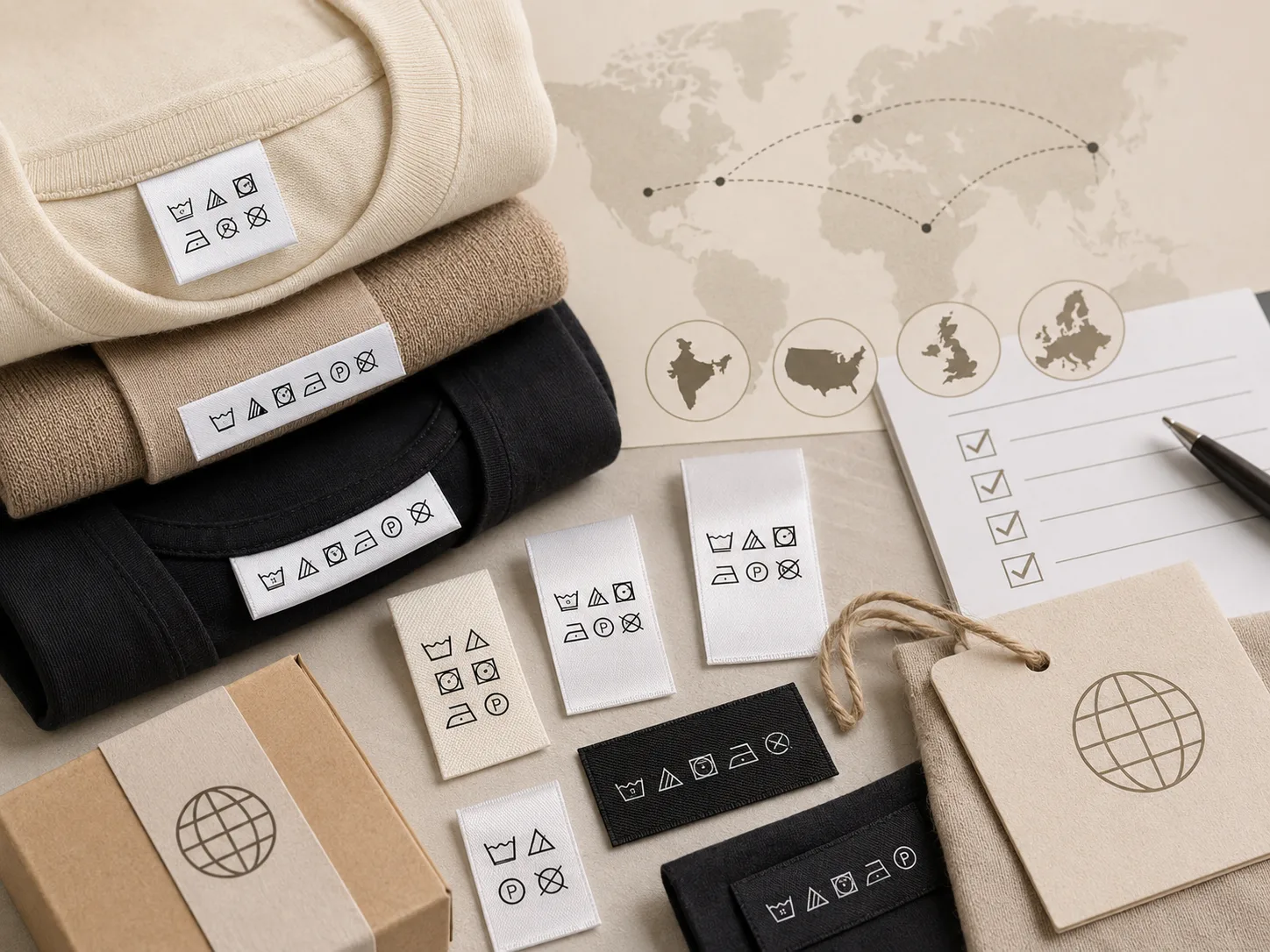
Every care label needs four things: fibre content, care instructions, country of origin and brand or manufacturer identity, sewn in and legible for the garment's useful life. India adds MRP and net quantity under Legal Metrology rules, the US requires permanent instructions under 16 CFR 423, and the EU and UK expect ISO 3758 symbols with accurate fibre composition.
Every garment you sell needs a care label, and it's not just good practice, it's the law. Sell without the right information and you risk customer returns, marketplace delisting, or for exporters, a shipment held at customs. The catch: India, the US, the UK and the EU each phrase the rules slightly differently.
This guide lays out exactly what must appear on a care/content label for each market, in plain language, so a first-time brand owner can get the very first order right and avoid an expensive reprint. Note: this is a practical buyer's overview, not legal advice. Confirm the latest rules for your specific product before a large export run.
What are the four things every care label needs?
Almost every market wants these four. Size is commercially expected (and required by most marketplaces) but is not always a strict legal element. Get these four right and you've covered roughly 90% of label compliance everywhere.
Need a compliant care label fast? The free label designer's care-label generator builds the composition, wash symbols, origin and Legal Metrology lines for you, all editable.
What must a care label carry for sale in India?
For garments sold in India, the relevant framework is the Legal Metrology (Packaged Commodities) Rules, which apply to pre-packaged goods including apparel.
- Fibre content: the composition, e.g. "60% Cotton 40% Polyester"
- MRP (inclusive of all taxes) and net quantity
- Manufacturer / packer / importer name and address
- Country of origin: mandatory, especially for marketplace listings
- Month & year of manufacture/import; consumer-care contact
- Care instructions & size: expected by retailers and platforms (Myntra, Amazon, Flipkart) even where not strictly mandated
Marketplace reality: Indian e-commerce platforms enforce country-of-origin and fibre-content declarations strictly. A missing declaration is one of the most common reasons new brands get listings blocked.
What does the US FTC Care Labeling Rule require?
Two US rules govern apparel labels: the FTC Care Labeling Rule (16 CFR Part 423) and the Textile Fiber Products Identification Act.
- Permanent care label with full instructions for washing/dry-cleaning. Must stay legible for the useful life of the garment
- Fibre content by generic name and percentage
- Country of origin, "Made in …"
- Manufacturer identity: company name or a registered RN number
- Care info may use words or symbols; if symbols, they must follow the ASTM care-symbol system
What do the EU and UK require on a care label?
The EU regulates fibre labelling under Regulation (EU) 1007/2011; the UK applies closely aligned rules post-Brexit.
- Fibre composition is mandatory and must be accurate: often required in the language(s) of the destination country
- ISO 3758 care symbols are the norm (wash, bleach, dry, iron, professional care)
- Country of origin and importer/EU-responsible-person details are expected
- Care instructions themselves are largely customary/commercial, but buyers demand them
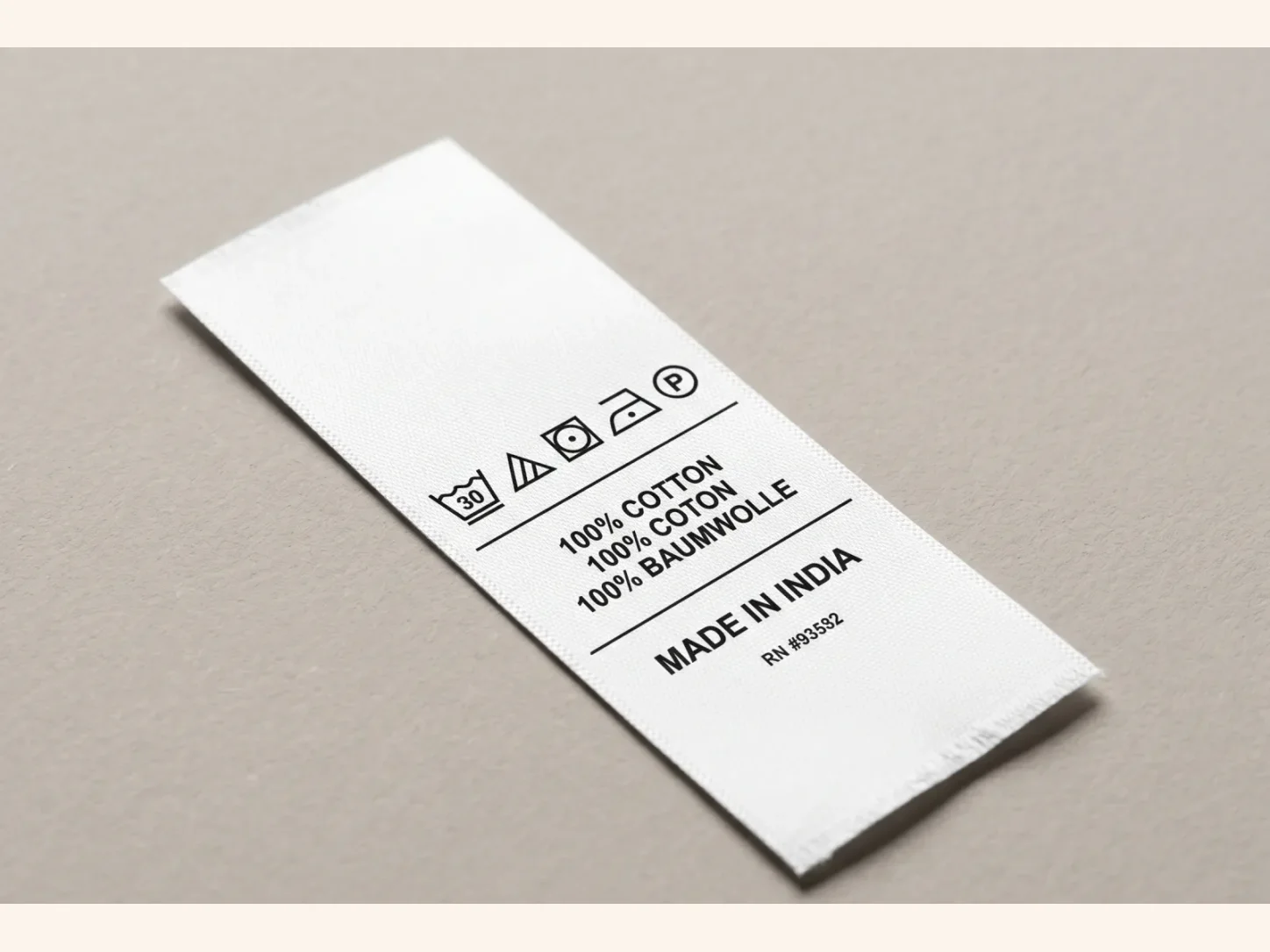
The safe export formula: ISO 3758 wash symbols + short English care text + fibre content + "Made in India" + importer details. This combination is accepted across the US, UK and EU and saves you printing a different label per country.
Market-by-market quick comparison
- Fibre content, MRP, net quantity
- Manufacturer/importer + country of origin
- Care & size expected by marketplaces
- Symbols or words accepted
- Permanent care instructions (16 CFR 423)
- Fibre content + country of origin
- RN or manufacturer name
- ASTM symbols or written words
- Mandatory fibre composition
- Often in destination language
- ISO 3758 care symbols standard
- Importer / origin details expected
- Wrong fibre percentages (must be accurate)
- No country of origin
- Care info that washes off (not permanent)
- English-only labels for EU markets
What material should a care label be?
Because care labels carry dense, small text and symbols, they're almost always printed on taffeta: its tight weave keeps tiny ISO symbols sharp and it survives industrial laundry. Satin printed is a softer alternative for skin-contact positions. Woven is rarely used for care labels because fine text loses legibility in a weave.
- Taffeta printed: export standard, sharpest symbols, lowest cost
- Satin printed, softer for babywear/innerwear care labels
- Placement: inside side seam (hip) or back neck; must be permanent and findable
See our care-label symbols & fabric guide and taffeta labels for exporters for the production detail.
Your care-label checklist before ordering
Get the exact composition and percentages from your fabric supplier. This is the most-checked, most-penalised field.
Use ISO 3758 wash symbols plus short English text: accepted across India, US, UK and EU.
"Made in India", plus your brand name (and RN for US, importer for EU).
Print on taffeta for sharp, permanent symbols; place at the inside seam or back neck.
Why test the care instruction before you print it?
The most common complaint about a care label is not that it was wrong on paper. It is that the garment did not survive what the label told the customer to do.
Care instructions get copied from a previous style, from a fabric supplier's sheet, or from what seems reasonable, and none of those account for the finished garment: the trims, the interlining, the print, the dye and the thread all react differently. A shell that washes at forty degrees can still fail at forty once there is a print on it.
- Test the finished garment, not the fabric. It is the combination that fails.
- Test at the instruction you intend to print, and repeat it several times rather than once.
- Check shrinkage, colour bleed and trim damage separately. They fail at different points.
- Read the label itself afterwards. If the smallest symbol has gone, the label failed its own instruction.
Where there is doubt, state the gentler instruction. A garment that survives more than the label promises produces no complaints; one that survives less produces returns, and the label is the document a customer will point at.
Keep the test results with the style file as well. If a complaint ever turns into a question about whether the garment was correctly labelled, a record of what was tested and at what setting is the difference between a documented decision and a guess.
It is also the fastest way to settle the same question on the next style, since most ranges reuse a small number of base fabrics and the results carry across.
One more habit worth adopting: write the instruction for the customer you actually have rather than the ideal one. Most garments are washed in a machine, on a normal cycle, with whatever else was in the basket. A label that assumes hand washing and line drying will be ignored, and a garment that only survives under those conditions will come back.
Can one care label serve several markets?
Brands selling in more than one market usually assume they need a separate label per market, and in practice almost nobody does that. Running several versions means several artworks, several minimums, several stock lines and a real risk of the wrong label reaching the wrong country.
The workable approach is a single label that satisfies the strictest requirement in each place you sell. In practice that means carrying all of the following, whether or not every market demands every item:
- Full fibre composition by percentage, using generic fibre names.
- Country of origin, stated plainly.
- Care symbols, with a short written instruction alongside where space allows. Symbols travel across languages; sentences do not.
- The responsible party, meaning the manufacturer or the importer, with enough detail to be contacted.
The cost of the extra label area is small. The cost of discovering at a border that a consignment carries the wrong version is not, and neither is the cost of holding four label stock lines for one garment.
Permanence is part of the requirement
The item most often missed is not what the label says but how long it has to keep saying it.
Care and composition information has to stay with the garment and remain legible for its useful life. That rules out the hang tag, which is removed at purchase, and it rules out stickers and anything adhesive. The label has to be sewn in, and it has to survive the washing the garment is rated for.
Two practical consequences follow. First, the substrate matters: a printed polyester label holds small text and symbols through repeated laundering in a way that surface treatments on natural fibres do not. Second, wash testing is not optional. If the smallest symbol on the label is unreadable after the wash cycle you have specified on that same label, the garment is not properly labelled however correct the artwork was.
You can repeat any of this on a hang tag for the shopper, and it helps at the point of sale. What you cannot do is put it only there.
Common mistakes
- Putting composition or origin information only on a hang tag.
- Rounding fibre percentages so they do not total a hundred.
- Using trade names for fibres instead of generic ones.
- Listing a care instruction the garment cannot actually survive, which is the most common source of complaints.
- Weaving a care label, where the volume of small text will not stay legible.
- Leaving out the manufacturer or importer, which marketplaces and retailers both expect.
- Approving artwork without a washed physical sample.
- Running a separate label per market when one combined label would serve all of them.
Getting care labels made at Labelwala
We have been weaving and printing labels in Ahmedabad, Gujarat, for 25 years.
- Care symbols: set to ISO 3758.
- Minimum order: 1,000 pieces per design.
- Production: 7-10 days from artwork approval, or 3-5 days on a rush job.
- Delivery: across India, depending on destination and consignment size.
Tell us which markets the garments go to and send the composition. The market list decides what has to appear, and it is much cheaper to settle before the artwork than after the run.
We are rated 5.0 on Google from 27 reviews.
The short answer
For India, declare fibre content, MRP, net quantity, manufacturer/importer and country of origin, and add care symbols and size because marketplaces expect them. For the US, you must have permanent care instructions, fibre content, country of origin and an RN or manufacturer name. For the EU and UK, fibre composition is mandatory (often in local languages) with ISO 3758 care symbols. The simplest path for a brand selling in India and exporting is a single printed taffeta care label carrying ISO symbols, English care text, accurate fibre content, "Made in India" and your brand identity. Send us your details and we'll lay out a compliant care label before you print.