In brief
Labels themselves move very little in the wash; it is the garment around them that shrinks, leaving the label too large so it puckers and curls. Woven labels last longest because the colour is dyed thread, so stitch a sample into your actual garment fabric and wash it repeatedly before the full run.
Nobody inspects a label after the tenth wash: until a customer sends the garment back. By then you've produced thousands of them.
Label durability is one of the few specification decisions where the failure shows up months after the order. This guide covers what goes wrong, why, and the test that takes a fortnight and saves a production run.
What are the four ways a label fails in the wash?
Of these, bleeding is the worst: it damages the garment, not just the label. A dark neck label running onto a pale shirt turns one faulty label into one ruined product.
Do labels shrink? Not quite
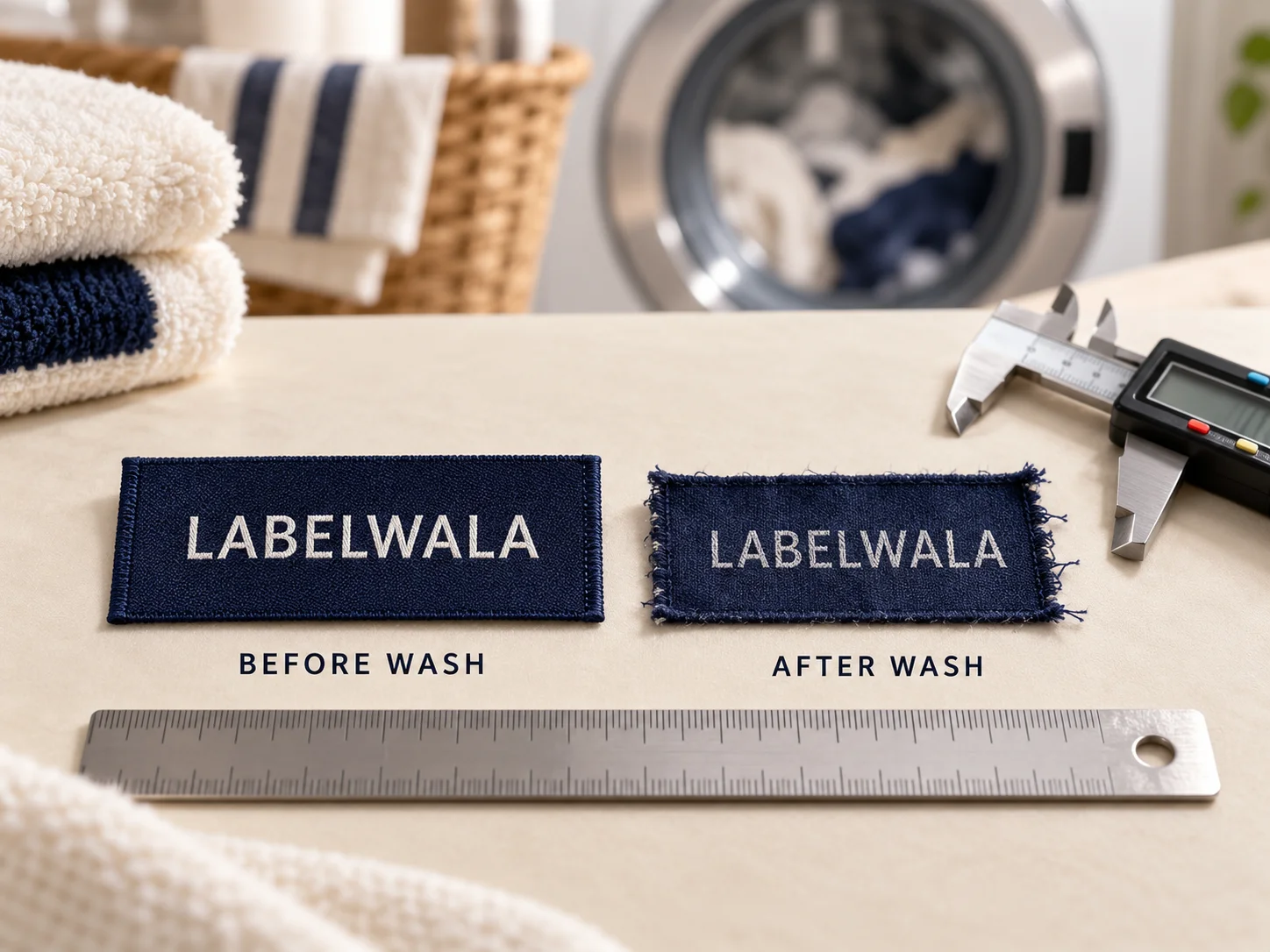
This is the most misunderstood part. The label itself moves very little. The garment around it shrinks, and the difference is what causes trouble.
Picture a cotton tee with a polyester-based woven label. After a few hot washes the cotton has drawn in; the label hasn't. The label is now slightly too large for the space it's stitched into, so it puckers and lifts at the edges.
Label material should be chosen alongside the garment fabric, not in isolation. A label that's fine on a stable polyester blend can pucker on high-shrinkage cotton. Tell your supplier what fabric it's going into.
Why do labels curl, and how do you stop it?
Curling has two causes, usually together:
- Differential shrinkage: the mismatch described above
- Insufficient stitching: a label secured only top and bottom has free side edges that lift as the garment moves
Tumble drying accelerates both, because heat is what drives most shrinkage. The fixes are straightforward:
- Choose a fold that hides raw edges: an end-fold tucks them under
- Stitch on all four sides where the placement allows
- Match the label material sensibly to the garment fabric
How do label materials compare in the wash?
Longest lasting. The design is dyed thread woven into the structure. The colour is the material. No print layer to crack, peel or wear away.
Can be very durable when produced well, but the printed layer sits on the surface and is inherently more exposed to abrasion over many cycles.
Attractive and smooth against skin, but the sheen finish shows wear sooner than a dense weave under heavy laundering.
Comfortable and seam-free, but it's a transfer bonded to fabric: the most vulnerable option under repeated hot washing.
For garments facing heavy or industrial laundering, woven is usually the safer specification. See woven vs printed for the full comparison.
Why do care labels have a higher bar?
A brand label fading is a cosmetic disappointment. A care label fading is an information failure.
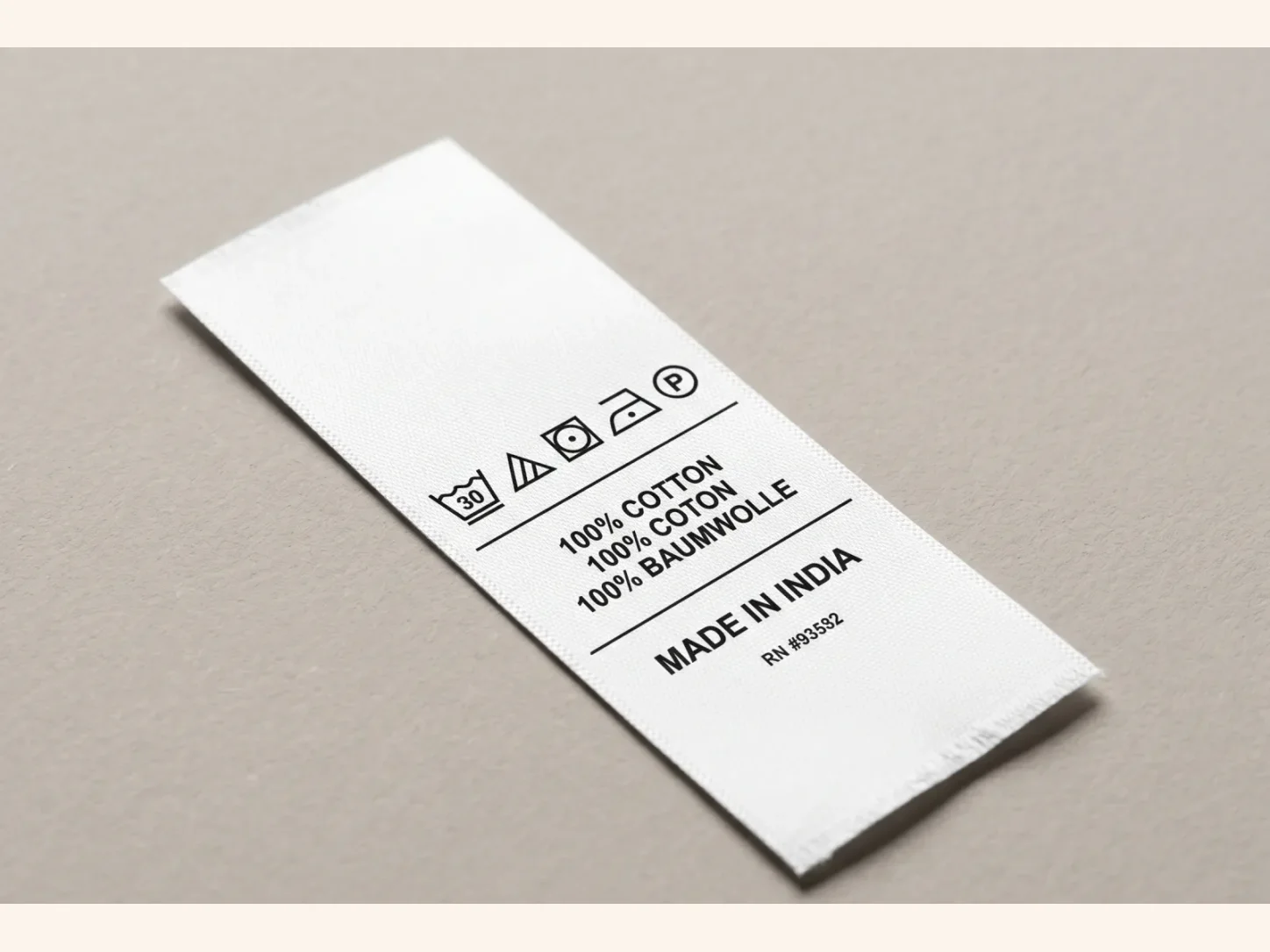
The care label carries washing instructions, fibre content and often country of origin, and that information must stay legible for the useful life of the garment. In many markets it's required to remain present and readable, not merely to have been present at the point of sale.
Specify care labels for durability and legibility, not appearance. This is the one label where a slightly plainer, tougher specification is the right call. Our care label symbols guide covers what has to be on there.
Why is industrial laundry a different world?
If your garments go to hotels, hospitals, restaurants or uniform contracts, domestic assumptions don't apply. Industrial laundering is harsher on every axis:
- Higher wash temperatures
- Stronger chemicals, frequently including bleach
- Longer, more aggressive mechanical action
- High-heat tunnel drying or pressing
- Repeated several times a week, not weekly
Say so at the quoting stage. A label specified for domestic washing can degrade fast under industrial conditions. This has to be known before the specification is set, not after the first complaint. See labels for industrial laundry.
Colourfastness in plain terms
Colourfastness means how well colour stays put. Two kinds matter for labels:
- Fastness to washing. The colour doesn't bleed into the garment or wash out over cycles
- Fastness to rubbing. The colour doesn't transfer when the label rubs against skin or fabric
Bleeding is the more serious failure for the reason given earlier: it damages the garment. Deep, saturated colours on labels destined for pale garments deserve particular attention here.
How to run your own wash test
Request a physical sample of the exact specification you intend to order.
Into an offcut of the actual garment fabric, same placement, same stitching.
Repeated cycles at the temperature and with the drying the garment will really face.
Curling, fraying, text legibility, and any colour transfer onto the fabric.
Step 2 is the one people skip, and it's the one that matters. A label can behave perfectly on its own and still pucker once stitched into a garment that shrinks. Testing a loose label tells you almost nothing.
What should you put in your purchase order?
Most durability problems trace back to a PO that named only size and colours. Include:
- Domestic or industrial laundering
- Expected wash temperature
- Bleach or strong chemicals involved
- Tumble dried or heat pressed
- The garment fabric it's stitched into
- Placement and stitching method
- Size and colour count only
- "Same as last time" with no spec on file
- Material named with no wash context
- No mention of the garment fabric
- Approval from a digital mock-up
A supplier who knows the real conditions can recommend a suitable material and finish. One who only knows the size is guessing on your behalf.
The label is only half of what you are testing
Wash testing gets treated as a question about the label, and in practice it is a question about the label and the garment together. Most of the failures that reach customers are interactions rather than defects in either piece on its own.
- Stiffness mismatch. A firm label stitched to a soft, lightweight knit gathers the cloth around it, and the fabric puckers even though the label is intact.
- Differential shrinkage. The garment moves slightly in the wash and the polyester label does not, which shows as a ripple around the stitching.
- Dye migration. Colour from a dark or freshly dyed garment moves into a pale label, usually during warm storage rather than during the wash itself.
- Thread failure. The label survives and the stitching does not, which looks like a label problem and is not.
So test the assembly, not the component. Stitch the sample to a scrap of the fabric you will actually use, in the colour you will actually sell, attached the way the factory will attach it. A label approved loose, or stitched to white cotton when the garment is a dark knit, has not been tested in any useful sense.
What counts as a failure
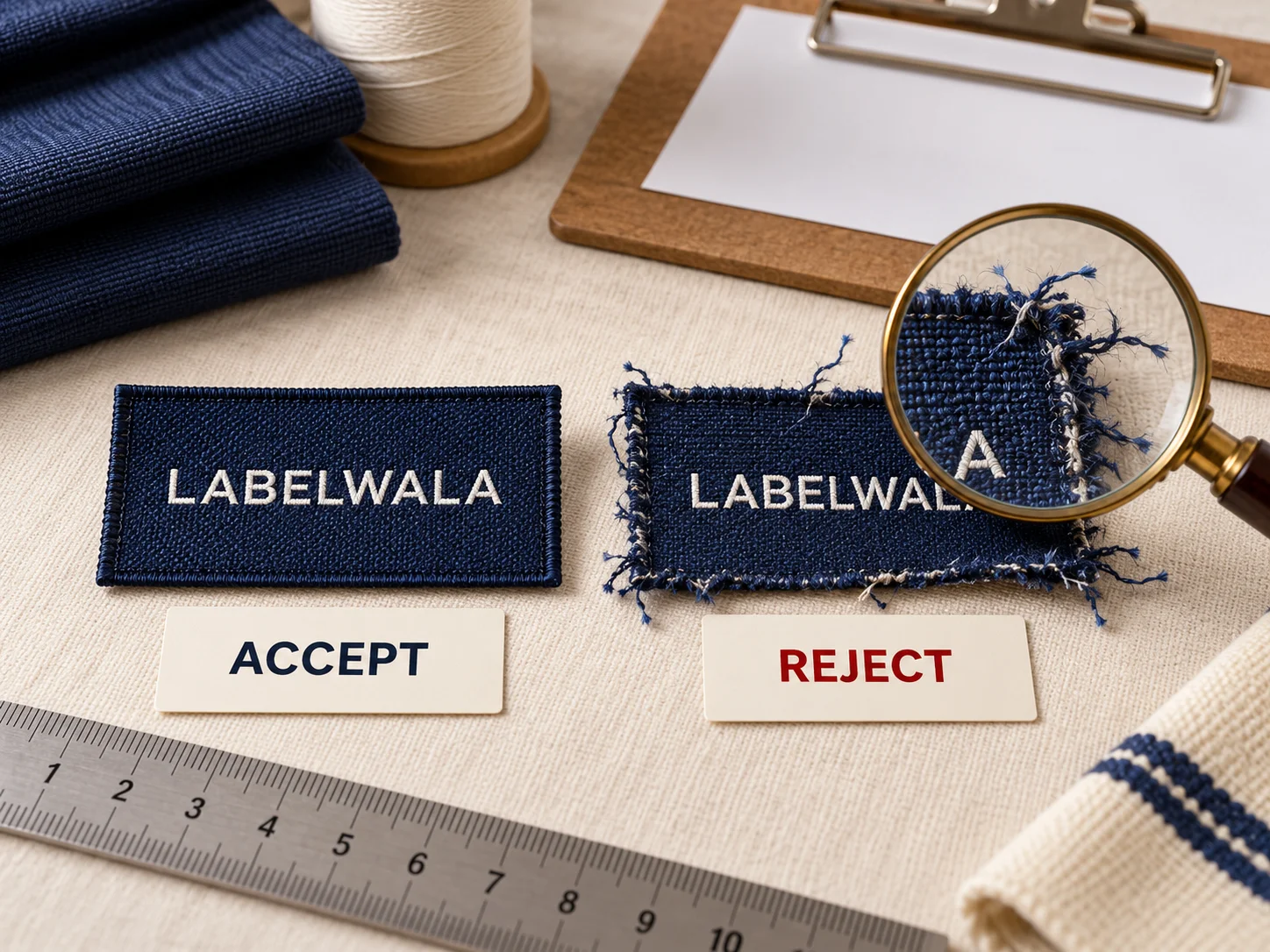
Test results get described as pass or fail with no stated threshold, which is how two people look at the same sample and disagree. Set the bar before you start.
For a care label the bar is legibility. After the wash cycle printed on that same label, every symbol and every line of composition has to be readable at arm's length. Not readable up close, and not readable to someone who already knows what it says. If the smallest symbol has gone, the label has failed its own instruction.
For a brand label the bar is appearance. The mark should still look deliberate: colour dulled slightly is acceptable, edges lifting or a fill that has broken up is not.
For the garment the bar is that nothing changed because of the label. No puckering, no rippling around the stitch line, no colour transferred into the label or out of it.
Write those three down before the first cycle. Judging afterwards, against a sample you have grown used to, is how borderline results get approved and then complained about.
Keep the tested sample as well, alongside the untested one. Two pieces side by side make a marginal result obvious in a way that memory never does.
They are also the pair to send a supplier if a batch ever needs discussing, because a described failure and a demonstrated one get very different responses.
Store both out of sunlight while you keep them. A reference sample that has faded on a windowsill is worse than no reference at all, because it makes every later batch look wrong in a direction that has nothing to do with production.
Common mistakes
- Testing the label loose instead of stitched to the garment fabric.
- Testing against white sample cloth when the garment is dark or freshly dyed.
- Washing once and calling it a test.
- Looking only at the end rather than after each cycle, which is what tells you how it failed.
- Testing at a gentler setting than the care label instructs.
- Skipping the warm-storage check for dye migration, which is the failure that appears after shipping.
- Testing after the bulk order rather than before it.
- Leaving durability expectations out of the purchase order, so there is nothing to point at if a batch differs.
Sampling and testing with Labelwala
Woven and printed labels, made by us in Ahmedabad, Gujarat, for 25 years.
- Production: 7-10 days once artwork is approved. Rush jobs run 3-5 days.
- Care symbols: set to ISO 3758.
- Minimum order: 1,000 pieces per design.
Ask for the sample on the exact base and fold you intend to order, and tell us what the garment is washed at. A sample tested against the wrong instruction proves very little.
We are rated 5.0 on Google from 27 reviews.
The short answer
Labels barely shrink. Garments do, and that difference causes puckering and curling. Curling also comes from stitching on too few sides, so use a fold that hides raw edges and stitch all four sides where you can. Woven labels last longest because the colour is the material rather than a layer on top; heat-press transfers are most vulnerable. Care labels must stay legible for the garment's life, so specify them for durability over appearance. Industrial laundering is far harsher than domestic: say so before the specification is set. And test properly: stitch a sample into the real garment fabric and wash it repeatedly before committing. Tell us how your garments will be laundered and we'll recommend a specification that holds up, with a sample to test first.