In brief
A label MOQ is the smallest number a supplier will make in one run of one design, and it exists because loom threading, screens or plates and dyed base fabric cost the same for 200 or 20,000 pieces. Woven labels usually carry the highest minimum, printed and satin sit lower, and care labels are usually the most accessible.
MOQ is the objection that stops more first orders than price does. A new brand with 50 garments hears "minimum 1000 labels" and assumes the supplier isn't interested in small business.
That's not what's happening. The minimum is a consequence of how labels are physically made, and once you see the mechanism, you can work with it instead of against it.
What does MOQ actually mean for labels?
MOQ, minimum order quantity, is the smallest number of labels a supplier will produce in a single run of one design. That last part matters more than most buyers realise, and we'll come back to it.
The number isn't a sales tactic. It's the point below which the cost per label stops making sense for either side.
Why do custom labels have a minimum order?
Here's the mechanism. Before a single label is made, work has to happen that costs the same whether you order 200 or 20,000:
A woven label loom is loaded and threaded for your exact design, colours and width. Skilled work, measured in hours.
Printed labels need a screen or plate prepared per colour before anything prints.
Dyed base comes in production lots, not by the metre. A short run still consumes a lot.
First pieces off the loom are checked and adjusted before the run is accepted.
None of that scales down. Order 200 labels and the setup cost lands on 200 pieces; order 5000 and the same cost spreads across 5000. That's the whole story.
The minimum protects you as much as the supplier. Below it, the per-label cost climbs to a point where most buyers would rather not place the order at all once they see the number.
How does cost per piece change with quantity?
Because setup is divided across your quantity, the cost per label falls steeply at first, then flattens:
The useful question isn't "what's the lowest quantity you'll accept?" It's "where does the curve flatten for my design?" Just past that point is usually the sensible order. Beyond it you're mostly buying inventory, not savings. You can model this on our price calculator.
How does MOQ vary by label type?
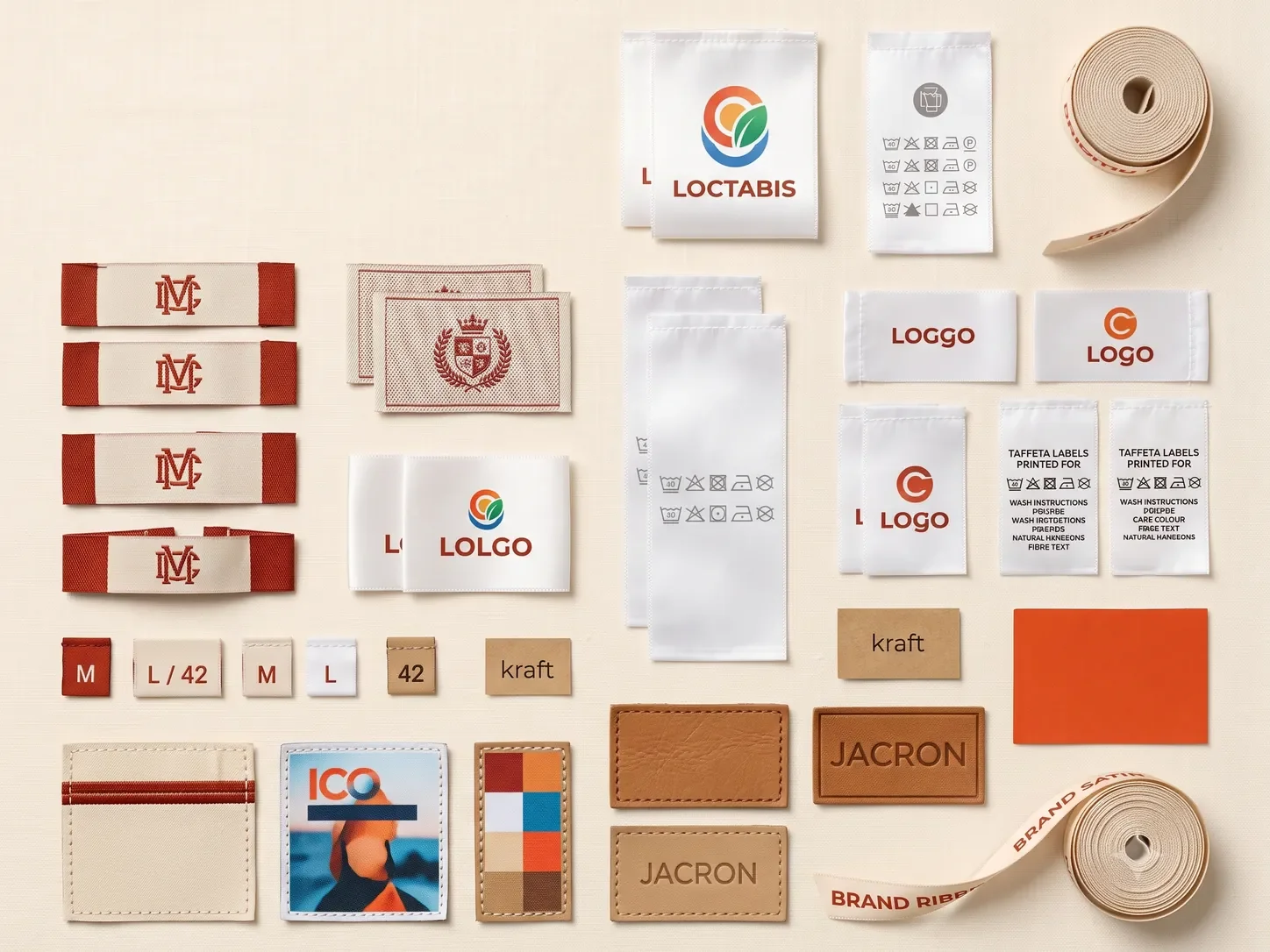
Usually the highest minimum. Loom threading is the most involved setup of any label type, and more colours means more threading.
Generally lower. Preparing a screen is quicker than threading a loom, so the setup barrier is smaller.
Typically the most accessible: usually single-colour printing on a standard base, so minimal setup.
Same 1,000-piece minimum, but no setup at all, since the labels are already produced.
Ask for the minimum against your specific artwork. Minimums move with design complexity, colour count and size. A blanket figure quoted before anyone has seen your design is a rough guide, not a commitment.
How can you work around a label minimum?
1. Use premade labels for the non-branded pieces
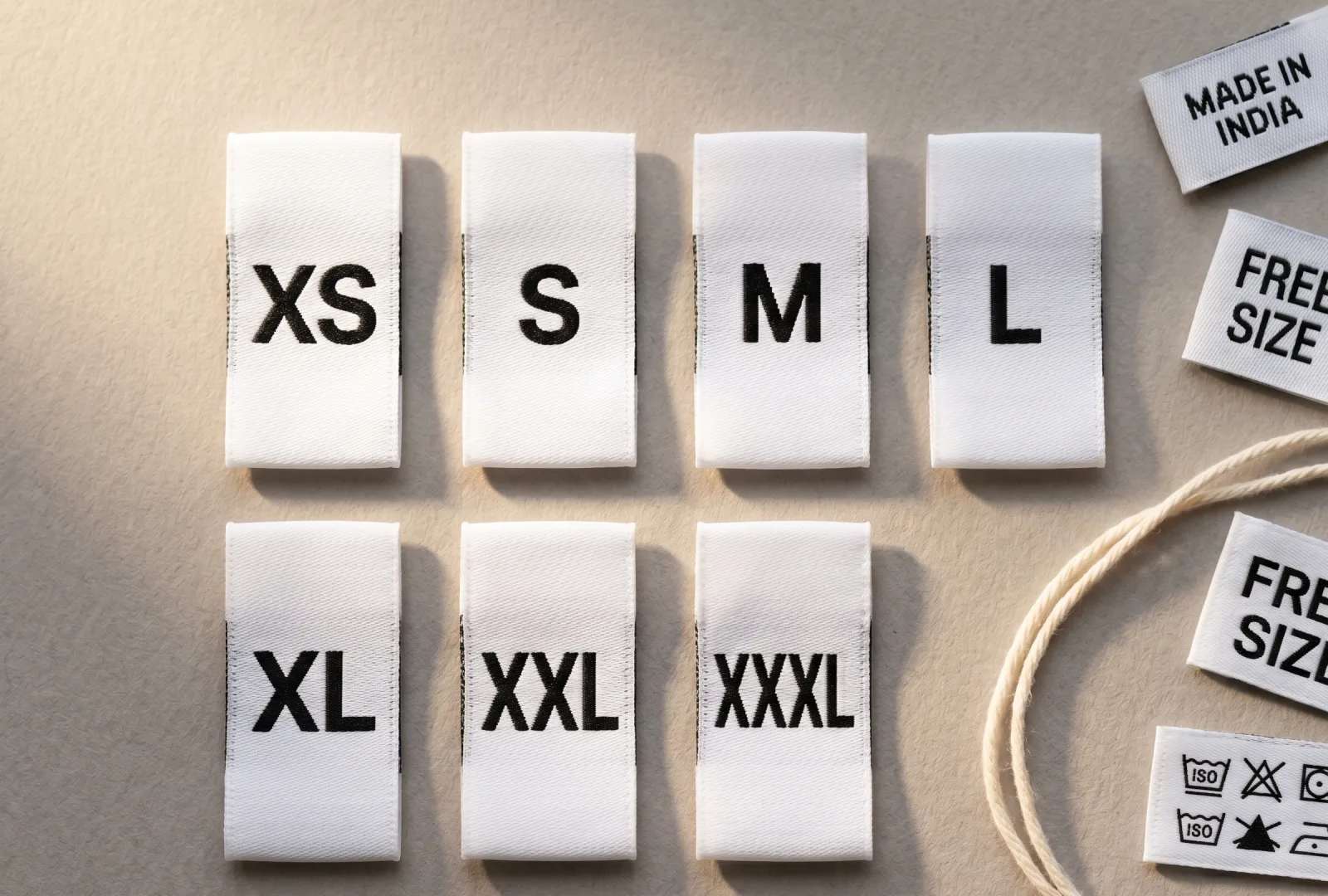
This is the most effective route and the one small brands underuse. Your size tabs and care labels carry no branding, they carry information. Use premade stock labels for those and put your only custom order on the neck label, where the branding actually lives. One setup charge instead of three.
2. Check whether designs can share a run
Minimums are per design, so three designs usually means three setups. But where designs share the same base fabric, width and colour palette, some setup work carries across. Worth asking. It doesn't always apply, but when it does the saving is real.
3. Simplify the design
Colour count drives both setup and rate. A logo reduced from five thread colours to two is cheaper to set up and cheaper per piece, and on a 4cm woven label, fine colour gradations rarely survive the weave anyway. Our artwork setup guide covers what actually reproduces at label scale.
4. Plan the reorder into the first order
If you're confident in the design, ordering the quantity where the curve flattens beats two small runs paying setup twice. Labels are stable stock: stored dry and flat they keep indefinitely.
Reorders: the minimum gets easier
An exact repeat of an unchanged design is easier, because the setup is done and the specification is on file. Many suppliers reduce or waive setup on a true repeat, which effectively lowers the barrier to a smaller quantity.
Keep your specification recorded: artwork file, thread references, size, fold. Any change to size, colours or fold generally counts as a new design and resets the setup charge. See reorders and consistency.
Advice for a first order
- One custom neck label, done properly
- Premade stock for size and care
- A physical sample before the full run
- Being honest about your stage
- Ordering just past the curve's flattening point
- Three custom designs on a tiny first order
- Approving bulk from a screen mock-up
- Splitting one design across two suppliers
- Chasing the absolute lowest quantity
- Changing artwork slightly on the reorder
Most suppliers will advise on the quantity where cost per label becomes reasonable rather than pushing the largest possible order. A brand that reorders for years is worth considerably more than one large first order.
When you order changes what the minimum costs you
A minimum is easier to absorb early than late, and that is a scheduling point rather than a pricing one.
Ordered ahead of production, surplus labels sit in a box until the next run and cost nothing but the money tied up. Ordered late, with garments already cut, the same shortfall becomes a rush job: the setup is paid again, the lead time compresses, and the pieces per rupee are the worst you will ever see.
The sequence that avoids it is unglamorous. Settle the artwork while fabric is being sourced, approve a physical sample while cutting is being planned, and have labels in the factory before stitching starts. A neck label goes in early in assembly, so it is needed sooner than the dispatch date suggests.
Work backwards from the stitching date rather than the delivery date, and add a sampling round. Those two habits between them prevent most minimum-related panic, because the minimum is only painful when there is no time to spread it across a proper run.
Why is the minimum not the number you should order?
The two get conflated constantly, and they answer different questions. The minimum is the point below which a supplier cannot run the job economically. The right quantity is what your production actually consumes.
Work it out from the bottom up rather than accepting the minimum as a default:
- Your garment count, which is where most people stop.
- Sewing wastage. Labels get mis-stitched, cut crooked or caught in the wrong seam and unpicked.
- Samples and photography, which consume garments before anything is sold.
- The next run. If you expect to repeat the style, the labels for that run cost far less bought now than ordered separately later.
The asymmetry is what matters here. Overstocking labels ties up a small amount of money in something that does not perish. Running short mid-production, with garments cut and a dispatch date fixed, means a top-up run that pays the setup again for a fraction of the pieces. The two mistakes are not remotely equal in cost.
Surplus labels are stock, not waste
Because the setup dominates the price, the sensible response to a minimum is usually to treat the surplus as inventory rather than as an overpayment.
Woven and printed polyester labels do not perish. Stored properly they are as good in two years as on the day they arrived, which makes them one of the few things a small brand can safely buy ahead of demand.
- Keep them sealed and dry, in the bags they arrive in rather than loose in a drawer.
- Keep them out of sunlight. A stack near a window fades unevenly from the top down, and the fade is not obvious until you compare against the bottom of the pile.
- Label the packet with the design, the date and the quantity, so a stock check does not mean counting.
- Count what is left before reordering. Brands routinely reorder while holding several thousand of the same label.
The one thing that does date a label is a change of design, which is why it is worth separating what changes from what does not. A brand label rarely changes between seasons and can be ordered deep. A collection-specific or seasonal label should be ordered to that season and no further.
Common mistakes
- Ordering exactly the minimum when production needs more than that.
- Ordering exactly as many labels as garments, with nothing for sewing wastage.
- Treating the minimum as a negotiating position rather than as arithmetic about setup cost.
- Putting the size on the brand label, which turns one design into five and multiplies the minimum.
- Ordering seasonal and permanent artwork on the same label.
- Storing surplus loose and in the light, then discarding a faded top layer.
- Reordering without checking existing stock.
- Comparing per-piece prices across different quantities as though they were the same offer.
Minimums at Labelwala
We have been weaving and printing labels in Ahmedabad, Gujarat, for 25 years.
- Minimum order: 1,000 pieces, counted per design rather than per order.
- Quotes: usually within 2 hours on a working day.
- Production: 7-10 days once artwork is approved. Rush jobs run 3-5 days.
If your first run is smaller than the minimum, say so in the enquiry. It is usually more productive to talk about what the surplus is worth holding than to shrink the order to a quantity that costs more per piece than it saves.
We are rated 5.0 on Google from 27 reviews.
The short answer
MOQ is the smallest run of one design, and it exists because loom threading, screens and dyed base fabric cost the same at any quantity. Woven labels carry the highest minimum, printed and satin sit lower, care labels lower still, and premade stock labels have effectively none. Cost per label falls steeply then flattens. Order just past the flattening point. For a small first order, put your one custom label at the neck and use stock labels for size and care. Tell us your design and quantity and we'll tell you honestly where your cost per label becomes sensible.