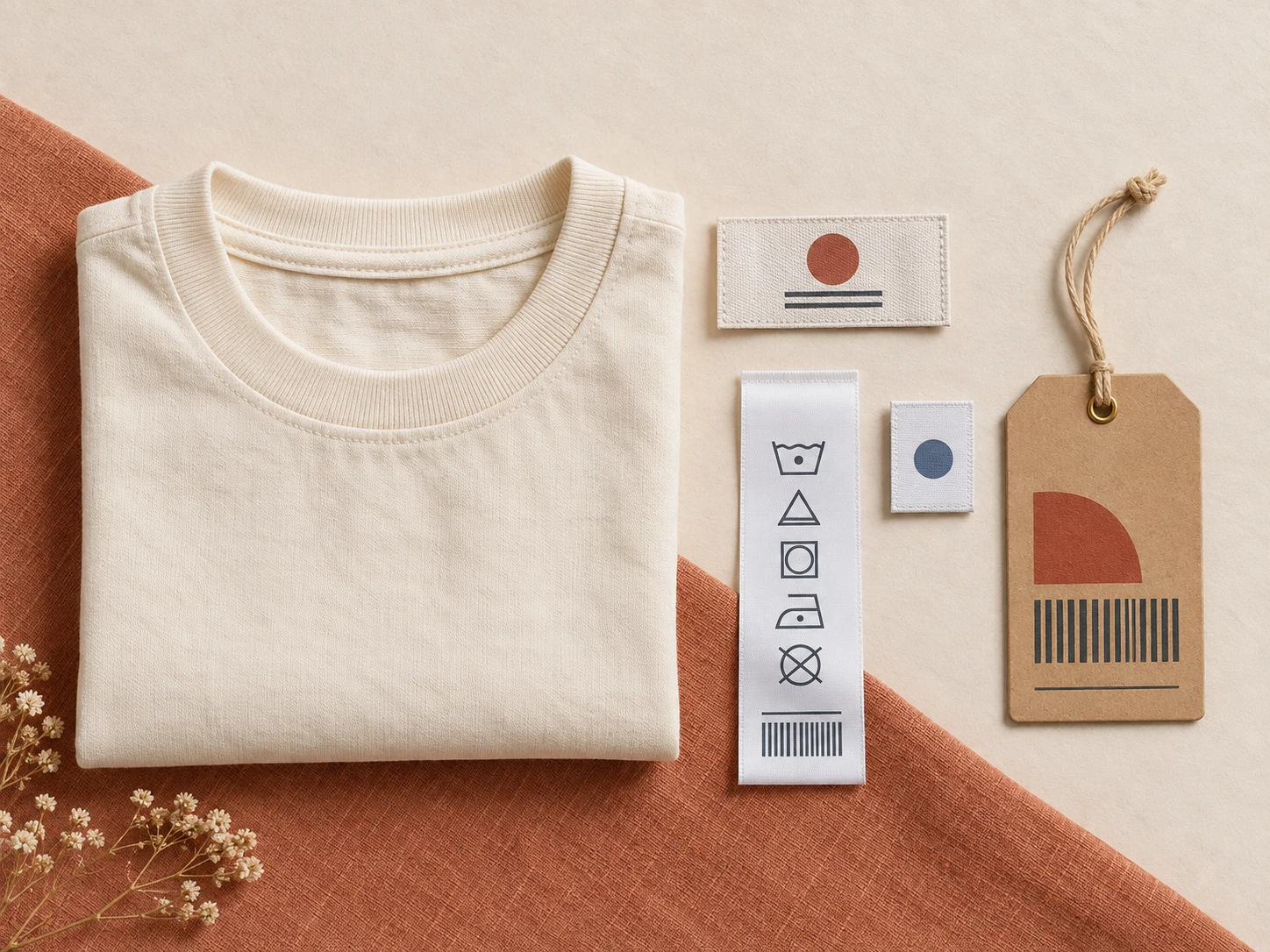
In brief
To list apparel on Amazon India, Flipkart or Myntra you need a brand label, a care and content label with fibre composition, care and country of origin, a size label, and a hang tag carrying MRP, net quantity and manufacturer details. Amazon gates fashion and needs trademark papers, Flipkart runs brand verification, and Myntra refuses unbranded goods.
You can be fully compliant with Indian labelling law and still have your listing taken down. That catches out most first-time sellers. The law sets a floor, and each marketplace stacks its own requirements on top: brand paperwork, listing attributes, packaging rules, and in some categories a physical security tag.
The frustrating part is that none of it is difficult. It is just spread across three different rulebooks, and you usually discover the third one after your labels are already made. A woven label is produced in bulk and cannot be edited afterwards, so a field left off the artwork is not a correction, it is a reprint.
This guide puts the three layers in one place, in the order they will hit you. Note: this is a practical buyer's overview, not legal advice, and platform policies are revised regularly. Confirm the current seller policy for your category before a large run.
Layer 1: the law
Legal Metrology declarations. The same everywhere, online or in a shop.
Layer 2: the platform
Brand approval, listing attributes, packaging. Differs per marketplace.
Layer 3: the customer
Not written down anywhere, and the layer that drives your return rate.
Layer 1: what does Indian law require?
Garments sold in India fall under the Legal Metrology (Packaged Commodities) Rules. Rule 6 sets out the mandatory declarations for a pre-packaged commodity, and an amendment extended these to garments and hosiery sold loose or open at the point of sale, with effect from 1 January 2023.
The declarations are:
- Name and address of the manufacturer, packer or importer
- Country of origin
- MRP, inclusive of all taxes
- Net quantity
- The generic name of the commodity
- Month and year of manufacture, packing or import
- Consumer care contact details
Two things about this list surprise people. The first is that it says nothing about wash care. Care instructions are a commercial and consumer expectation rather than a Legal Metrology declaration, though every marketplace asks for them and buyers judge you on them. The second is that where the garment is sold online, these declarations also have to appear on the listing itself, not only on the product. The obligation follows the sale, not the shopfront.
For what has to go on the care label specifically, including fibre content and export markets, see our care label requirements guide. This article covers the marketplace layer that sits on top of it.
Need a compliant care label fast? The free label designer's care-label generator builds the composition, wash symbols, origin and Legal Metrology lines for you, all editable.
Which label carries which declaration?
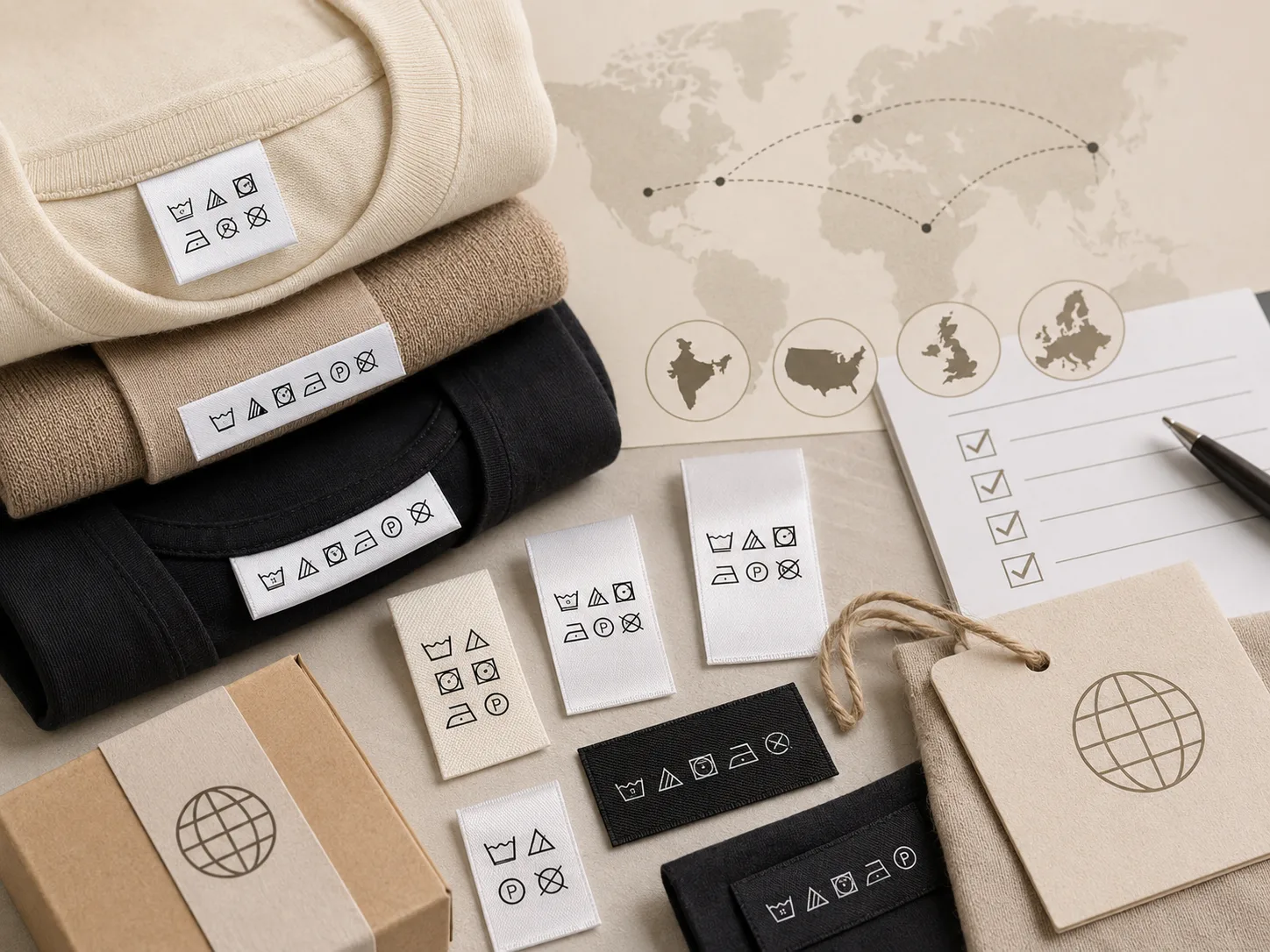
Nothing says all of this has to sit on one label, and it should not. The declarations split naturally by how often they change.
| Component | Carries | Why there |
|---|---|---|
| Neck / brand label | Brand name or mark, sometimes size | Never changes. Woven or satin, made in bulk. |
| Care & content label | Fibre composition, care symbols, country of origin, manufacturer identity | Fixed per fabric. Printed taffeta holds small text. |
| Size label | Size only | Separate, so one artwork covers the whole size run. |
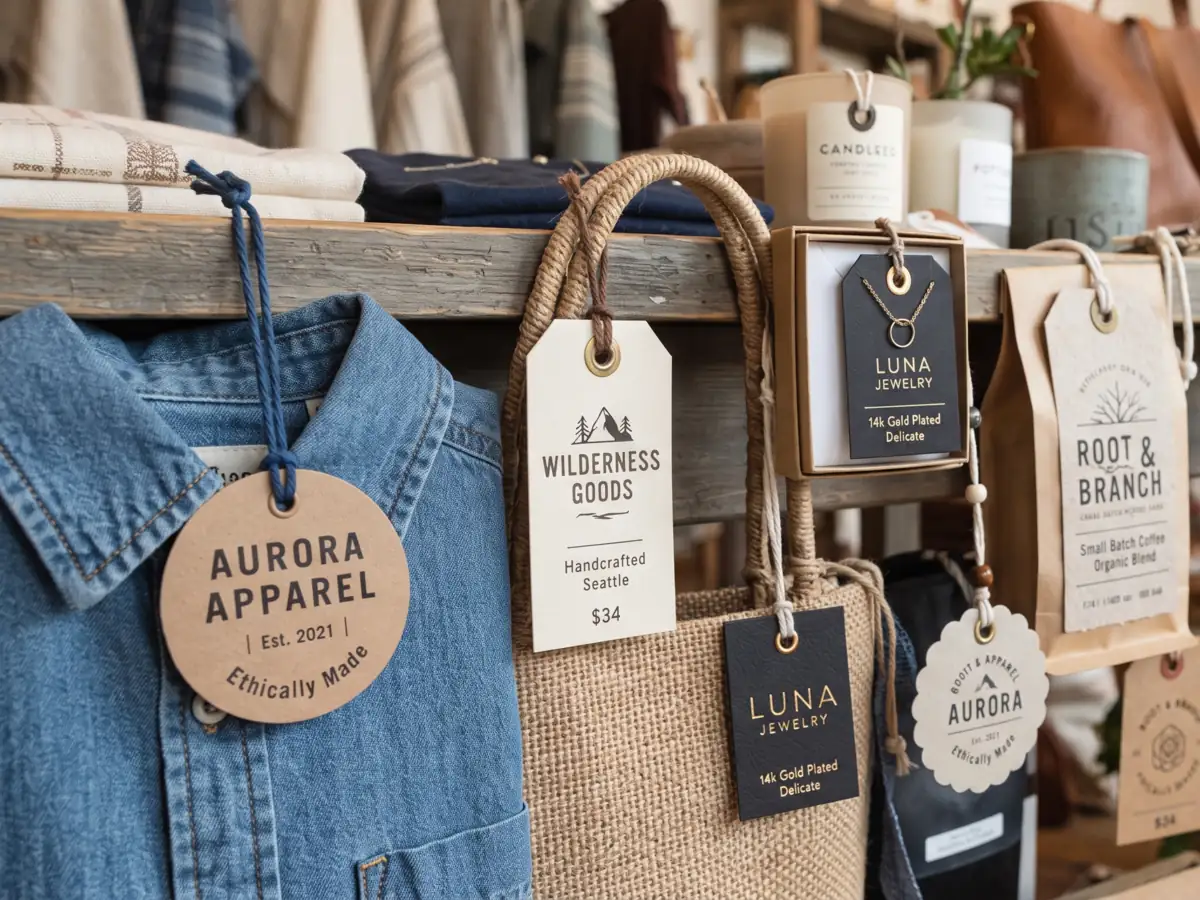
| Hang tag | MRP, net quantity, month and year, consumer care contact, barcode | Changes per season and variant. Printed in small batches. |
That last row is the one to get right. MRP does not belong on a sewn label. Your labels are ordered months ahead in bulk, and the price will move. Put a price on a woven label and you have converted a cheap reprint into an expensive one, or worse, into a compliance problem you cannot fix without unpicking every garment.
The split that works: sewn labels carry what is true for the life of the garment. The hang tag carries what is true for this season. Get that boundary right and you will never reprint a woven label for a commercial reason.
Amazon India
Fashion is a gated category on Amazon India. You cannot simply create a clothing listing the way you can in an open category: the category has to be approved for your account first.
- Category approval before you can list apparel, footwear or fashion accessories.
- Brand documentation: trademark paperwork if it is your own brand, or an authorisation letter from the brand owner if you are reselling.
- Country of origin as a listing attribute, displayed to the buyer.
- Label content covering fibre composition, country of origin, manufacturer or importer identity and care instructions.
Country of origin deserves singling out. It is the field most likely to cause trouble, because it is enforced both as a legal declaration and as a platform attribute, and because a missing or wrong value can escalate from a blocked listing to action on the account itself. It costs nothing to add to the artwork and it is expensive to omit.
Flipkart
Flipkart's gate is brand verification. Every seller listing branded apparel goes through it, whether they own the brand or are an authorised reseller. A brand name on a listing has to be backed by paperwork before the listing runs.
The practical consequence for a new label order is that your brand name needs to be settled before you commit artwork to production. Brands sometimes order labels while a trademark application is still being decided, then find the mark has to change. Woven labels do not survive a rename.
Packaging is the other Flipkart-specific item, and it sits outside the garment: the shipping label format and the poly bag are governed separately from anything sewn in. Those are logistics decisions rather than label decisions, but they land on the same launch checklist and they are easy to forget until the first order needs dispatching.
Myntra
Myntra is the strictest of the three on brand identity, and it is where manufacturers moving into direct selling most often get stuck.
- A registered brand, or a valid brand authorisation letter.
- Unbranded white-label goods are not accepted. A garment with no brand identity cannot be listed.
- Wash care is among the mandatory attributes to be filled on the listing.
- Packaging is expected to meet platform guidelines, including branded poly bags and correct labelling.
- Selected categories use Tagloop, a numbered security lock with a barcode attached to the garment, used to prevent counterfeit and used-item returns. Where it applies, the ID is captured during packing.
The white-label point is worth dwelling on. A manufacturer who has sold to distributors for years may never have put a neck label in a garment, because the buyer added their own. Moving that same product onto Myntra means a brand label and a hang tag are no longer optional decoration, they are the entry requirement.
If you are converting wholesale stock to marketplace stock: the minimum viable addition is a neck label, a care and content label, and a hang tag. That is the set that turns an unbranded garment into a listable one.
Why must the label and the listing agree?
This is the failure nobody plans for, and it is the most common one after country of origin.
Your listing has attribute fields: fibre composition, wash care, country of origin, net quantity. Your garment has a sewn label carrying the same information. When those two disagree, the label wins, because it is the physical evidence in the customer's hands. The listing is what gets judged wrong.
It happens for boring reasons. Someone fills the listing from the range plan while the label was made from the final approved artwork, and the fabric changed in between. Or a 60/40 blend gets typed as 100% cotton because that is what the previous style was.
- Fill listing attributes from the approved label artwork, not from the range plan or from memory.
- Keep the approved artwork PDF with the style file, so there is one source rather than two.
- Re-check the attributes whenever the fabric changes, even slightly.
- If you sell the same style on three platforms, correct all three together.
A single customer complaint puts the label and the listing side by side in front of the platform at the same moment. That is the only audit most sellers ever face, and it is triggered by one person who bothered to read the tag.
What HSN code and GST apply to labels?
Separate from what goes on the label, there is the question of what you pay for it. Textile labels fall under HSN 5807, which covers labels, badges and similar articles of textile material, in the piece, in strips, or cut to shape, not embroidered.
Under the GST revision that took effect on 22 September 2025, Chapter 58 was moved to a uniform 5%, down from the earlier 12%. For a brand ordering labels regularly that is a real reduction in input cost. Rates are revised from time to time, so confirm the current position with your accountant rather than relying on a blog, including this one.
Layer 3: the requirement nobody writes down
The third layer is not in any policy document, and it is the one that decides whether you keep the sale.
Marketplace apparel is bought unseen and returned freely. The label is one of the first physical things a customer touches, and a scratchy neck label on a soft T-shirt reads as a cheap garment regardless of what the fabric cost. Returns get logged against fit or quality, so the label never appears in the data, and it is quietly contributing anyway.
- Next-to-skin garments: use satin, or move to a tagless heat transfer and put the care information at the side seam.
- Kidswear: softness is not optional. See our kidswear label guide.
- Outerwear and denim: woven damask holds up and looks the part.
- Care labels: printed taffeta at the side seam, out of contact with the neck.
Order a sample and wear it before you commit. It is the cheapest customer research available, and it takes one afternoon.
Why do listings actually get blocked?
- Country of origin missing from the label, the listing, or both.
- Brand paperwork not in place before listing under a brand name.
- Unbranded stock submitted to a platform that requires brand identity.
- Fibre composition on the listing that does not match the sewn label.
- MRP printed on a sewn label and now out of date.
- Mandatory attributes such as wash care left blank.
- Manufacturer or packer address absent from the tag.
- A care instruction the garment does not actually survive.
- Labels ordered against a brand name that later had to change.
Read that list again and notice how many are decided at the artwork stage rather than the listing stage. By the time a listing is rejected, the labels have been made.
Ordering a marketplace-ready label set
We make woven and printed labels in Ahmedabad, Gujarat, and have done for 25 years. A marketplace launch is usually quoted as a set rather than as separate items, because the neck label, care label and size label are ordered together.
- Minimum order: 1,000 pieces.
- Quotes: usually back within 2 hours on a working day.
- Production: 7-10 days after artwork approval. Rush runs 3-5 days.
- Care symbols: set to ISO 3758, which is what buyers and platforms expect.
- Delivery: throughout India, with timing following destination and consignment size.
Tell us at the quote stage that the labels are for marketplace listings. It changes what we check: we will look for country of origin and manufacturer identity on the care label artwork before it goes to production, rather than after you have discovered the gap.
We are rated 5.0 on Google from 27 reviews. Ask for a sample first, particularly for the neck label, since that is the one your customer will actually feel.
Before you order the labels
- Is the brand name final, and is the trademark position settled?
- Do you have the exact fibre composition in writing from the fabric supplier?
- Is country of origin on the care label artwork?
- Is the manufacturer or packer name and address on the artwork or the tag?
- Is MRP on the hang tag rather than anywhere sewn in?
- Does the hang tag carry net quantity, month and year, and a consumer care contact?
- Are the care instructions tested on the finished garment, not the fabric?
- Will the listing attributes be filled from this artwork?
- Is the neck label material right for a garment that will be returned freely?
- Have you allowed for sampling plus production before the listing date?
A brief that works: "Marketplace launch set for a cotton T-shirt range. Woven neck label 40 x 20 mm with brand mark, printed taffeta care label with 100% cotton, ISO 3758 symbols, Made in India and our company name, separate size labels S to XXL, 2,000 pieces each." That gives a supplier everything needed to quote without a follow-up.
What we would recommend
Settle the brand name and the fibre composition first, because everything else depends on both and neither can be corrected after production. Then order one label set that satisfies the legal requirements, and vary the hang tag per channel rather than the sewn labels.
Put the permanent information on the sewn labels and the seasonal information on the tag. Fill your listing attributes from the approved artwork. Those two habits prevent most of the rejection list above, and neither costs anything.
If you are launching on more than one platform, work to the strictest of them and list everywhere from that single specification. Managing one compliant label set is straightforward. Managing three nearly identical ones is how the wrong label ends up in the wrong garment.