In brief
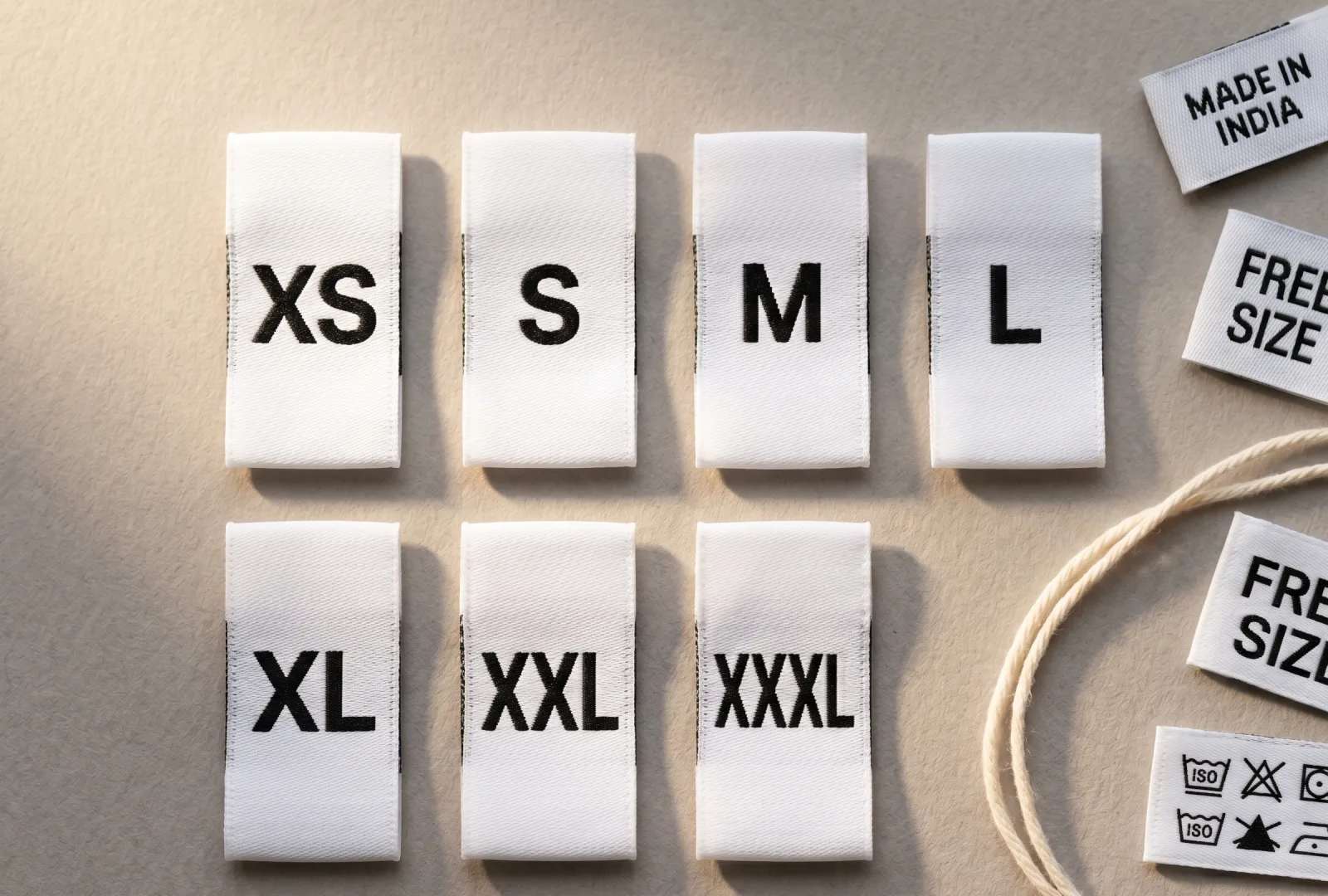
Pre-made size labels are standard designs woven or printed in bulk and held in stock, covering letter sizes XS to XXXL, numeric waist sizes 28 to 42, free-size tabs, care panels and Made in India tabs. They dispatch within 24 to 48 hours and cost ₹0.80 to ₹1.00 per piece at 1,000 pieces, for buyers without artwork or time.
Most label content online assumes you're a brand with a logo, an MOQ budget and a 6-month plan. But half the people who buy clothing labels in India are small-batch: a tailor sewing 3 kurta sets a week, a boutique making 20 lehengas a month, a marketplace seller flipping 10 SKUs at a time. Pre-made labels exist for them. Here's the full guide.
What does "pre-made" actually mean?
Pre-made labels (also called "stock" or "ready" labels) are standard designs printed or woven in bulk, kept in inventory, and sold by the piece on demand. They cover the three things every garment legally and practically needs:
- Size labels (XS, S, M, L, XL, XXL, XXXL, plus numeric sizes (28) 42 waist).
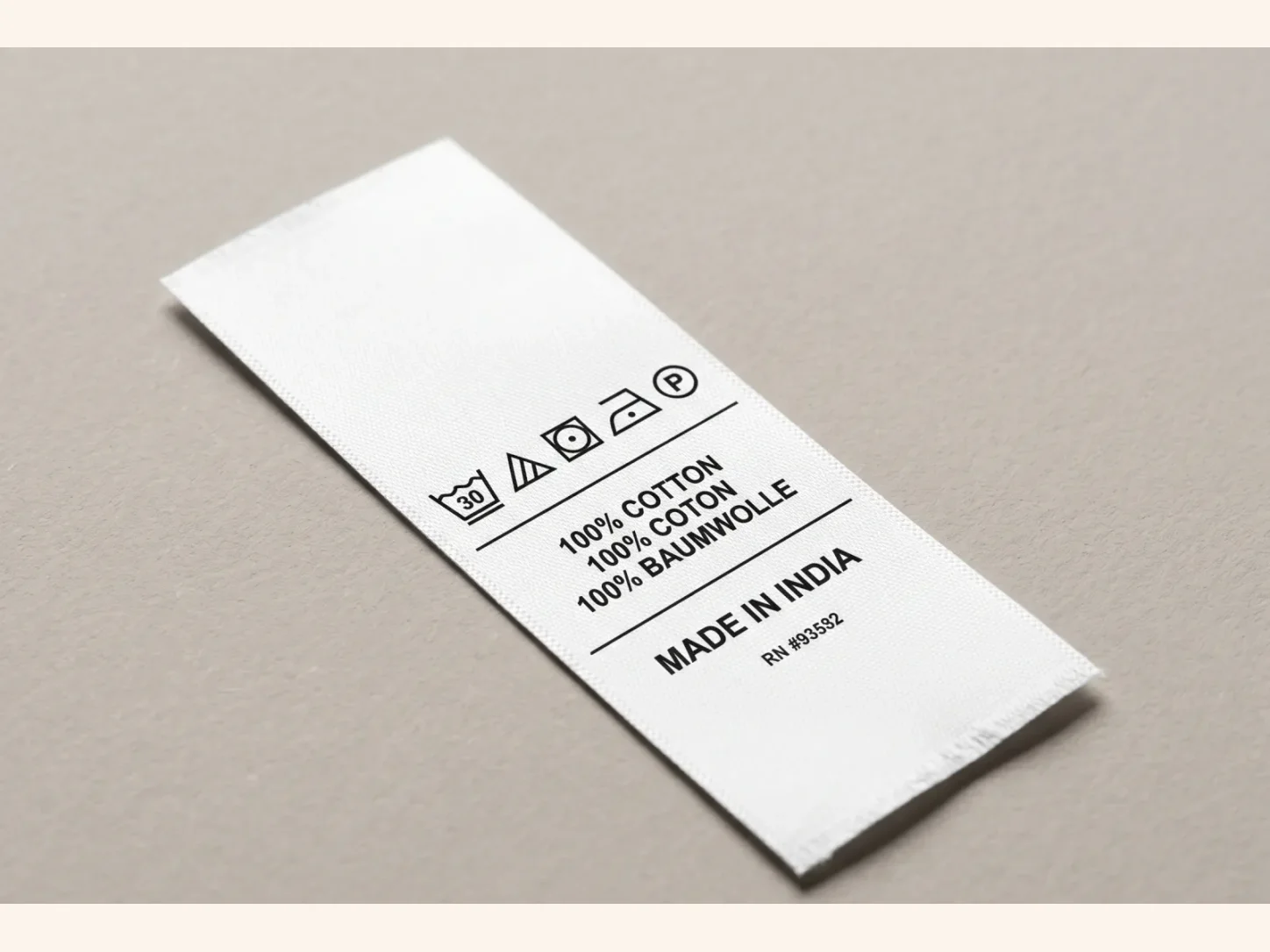
- Care symbol labels. Wash temperature, dry, bleach, iron symbols. Generic templates that work for most cotton and blend garments.
- Country-of-origin tabs, "Made in India" labels, required for export and increasingly important for marketplace sellers.
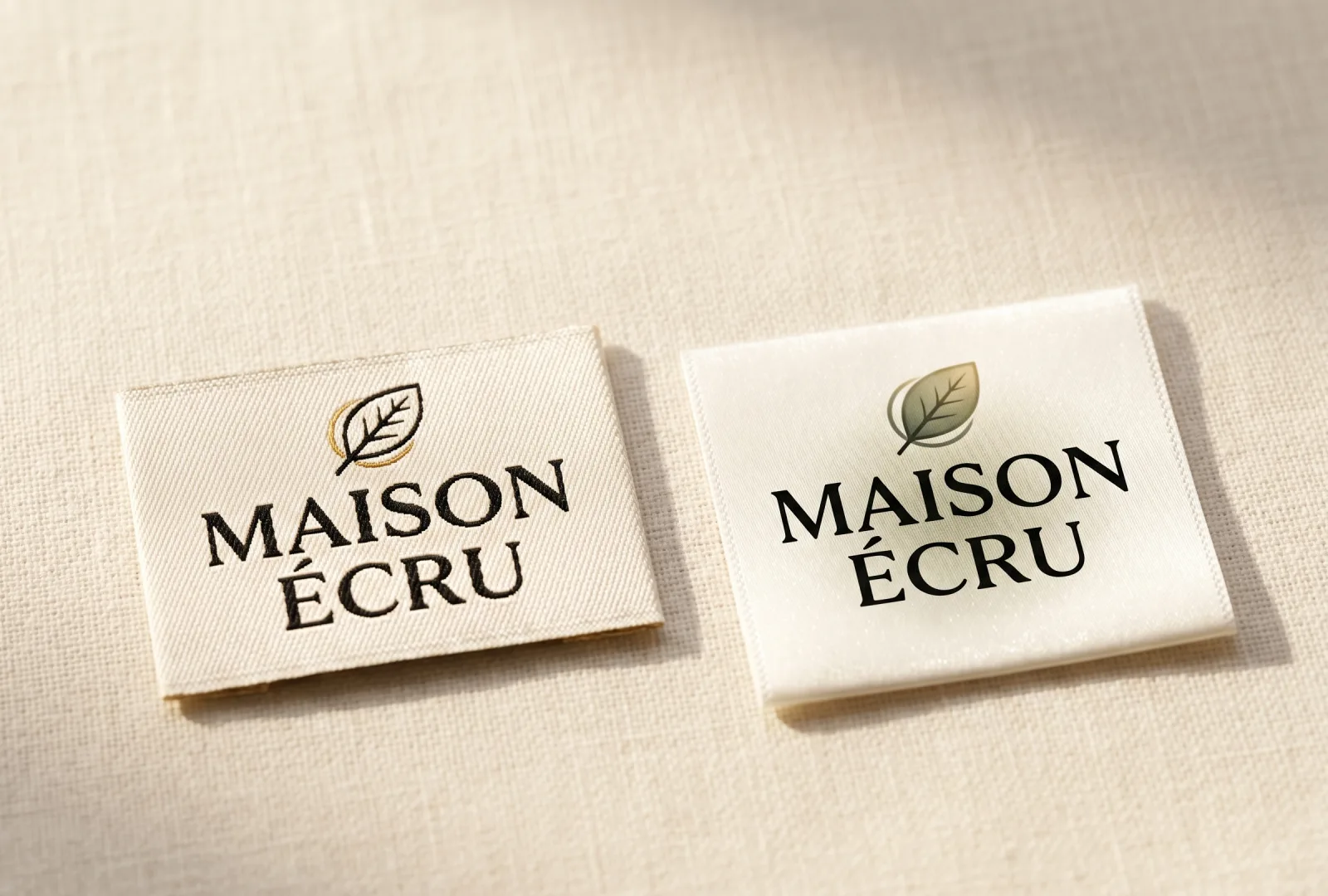
What they don't cover is your brand name. Anything carrying that has to be made to your artwork, which means custom, at the same 1,000-piece minimum.
When does pre-made beat custom?
Common scenarios where pre-made is the right call:
- Bespoke tailor: making one suit, one dress at a time. Each garment needs a size and care label. Custom MOQ doesn't fit.
- Small boutique (5-30 garments/month). Already has a custom brand label, needs ready-stock size and care to complete each piece.
- Marketplace flipper: buys wholesale garments without labels, adds size + care + Made-in-India before listing on Amazon/Myntra.
- First-time founder testing: wants to sell a few pieces before committing to a brand identity. Generic labels keep things flexible.
- Pop-up or craft fair stock, where the garments are one-offs, the label content is generic and there is no artwork to draw up.
How much cheaper is pre-made than custom?
Indicative per-piece pricing for pre-made size labels (woven satin, end-fold, 15×30mm):
Care labels and Made-in-India tabs sit at similar prices. What decides between stock and custom is not the quantity, since the minimum is the same, but whether you need one size in depth or a spread across the range. A single size in volume is worth having made to your own artwork; a mixed spread across XS to XXL is where stock earns its place, because custom would mean a separate setup for every size.
The standard ready-stock catalogue
What's typically in stock at any time:
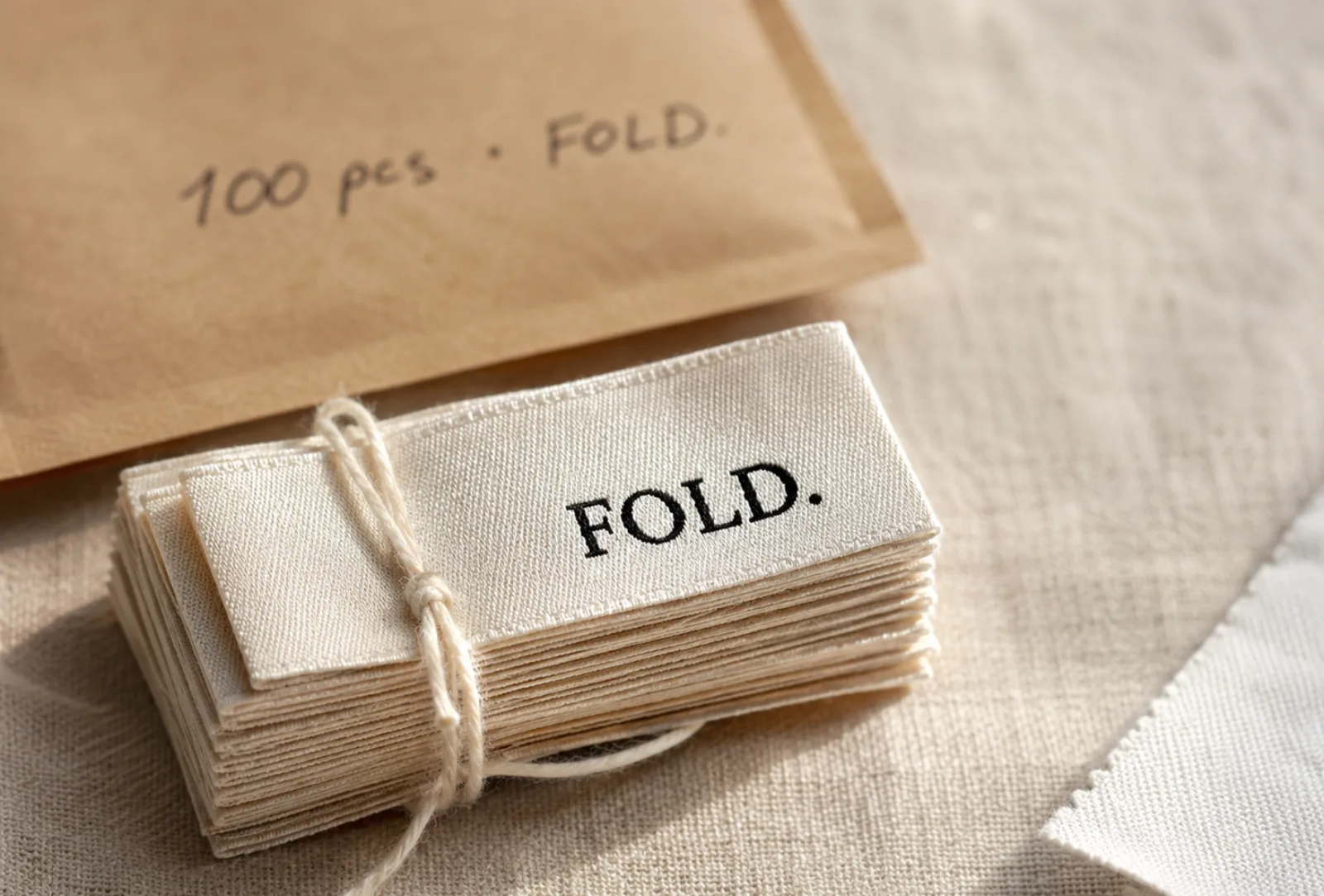
- Letter sizes: XS, S, M, L, XL, XXL, XXXL on white satin with black thread. Some suppliers also stock kraft (natural off-white) and black tape variants.
- Numeric waist sizes: 28, 30, 32, 34, 36, 38, 40, 42 for trousers and jeans.
- Free-Size / One-Size: used for sarees, dupattas, scarves, kaftans.
- Standard care label panels: combinations of wash (30°C / 40°C / hand-wash / dry-clean) + dry symbols + iron + bleach.
- Made in India tabs: small (8×40mm) or larger (15×60mm), woven or printed.
- Numeric kid sizes: 2T, 3T, 4T, 5-6, 7-8, 9-10 for children's clothing.
Customs (like "Made in Bharat" or boutique-specific fabric symbols) aren't pre-stocked but can be added to a custom run alongside pre-made for the rest.
How fast do pre-made labels ship?
The biggest reason to use pre-made: they ship in 24-48 hours because the labels are already woven / printed and just need to be picked, cut and packed. Compare to custom:
Place by 2pm · ships same / next day
1-3 days India-wide
3-5 days hand-to-hand
Custom labels for the same need would take 10-14 days. If a wedding-rush boutique or a marketplace seller needs labels by Friday, pre-made is the only realistic option.
The "pre-made + custom brand" combination
The smartest setup for a small brand:
- Custom brand label: your own woven brand-name tab at the neck, from 1,000 pieces, which is the minimum on anything made to your artwork.
- Pre-made size labels, taken as a mix across XS to XXL so one order covers the whole range, at the 1,000-piece minimum.
- Pre-made care label: one standard cotton-care template, at the same minimum, with no artwork round to sit through.
- Pre-made Made-in-India tabs, the cheapest piece in the set and the one least worth customising.
The saving is not in the minimum, which is the same either way. It is in the setup: only the brand label needs artwork, a sampling round and a loom set up for it, and the other three pieces come off the shelf. That is one approval cycle instead of four, and it is where both the money and the fortnight go.
Where pre-made falls short: they all look slightly generic. The font, weave, fold style is standardised across the whole catalogue. If your brand positioning is "premium" or "luxury," pre-made size labels won't sit right next to a hand-stitched lehenga. Use pre-made for the legal/info layer (size, care, country) but invest in custom for the brand layer.
What to send for a pre-made order
- Size mix, how many of each size. "20 each S/M/L, 10 each XS/XL, 5 each XXL" works fine.
- Care label preference. Pick a template (we'll send the catalogue). If unsure, the "30°C wash, line dry, warm iron" template covers most cotton garments.
- Made-in-India: yes / no, and what size.
- Backing: sew-in tape with cut edge (default), or with adhesive backing (rare for size labels).
- Delivery pincode.
That's it. No design files, no sampling round, no spec back-and-forth.
How much label stock should you keep?
Because nothing perishes, surplus is stock rather than waste, so the only real question is how much shelf space you want to commit beyond the 1,000-piece minimum.
A sensible starting point is enough size tabs to cover a few months of your usual mix, weighted towards the middle sizes that actually sell, plus a smaller quantity of care and origin labels. Size demand is never even, so buying an equal number of every size guarantees you sit on XS and 3XL while running short on M and L.
Write down what you used over a season and buy to that shape next time. It is the cheapest forecasting anyone will ever ask you to do, and it removes the situation where an order is delayed for want of a label that costs a rupee.
The lead-time difference is the real advantage
Cost gets the attention, but for a small operation the timing usually matters more.
A custom label runs on a fixed sequence: quote, artwork, proof, sample, your approval, then production. The production window itself starts at approval rather than at your first message, and the stages before it are where most of the calendar actually goes. That is fine when a season is planned months out, and useless when an order arrives on Tuesday.
Stock labels remove the sequence entirely. There is nothing to approve because the design already exists, and nothing to set up because someone else paid for it. You buy the pieces and sew them in.
For a tailor working to a customer’s date, a boutique filling a wedding order, or a marketplace seller who has just been asked for twenty pieces, that difference decides whether the order can be taken at all. It is worth keeping a small stock of size and care labels on the shelf for exactly this reason, independent of what your custom labels cost.
A sensible split for a small operation
The question is rarely stock or custom. It is which pieces deserve a setup cost and which do not.
- Custom brand label. This is the only one that carries identity, and it is the piece a customer associates with you. Worth a setup even at a small quantity.
- Stock size tabs. A tab reading M is indistinguishable from a custom one, because it says the same word in the same place.
- Stock care labels, if the symbols fit. Check them against your actual composition first, since a generic template assumes a plain cotton or blend garment.
- Stock origin tabs. Made in India reads the same whoever printed it.
That arrangement puts your money on the one label that does brand work and takes the setup off the three that do not. It is also the structure most small brands arrive at eventually, usually after paying for custom size tabs once and realising nobody noticed.
Buying stock in slightly larger quantities is worth it too. They do not perish, they take almost no space, and having the right size tab on the shelf is the difference between shipping this week and waiting for a delivery.
Common mistakes
- Using a stock care label without checking the symbols against the actual fabric.
- Assuming a generic template covers elastane, viscose or an embellished garment.
- Paying for custom size tabs before the brand label exists.
- Buying stock in quantities so small that you run out mid-order.
- Sticking with stock long after the volume would justify a custom run.
- Expecting a stock label to carry a brand name, which is the one thing it cannot do.
What you are really buying is the absence of setup
The advantage of a stock label is not that it is cheap per piece. It is that it carries no setup at all.
A custom label has to be digitised, the loom threaded or a plate prepared, and trial runs checked before the first usable piece exists. That work costs the same for a hundred labels or fifty thousand, which is why unit prices fall so steeply with quantity and why small runs feel disproportionately expensive.
Stock labels have already paid that cost, for somebody else. You buy the pieces and nothing else, which is why they suit exactly the situations custom does not: a handful of garments, an order that appeared this week, a size you did not forecast.
The corollary is that they stop making sense at volume. Once you are buying enough of the same stock label, a custom run of the same thing costs less per piece and gives you a label that is actually yours.
Check the care symbols against your fabric
This is the one place a stock label can genuinely let you down, and it is worth ten minutes before you buy.
A generic care label is written for a typical cotton or cotton-blend garment. That template is wrong for a good deal of what small brands actually sell:
- Anything with elastane, where the stretch fibre rules out hot washing and tumble drying regardless of the other ninety-five per cent.
- Viscose, rayon and modal, which are far weaker wet than cotton and shrink unpredictably.
- Anything printed or embellished, where the decoration decides the care rather than the cloth.
- Deep or unfixed dyes, which need a wash-separately instruction a template will not carry.
Where the template does not fit, a custom care label is worth the setup even if everything else stays stock. A wrong care instruction produces a ruined garment and a complaint, which costs more than the label ever will.
Buying labels from Labelwala
We are label manufacturers in Ahmedabad, Gujarat, and have been for 25 years.
- Minimum order: 1,000 pieces per design.
- Quotes: usually within 2 hours on a working day.
- Delivery: across India, depending on destination and consignment size.
If you are working below a custom minimum, say so and say what the garment is. The usual answer is a custom brand label with stock size and care labels alongside it, which puts the setup cost only where it buys you something.
We are rated 5.0 on Google from 27 reviews.
When have you outgrown pre-made labels?
Signs you should switch most of your sizing to custom:
- You're ordering 500+ size labels per month consistently.
- You sell on marketplaces with strict size labelling rules (Myntra, Ajio), they sometimes require brand-specific sizing.
- Your customers complain that "M" doesn't fit standard: meaning you need your own size-to-measurement mapping printed.
- Your brand is repositioning to premium and the generic font on pre-made looks out of place.
Until then, pre-made labels are the most cost-effective way to look professional without over-investing in inventory.
Ready to order? See the full pre-made labels catalogue and the name & number labels page (closely related for small-batch use). When you're ready for custom, browse woven labels and care labels. For pricing, use the price calculator or send a brief via quick quote.