In brief
Knitwear and winter jackets need softer labels and different attachment than woven garments. Use a soft damask or satin-finish woven neck label sewn onto a neck tape, not into the loose rib; put the care label in the side seam with honest fibre content (acrylic is not wool); and on jackets list the shell, lining and filling separately, with any down claim backed by a test report.
Winterwear is a short, intense season in India. Most woollen knitwear, thermals, shawls and jackets sell between October and February, much of it made in the Ludhiana knitwear cluster and sold through marketplaces, multi-brand stores and winter exhibitions. Labels are usually ordered late, in the rush before the season, and that is when the expensive mistakes happen: a stiff label that scratches the neck, a care label that says machine wash on a sweater that felts, or a jacket label sewn through a down-proof shell.
Knitted and padded garments differ from woven ones in four ways that matter to a label. They stretch, so a rigidly stitched label puckers. Their surface is open, so a needle hole can start a ladder. Wool shrinks and felts while a polyester label does not. And jackets have layers (shell, filling, lining), each of which has its own fibre content and its own care limits. Each section below deals with one of these.
Label positions on knitwear and jackets
The positions are the same ones used on any garment, but where exactly the label sits changes with the construction.
| Garment | Brand label | Care label | Notes |
|---|---|---|---|
| Pullover, cardigan | Back neck, on the neck tape | Left side seam, 80 to 120 mm above the hem | Size tab under or beside the brand label |
| Fine merino, cashmere | Back neck, small and soft, ends only | Side seam, short loop | Smaller labels; skin contact is the priority |
| Thermals, innerwear | Tagless print, or a small label in the side seam | Side seam or printed inside | Nothing hard at the neck under other layers |
| Shawl, stole, muffler | One corner, on the hem | Same corner, or a sewn-in loop | Small flat label, folded or end-stitched |
| Puffer, padded jacket | Lining, back neck seam or hanger loop | Left lining side seam | Never stitched through shell and filling |
| Wool coat, blazer | Lining, back neck or inside pocket facing | Lining side seam or inside pocket | Larger label suits the heavier garment |
For the general rules on where labels sit and why, see our guide to label types and placement. The rest of this article covers what is specific to winter garments.
Choosing a label that does not scratch
Customers wear sweaters and thermals directly against the neck, often for hours, and they notice a hard label within minutes. Scratching is the most common complaint we hear about knitwear labels, and it comes from two things: the stiffness of the label material and the sharpness of its cut edge.
- Woven damask, fine count: the default for a knitwear neck label. It is dense enough for a sharp logo and flexible enough to follow the curve of the neck.
- Satin-finish woven: a woven label with a smooth satin face. It feels softest of the woven options and suits merino, cashmere and premium cardigans.
- Printed satin: the usual care label material. It holds small text and symbols sharply and is soft enough for the side seam.
- Cotton labels: a good fit for natural-fibre and handloom winterwear brands that want an unbleached, matte look. Our cotton and eco label guide covers the options.
- Taffeta: cheap and stiff. Acceptable for a care label hanging inside a jacket lining, but not for anything that touches the neck.
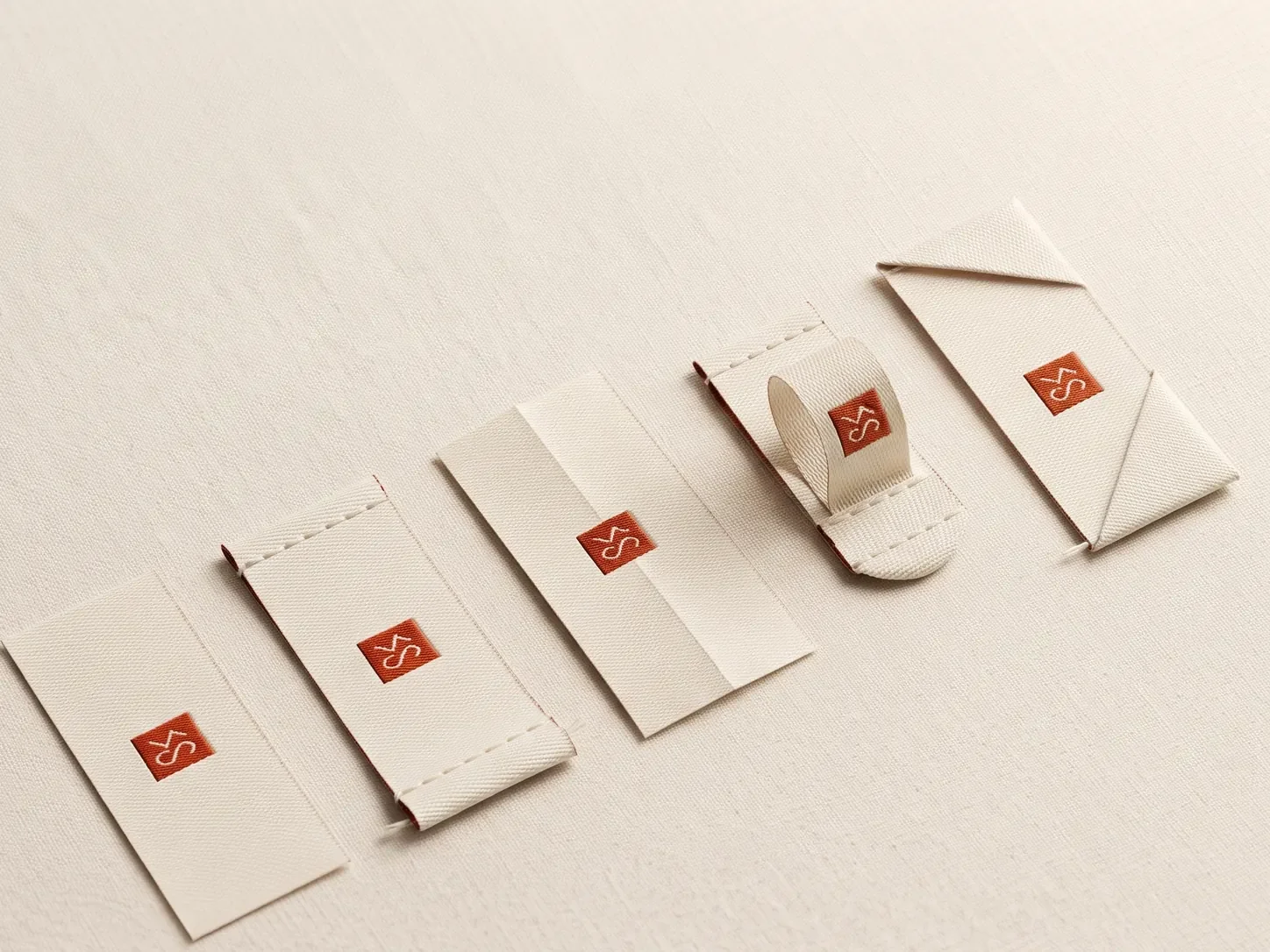
The edge matters as much as the material. A hot-knife or heat-cut edge on polyester leaves a hard bead of melted fibre, and that bead is what scratches. For neck labels on knitwear, specify folded ends (an end-fold label hides both cut ends under the fold) or a soft ultrasonic cut, and ask to feel a sample edge before approving. Our guide to woven label edge finishes compares the options in detail.
Sizes that suit winter garments
The label should match the weight of the garment. A fine-gauge merino pullover looks over-branded with a big label, while a chunky cardigan or a wool coat swallows a small one.
| Garment | Neck label (finished) | Care label | Fold |
|---|---|---|---|
| Fine-gauge merino, cashmere, thermals | 40 x 15 mm to 50 x 20 mm | 25 x 50 mm to 30 x 60 mm | End fold |
| Pullover, cardigan, regular gauge | 50 x 20 mm to 60 x 25 mm | 30 x 60 mm to 30 x 70 mm | End fold |
| Chunky knit, sweatshirt-weight knit | 60 x 25 mm to 70 x 30 mm | 30 x 70 mm | End fold |
| Shawl, stole, muffler | 30 x 15 mm to 50 x 20 mm | Combined, or 25 x 50 mm | Centre fold or end fold |
| Puffer, padded jacket, wool coat | 60 x 25 mm to 80 x 35 mm | 35 x 80 mm or longer for multi-part text | End fold or loop fold |
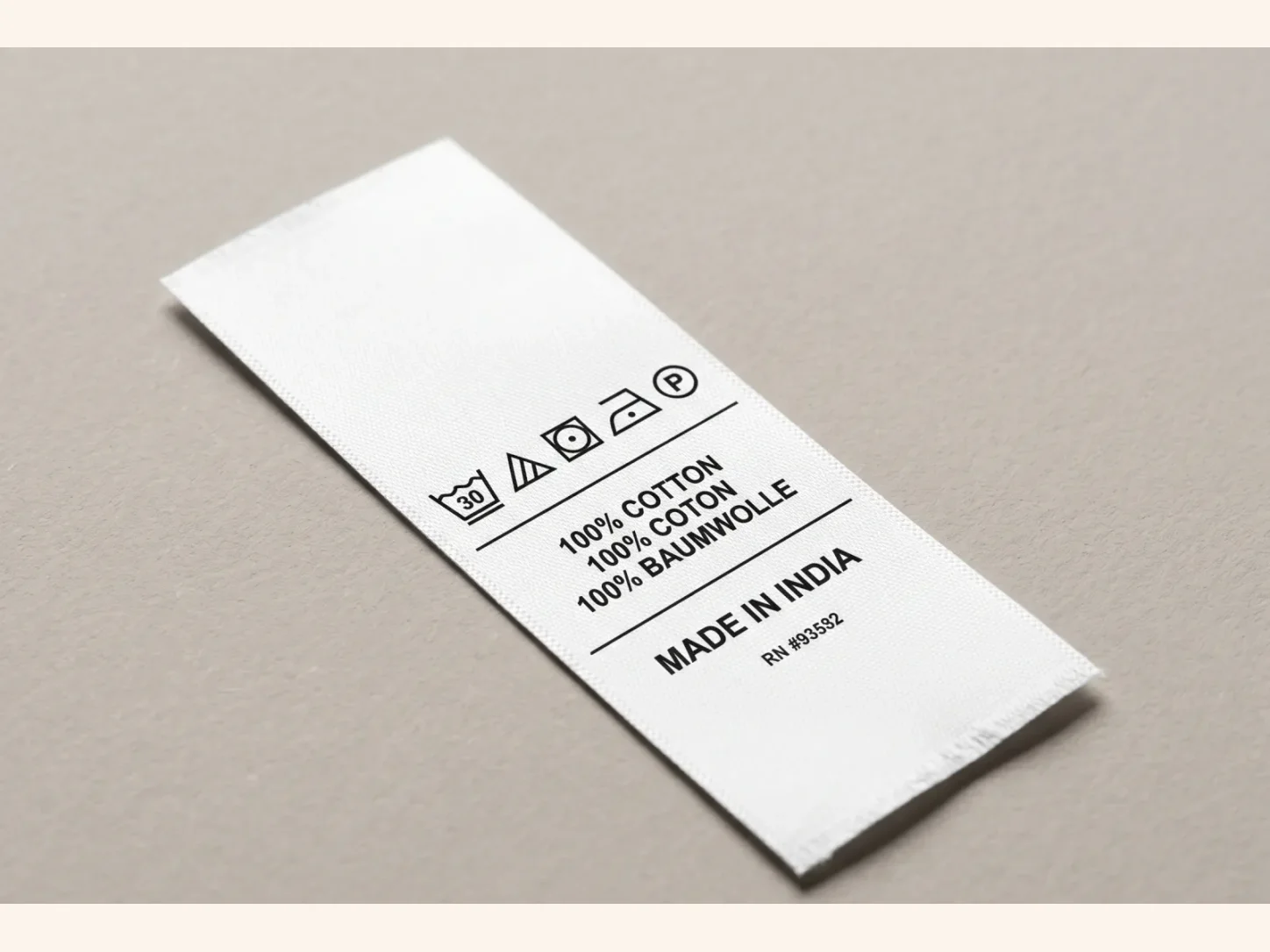
Jacket care labels run longer than any other kind, because they list three fibre compositions (shell, lining, filling) plus the care text, often in two or more languages for export. Size the label from the longest text block, not the shortest; our care label size guide shows the widths that fit different amounts of text.
Check the size at true scale. The free label designer draws your neck label at real millimetre size on the fold you choose, so you can see how a 40 mm and a 60 mm label compare before you order samples.
Sewing labels into knits without laddering
A knitted fabric is a chain of interlocking loops. When a sewing needle cuts a loop in a loose or fine gauge, the fabric can ladder from that hole, and a label stitched on all four sides through a single layer of knit gives you dozens of holes in a spot that stretches every time the sweater goes over a head.
Four practices prevent it, and good knitwear units use all of them:
- Sew onto a neck tape. Most cut-and-sew sweaters have a twill or knitted tape covering the back-neck seam. Stitch the label to that tape, not to the knit body.
- Stitch the ends only. An end-fold label is sewn at its left and right ends. The knit between the stitches can still stretch, so the label does not pucker and the knit does not tear.
- Use a backing on fully fashioned knits. Where there is no tape, a small patch of matching fabric behind the label spreads the stitches over a stable layer.
- Hand-tack fine gauges. On cashmere and fine merino, labels are often tacked by hand or linked in at the ends, with a fine needle and a stitch that goes between loops rather than through the yarn.
Tell the knitting unit how the label will be attached when you place the label order. Our guide to how labels are sewn into garments describes each sewing method and the machines used.
Fibre content: wool, acrylic and blends
Many of the winter knits sold in Indian markets are acrylic, or acrylic blended with a smaller share of wool. That is a reasonable product at a good price point, but the label has to say so. The fibre content must name each fibre by its generic name and give its percentage by weight, largest first, for example 70% acrylic, 30% wool.
- Not fibre names: woollen, wool-feel, wool touch, cashmilon and soft wool are descriptions or trade names. Put them in the product name or hang tag if you like, never in place of the fibre content.
- Merino and lambswool: both are wool and may be named as such when the fibre really is merino or lambswool, for example 100% merino wool.
- Cashmere and pashmina: only for the real fibre. Shawls sold as pashmina are among the most frequently mislabelled products in the country, and GI-tagged Kashmir Pashmina carries its own certification label from the testing centre in Srinagar, separate from your brand label.
- Recycled wool: declare it. Many low-cost blankets and shawls use reprocessed wool, and export markets treat recycled and virgin wool as different fibres.
- Blends with stretch: elastane in a rib or a thermal still has to appear in the percentage list, even at 2% or 3%.
For marketplace listings, the fibre content on the label and on the product page must match; a mismatch is a common reason for a listing being blocked or a return being accepted against the seller. Our fibre content and country of origin guide explains the wording rules in India, and the marketplace requirements guide covers what Amazon, Flipkart and Myntra check.
Care text for wool and knitwear
Wool felts when it meets heat, agitation and moisture together, and a single wrong machine wash can shrink a sweater by a full size. The care label is the only place most customers look before washing, so write it for the fabric you actually made, not the one in the template.
| Fabric | Typical care text |
|---|---|
| Untreated wool, lambswool | Hand wash cold, do not bleach, do not tumble dry, dry flat in shade, cool iron, dry clean |
| Superwash merino | Machine wash 30°C wool cycle, do not tumble dry, dry flat, cool iron |
| Cashmere | Hand wash cold or dry clean, do not wring, dry flat, cool iron |
| Acrylic, acrylic-wool blend | Machine wash 30°C gentle, do not tumble dry, dry flat, low iron |
| Thermals (cotton or poly blends) | Machine wash 30°C to 40°C, do not tumble dry, line dry |
Use the symbols to ISO 3758, and add the words for the instructions that matter most. The dry flat symbol (a square with a horizontal line) is the one customers misread most often, and "Dry flat in shade" in words next to it prevents most stretched-out sweaters. Our guide to care label symbols by fabric has the full set.
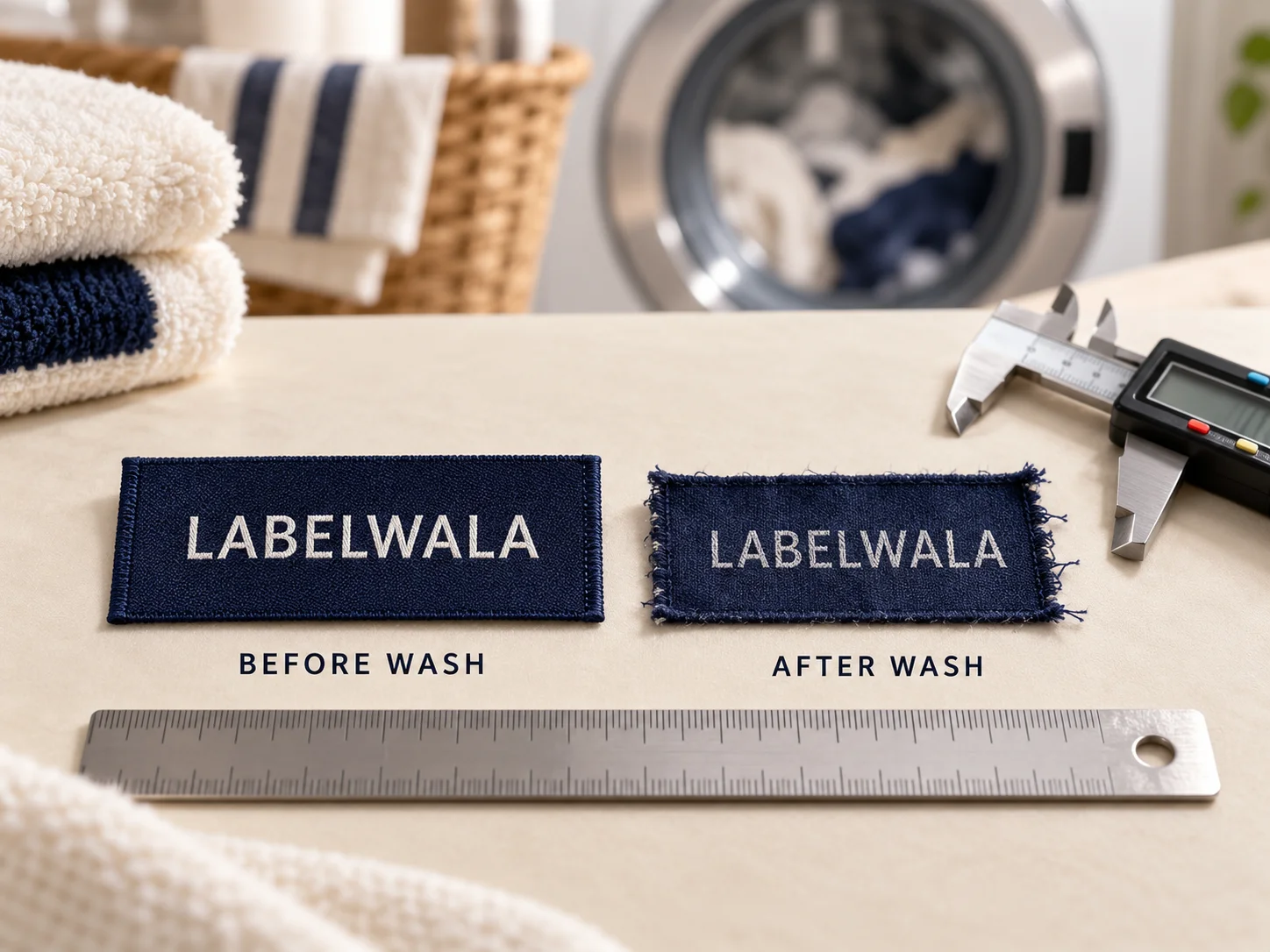
The label itself has to survive the same washing. A woven polyester label does not shrink when the sweater does, so a label stitched tight on all sides puckers the knit after a few washes; the end-fold, ends-only stitching described above leaves room for that difference. Dark labels on light knits should be colourfast, because wool is often washed by hand in a basin, where dye from a label has plenty of time to transfer. Our wash-testing guide explains how to check both before bulk.
Puffers, padded jackets and wool coats
A jacket is three garments in one: an outer shell, a filling for warmth and an inner lining. Each layer has its own fibre content, and buyers in most export markets expect all three on the care label. A clear jacket care label reads like this:
- Shell: 100% polyamide
- Lining: 100% polyester
- Filling: 90% duck down, 10% feather (or 100% polyester wadding)
Down claims need evidence. A down-to-feather ratio, a fill power figure or a certification such as the Responsible Down Standard (RDS) should appear on a label only when the supplier's test report or certificate supports it. The European labelling standard for down and feather fillings, EN 12934, sets out how the composition is described, and many international buyers ask for it on orders shipped to Europe.
Where to put the labels is a practical question as much as a legal one:
- Never sew through the shell and filling. Down-proof shell fabric is tightly woven to hold feathers in, and every needle hole is a leak. Labels go on the lining, at a seam.
- Brand label at the back-neck lining seam, or woven into the hanger loop. A printed or woven ribbon with the brand name makes a neat hanger loop; see our printed ribbons.
- Care label in the left lining side seam, loop folded so it hangs free and can be read without turning the jacket inside out.
- Outside branding on the sleeve or chest is usually a woven patch or a badge. Sew it before the panel is quilted and filled, never after. Our patch comparison covers the options.
Wool coats and blazers follow the tailoring convention: a larger brand label on the lining at the back neck or on the inside breast-pocket facing, and the care and composition label in the lining side seam or inside the pocket. Wool coats are usually dry clean only, and the label should say so plainly.
Exporting winterwear: the rules that differ
Winterwear goes mostly to cold-climate markets, and the buyers there check wool and filling labels more strictly than for summer goods.
- United States: wool garments fall under the Wool Products Labeling Act of 1939, which requires the wool content by percentage and treats wool and recycled wool as separate fibres. The US also defines cashmere by fibre fineness, so a cashmere claim must be backed by testing. Fillings and linings used for warmth must be disclosed. See our US label requirements guide.
- European Union: Regulation (EU) No 1007/2011 requires the fibre content of each component of a garment, and the main lining always counts. Terms like virgin wool or fleece wool may only be used under the regulation's conditions, including a minimum wool share in blends. See our EU textile labelling guide.
- United Kingdom and Australia: broadly similar fibre and care rules, with their own conventions on wording. Our UK and Australia guides list them.
Multilingual care labels on a jacket can run to 120 mm or more. Plan the layout early; our multilingual care label guide shows how to fit several languages without going below a readable type size.
Timing your winter label order
Labels are a small part of the cost of a winter garment, but late labels hold up the whole range. Knitwear is labelled at linking or finishing and jackets at lining assembly, so the labels must be at the unit before those steps start, not when the garments are packed.
- Brand and size labels: order with the yarn or fabric. They rarely change between styles and can be reused across the season.
- Care labels: order once the fibre composition is final for each quality. A yarn substitution late in the season changes the care text and wastes the labels already printed.
- Allow for samples: approve a sample label on a finished, washed garment before bulk. Our production time is 7-10 days after artwork approval, with rush jobs in 3-5 days; build the sample round on top of that.
- Top-up runs: winter sells fast in a cold spell. Keep the approved artwork and thread references on file so a mid-season reorder matches the first batch; our guide to consistent reorders explains what to record.
Getting winterwear labels made at Labelwala
We make woven, satin and cotton labels in Ahmedabad, Gujarat, and we have been doing it for 25 years. Knitwear neck labels, jacket care labels and branded hanger loops are regular orders before every winter season.
- Minimum order: 1,000 pieces per design. A neck label, care label and size tab are three designs.
- Quotes: we usually reply within 2 hours on a working day.
- Production: 7-10 days once artwork is approved. Rush jobs run 3-5 days.
- Care symbols: set to ISO 3758 on every care label we print.
- Delivery: we ship across India and export worldwide.
Tell us the garment, the yarn or shell fabric, and how the label will be attached (neck tape, backing, hand-tacked or lining seam). That decides the label size, the edge we recommend and whether we suggest a satin-finish woven for skin contact. For jackets, send the full shell, lining and filling composition so the care label is sized for all of it the first time.
We are rated 5.0 on Google from 27 reviews. Ask for a physical sample of the neck label with your quote, and feel the edge against your neck before you approve it.
Common mistakes
- A stiff taffeta or heat-cut neck label on a sweater worn against the skin.
- Stitching a label on all four sides through a single layer of loose knit.
- "Machine wash" on an untreated wool sweater that felts in the first wash.
- Calling an acrylic sweater a woollen, or leaving the wool share out of a blend.
- Selling a shawl as pashmina when the fibre is something else.
- Sewing a care label through a puffer's shell and filling, so it leaks feathers.
- Listing only the shell fabric on a jacket and leaving out the lining and filling.
- Fill power or RDS claims without a test report or certificate.
- A care label too short for three compositions and two languages.
- Ordering care labels before the yarn composition is final.
Sample checklist
Approve the labels on a finished garment from production yarn or fabric, washed the way your care label tells customers to wash it.
- Does the neck label feel soft against the skin, including the edges?
- Does the knit stretch freely around the label without puckering or laddering?
- Has the label stayed flat after the sweater shrank slightly in the first wash?
- Has a dark label bled into a light knit after hand washing?
- Does the fibre content match the yarn supplier's composition, fibre by fibre?
- Does the care text match what the fabric actually survived in testing?
- On jackets, are the shell, lining and filling each listed?
- Is the jacket care label on the lining, readable without turning the jacket inside out?
- Are any down claims backed by a current test report?
- Is the label size right for the gauge: not lost on a chunky knit, not loud on a fine one?
What to send your supplier
- Garment type, yarn or shell fabric, and gauge or weight.
- How the label will be attached: neck tape, backing, hand-tacked or lining seam.
- Vector artwork for the brand label, fonts outlined.
- Finished sizes in mm and the fold for each label.
- Full care text, with every composition (shell, lining, filling on jackets).
- Languages needed, if exporting.
- Size codes and the quantity split.
- Whether the garments are washed or milled after the label is sewn.
A brief that works: "Cardigan, 12-gauge 70% acrylic 30% wool. Neck label 55 x 20 mm end fold, satin-finish woven, cream ground, brown logo, folded ends, sewn on neck tape. Care label 30 x 60 mm loop fold printed satin, text attached. Size tabs S to XL in attached split."
What we would recommend
For a knitwear range: a 50 x 20 mm to 60 x 25 mm end-fold woven neck label in a soft damask or satin-finish weave, with folded ends, sewn onto the neck tape at the two ends only; a printed satin care label in the left side seam with honest fibre content and care text tested on the real garment; and a matching size tab. For jackets, put everything on the lining, list the shell, lining and filling, and claim nothing about the down you cannot show a report for.
Order the brand label early and reuse it across the season, order care labels per composition once the yarn is fixed, and approve every label on a washed garment. A winter range labelled that way does not scratch, does not ladder, and can go to a marketplace or an export buyer without being sent back.