In brief
Regulation (EU) No 1007/2011 makes the fibre composition mandatory on textiles sold in the EU: generic fibre names from its Annex I, percentages in descending order, on a durable and accessible label, in the official language of every country of sale. Products with non-textile parts of animal origin must say so. Care instructions, size and country of origin are voluntary at EU level, though retailers expect ISO 3758 care symbols. National rules, France in particular, add requirements on top.
This is a guide, not legal advice. It describes the regulation and the common national additions as they stand at publication. The Commission is revising the textile labelling rules and the Digital Product Passport is being written; your importer or compliance adviser confirms the content for your product, your countries and your season.
We make labels, so this guide concentrates on what has to be on the physical label, how the language rule multiplies it, and how to fit the result on a care label that still reads after fifty washes. The customs, VAT and market-surveillance side appears where it changes the label.
What Regulation 1007/2011 is and where it applies
Regulation (EU) No 1007/2011 on textile fibre names and related labelling replaced three older directives in 2012. Because it is a regulation rather than a directive it applies directly and identically in every member state, which is why a German label and a Spanish label follow the same fibre rules. It covers any product that is at least 80% textile fibre by weight, plus the textile parts of listed mixed products such as upholstered furniture and footwear.
| Territory | Rule applied | Language of the fibre line |
|---|---|---|
| EU member states (27) | Regulation 1007/2011 directly | Official language(s) of each country of sale |
| Norway, Iceland, Liechtenstein | Same regulation via the EEA agreement | Their official languages |
| Northern Ireland | EU regulation under the Windsor Framework | English |
| Great Britain | Retained as the UK Textile Products Regulations 2012 | English |
| Switzerland | Own declaration rules, broadly aligned | German, French or Italian as sold |
The regulation has one job: to tell the consumer what the garment is made of, truthfully and comparably. Almost every other thing on a European care label comes from somewhere else.
The fibre composition: names, order and tolerances
The fibre line is built from the generic names in Annex I of the regulation and nothing else. "Cotton", "polyester", "polyamide", "elastane", "viscose", "lyocell", "wool", "silk", "linen" are Annex I names; "nylon" is not (it is polyamide), "Lycra" is not (elastane), "Tencel" is not (lyocell). Brand names may be added only alongside the generic name.
- Order. Fibres are listed in descending order of weight: "80% cotton 20% polyester", never the reverse.
- Percentages. Each fibre's share of the total fibre weight. Fibres that cannot easily be identified, or are under 5%, may be grouped as "other fibres" with their combined percentage, placed where their weight puts them in the order.
- "100%", "pure", "all". Only for single-fibre products, allowing up to 2% other fibres where technically unavoidable (5% for carded products), plus exempt decorative and antistatic fibres. Elastane in a jersey ends the "100% cotton" claim.
- Tolerance. A manufacturing tolerance of 3% of total weight applies to the stated percentages, with the agreed moisture allowances in Annex IX. Test to the regulation's methods and label what the test says.
- Multi-component products. Shell, lining and filling are declared separately when they are different and the product has more than one component: "Outer: 100% polyester. Lining: 100% polyamide. Filling: 100% polyester".
- Abbreviations. Not allowed for fibre names, except mechanised processing codes with a key available at the point of sale. Write "polyester", not "PES".
- Exempt items. Annex V lists products that need no label, including labels themselves, sewing thread, buttons, zips, and other findings, so the care label does not state its own composition.
The common failure is not a wrong fibre; it is a fibre named outside Annex I. A label that says "nylon" in Germany is non-compliant even when the composition is right. Our fibre content and origin guide has the Indian-side vocabulary that needs translating into the EU names.
The language rule, and how it multiplies the label
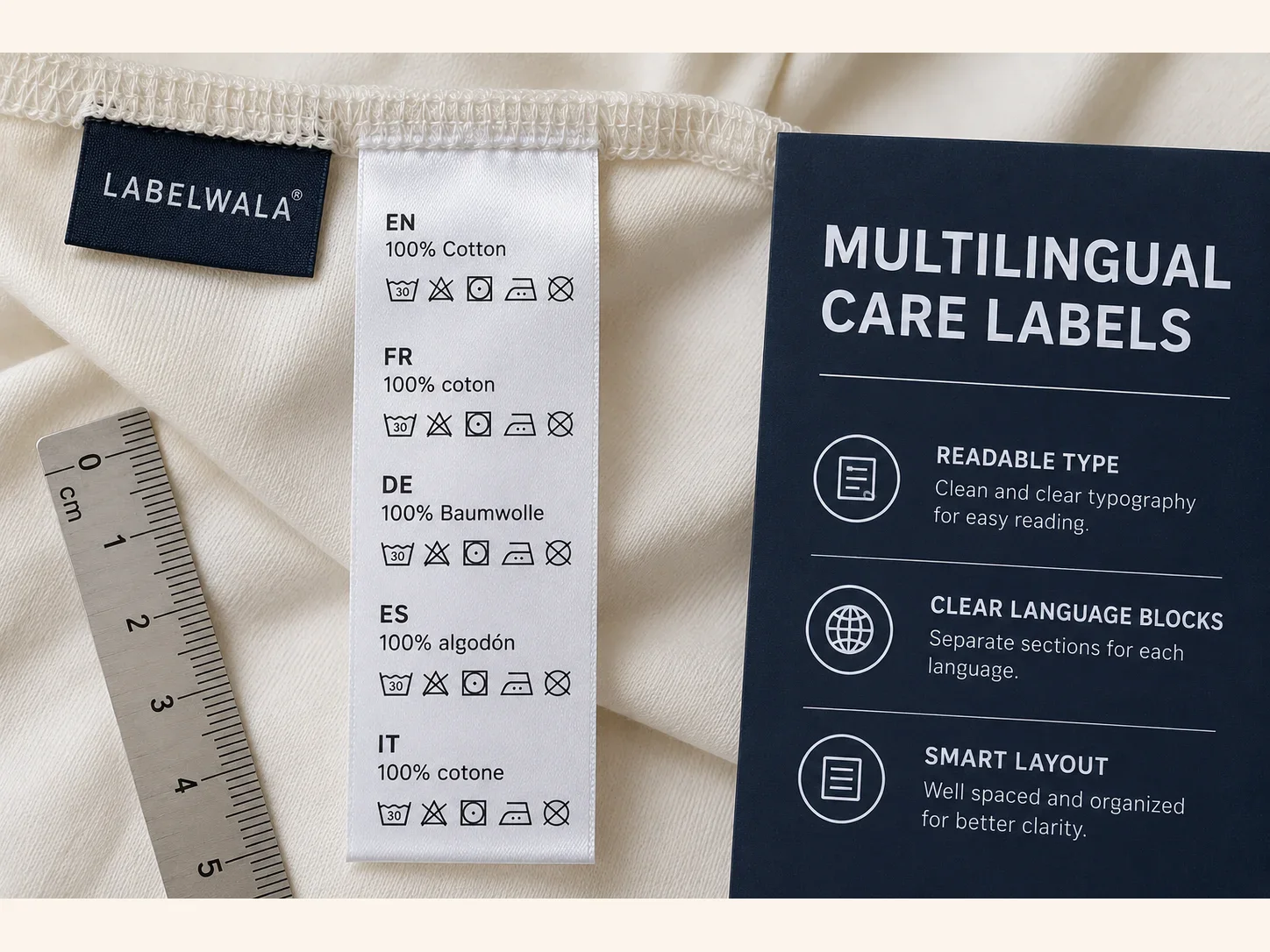
Article 16 is the one that changes the artwork. The mandatory information must be in the official language or languages of the member state in whose territory the product is made available to the consumer, unless that state provides otherwise. Few do. So a garment sold in Germany carries its fibre line in German; sold in Belgium, in Dutch and French (and German in the east); sold across five countries, in five languages.
| Market | Fibre line |
|---|---|
| Germany, Austria | 100% Baumwolle |
| France, Belgium (FR), Luxembourg | 100% coton |
| Spain | 100% algodón |
| Italy | 100% cotone |
| Netherlands, Belgium (NL) | 100% katoen |
| Portugal | 100% algodão |
| Poland | 100% bawełna |
| Sweden | 100% bomull |
The fibre names in each language are themselves fixed by the regulation's Annex I, which exists in every official language, so there is no translation judgement to make: use the Annex I word. Only the fibre line and the animal-origin statement are affected. Brand names, care symbols, size letters and any voluntary wording are free, and most brands keep the voluntary wording to English plus one or two local languages.
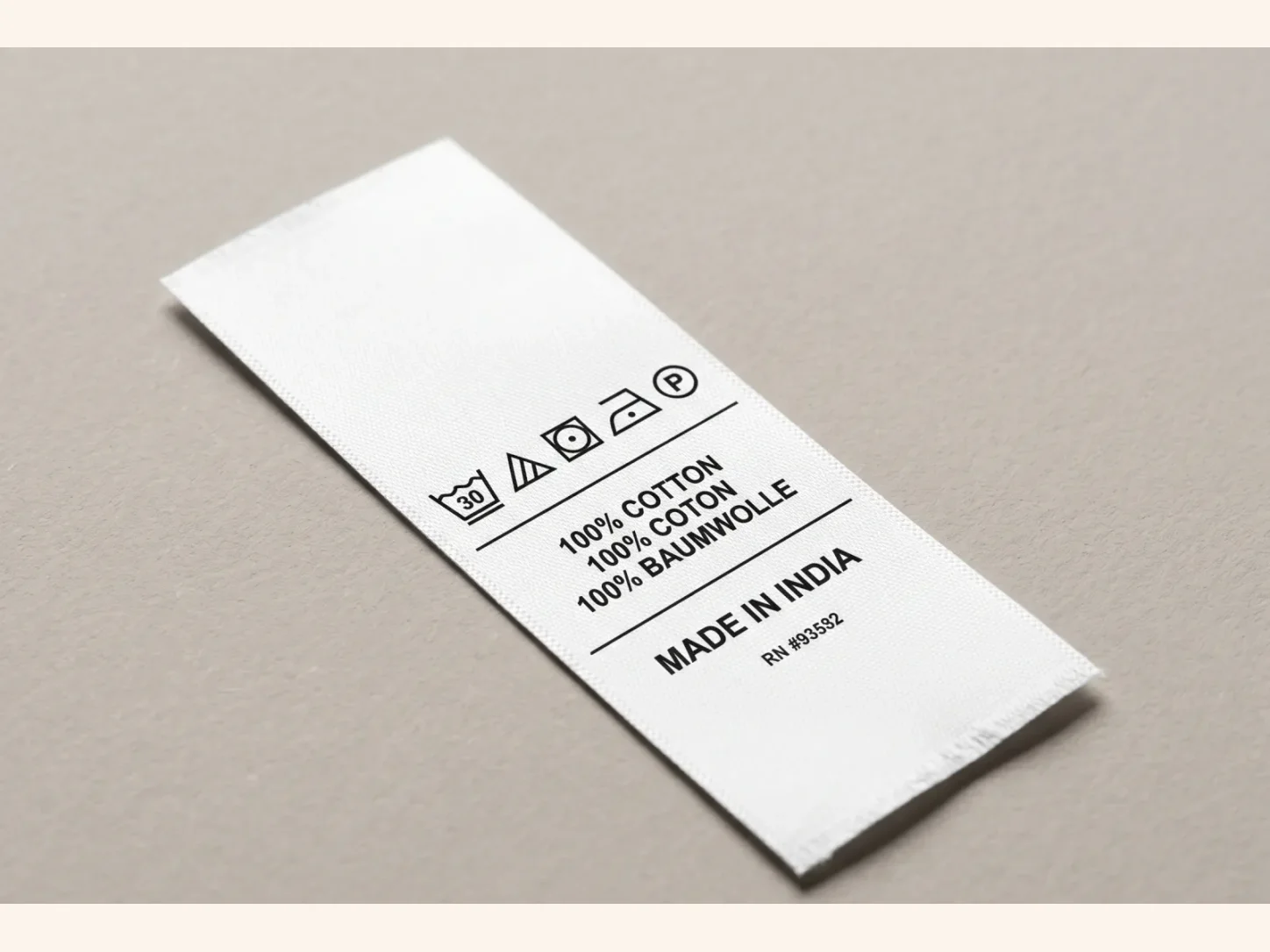
The practical consequence is a care label that grows with the number of markets. Our multilingual care label guide works through the layouts for two to six languages: one line per language with the percentages aligned, the symbols printed once, and a multi-page fold when five or six languages are needed.
Marketplaces count as every market. A garment listed on a pan-European marketplace is made available to consumers in every country it ships to. Brands selling EU-wide online usually carry the five or six biggest languages on the label and restrict shipping to those countries, rather than labelling for all 24 official languages.
The animal-origin statement
Article 12 requires any textile product containing non-textile parts of animal origin to carry the words "Contains non-textile parts of animal origin" when it is made available on the market. The parts in question are the things sewn onto or into textiles: a leather patch on the back of jeans, horn or mother-of-pearl buttons, a feather or down trim, a fur collar, a bone toggle. Down filling counts.
The statement goes on the label in the language of the country of sale, like the fibre line, and it is one more line to budget for on a multilingual label. A denim brand with a leather patch therefore carries the statement in every market language. Brands that want to avoid it use synthetic or textile alternatives for the patch and the buttons, and many have, which is one reason jacron paper patches have replaced leather on much European denim. Our denim label guide covers the patch options.
What is voluntary: care, size, origin
Three things exporters often assume are mandatory in the EU are not, at EU level.
| Information | EU law | Market reality |
|---|---|---|
| Care instructions | Not required | Universally expected as the GINETEX symbols standardised in ISO 3758, often with short wording; retailer specs make them compulsory in practice |
| Size | Not required; EN 13402 is a voluntary standard | Expected; EU sizes with UK or US conversions on garments sold across markets |
| Country of origin | Not required; proposals for mandatory origin marking have not been adopted | Common; required by many non-EU markets, so export labels carry it anyway; if stated, it must be true |
Voluntary does not mean unregulated. Anything you choose to print must not mislead, under the EU's unfair commercial practices rules, and environmental claims face the new rules on green claims. "Eco", "sustainable" or "recycled" on a label needs the evidence behind it; our sustainable label guide explains how to word it.
The GINETEX symbols deserve a note. The five basic symbols (washtub, triangle, square, iron, circle) are a trademarked system managed by GINETEX and its national members, and ISO 3758 standardises how they are used. Brands normally obtain the right to use them through their national GINETEX member or through their retailer's licence; a label maker reproduces what the brand specifies. The symbols are the same across the EU, so they appear once on a multilingual label and do not multiply with the languages. The care symbol guide explains each one.
National rules that add to the EU label
Member states cannot add fibre-labelling requirements, but they can and do regulate other things that end up on the label or hang tag.
- France has the most. The AGEC law requires sorting instructions for textiles (the Triman logo with the sorting information), and environmental labelling (affichage environnemental) for textiles is being rolled out. French retailers also expect care wording in French alongside the symbols.
- Germany implements the regulation through the Textilkennzeichnungsgesetz and enforces it through market surveillance and, frequently, competitor warnings (Abmahnungen) for labelling errors in online listings, so the product page must match the label.
- Italy has had its own "Made in Italy" rules, which only matter if you claim Italian origin; for Indian-made garments they do not apply.
- Nordic countries and the Netherlands add little to the label itself but have active consumer authorities checking fibre claims and green claims.
The lesson for an exporter is that "EU-compliant" is the floor. Ask the buyer which countries the style sells in and get the national add-ons from their compliance adviser before the label size is fixed.
Putting it on the label
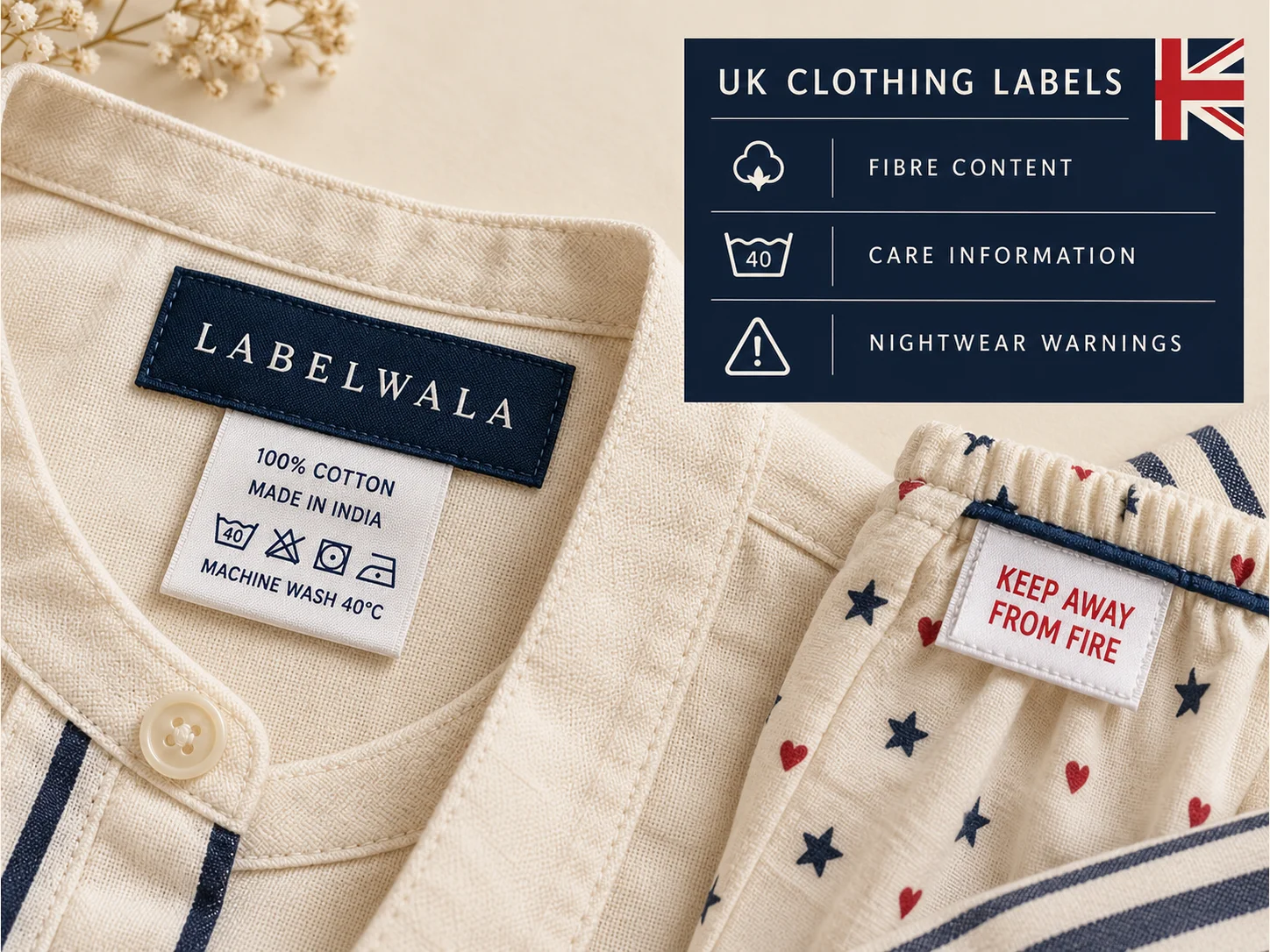
The regulation asks for a label that is durable, easily legible, visible and accessible, with the fibre information in uniform lettering and not obscured by other text or pictures. For a multilingual EU care label that means:
- Material. Printed polyester satin or taffeta, where the print is fused into the fibre and survives domestic washing. A faded fibre line is no longer "easily legible".
- Layout. One fibre line per language, in a consistent order of languages, percentages aligned; the animal-origin line per language if needed; symbols once; size once; origin once if used. Six-point type is the realistic minimum.
- Format. Two or three languages fit a single 30 x 70 mm label; four or five need a longer label or a centre-fold two-page; six usually means a multi-page book label. Keep the mandatory text off the fold and out of the seam allowance.
- Consistency. The composition on the label, the hang tag, the product page and the customs invoice must agree. German competitor enforcement in particular compares them.
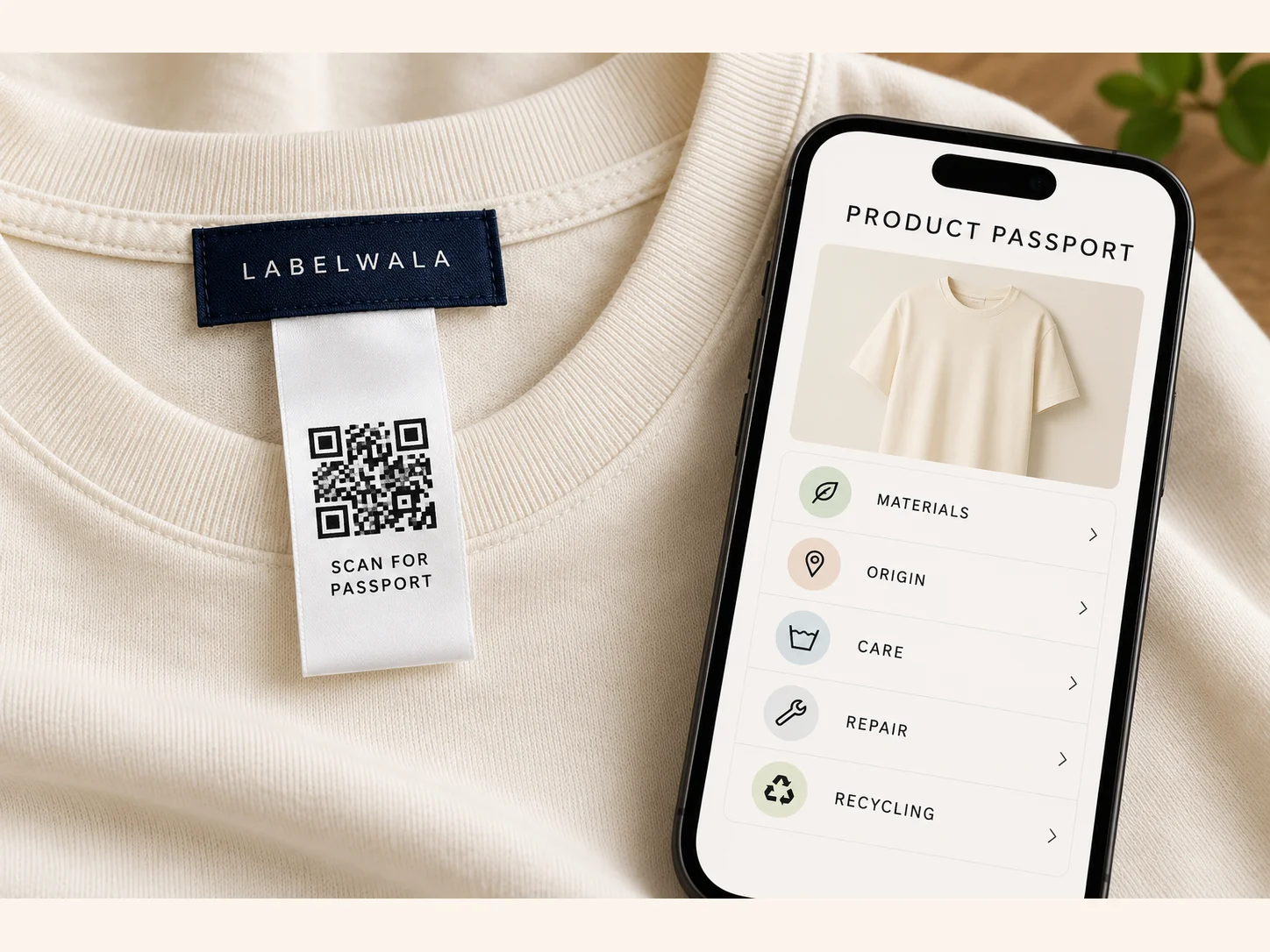
- Room for what is coming. If the brand expects a Digital Product Passport QR code on the care label, leave a 15 to 20 mm square and a line for the identifier now, rather than redesigning in two seasons.
The woven brand label is unaffected by all of this. It carries the brand and perhaps the size; the mandatory text lives on the printed care label where small type is cheap and accurate. Our label guide shows the fold types and safe areas.
What is changing: the revision and the passport
Two EU initiatives touch the textile label in the next few years. The Commission has been reviewing Regulation 1007/2011 under the EU Strategy for Sustainable and Circular Textiles, with digital labelling, more fibre names and sustainability information under discussion. Separately, the Ecodesign for Sustainable Products Regulation is creating the Digital Product Passport, with textiles among the first product groups and application expected from around 2027.
Neither is expected to remove the fibre line from the physical label; a shopper in a store cannot be obliged to scan anything. What they add is a data carrier, almost certainly a printed QR code on the care label, and a record behind it. Our Digital Product Passport guide explains what to collect now and how to make a code that still scans in year five.
Getting EU-ready labels made at Labelwala
We make woven and printed labels in Ahmedabad, Gujarat, and have been doing it for 25 years. We print multilingual care labels with the fibre line per language, ISO 3758 symbols and the animal-origin statement where needed, on satin and taffeta, and we ship to EU addresses by international courier with a commercial invoice and packing list; our European Union guide covers shipping and payment.
- Minimum order: 1,000 pieces per design.
- Quotes: we usually reply within 2 hours on a working day, in EUR if you prefer.
- Production: 7-10 days once artwork is approved. Rush jobs run 3-5 days.
- Care symbols: set to ISO 3758.
- Wash fastness: grey-scale 4-5 through 50+ wash cycles on printed care labels.
Send the tested fibre composition, the list of countries the style sells in, and the approved Annex I wording per language. We lay the label out, send a digital sample preview, and go into production only after you approve it. The content is yours to confirm; the label that carries it legibly through the garment's life is ours.
We are rated 5.0 on Google from 27 reviews.
Common mistakes
- "Nylon", "Lycra" or "Tencel" on the label instead of the Annex I generic name.
- "100% cotton" on a jersey with elastane.
- The fibre line in English only for a garment sold in Germany or France.
- Fibres listed in the wrong order, or percentages that do not add up to 100.
- Leather patch or horn buttons with no animal-origin statement.
- "PES" or "CO" abbreviations in the fibre line.
- The composition on the product page not matching the label.
- Care symbols reproduced from memory rather than from the brand's licensed artwork.
- Mandatory text printed in a fold or under the side-seam stitching.
- A label sized for two languages when the style sells in five.
Pre-production checklist for EU-bound labels
- Fibre composition from a lab test, expressed in Annex I names, descending order, adds up to 100.
- "100%" claims checked against the 2% allowance; elastane declared.
- List of countries of sale agreed; fibre line in each official language, using the Annex I word.
- Animal-origin statement added per language where leather, horn, feather, down or fur is present.
- Care symbols from the brand's licensed artwork, printed once.
- National add-ons checked (France sorting information, retailer care wording).
- Voluntary claims (origin, eco wording) true and evidenced.
- Label material and type size chosen for legibility after fifty washes.
- Fold and seam allowance checked; nothing mandatory hidden.
- Space reserved for a passport QR code if the brand expects one.
- Physical sample approved by the importer before bulk.
What we would recommend
Start from the regulation's one real demand and build outward. Get the fibre composition tested and written in Annex I names, then decide the countries of sale, because that decision sets the number of languages and therefore the label size. Add the animal-origin line if the garment needs it, print the ISO 3758 symbols once, and keep voluntary wording short and true. Put all of it on a printed polyester care label, leave the woven brand label alone, and reserve space for the QR code the passport will bring.
Done this way the EU label is not the hardest in the world to get right; it is the one with the most repetition. Get the single line right, repeat it carefully, and the garment is legal from Lisbon to Helsinki.