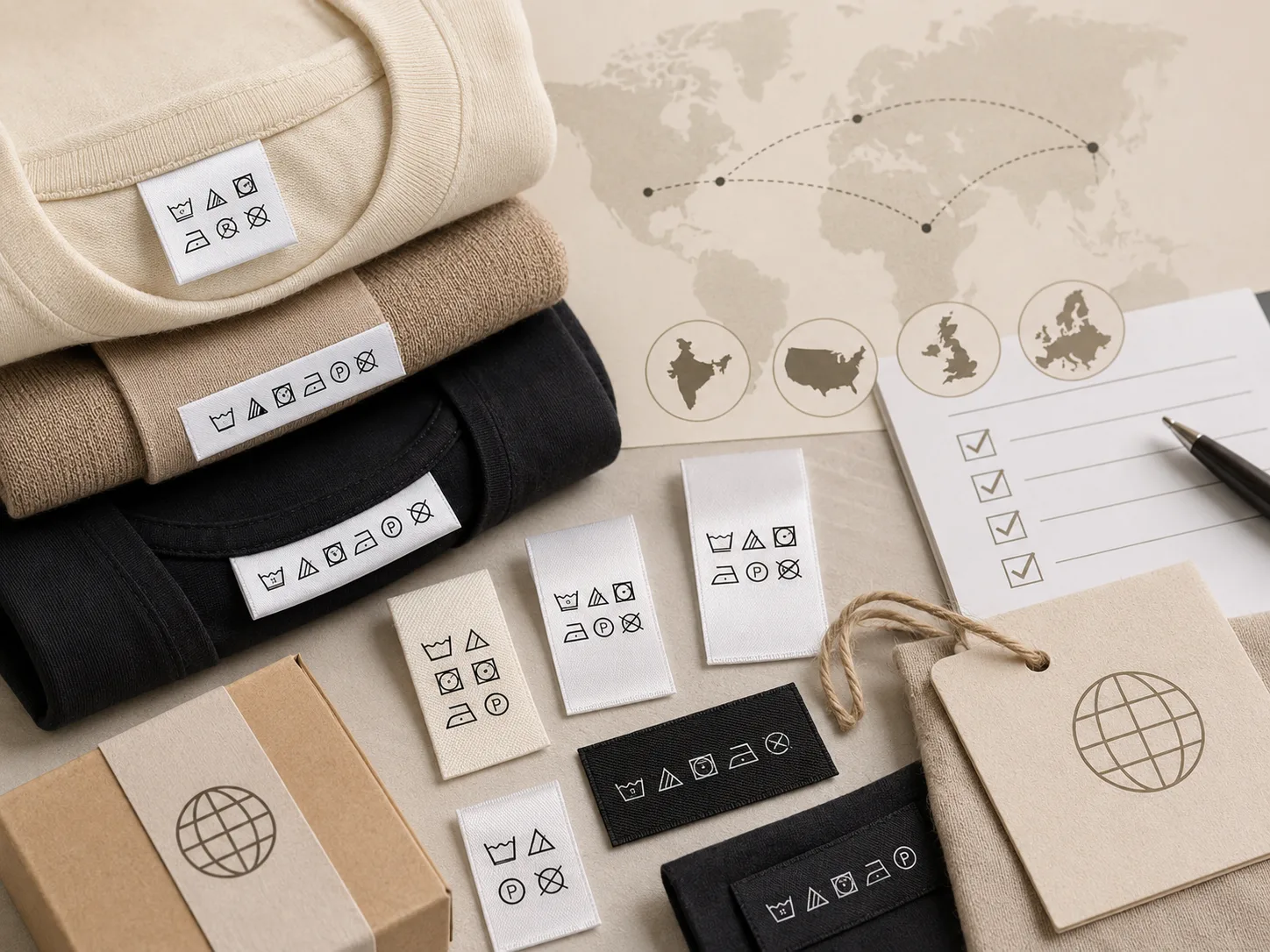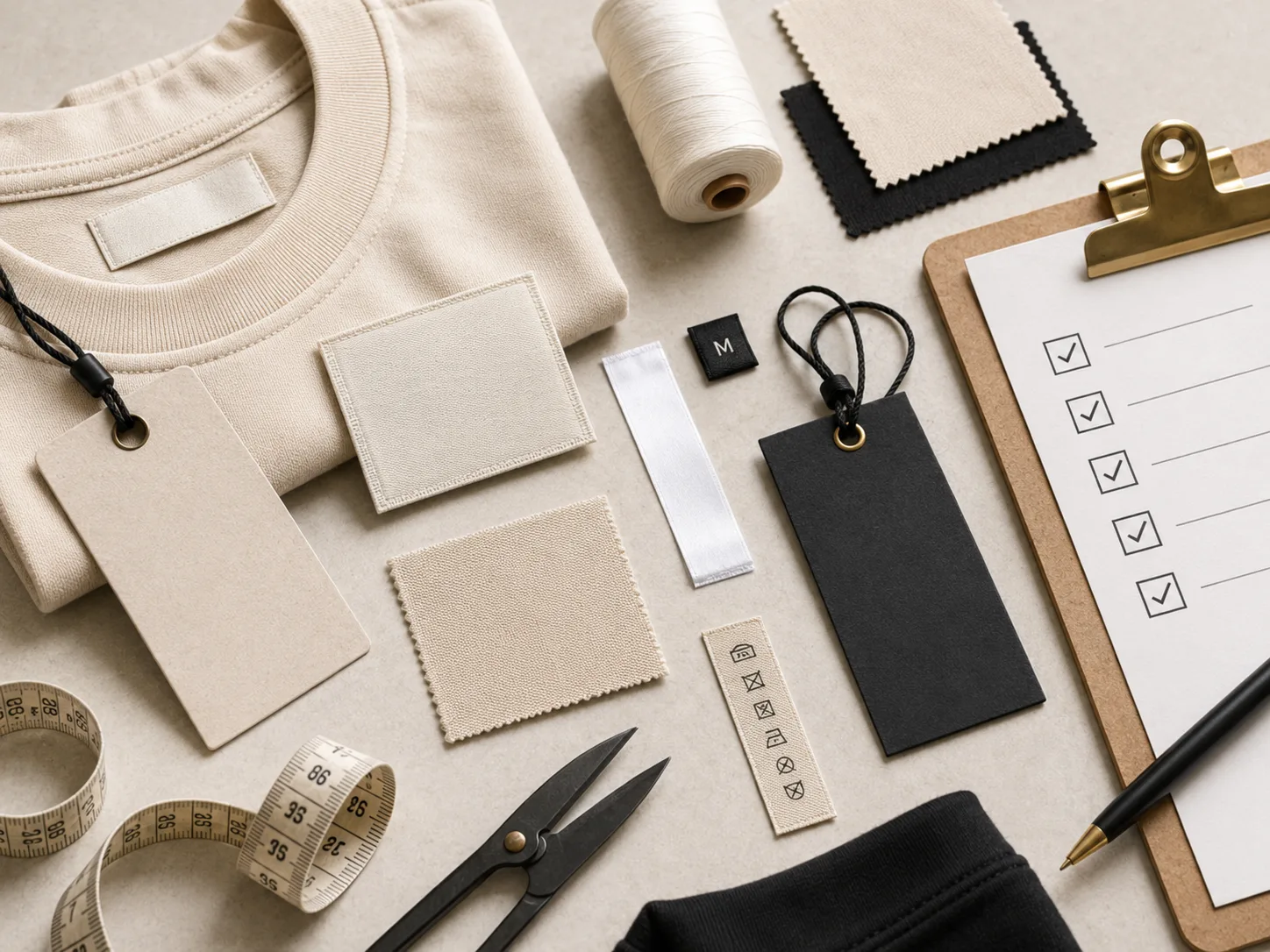
In brief
Indian sellers must print the fibre composition by percentage in descending order by weight, using generic fibre names, plus the country of origin, Made in India, with manufacturer or importer details, size and MRP under Legal Metrology rules. These declarations belong on a permanent sewn-in or heat-pressed label, legible for the garment's life, never on a hang tag alone.
Most brands know a garment needs wash symbols. Fewer realise that the "Made in India" and "100% Cotton" declarations are just as important, and are exactly what customs officers, e-commerce marketplaces and switched-on customers look for. Getting them wrong can hold up an export shipment or a marketplace listing.
This is a plain-English guide to the country-of-origin and fibre-content information Indian sellers and exporters must print, and how to place it. It's a practical overview, not legal advice. Confirm the current rules for your product and markets.
This is guidance, not legal advice. Labelling rules change and vary by product type, sales channel and market. Confirm the current requirements for your situation with an official source or advisor before you print in bulk.
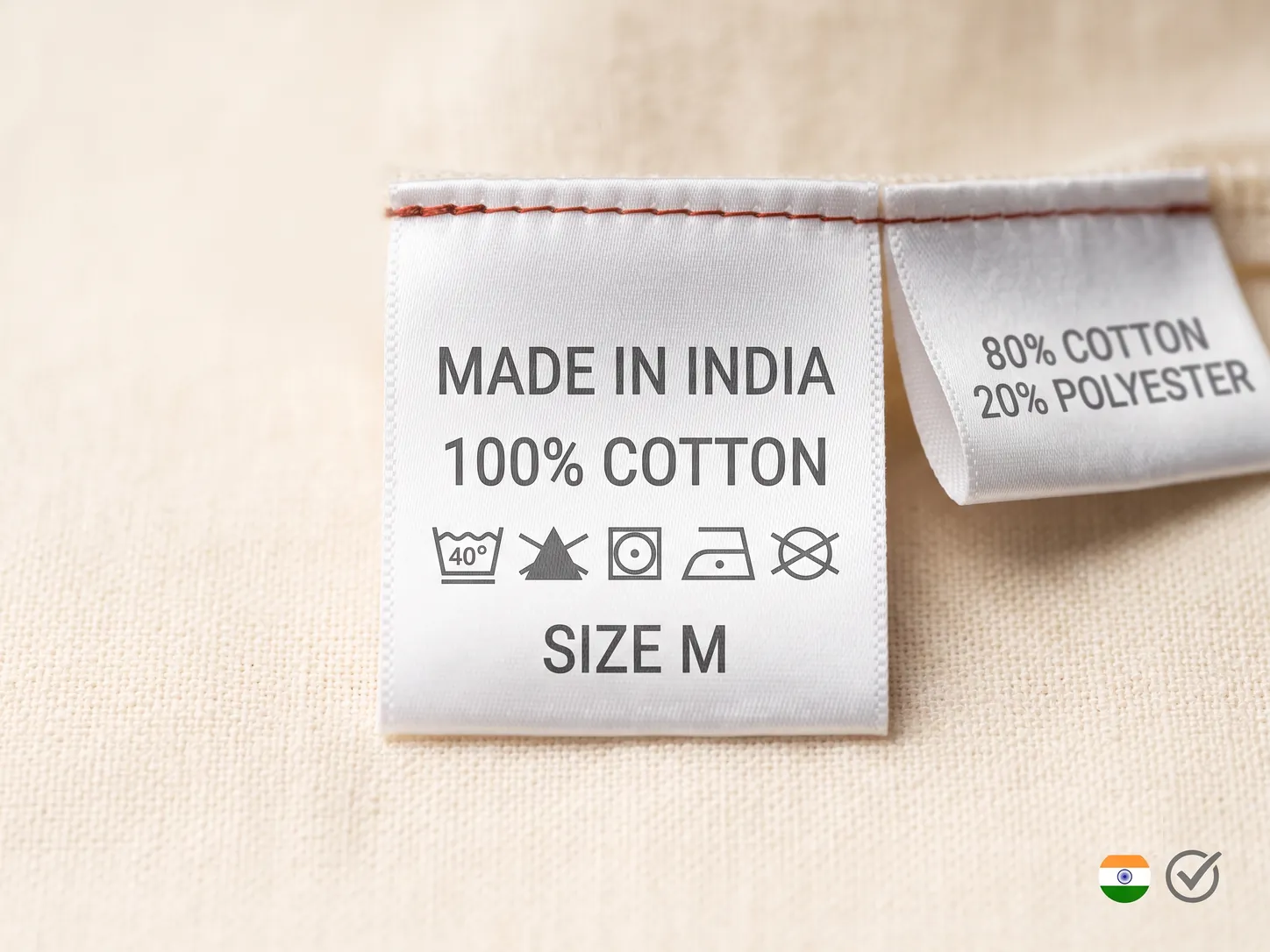
Country of origin: "Made in India"
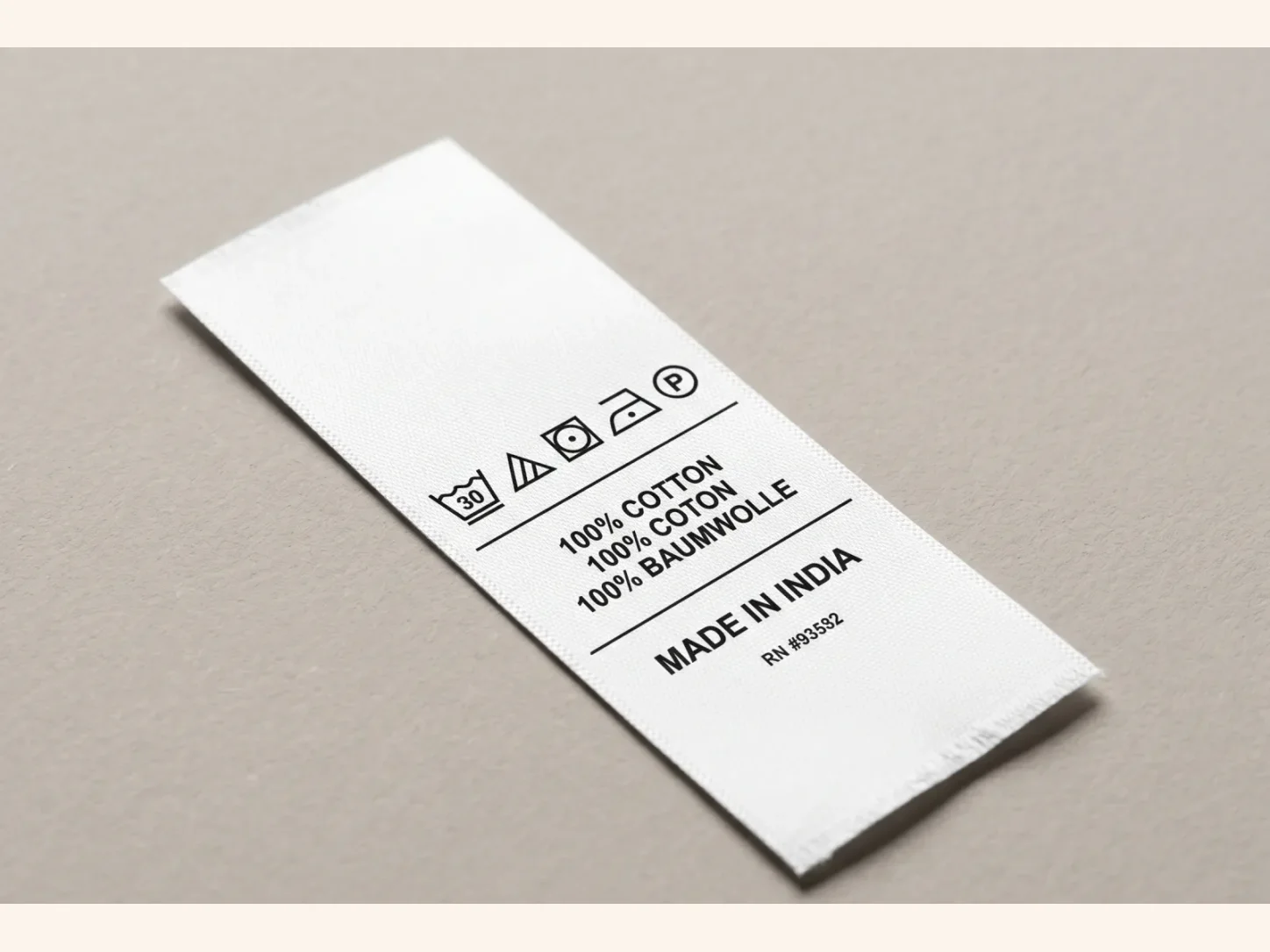
A country-of-origin label states where the garment was made. For Indian-made garments sold at home or abroad, Made in India is the standard declaration. It tells the buyer and customs where the product originates and is required for imports, exports and many retail and e-commerce listings. It usually sits on the main brand label or the care label.
Need a compliant care label fast? The free label designer's care-label generator builds the composition, wash symbols, origin and Legal Metrology lines for you, all editable.
Fibre content: what it's made of
- By percentage of each fibre, by weight
- Descending order: 80% Cotton 20% Polyester
- Single fibre shown as 100%
- Required in India & export markets
- Helps allergies, care & value
- Must match the actual fabric
Accuracy is not optional. The percentages must reflect the real fabric. A wrong fibre declaration is a compliance issue and can cause problems at customs or with marketplaces.
What does a compliant garment label carry?
For garments sold in India, the label and packaging generally need to cover:
- Fibre / fabric composition, by percentage
- Country of origin, e.g. Made in India
- Manufacturer / importer details
- Size
- MRP and pack declarations (under Legal Metrology packaging rules)
- Care instructions: strongly expected (see our care label guide)
Where does it go on the garment?
Country of origin and fibre content usually appear on the main brand label at the neck or on the care label in a side seam, alongside the wash symbols. Many brands combine fibre content, origin and care on a single sewn-in care label. The key rule: it must be permanent and legible for the life of the garment.
Not on a hang tag alone. A hang tag is removed after purchase, so the compulsory declarations must be on a permanent sewn-in or heat-pressed label. You can repeat the info on a tag or care card for the shopper, but the label carries the legal version.
Exporting? Check each market
Every export market has its own rules. The US, UK and EU all require fibre content and country of origin, each with specific formats and language requirements: sometimes stricter or differently formatted than India's. If you export, you must meet the destination market's rules. Confirm them before you print. Our India + export care label guide covers the wash-symbol side.
How should you word the composition line?
The information is simple; the wording is where declarations go wrong. A few conventions cover most cases.
- List by weight, in descending order. 80% Cotton, 20% Polyester, not alphabetically, and not with the marketing fibre first.
- Use the fibre’s generic name, not a trade name. If you want to use a brand name for a fibre, it sits alongside the generic term rather than replacing it.
- Percentages should total 100. If they do not, someone has rounded carelessly, and it is the first thing an inspector notices.
- Keep it consistent across the range. Two garments with the same fabric should carry identical wording, including capitalisation.
- Match the actual fabric, not the fabric you specified. If the mill substituted something, the label has to follow.
That last point is the one that bites in practice. Fabric gets substituted mid-season more often than brands expect, a supply problem, a shade match, a cost adjustment, and the label is rarely revisited. A garment carrying a composition that no longer matches its cloth is a compliance problem even though nothing about the label was wrong when it was printed.
Are linings, trims and parts declared separately?
Most garments are not one fabric, and a single composition line frequently is not enough.
Where a garment has a distinct lining, a separate shell, or a component made of something different, those parts are normally declared separately instead of averaged into one figure. A jacket might carry a shell composition and a lining composition as two lines; a garment with a contrast panel might name the panel.
- Shell and lining as separate declarations on outerwear.
- Named parts where a component is materially different, a hood, a contrast yoke, a rib trim.
- Small trims are often excluded from the declaration, but the definition of small varies by market, so check rather than assume.
- Padding and fill generally declared in its own right on insulated garments.
The practical effect is on label size. A shell-and-lining declaration in two languages is a substantial amount of small text, and it is one of the most common reasons a care label has to be larger than a brand expected, or has to become a folded multi-panel label rather than a single strip.
Language, and the wording of origin
“Made in India” is the standard declaration, and there are a few things worth knowing about how it appears.
- Several export markets require the information in specific languages, so one EU shipment can need the composition in three or four. Origin is usually expected in the destination language too.
- Keep the origin statement prominent. Some markets specify how visible it must be, and it is not a line to set in the smallest type on the label.
- Importer or responsible-person details are increasingly expected alongside origin, which means a company name and address in small type.
- Do not imply an origin you do not have. A brand name that suggests another country alongside “Made in India” is the kind of thing marketplaces and customs question.
Multi-language is what most often forces a bigger label or a change of construction. When four languages will not fit legibly on one strip, the answer is a folded multi-panel label rather than smaller type, see our book cover fold guide. Shrinking the type until it fits is the wrong solution, because information that cannot be read has not really been declared.
What rules do marketplaces apply?
Beyond statutory requirements, the channel you sell through has its own expectations, and those are often what actually holds up a listing.
Marketplaces enforce labelling independently because they need somewhere to route a complaint and because their own compliance sits behind your product. In practice that usually means they want the composition, the origin, care instructions and manufacturer or importer details present and legible in listing photographs as well as on the garment.
- Photograph the label clearly if the platform asks for it. A blurry image of a compliant label reads as a non-compliant product.
- Keep the listing and the label consistent. A listing saying 100% cotton against a label saying 95/5 is a discrepancy someone will eventually flag.
- Expect QC at the warehouse, not just at listing. Consignments are checked on arrival.
- Check the platform’s own guidance for your category instead of assuming general rules apply.
Why is legibility part of compliance?
A declaration that cannot be read has not really been made, and this is where a technically correct label still fails an inspection.
Composition and origin usually end up as the smallest type on the label, because they are added last and space is tight by then. That is the wrong order of priorities: these are the lines an inspector, a customs officer and a marketplace QC team will look for, and they need to survive the life of the garment rather than just the first look.
- Keep the origin statement clearly visible rather than setting it in the smallest available size.
- Do not shrink type to make content fit. Make the label bigger, or move to a folded multi-panel construction.
- Check legibility on a washed sample, not a fresh one. Print fades and woven text closes up.
- Use a printed label for this content. Composition and origin will not weave legibly at care-label size in any material.
- Keep it permanent. The declarations belong on a sewn-in or heat-pressed label, not on a hang tag that is removed at purchase.
Common mistakes
- Percentages that do not add up to 100.
- Fibres listed in the wrong order, or by trade name only.
- A composition that no longer matches the fabric after a mid-season substitution.
- Averaging a lined garment into one declaration instead of separating shell and lining.
- Missing a language required by the destination market.
- Setting the composition so small it cannot be read after a season of washing.
- Omitting importer or manufacturer details.
- A composition on the label that contradicts the marketplace listing.
- Shrinking type to fit rather than resizing the label.
Nearly all of these are settled at artwork stage. Once labels are sewn into garments, correcting a declaration means unpicking every piece, which is why it is worth spending an hour on the wording before the run rather than a fortnight afterwards.
Getting compliance labels made at Labelwala
We make woven and printed labels in Ahmedabad, Gujarat, and we have been doing it for 25 years. Composition and origin usually sit on the care label, so they tend to be quoted as part of a set.
- Minimum order: 1,000 pieces per design.
- Quotes: usually within 2 hours on a working day.
- Production: 7-10 days once artwork is approved. Rush jobs run 3-5 days.
- Care symbols: set to ISO 3758.
- Delivery: across India, depending on destination and consignment size.
Send the exact composition per style, including any lining, and the markets you are selling into. Those two answers determine how much text the label has to carry, which determines its size, and that is the decision worth getting right before artwork not at sampling.
We are rated 5.0 on Google from 27 reviews. As above, this is practical guidance not legal advice: confirm the current requirements for your product and markets before printing in bulk.
The short answer
Indian clothing sellers must print, on a permanent sewn-in label: the fibre content by percentage (e.g. 80% Cotton 20% Polyester, accurate to the real fabric), the country of origin (Made in India), plus manufacturer details, size and the required pack declarations, with care information alongside. It goes on the neck brand label or the side-seam care label, never on a removable hang tag alone. Exporters must also meet each destination market's rules. This is guidance, not legal advice. Confirm current requirements, then share your product and markets with us and we'll make sure the label carries everything before bulk.