In brief
Size labels come in alphabetic, numeric, age-based and European systems, matched to your market, and are made in woven, satin or taffeta, with taffeta the cheapest at scale. Place them below the neck label on tops and inside the waistband on bottoms, and order the full size run in one batch from 1,000 pieces per size.
Size labels are the smallest piece of a garment and the most disproportionately important. Get them wrong and returns spike, retail shelves look messy, and exports get held at customs. Here's how to pick the right type, material and placement.
Size labels are the smallest piece of a garment and the most disproportionately important. Get them wrong and return rates spike, retail shelves look messy, and customs holds export shipments. This is a no-jargon guide to sizing systems, material choices, placement, and how to order size labels that match your brand and your buyer.
Why do size labels matter more than they look?
A size label does three things at once: it tells the customer if the garment fits, it tells the retailer how to merchandise the rack, and it tells customs what they're shipping. A wrong or missing size label triggers a return; an inconsistent batch creates retail-display problems; a non-compliant export size label can block a container at port.
- Returns & exchanges (clear, correct size labels reduce returns by 8-12% on D2C orders.
- Retail display: folded retailers rely on size tabs to merchandise; mismatched fonts/folds across sizes look unprofessional.
- Compliance: EU and US retail buyers often insist on dual-system labels (e.g. UK + EU sizing).
Which sizing system should you pick for your market?
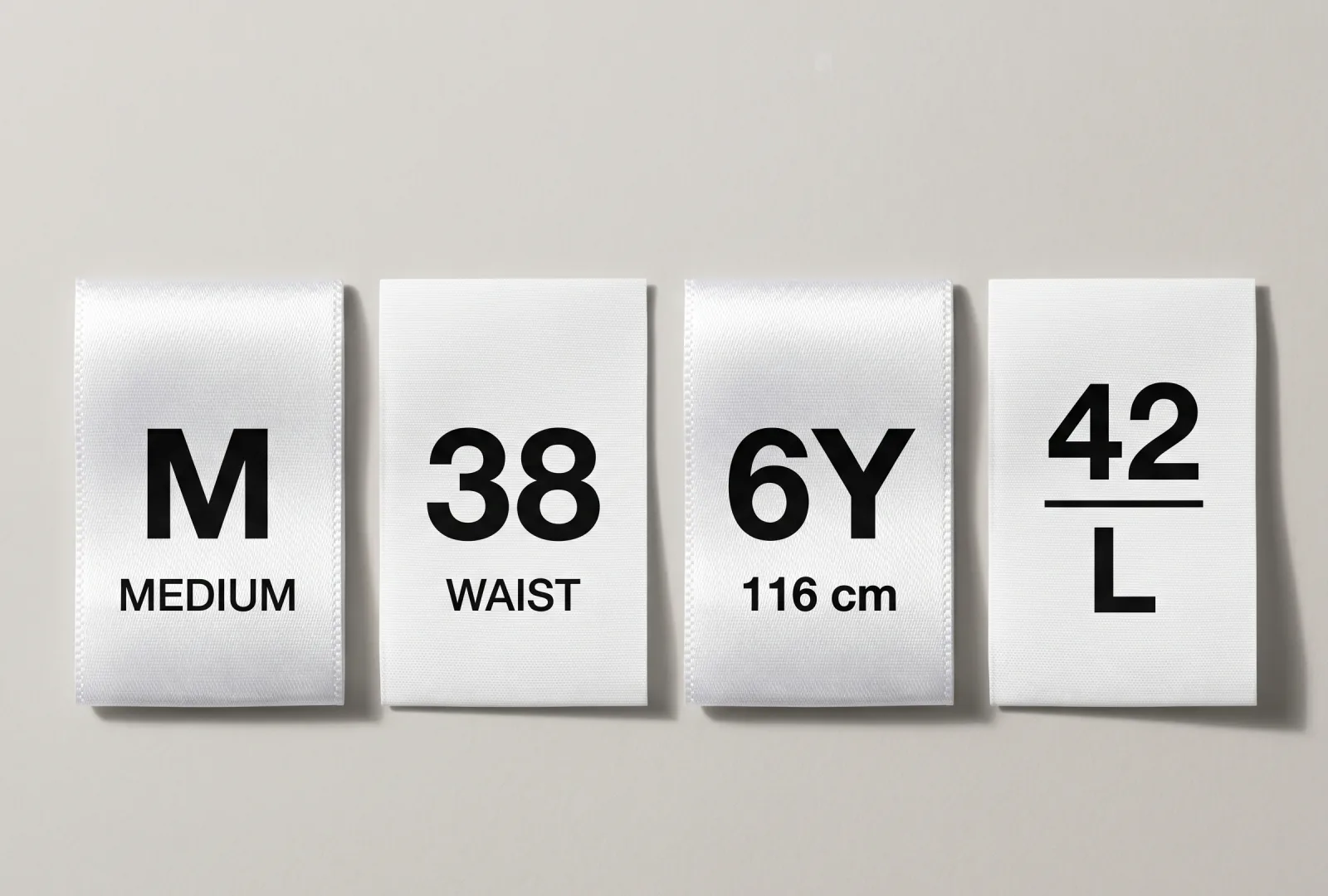
Four systems are common in Indian garment production:
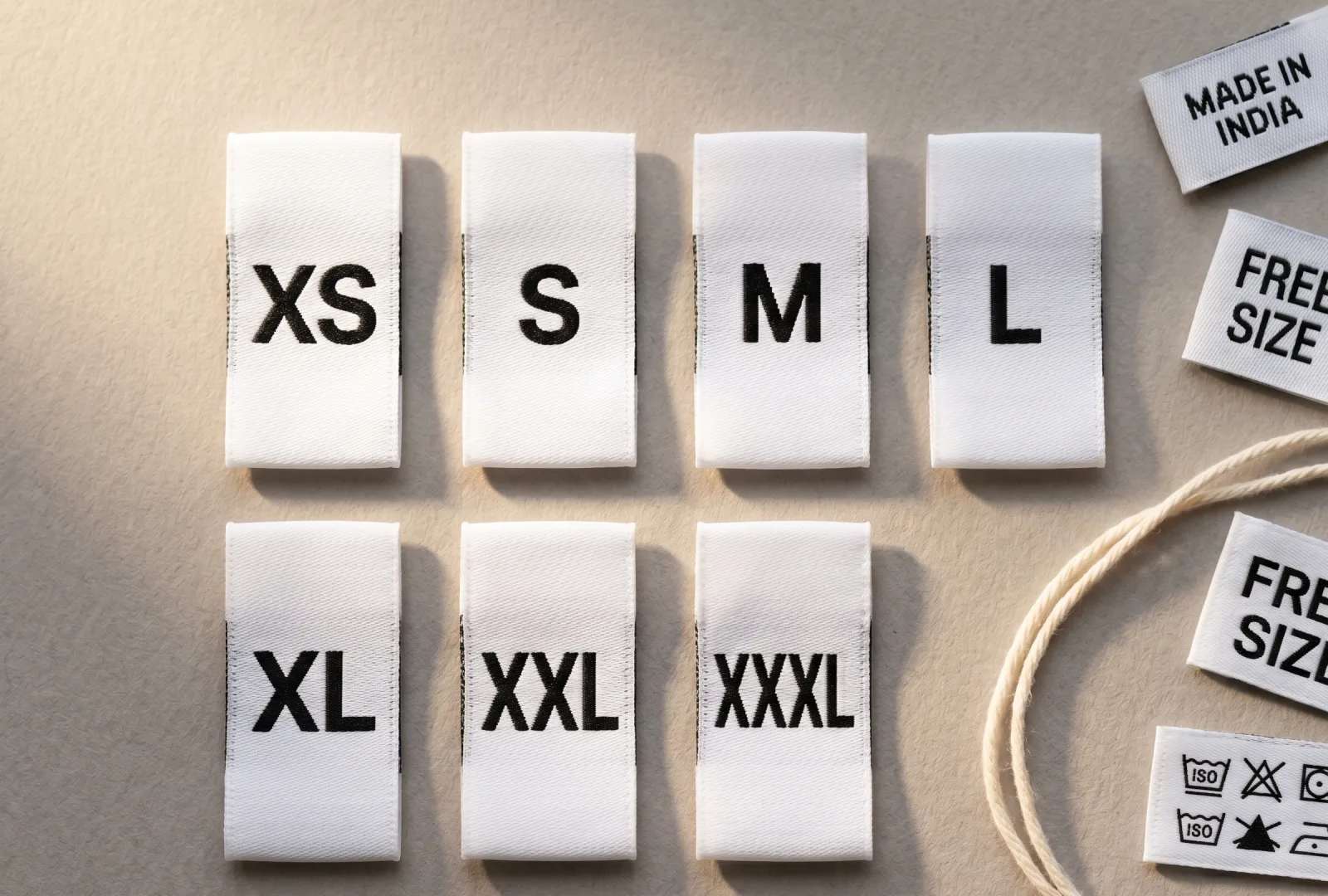
Match the system to your market. D2C casualwear typically uses alphabetic. Formal shirts and bottoms use numeric (collar/waist size). Kidswear uses age-based with size-by-height notes. Export programmes often use dual systems on the same label.
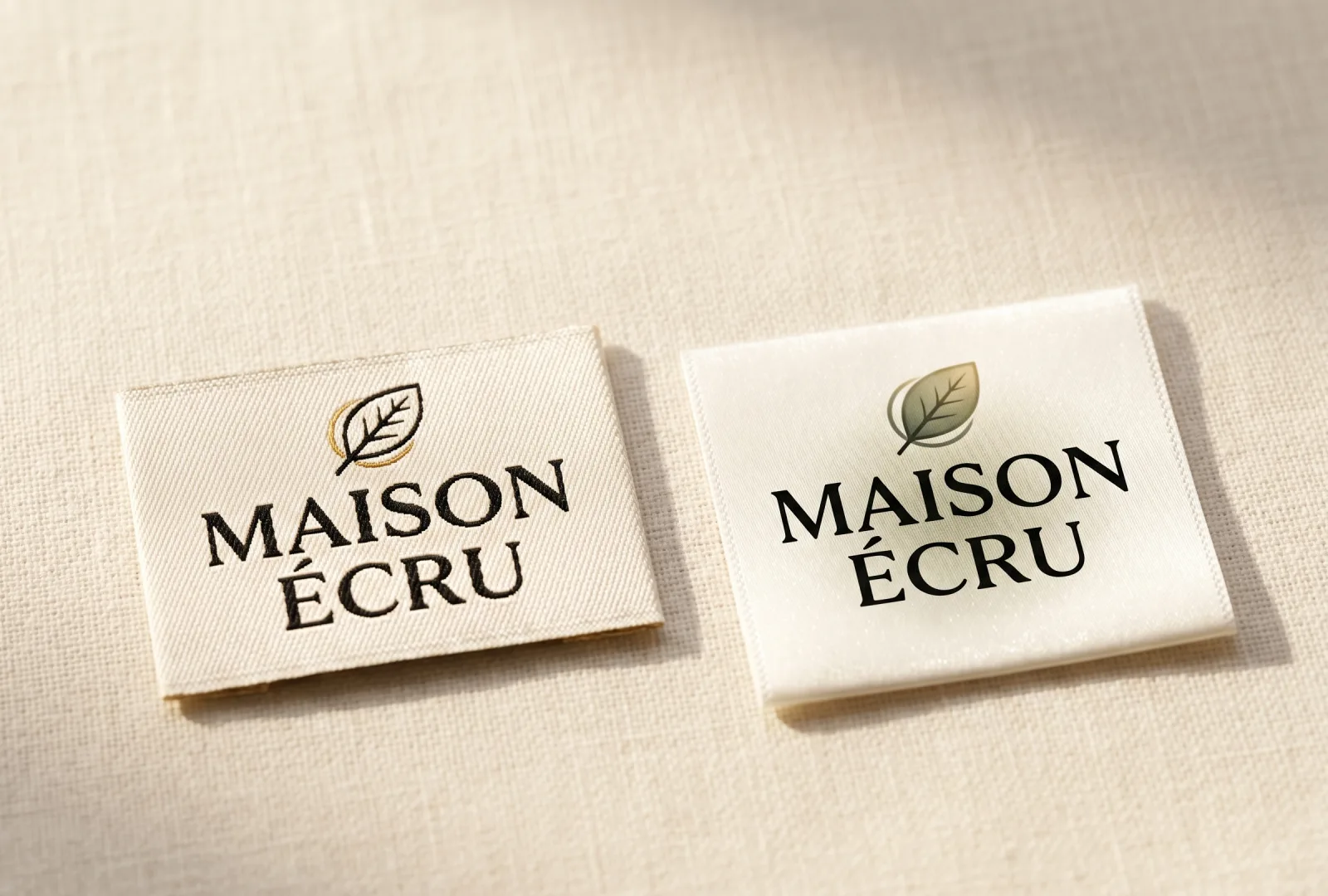
Material picker: woven, satin or taffeta?
- Premium feel, permanent colour, woven into the fabric
- Best for boutique, premium and heritage brands
- Limited to 1-4 colours on a small label
- Cost: highest per piece (₹1.5-3.5 at 1,000+ pieces)
- Soft, vibrant, full-colour, best for kidswear and D2C
- Best for contemporary, casual, kidswear
- Any number of colours, gradients OK
- Cost: mid (₹0.80-2 at 1,000+ pieces)
- Most economical at scale, crisp print
- Best for exporters, uniforms, bulk production
- Single colour, very sharp tiny text
- Cost: lowest (₹0.40-1 at 1,000+ pieces)
Where should size labels go on each garment type?
Placement is as important as the label itself. Standard convention across the industry:
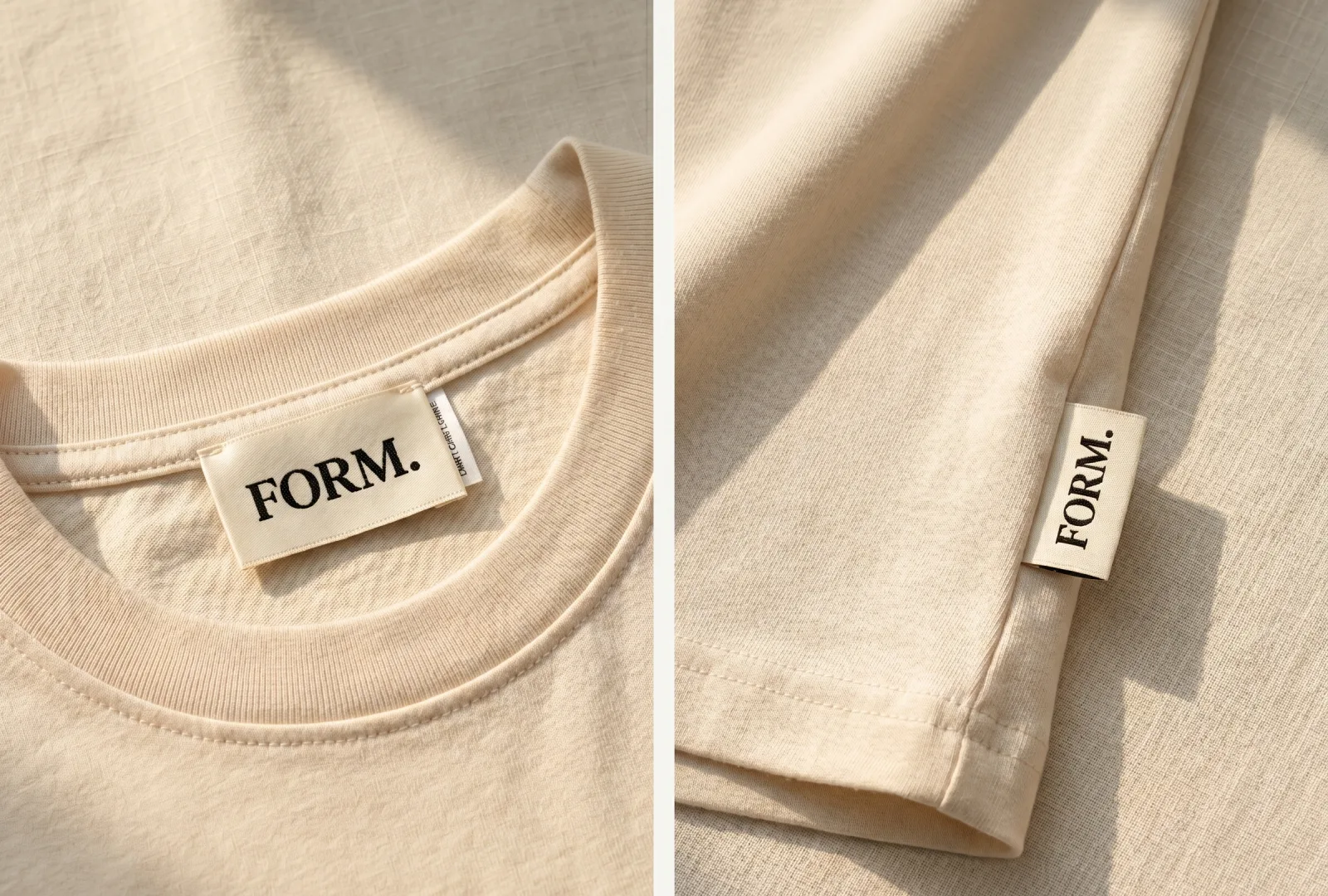
- T-shirts / casual tops: below the main neck label, inner back, ~30mm wide
- Formal shirts: inside collar band on left, separate from brand label
- Trousers / jeans / shorts: waistband interior, on top of pocket bag at right hip
- Dresses / kurtas: below brand label at neck, OR side-seam at hip for floor-length
- Jackets / outerwear: inner left chest, near the pocket; some brands use a hem tab
- Kidswear: back-neck under brand label, with age + height info combined
- Uniforms: back-neck, large & legible, staff need to find size at a glance
- Underwear / loungewear: tagless heat-press on inner waistband, no fabric label
Hem tab vs neck position: hem tabs are visible on the rack (good for merchandising) but get cut off by customers. Neck labels are permanent but invisible to the retailer. Many brands use both, see our hem tags vs neck labels guide.
Should you use pre-made stock or custom size labels?
If you use the standard alphabetic size system (XS, S, M, L, XL, XXL, 3XL) and don't need a logo on the size label, pre-made stock size labels are dramatically cheaper than custom, and ship same-day, from a 1,000-piece minimum.
- Pre-made (stock): ₹0.20-0.50 per piece, ships same day, MOQ 1,000 pieces.
- Custom (with brand mark): ₹0.50-3 per piece, 7-10 day production, MOQ 1,000 per size.
For first-time founders and small batches, start with pre-made stock labels. Switch to custom once you cross 1,000+ pieces per size.
Pro tips before you order
Get all sizes from a single batch. Avoids colour drift between sizes.
Production slack + future cutting losses. Cheaper than re-ordering one size later.
End-fold for neck labels, straight-cut for waistband, loop-fold for tabs.
Adding a second language later means a re-print, not a re-stitch. Lock the format before bulk.
Quick start: WhatsApp us your sizing system + estimated quantity per size, and we'll send a per-piece + total quote in 2 hours. Message Labelwala or use the quote form.
Separate size tab, or size on the neck label?
This is the decision that quietly determines how much stock you have to hold, and it is worth making deliberately instead of copying whatever your last supplier did.
With a separate size tab, your main neck label is identical on every garment and only the small tab changes. You buy one neck label in bulk plus a set of cheap tabs, one per size. Reordering is simple because your expensive label does not depend on size, and adding a size later means ordering one new tab rather than a whole new neck label.
With the size printed on the neck label, the garment carries one clean label instead of two. The cost is stock: every size becomes a separate item to order, count, store and reorder. Ten sizes means ten labels, and if you misjudge demand on one you are holding labels that fit nothing else.
- Separate tab if your range is wide, changes often, or your neck label is complex and expensive.
- Combined label if your range is narrow, or a second label would look cluttered in a premium garment.
- Combined label if you are going tagless, where every extra piece is another step on the line.
There is a middle option worth knowing: one combined design where the size sits in a fixed position and only that character changes. You still need one label per size, but the artwork is a single file with one swapped character, which cuts proofing and stops the versions drifting apart over time.
Why size the tab around your longest code?
Sort the width out first, because that is the dimension that causes trouble later. Height is largely fixed by the fold and the seam, so width is where the real decisions are, and width is set by your longest size code, not your most common one.
A brand running S to XL has two characters at most. Add XXL and it is three. Add 3XL and you have a number plus two letters, which is wider than three letters in most typefaces. Size the tab for the widest code you will ever run, including sizes you plan to add later.
- Write out every size code you will ever use.
- Set them all in your chosen font at your chosen letter height.
- Measure the widest, then add clear space on both sides.
- Add the fold allowance for the fold you have picked.
- Round up to the nearest 5 mm, because mills work in round steps.
Getting this wrong later leaves three options, all worse than planning ahead: shrink the letters on the big sizes so the range no longer matches, run a wider tab on big sizes so garments look inconsistent, or reorder every tab at a new size. Most brands take one of the first two, because the third costs money nobody budgeted.
Letter height and staying readable
A size tab holds so few characters that it is tempting to set them small. That works on a fresh sample and stops working after a season. On woven labels the letters close up as the threads settle; on printed labels the ink spreads slightly as the fabric softens.
- 4-5 mm: kids tabs, dual sizing, or anything on two lines.
- 5-6 mm: the normal range for adult letter and number sizes.
- 6-8 mm: useful where staff sort garments in bulk by size.
Below about 3 mm the enclosed gaps inside characters start to fill in, the holes in 8, 6, 0 and R. On a woven label this is a hard physical limit, because the weave cannot make a gap thinner than a few threads. It is exactly how an 8 ends up reading as a 6, and it is the most common problem with numeric sizing.
Avoid solving a width problem with a narrow typeface. Narrow fonts fit more characters in the same space and shrink those internal gaps at the same time, so the closing-up problem arrives sooner. If a code does not fit, widen the tab.
Why should size quantities not be spread evenly?
Size labels are the one label where ordering equal quantities across the range guarantees a problem. A range selling mostly M and L needs far more of those tabs than XS or 3XL, and equal ordering leaves you short on some and overstocked on others.
- Base the split on real sales history where you have it.
- For a new range, weight the middle sizes and taper towards the ends.
- Order slightly ahead of garment numbers to cover sewing wastage.
- Write the split down so a reorder can be repeated rather than re-guessed.
The economics pull the other way, which is the tension: minimum order quantities usually apply per size code, so a ten-size range can mean ten minimums. That is a strong argument for the separate-tab structure. Your expensive neck label is ordered once in bulk, and only the cheap tabs carry a minimum each.
If per-size minimums are your constraint, ask whether every size genuinely needs its own tab. Some brands combine adjacent sizes where the fit allows; others run a shorter range in season one and add sizes once they know what actually sells.
Common mistakes
- Sizing the tab around a mid-range code, then finding 3XL does not fit.
- Setting letters small enough that internal gaps fill in after washing.
- Letting a character sit on or near the fold line, where a permanent crease runs through it.
- Using a narrow typeface to solve a width problem.
- Quoting a flat size when you meant the finished size, or the reverse.
- Pairing a woven neck label with a printed size tab and expecting them to match.
- Ordering equal quantities of every size.
- Approving one size code and assuming the rest of the set is fine.
- Placing the tab differently on different styles, so nothing in the range matches.
Nearly all of these are settled before anything is made. A size tab is too small to correct afterwards, you cannot trim it or edit it, only replace it, which is why the specification stage carries so much weight on such a small piece.
Ordering size labels at Labelwala
Labels are woven and printed by us in Ahmedabad, Gujarat, and have been for 25 years. Size tabs come up in most enquiries, and they are nearly always quoted together with the neck label and the care label rather than on their own.
- Minimum order: 1,000 pieces per design. Tell us your split across sizes and we will confirm how it applies.
- Quotes: usually within 2 hours on a working day.
- Production: 7-10 days once artwork is approved. Rush jobs run 3-5 days.
- Delivery: across India, depending on destination and consignment size.
Send your full list of size codes not one example. Seeing the whole set lets us check the widest code fits the tab you want before anything is made, which is the single most useful thing you can do at quote stage.
We are rated 5.0 on Google from 27 reviews.