In brief
An organic cotton label uses cotton tape, ideally undyed, printed with soy or water-based ink so the whole label biodegrades, and OEKO-TEX is the practical starting certification for most Indian eco-brands. GOTS certification on the label itself needs a certified weaver or printer, adds 15 to 20% to cost and 5 to 7 extra days of lead time.
A GOTS-certified organic cotton t-shirt with a polyester satin label is a contradiction the customer can feel. Sustainable Indian fashion brands are growing fast, but most still source labels from generic suppliers who only offer synthetic ribbon. Here's how to spec eco-friendly labels that match your garment story.
What does "eco-friendly label" actually mean?
The term gets thrown around loosely. There are three real dimensions, and a serious eco brand should think about all three:
- Base material: cotton tape (biodegradable) vs polyester satin (not). Cotton can be conventional, organic, or organic + GOTS-certified.
- Ink / thread: soy-based or water-based pigment ink for printing, OEKO-TEX-compliant threads for weaving. Avoid plastisol on eco labels.
- End-of-life: a cotton label with soy ink composts. A polyester label with plastisol does not.
If your brand uses "sustainable" or "eco" in its messaging, the label is the most visible proof point. Customers in this segment notice.
Which cotton label options are most sustainable?
The top tier is the cleanest claim. Undyed cotton looks natural off-white, prints accept any colour, and the entire label biodegrades. Costs 20-30% more than conventional cotton, but it's the strongest visual signal of sustainability.
GOTS, OCS, OEKO-TEX, which certification matters?
Three certifications come up most often for eco fashion in India. Each means something different:
- GOTS (Global Organic Textile Standard): covers the entire supply chain from fibre to finished product. If you want to put the GOTS logo on your hangtag or label, every step (cotton farm, spinner, weaver, dyer, printer, label maker) must be certified. This is the hardest and most credible certification.
- OCS (Organic Content Standard): only verifies the organic fibre content (≥95% for "Organic", 5-95% for "Made with Organic"). Easier to obtain than GOTS, useful for blends.
- OEKO-TEX Standard 100: tests the finished label for harmful substances. Doesn't certify organic origin, but proves the label is skin-safe. Most premium label suppliers can offer this.
For most Indian D2C eco-brands, OEKO-TEX is the practical starting point. GOTS labels are required only if you want the GOTS logo on your finished garment label.
What do cotton and organic labels cost?
Indicative per-piece pricing for a 30×50mm printed cotton label (brand mark on front, care symbols on back, 2 colours):
Cost adders to plan for:
- Soy ink instead of plastisol, +10-15%
- Organic cotton (vs conventional), +20-30%
- GOTS-certified supply chain, +15-20% on top, plus 5-7 extra days lead time
- Undyed natural cotton: same price as conventional cotton (no dye step)
A fully organic, soy-ink, OEKO-TEX label lands around ₹4-5 per piece at the 1,000-piece minimum, roughly the price of a basic woven satin label, and less again as the run grows. The gap between eco and conventional is much smaller than founders assume.
Which label format suits each cotton garment?
Different cotton garment types need different label approaches:
- T-shirts / loungewear (jersey cotton): tagless heat-press for the brand, or a soft sewn cotton label with end-fold. Avoid stiff woven satin against bare-skin contact areas.
- Shirts (woven cotton): sewn cotton or printed satin label at the neck, paired with a printed care label at the side seam.
- Knitwear / sweaters: small woven cotton label at the inside back neck. Heat-press doesn't bond well to knits.
- Workwear / outerwear: durable cotton-blend label survives industrial washing better than 100% cotton. A small trade-off vs full eco purity.
- Babywear: undyed organic cotton, no print on skin-facing side. OEKO-TEX class 1 (intended for babies under 36 months).
Common eco-label mistakes: printing "100% organic cotton" on a label that's actually conventional cotton (greenwashing: bad for trust and increasingly illegal in EU markets); using plastisol ink on cotton tape (kills the biodegradability claim); going through a non-certified middleman while paying GOTS prices.
What to send for an eco-label quote
- Brand logo: vector preferred (AI / EPS / PDF / SVG).
- Certifications you need on the label, GOTS / OCS / OEKO-TEX / "none, just want cotton material".
- Garment type: t-shirt / shirt / babywear / loungewear etc. Drives format.
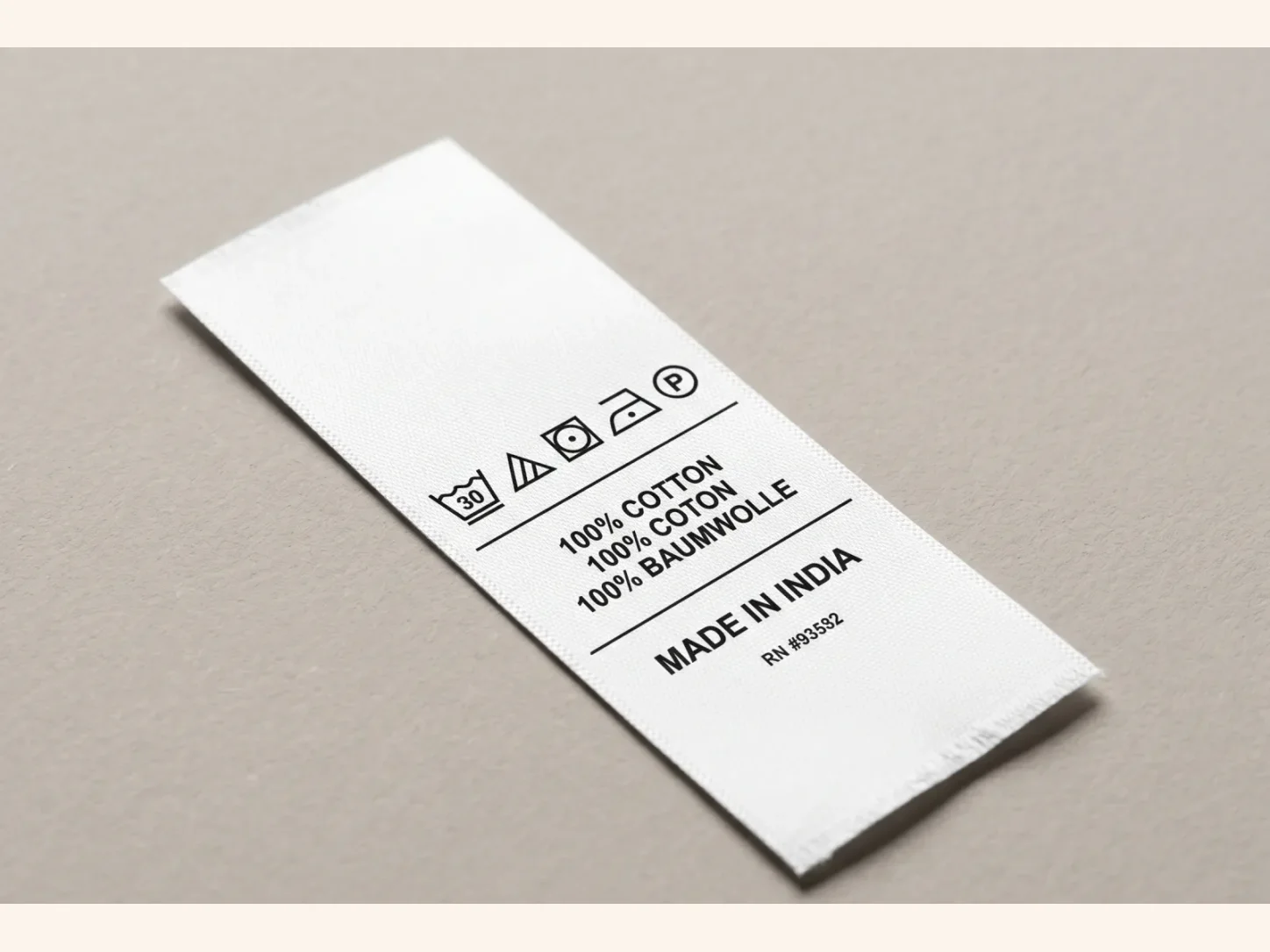
- Care symbols: wash temp, dry symbol, bleach yes/no, iron temp.
- Fabric composition: 100% organic cotton / 95% cotton 5% spandex / etc. Goes onto the care label by law.
- Quantity, even rough. 100 / 500 / 1000.
How long do eco labels take to produce?
Logo + cert level + garment type
Material, ink, finish · 2-4h
Digital image + (optional) physical sample
10-14 days for standard; +5-7 if GOTS-certified
GOTS-certified runs take longer because the certified chain has fewer slots and pre-booking is common. Plan 21 days ahead for GOTS; 10-14 for standard organic cotton.
Common mistakes
- Putting a polyester satin label inside a certified organic garment, which is the contradiction a customer can feel.
- Writing an unqualified certification claim when the licence is held by a supply partner.
- Using vague words like eco-friendly or green, which mean nothing specific and attract scrutiny.
- Specifying a laser or heat-cut edge on cotton, which scorches instead of sealing.
- Leaving a cotton edge unfolded, so it frays progressively for the life of the garment.
- Forgetting the label sits inside the same chemical testing boundary as the fabric.
- Letting certification paperwork lapse, then failing an audit on dates rather than substance.
- Putting dense care text on cotton, where fine type spreads and legibility suffers.
Specifying an eco label set
A workable set for a sustainable range looks like this, and it is worth writing down before you quote anything.
- Brand label: cotton, folded edge, printed with water-based ink or woven from undyed and naturally coloured yarn. This is the piece doing the fibre-story work.
- Care label: printed, and usually not cotton. Composition, symbols and origin need a smooth substrate to stay legible for years.
- Size tab: match it to the brand label if the two sit together, since a mismatch is visible.
- Hang tag: recycled or kraft card with a cotton or jute string, never a plastic barb.
- Sewing thread: worth asking about, because it is polyester by default and nobody specifies it.
Work through the list in order, because the first two decisions constrain the rest. Decide the sewing thread and the hang tag fastener at the same time as the labels, since those are the two components that most often arrive as a default nobody chose.
Quote the set as one job. It is one setup rather than several, and it is the only reliable way to check the pieces agree with each other before anything is made. It also stops the common outcome where the brand label is carefully specified and the care label quietly arrives as standard polyester satin.
Think about how the label ends
End-of-life is the dimension most eco specifications skip, and it is the one that makes the difference between a genuine claim and a cosmetic one.
A cotton label printed with water-based or soy-based ink can compost with the garment. A polyester label with a plastisol print cannot, and neither can a cotton label carrying a plastic-based print, which is the combination brands most often end up with by accident. The base material and the ink have to agree.
- Cotton base with water-based ink is the coherent end-of-life story.
- Avoid plastisol on an eco label entirely, since it is a plastic layer sitting on top of a natural fibre and it prevents the label composting at all.
- Watch the thread the label is actually sewn on with, which is almost always polyester by default and very rarely considered by anyone.
- Watch the hang tag fastener as well. A kraft or recycled tag attached with a plastic barb quietly undoes the whole argument that the tag itself is making.
The sewing thread is the one that surprises people. A cotton label attached with polyester thread is still a mixed-material item at end of life, and almost nobody specifies it because it is the garment maker who buys it rather than the brand.
None of this needs to be perfect to be worth doing. It needs to be consistent, because the inconsistencies are what an informed customer notices and what a competitor points at.
Getting the wording right
This is where eco labelling most often goes wrong, and the surprise is that it is a writing problem rather than a sourcing one. The material can be impeccable and the sentence describing it still be a liability.
Three statements look similar and mean very different things: that a fibre is certified, that a supply partner holds a licence, and that a material would qualify. Only the one you can document belongs on the label, and the qualifier is the part that makes it accurate.
- Name the certification and keep the qualifier. Routed through a licensed supply partner is a true statement; we are certified may not be.
- Know who holds the paperwork, and be able to pass through a licence number or transaction certificate on request.
- Keep it current. Certificates expire, and an audit checks dates.
- Avoid vague words. Eco-friendly and green are exactly what misleading-claims rules target, because they mean nothing specific.
A modest, specific and evidenced claim is worth considerably more than an ambitious one you cannot actually support with paperwork. In this segment the customers are informed, and an unqualified claim invites precisely the question you least want asked.
What does cotton change in the specification?
Choosing a natural fibre removes some options, so the brief has to be more explicit than for a polyester label.
- The edge cannot be heat sealed. Cotton scorches instead of fusing, so specify folded, hemmed or selvedge.
- Give text more room. Cotton yarn is coarser and absorbs ink differently, so fine type spreads slightly.
- Allow for movement. Cotton takes up water, so it can shrink a little and stays damp longer than the fabric around it.
- Expect softer colour. Cotton takes dye towards muted shades rather than the saturated ones polyester holds, which usually suits a natural palette anyway.
- Approve a physical sample. The matte, natural hand is the entire point, and it is the one property a screen cannot show.
Sourcing eco labels from Labelwala
25 years making woven and printed labels in Ahmedabad, Gujarat.
- Minimum order: 1,000 pieces per design.
- Production: 7-10 days once artwork is approved. Rush jobs run 3-5 days.
- Delivery: anywhere in India; timing follows the destination and the size of the consignment.
Tell us whether cotton is for the feel, for the fibre claim, or both, and which certification you need to reference. That decides the construction, the edge and what we can put in writing. If certification has to be referenced on your packaging, raise it at quoting stage rather than after approval.
We are rated 5.0 on Google from 27 reviews.
The label as part of the brand story
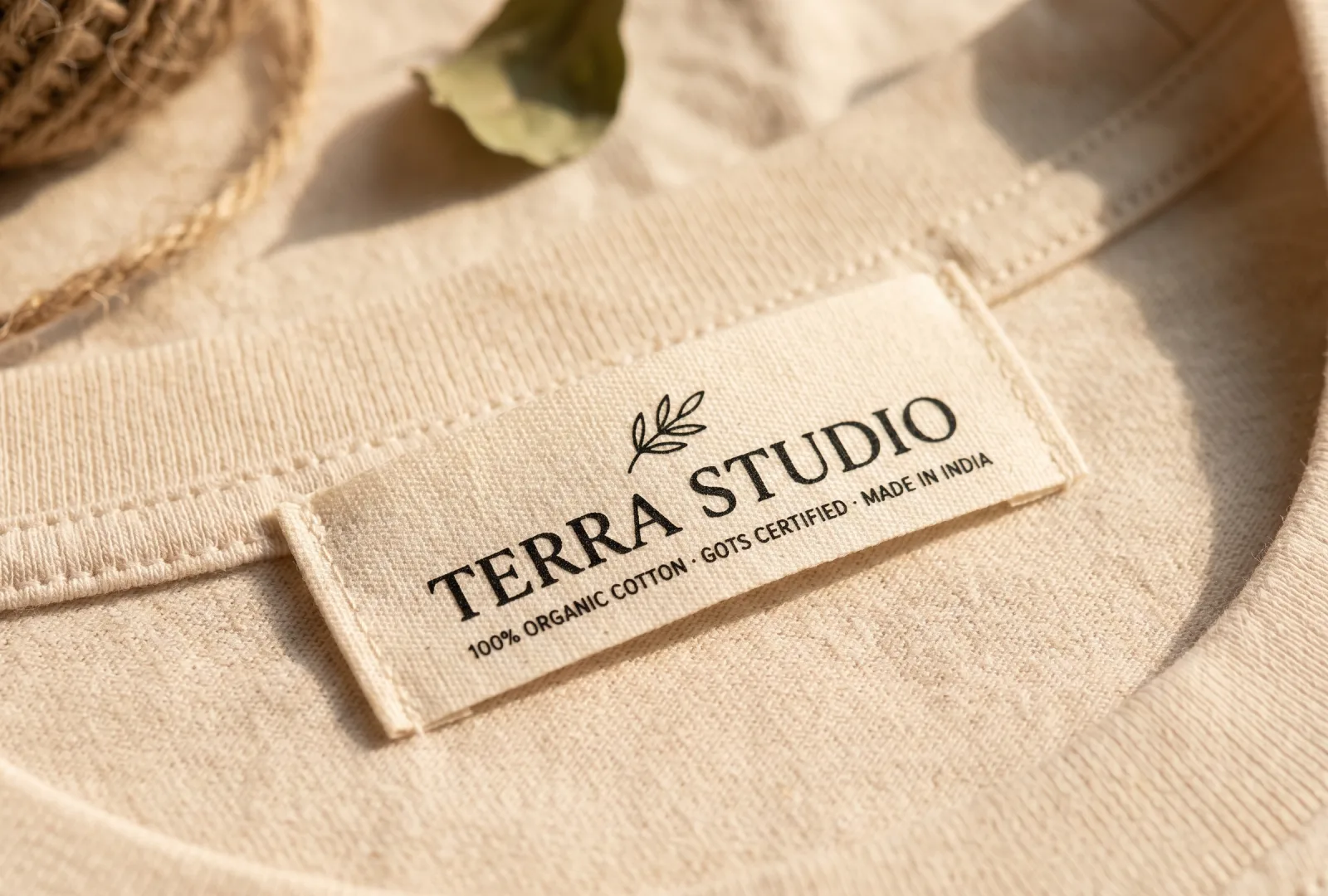
Eco-fashion customers care about how the garment was made, not just what it looks like. Most labels say nothing: a logo, a size, a wash code. An eco-brand label has a chance to say more: "100% GOTS-certified organic cotton. Soy ink. Compostable. Made in India." Four lines, on a 30×50mm undyed cotton label, costs around ₹4-5 a piece at the 1,000-piece minimum.
That label gets photographed, shared, screenshotted. It's the cheapest piece of brand storytelling you'll ever ship.
Ready to spec sustainable labels? Browse cotton labels and care labels on our product pages, or see labels for D2C fashion brands and labels for yoga & activewear for segment examples. For pricing, use the price calculator or send a brief via quick quote.