In brief
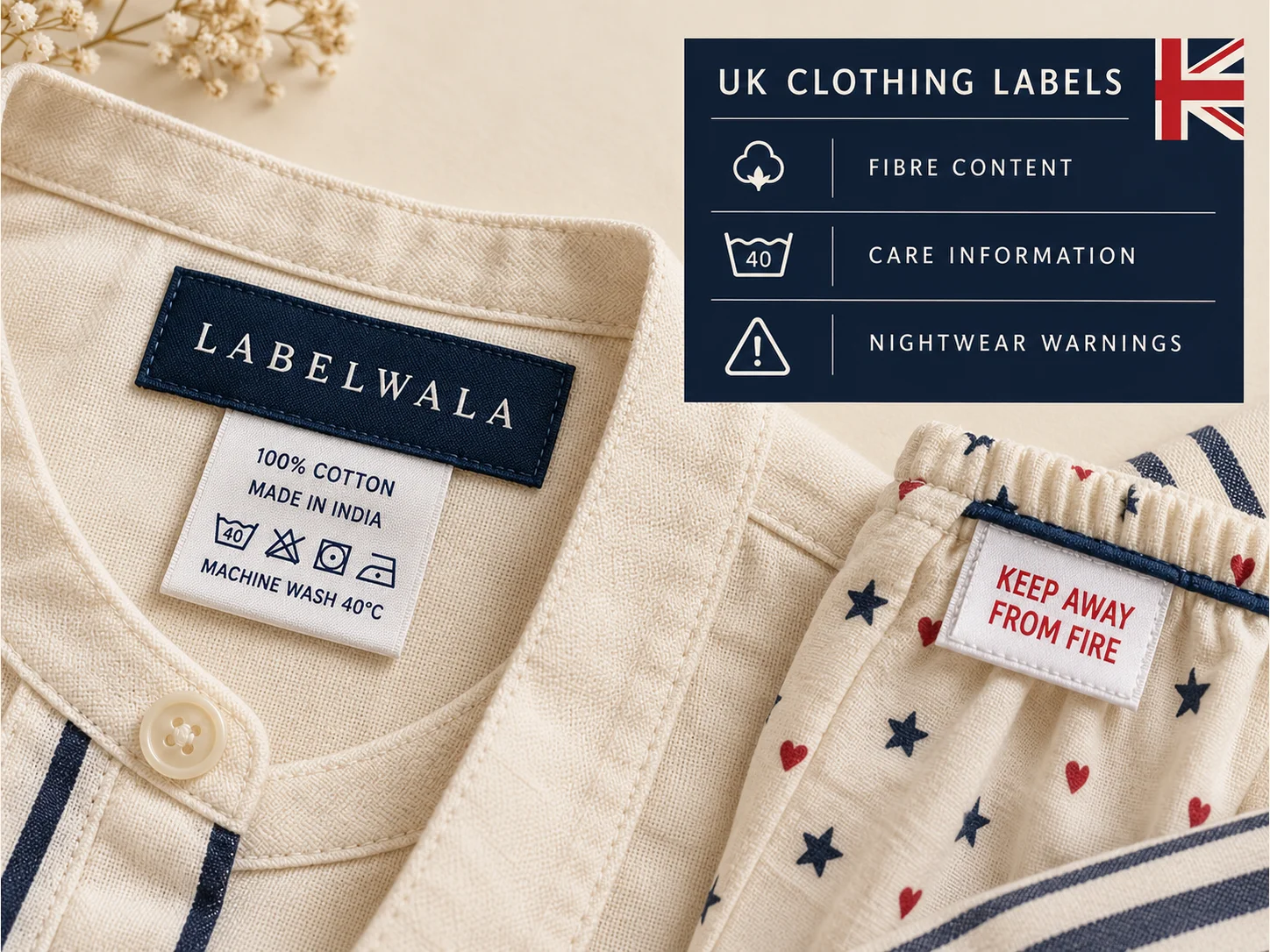
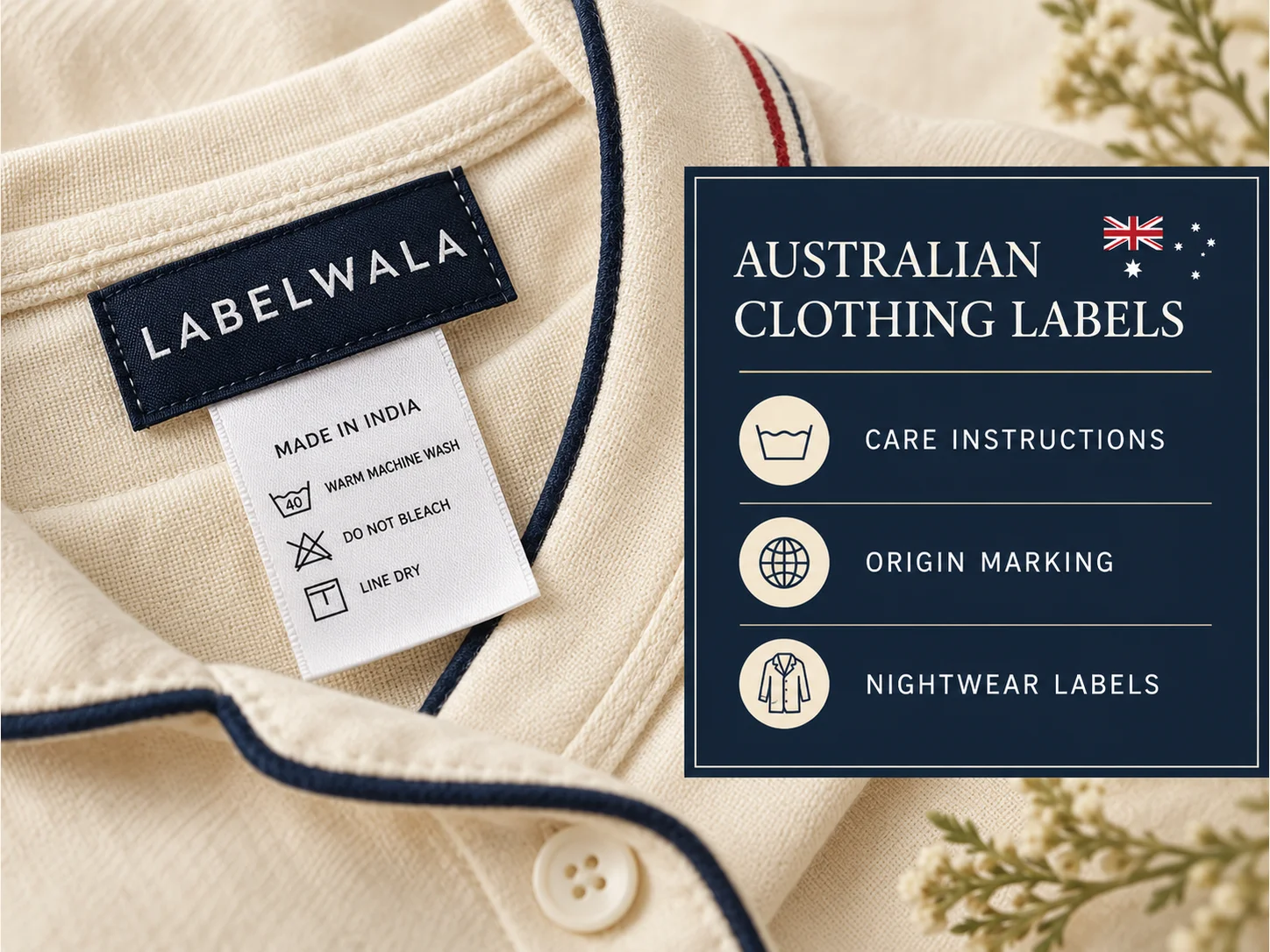
Clothing sold in Australia must carry care instructions in English on a permanent, legible label under the mandatory care labelling standard based on AS/NZS 1957; symbols may accompany the words but not replace them. Imported clothing must carry a trade description including the country of origin, so "Made in India" goes on the label. Children's nightwear must carry the fire-hazard label prescribed by the AS/NZS 1249 standard. Fibre content and size are no longer national mandatory standards but every retailer requires fibre content and a stated composition must be accurate.
This is a guide, not legal advice. It describes the Australian rules as they stand at publication. Mandatory standards are made under the Australian Consumer Law and updated from time to time; your importer or a compliance adviser confirms the content for your product. What follows is written for the person turning an Australian buyer's spec into a label that gets made correctly in India.
We make labels, so this guide concentrates on the physical label: what must be on it, what is optional, where it goes, and why the material matters more in Australia than almost anywhere else.
The rules behind an Australian garment label
Four sets of rules reach the label. Two are mandatory standards under the Australian Consumer Law, one is customs legislation on imported goods, and one is the general law on misleading claims.
| Rule | Basis | What it requires on the label |
|---|---|---|
| Care labelling mandatory standard | Consumer Goods (Care Labelling for Clothing and Textile Products) Safety Standard, based on AS/NZS 1957 | Adequate care instructions in English on a permanent, legible label attached to the garment |
| Trade description on imports | Commerce (Trade Descriptions) Act 1905 and the Commerce (Imports) Regulations | A trade description including the country of origin on imported apparel |
| Children's nightwear mandatory standard | Based on AS/NZS 1249 | Fire-hazard category label in prescribed wording and colours; highest-hazard garments banned |
| Australian Consumer Law | Misleading or deceptive conduct, country of origin claims, information standards | Everything stated must be true, including fibre content and any "Australian made" claim |
Enforcement is by the ACCC nationally and the state and territory consumer agencies, with the Australian Border Force checking trade descriptions at import. Retailers test on top. A single well-built label set satisfies all of them.
Care labelling: what the mandatory standard asks for
The care labelling standard applies to clothing, household textiles, furnishings, piece goods, yarns and some other textile products, with a short list of exemptions. For a garment it requires:
- Adequate instructions. Enough that a consumer who follows them will not damage the garment: the washing method (hand or machine) and water temperature, whether to bleach, how to dry, how to iron, or a dry-cleaning instruction with any solvent restriction, plus any warnings such as "wash separately" or "do not wring".
- In English. Words are required. The care symbols set out in AS/NZS 1957 may be added, and most labels carry both, but symbols alone do not comply.
- Permanent. On a label attached to the garment that will last its useful life. Swing tags, stickers and packaging do not count for clothing.
- Legible and accessible. Readable at the point of sale without damaging the garment, and still readable after washing.
- Appropriate to the garment. The instructions have to be right for the fabric, which means a test or reliable knowledge behind them. "Dry clean only" on a washable garment to avoid testing is not "adequate".
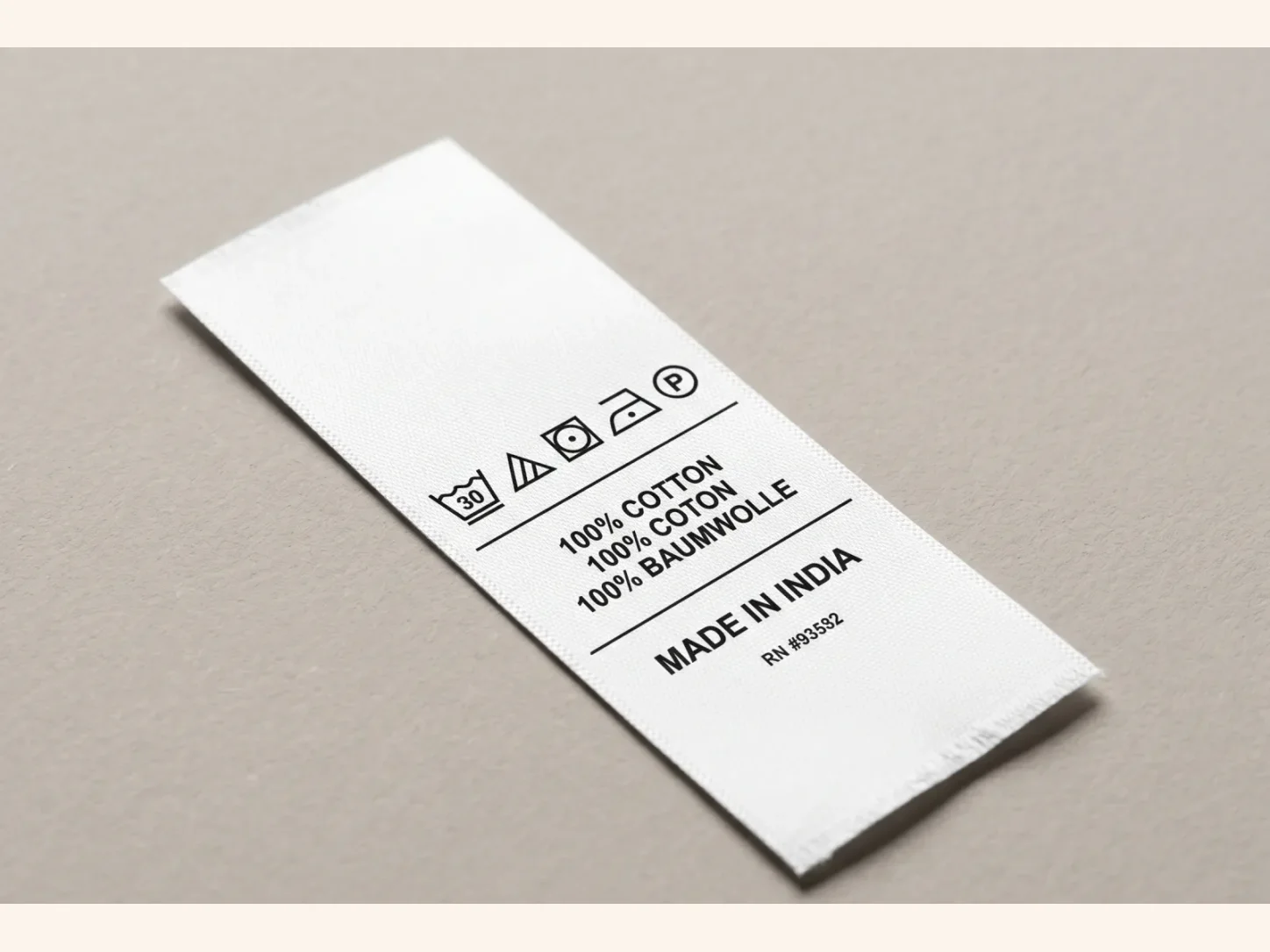
The standard's wording conventions are Australian: "Warm machine wash", "Cold hand wash", "Do not bleach", "Line dry in shade", "Warm iron", "Dry clean only". A brand selling in Europe and Australia typically prints the ISO 3758 symbols once and the Australian English phrases beneath them, which also satisfies the UK and, with the care rule wording, the US. Our care symbol guide maps the symbols to the words.
"Legible" is tested by the sun. An Australian activewear or swimwear label meets chlorine, salt water, hot washing and strong UV in its first season. A surface-printed cotton tape fades to grey, and a faded care label is a non-compliant care label. Printed polyester satin or taffeta, with the dye fused into the fibre, is the material that keeps the standard satisfied for the life of the garment.
Country of origin on imported clothing
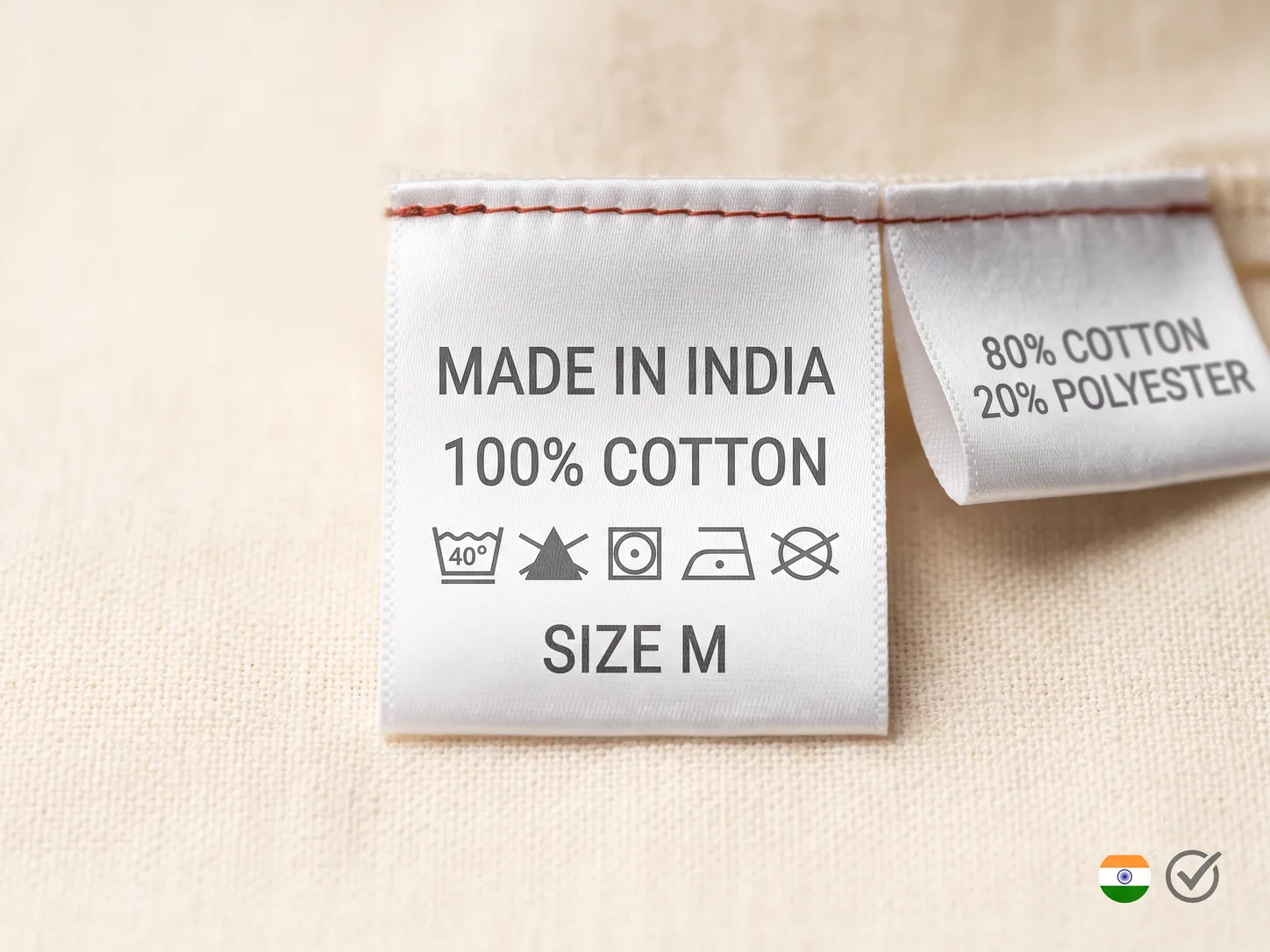
Under the Commerce (Trade Descriptions) Act and the Commerce (Imports) Regulations, listed goods imported into Australia must carry a trade description, and articles of apparel are on the list. The trade description must be in English, prominent and legible, in the form prescribed, and must include the country of origin of the goods. For a garment cut and sewn in India that is "Made in India" on a label attached to the garment. Goods without it can be held at the border.
The flip side is regulated too. Claims of Australian origin ("Made in Australia", "Australian Made" logos) are governed by the Australian Consumer Law's country-of-origin safe harbours and are not available to an imported garment, however much of the design or finishing is Australian. For imported goods the honest and required statement is the country of manufacture. Our country-of-origin guide covers the Indian-side rules for the same line.
Children's nightwear: fire-hazard labels
Australia's children's nightwear standard, based on AS/NZS 1249, is among the strictest in the world. It applies to children's nightwear and some limited daywear and paper patterns in sizes 00 to 14, and it does two things: it sorts garments into fire-hazard categories by fabric, design and fit, and it prescribes a label for each.
| Category | Typical garments | Required label |
|---|---|---|
| Categories 1 to 3 | Close-fitting pyjamas, garments in slow-burning fabrics, treated fabrics | White label: "LOW FIRE DANGER" in the prescribed form (category 3 adds a warning about treatment where relevant) |
| Category 4 | Loose-fitting garments in fabrics that burn more readily, such as some cotton nightdresses | Red label: "WARNING HIGH FIRE DANGER KEEP AWAY FROM FIRE" in white lettering |
| Fails all categories | Garments too flammable for any category | Cannot be supplied |
The label must be permanent, in the prescribed wording, size and colours, and visible at the point of sale, which in practice means a separate printed label at the neck or a prominent panel. The category depends on fabric testing and on the garment's design and fit, so it is the brand's technologist who decides which label a style gets; the label printer reproduces the prescribed artwork exactly. Our kidswear label safety guide covers the broader children's-wear labelling questions.
Fibre content and size: expected, not mandated
Australia once had a mandatory fibre-content labelling standard. It has been withdrawn, which surprises exporters who learned the rules a decade ago. Two things keep fibre content on every Australian label regardless:
- Retailer requirements. Every major Australian retailer and marketplace requires fibre composition by percentage on the care label, usually in the same order and format the EU and UK use: generic names, descending by weight, adding up to 100.
- The Australian Consumer Law. A composition that is stated must be true. "100% cotton" on a cotton-elastane jersey is misleading conduct whether or not a standard required the line.
Size labelling is likewise voluntary. The old Australian size standards have been withdrawn and brands use their own scales, often with international conversions. Children's sizes by age or height are common, and for nightwear the size matters because the standard's scope is set by size.
What Australian retailers add
As in the UK, the retailer's label specification is stricter than the law and governs the label you make. Expect requirements for care wording in the retailer's phrasing, ISO symbols, a minimum type size, fibre content, country of origin in a set form, the retailer's product or supplier code, a specified label position, and often a ban on certain label materials against skin in babywear. Many require label durability testing to a wash count. Get the spec before the artwork; it decides the label size.
Australian activewear and swimwear brands, a large share of the market, add their own practical requirements: labels that do not chafe under compression, heat-transfer or soft satin labels on tights and swimwear, and care wording that includes rinsing after chlorine or salt water. Our sportswear label guide covers the material choices.
Putting it on the label
- Material. Printed polyester satin or taffeta for the care label; the print is fused into the fibre and survives hot washing, chlorine, salt and sun. Soft satin or heat transfer where the label sits under compression garments.
- Content order. Fibre composition, care wording in Australian English with symbols, "Made in India", size, retailer codes. Nothing mandatory in a fold or under the seam allowance; the label guide shows safe areas.
- Type size. Six point is the realistic floor; retailers often ask for more on the origin and care lines.
- Brand label. Woven or printed at the neck, carrying the brand and perhaps the size; mandatory text lives on the printed care label where small type is cheap and accurate.
- Nightwear. The fire-hazard label is a separate, prescribed label in the prescribed colours, not a line on the care label.
- Multi-market styles. A garment also sold in Europe adds the EU fibre lines in local languages; the multilingual care label guide shows how to fit them.
Shipping to Australia
Labels for Australian brands either travel to the garment factory, in India or elsewhere, or to the brand in Australia for garments made there. For labels shipped to an Australian address we use international express courier with a commercial invoice and packing list; duty and GST, if charged, are paid by the importer. Our Australia guide covers the shipping, currency and payment side.
Getting Australia-ready labels made at Labelwala
We make woven and printed labels in Ahmedabad, Gujarat, and have been doing it for 25 years. We print care wording and symbols, fibre content, origin, size and retailer codes on satin and taffeta care labels, weave or print the brand label, and print nightwear fire-hazard labels to the prescribed wording and colours.
- Minimum order: 1,000 pieces per design.
- Quotes: we usually reply within 2 hours on a working day, in AUD if you prefer.
- Production: 7-10 days once artwork is approved. Rush jobs run 3-5 days.
- Care symbols: set to ISO 3758, with Australian English wording beneath.
- Wash fastness: grey-scale 4-5 through 50+ wash cycles on printed care labels.
Send the retailer's label spec, the tested fibre composition and the care instruction together, and for nightwear the category your technologist has assigned. We lay the label out, send a digital sample preview, and produce only after you approve it. You confirm the content; we make the label that carries it legibly through an Australian summer.
We are rated 5.0 on Google from 27 reviews.
Common mistakes
- Care symbols with no English wording.
- Care instructions on a swing tag or sticker instead of a sewn label.
- "Made in India" missing from an imported garment's label.
- An "Australian Made" claim on a garment sewn overseas.
- Children's pyjamas with no fire-hazard label, or a redesigned one.
- A category 4 nightdress carrying the white low-fire-danger label.
- Fibre content omitted because "it is not mandatory any more".
- Surface-printed cotton care labels that fade after a season of chlorine.
- "Dry clean only" on a washable garment to avoid testing.
- Retailer codes and position missed because the spec came after the artwork.
Pre-production checklist for Australia-bound labels
- Care instructions in English words, adequate for the fabric, with symbols added if wanted.
- Care label permanent, sewn in, legible at point of sale.
- "Made in India" on the garment label as the trade description.
- Fibre composition tested, generic names, descending order, adds up to 100.
- Nightwear classified by the brand's technologist; prescribed fire-hazard label specified.
- No Australian-origin claims on imported garments.
- Retailer spec in hand: wording, type size, position, codes, materials, durability test.
- Label material chosen for chlorine, salt and sun: printed polyester satin or taffeta.
- Fold and seam allowance checked; nothing mandatory hidden.
- Physical sample approved by the importer before bulk.
What we would recommend
Start with the care instruction, because in Australia it is the law and it has to be in English words on a permanent label. Put "Made in India" on every imported garment as the trade description. Treat children's nightwear as a separate job with a classification from the technologist and the prescribed label. Keep fibre content and size on the label because every retailer wants them and the composition must be true. Then choose a printed polyester label so that all of it is still legible after the garment's first summer.
Australia's rules are few but they are checked, at the border, in the store and in the laundry. A label built on these lines passes all three.