In brief
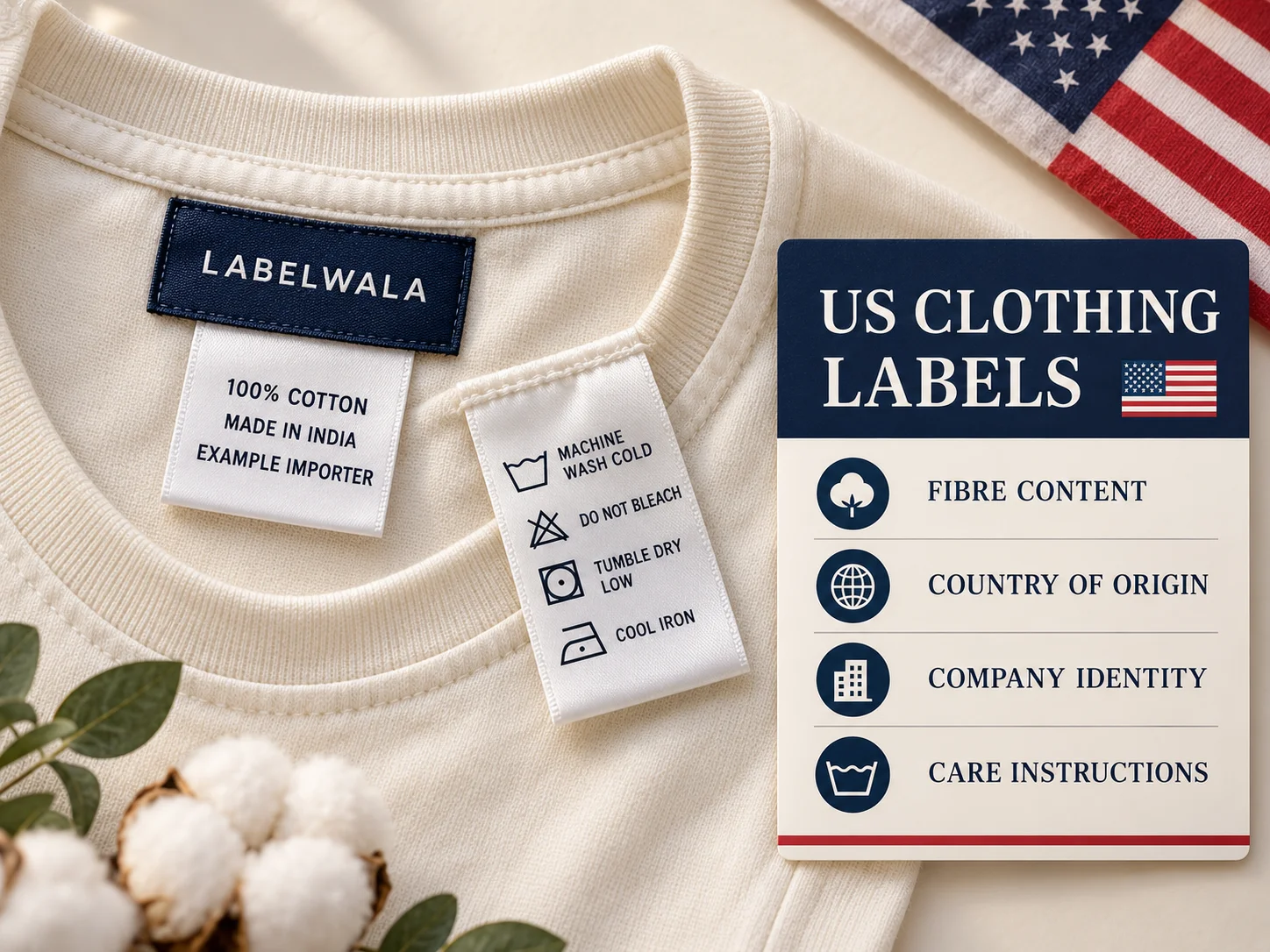
A garment sold in the US needs its fibre content by generic name and percentage, its country of origin, the name or RN number of the responsible company, and care instructions giving at least one safe cleaning method. Origin goes on the front of a label at the inside centre of the neck; fibre, RN and care may share that label or sit on another one that is easy to find. English is mandatory, other languages optional. Care instructions may be ASTM D5489 symbols alone.
This is a guide, not legal advice. The rules below are the Federal Trade Commission's textile labelling rules and Care Labeling Rule as they stand at publication. The FTC reviews both periodically and your importer's compliance adviser has the final word on your product. What follows is written for the person who has to turn a buyer's spec sheet into a label that gets made correctly in India and accepted in the United States.
We make labels, so this guide concentrates on what has to be on the physical label, where it goes, and how the artwork and material choices decide whether it still complies after a year of washing. The sourcing, lab-testing and customs-entry side is touched where it changes the label.
The three laws behind a US garment label
Three pieces of federal law decide what a clothing label in the United States must say. They are old, they overlap, and the FTC enforces all of them through rules published in the Code of Federal Regulations.
| Law | Rules | What it requires on the label |
|---|---|---|
| Textile Fiber Products Identification Act | 16 CFR Part 303 | Fibre content by generic name and percentage, country of origin, and the identity of the manufacturer, importer or marketer (name or RN) |
| Wool Products Labeling Act | 16 CFR Part 300 | The same three disclosures for anything containing wool, with wool-specific fibre terms and the "recycled wool" rules |
| Care Labeling Rule | 16 CFR Part 423 | At least one safe method of cleaning, on a permanent label the consumer can find, legible for the garment's useful life |
Alongside these, US Customs and Border Protection enforces its own country-of-origin marking law on imported goods, which for apparel points to the same label. A single well-made label satisfies all of them, and that is the practical goal: one spec, one artwork, one label that answers every inspector.
Fibre content: generic names and percentages
The fibre disclosure is the heart of the Textile Act. Every fibre present at 5% or more of the fibre weight is named by its generic name and its percentage, in order of predominance by weight. "100% Cotton", "65% Polyester 35% Cotton", "95% Cotton 5% Spandex". Brand names for fibres may appear only alongside the generic name, never instead of it, so "Lycra" has to read "Spandex (Lycra)" or similar.
- Generic names are the ones the FTC recognises: cotton, polyester, nylon, rayon, spandex, acrylic, wool, silk, linen, lyocell and the rest. Trade terms such as "viscose" are accepted where they are recognised generic names; marketing words such as "performance fibre" are not.
- Under 5% fibres are grouped as "other fiber" or "other fibers" with the combined percentage, unless the fibre has a clear functional significance, in which case it may be named with its function stated, for example "4% Spandex for elasticity".
- Tolerance is 3 percentage points on any stated fibre for blends; a label that says 60% cotton covers a fabric that tests at 57 to 63%. A "100%" or "all" claim has no tolerance apart from permitted ornamentation and trim.
- Trim and ornamentation are exempt within limits: decorative trim up to 15% of the surface area and ornamentation up to 5% of fibre weight need not be included, provided the label says "exclusive of decoration" or "exclusive of ornamentation".
- Linings, interlinings, fillings and paddings that are there for warmth are disclosed separately: "Shell: 100% Polyester. Lining: 100% Nylon. Fill: 100% Down".
Wool has its own vocabulary. "Wool" means new wool; "recycled wool" must be stated where the fibre has been reclaimed; and the specialty names such as cashmere, mohair and alpaca may be used for the fibre they describe. A cashmere claim that fails a fibre test is one of the most common grounds for a US retailer to reject a shipment, so the fibre test comes before the label artwork.
Country of origin: wording and placement
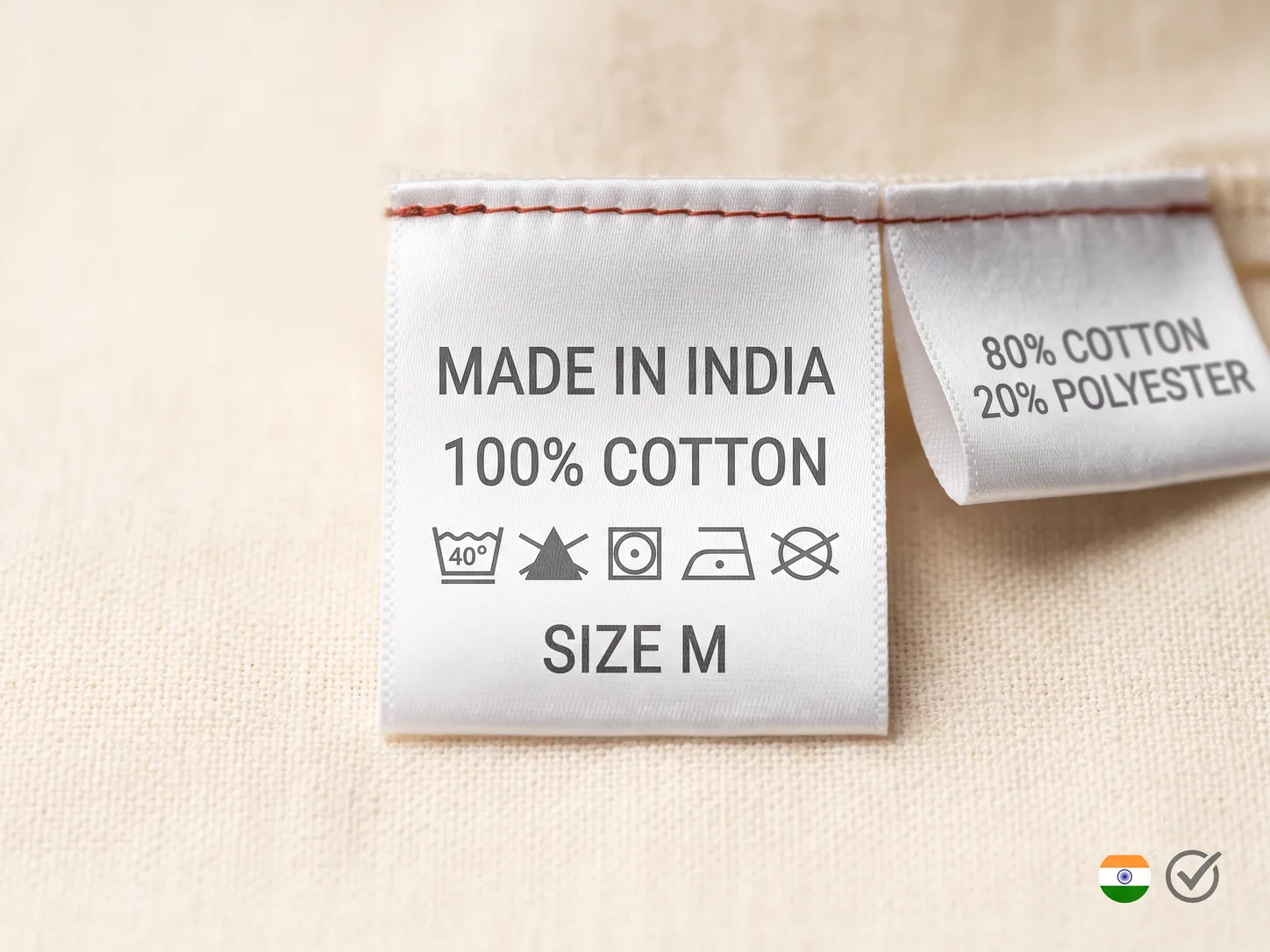
Every imported garment must say where it was made, and the Textile Act is specific about where that statement sits. For a garment with a neck, the origin label goes on the inside centre of the neck, midway between the shoulder seams, or on another label in that position. For garments without a neck, it goes in a conspicuous location where the consumer will find it. In both cases the statement has to be on the front of the label. Fibre content and RN may be on the reverse of the same label if the label is accessible, but the origin may not.
| Situation | Required wording |
|---|---|
| Garment cut and sewn in India from Indian fabric | Made in India |
| Garment sewn in India from imported fabric | Made in India (sewing is the origin-conferring step for most apparel) |
| Imported fabric, cut and sewn in the US | Made in USA of imported fabric, or similar qualified claim |
| Everything done in the US | Made in USA (the FTC's "all or virtually all" standard applies) |
The origin country is spelled out in English. "India" is fine; "Bharat" on its own is not, because the rule wants the name a US consumer recognises. Abbreviations are not accepted for origin. Keep the origin wording in the same type size as the rest of the required information so it is not argued to be hidden.
The origin label is the one customs reads. Fibre and RN errors are usually caught by retailer QA and fixed with a sticker or a re-label. A missing or wrong country of origin is a customs marking violation, which means a held shipment and a marking duty or a re-export order. Check it on the sample, not the invoice.
RN numbers and company identity
The third disclosure is who is responsible for the garment: the manufacturer, importer or marketer. It can be the company's full name, as it appears on business documents, or its Registered Identification Number, written as "RN" followed by the digits. The FTC issues RNs free of charge to businesses based in the United States, and keeps a public lookup so anyone can turn an RN back into a company name.
- An Indian exporter cannot hold an RN. The number on the label belongs to the US brand or importer, and the exporter must have it in writing before artwork starts.
- A brand name may be used instead of the legal name only if it is registered as a trademark with the US Patent and Trademark Office and the FTC has a copy of the registration. Most brands use the RN to avoid the question.
- Canadian CA numbers are not accepted in place of an RN, and vice versa. Garments sold in both countries carry both.
- Private-label programmes put the retailer's RN on the label, not the factory's buyer's. Confirm whose number goes on which style when a factory sews for several labels.
The RN may share the origin label (on the front or the reverse) or sit on a separate label, as long as it is in an accessible place. Our private label and relabelling guide covers the identity question when garments change hands before sale.
Care instructions: the Care Labeling Rule
The Care Labeling Rule is the part of US law that most resembles what the rest of the world calls a care label. It requires the manufacturer or importer to attach a permanent label giving at least one safe cleaning method, with any warnings needed to follow it, and to have a reasonable basis for that instruction. The label must be attached so the consumer can see it or find it easily at the point of sale, and must stay legible for the useful life of the garment.
For a washable garment the instruction has four elements, in this order, and each is given or implied:
| Element | What to state | Example |
|---|---|---|
| Washing | Hand or machine, water temperature if hot water would harm the garment, and cycle if a regular cycle would harm it | Machine wash cold, gentle cycle |
| Bleaching | If all commercially available bleaches are safe, nothing is needed; otherwise "Only non-chlorine bleach, when needed" or "Do not bleach" | Only non-chlorine bleach, when needed |
| Drying | Method, and temperature if high heat would harm the garment | Tumble dry low |
| Ironing | Only if ironing is needed on a regular basis, with temperature if a hot iron would harm the garment | Cool iron if needed |
| Warnings | Anything a consumer could reasonably be expected to do that would harm the garment or others washed with it | Wash with like colours |
For a dry-cleaned garment the instruction is "Dryclean" or "Dry Clean Only", with a solvent or process warning if a common solvent or a normal process would damage it, for example "Dryclean, petroleum solvent only" or "Dryclean, no steam". A garment that can be either washed or dry-cleaned need only state one method, though many brands give both.
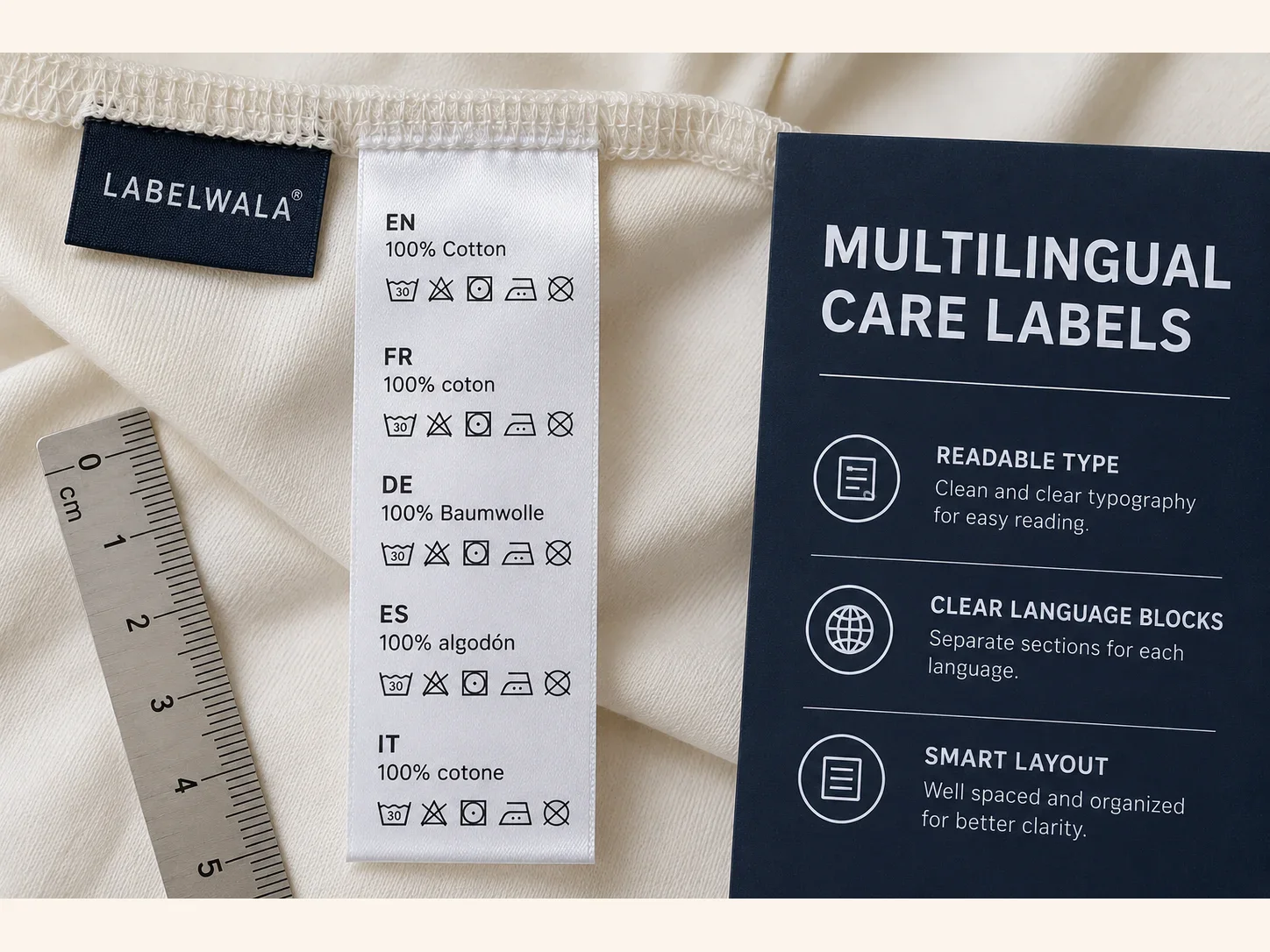
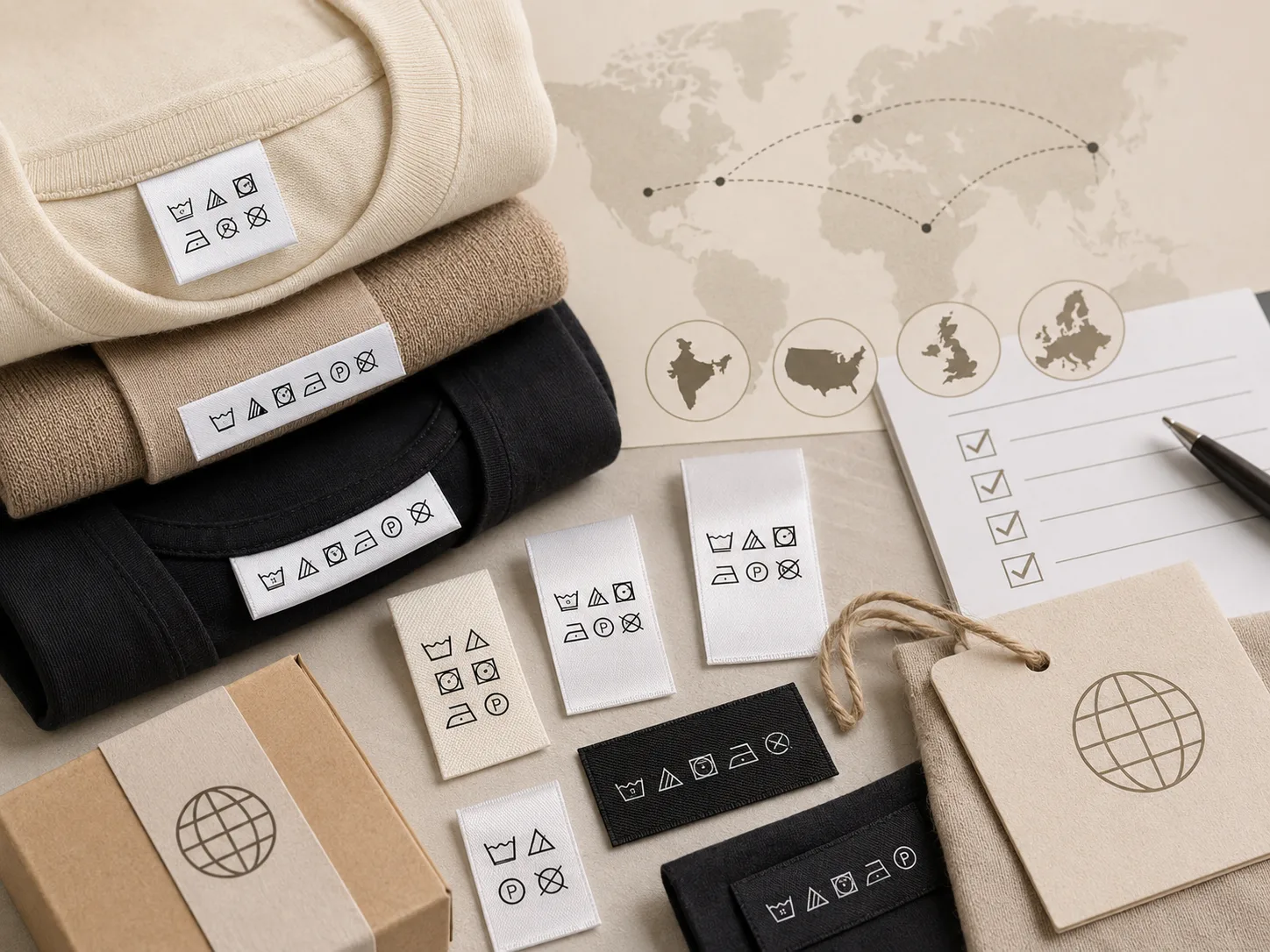
The FTC allows the care symbols in ASTM D5489 to be used in place of words, without text, as long as they convey the same instruction. These are the washtub, triangle, square, iron and circle symbols US consumers see on most garments. They are compatible with, but not identical to, the ISO 3758 symbols used in Europe and the GINETEX system; the main differences are in how temperatures and dry-cleaning solvents are shown. A garment sold on both sides of the Atlantic usually carries ISO symbols plus the US wording, or both symbol sets. Our multilingual care label guide shows how to lay that out without a label the size of a pocket.
Reasonable basis. The rule does not tell you what to write; it tells you to be able to justify it. A care instruction backed by a wash test on the actual fabric, or by reliable experience with that fabric and construction, is defensible. "Dry clean only" on a washable cotton shirt, chosen to avoid testing, is the kind of over-cautious instruction the FTC has specifically said it does not accept.
Exemptions worth knowing
A few categories escape part of the rules, and knowing them stops you from over-labelling or, worse, assuming an exemption that does not apply.
- Totally reversible garments without pockets may carry care instructions on a hang tag instead of a permanent label.
- Garments that survive any method, meaning they can be washed, bleached, dried, ironed and dry-cleaned by the harshest common method without damage, may use a hang tag that says so. Few garments qualify honestly.
- Institutional sales of garments sold directly to businesses for their own commercial use, such as uniforms sold to a hospital, are exempt from the Care Labeling Rule. They are not exempt from the fibre and origin rules.
- Items outside the rules include handkerchiefs, hats, gloves, footwear, belts and suspenders for care labelling; and for fibre labelling, a list that includes certain trims, linings not for warmth, and products already covered by the Wool or Fur acts.
- Labels themselves, sewing thread, and findings are not textile products for the purpose of the fibre disclosure, so the composition of the care label fabric is not stated on it.
Exemptions are read narrowly by inspectors and by retailer QA. If you are relying on one, have the citation in the tech pack.
Putting it on the label: layout and materials
The law says nothing about label size, material or font. The practical requirements come from the durability rule and from what US retailers specify. A typical US-bound labelling set is:
| Label | Carries | Usual material |
|---|---|---|
| Neck label (woven or printed) | Brand mark; often size; country of origin on the front; RN and fibre may go on the reverse | Damask or satin woven; printed satin for tagless-feel; heat transfer for tagless |
| Care label (side seam) | Fibre content, RN, country of origin, care instructions, often in English and Spanish | Printed polyester satin or taffeta; multi-page for several languages |
| Size tab | Size, sometimes origin for garments where the neck label is a heat transfer | Woven or printed |
Three choices decide whether the label still complies after a year:
- Material. Polyester satin and taffeta hold print through domestic washing because the dye is fused into the fibre. Surface prints on cotton tape fade. A care label that is unreadable after thirty washes has failed the "useful life" test.
- Type size. Nothing in the rule sets a point size, but a label the consumer cannot read is not conspicuous. Six point is the realistic floor for printed care labels; US retailers often specify larger for the origin line.
- Fold. Required text must not fall into a fold or under a stitch line. A centre-fold care label puts the origin on the outside face; an end-fold label loses a few millimetres each side to the seam allowance. Our label guide shows the folds and the safe areas for each.
Heat-transfer "tagless" neck prints are legal and common, but they wear faster than sewn labels on fleece and knits, and an origin statement that has rubbed off is a marking violation at the point of sale, not just a cosmetic problem. Brands using heat transfers usually move the mandatory text to a sewn care label. The sew-in versus heat-transfer guide covers the trade-off.
Language, size labels and the extras retailers add
All required information must be in English. Other languages may be added, and Spanish is common on US mass-market garments, provided the English is complete and the translations say the same thing. There is no federal size labelling law for adult clothing, so sizes follow brand or retailer convention. Children's sleepwear has flammability rules from the Consumer Product Safety Commission that bring their own labelling, and that is a separate article; our kidswear label safety guide is the starting point.
What a US retailer adds on top of the law is usually more demanding than the law itself: a specific care wording set, a required label position measured from the seam, a minimum type size, a UPC or RFID requirement on the hang tag, and a ban on certain fibres in the label tape. Get the retailer's label spec before the brand's artwork, because the spec changes the label size and the label size changes the artwork.
Getting US-ready labels made at Labelwala
We make woven and printed labels in Ahmedabad, Gujarat, and have been doing it for 25 years. We print fibre content, origin, RN and care text on satin and taffeta care labels, weave or print the neck label, and ship to US addresses by international courier with a commercial invoice and packing list; our United States guide covers the shipping and payment side.
- Minimum order: 1,000 pieces per design.
- Quotes: we usually reply within 2 hours on a working day, in USD if you prefer.
- Production: 7-10 days once artwork is approved. Rush jobs run 3-5 days.
- Care symbols: ASTM D5489 or ISO 3758 as your spec requires, or both.
- Wash fastness: grey-scale 4-5 through 50+ wash cycles on printed care labels.
Send the retailer's label spec, the brand's RN, the tested fibre content and the care instruction together. We lay them out on the label size the spec allows, send a digital sample preview for approval, and only then go into production. The content is yours to confirm; the label that carries it legibly for years is ours.
We are rated 5.0 on Google from 27 reviews.
Common mistakes
- Country of origin printed on the reverse of the neck label.
- "Made in India" missing on garments whose brand label is a heat transfer that has worn off.
- Fibre percentages that do not add up to 100, or a "100% Cotton" claim on a fabric with 4% spandex.
- A brand name used as the identity without a registered trademark and no RN.
- The factory's or agent's name on the label instead of the US importer's RN.
- "Dry clean only" on a washable garment to avoid wash testing.
- Care wording that gives bleach or drying instructions in the wrong order or leaves out a needed warning.
- Label text in Spanish only, or Spanish that does not match the English.
- Six-point text printed on cotton tape that fades by the tenth wash.
- Required text falling into a fold or under the side-seam stitching.
Pre-production checklist for US-bound labels
- Fibre content from a lab test or mill certificate, generic names, adds up to 100, ornamentation handled.
- Country of origin agreed with the importer and placed on the front of the neck-position label.
- RN or legal company name from the US importer, in writing, and verified in the FTC lookup.
- Care instruction with a reasonable basis, all four elements covered, warnings included.
- ASTM D5489 symbols, words, or both, as the retailer spec requires.
- English complete; any Spanish checked against it.
- Label material chosen for the garment's wash life: polyester satin or taffeta for care labels.
- Type size and fold checked so no required text is hidden or cut.
- Retailer's label spec (position, size, UPC) in hand before artwork.
- Physical sample approved by the importer before bulk.
What we would recommend
Treat the US label as a spec sheet exercise rather than a design one. Collect the four facts first: tested fibre content, origin, the importer's RN, and a care instruction you can defend. Put the origin on the front of the neck-position label and the rest on a printed polyester care label in the side seam, in English, with ASTM symbols if the brand wants them. Get the retailer's label spec before the artwork, because it decides the label size. Then sample it, wash it, read it, and only then approve bulk.
The law has barely changed in decades, which is the good news: a label that complied five years ago complies today, and a label built this way will still be readable, and still legal, when the garment is handed down.