
In brief
Keep labels consistent by storing your approved first sample, reusing the exact same artwork file, specifying the same Pantone codes and reordering from the supplier who holds your approved reference. Drift happens when colour was never pinned to Pantone, the file or supplier changed, or there is no sample to match against.
Your first label batch came out exactly right. Then months later you reorder, and the red is a shade off, or the weave feels slightly different. Put the two batches side by side on a shelf and customers notice, even if they can't say why. Consistency is branding.
The good news: keeping every batch identical isn't luck. It comes down to a few simple habits around your sample, your colours and your artwork. Here they are.
The four habits that prevent drift
- Your approved first sample is the benchmark
- Match every batch to it
- Store it with your artwork
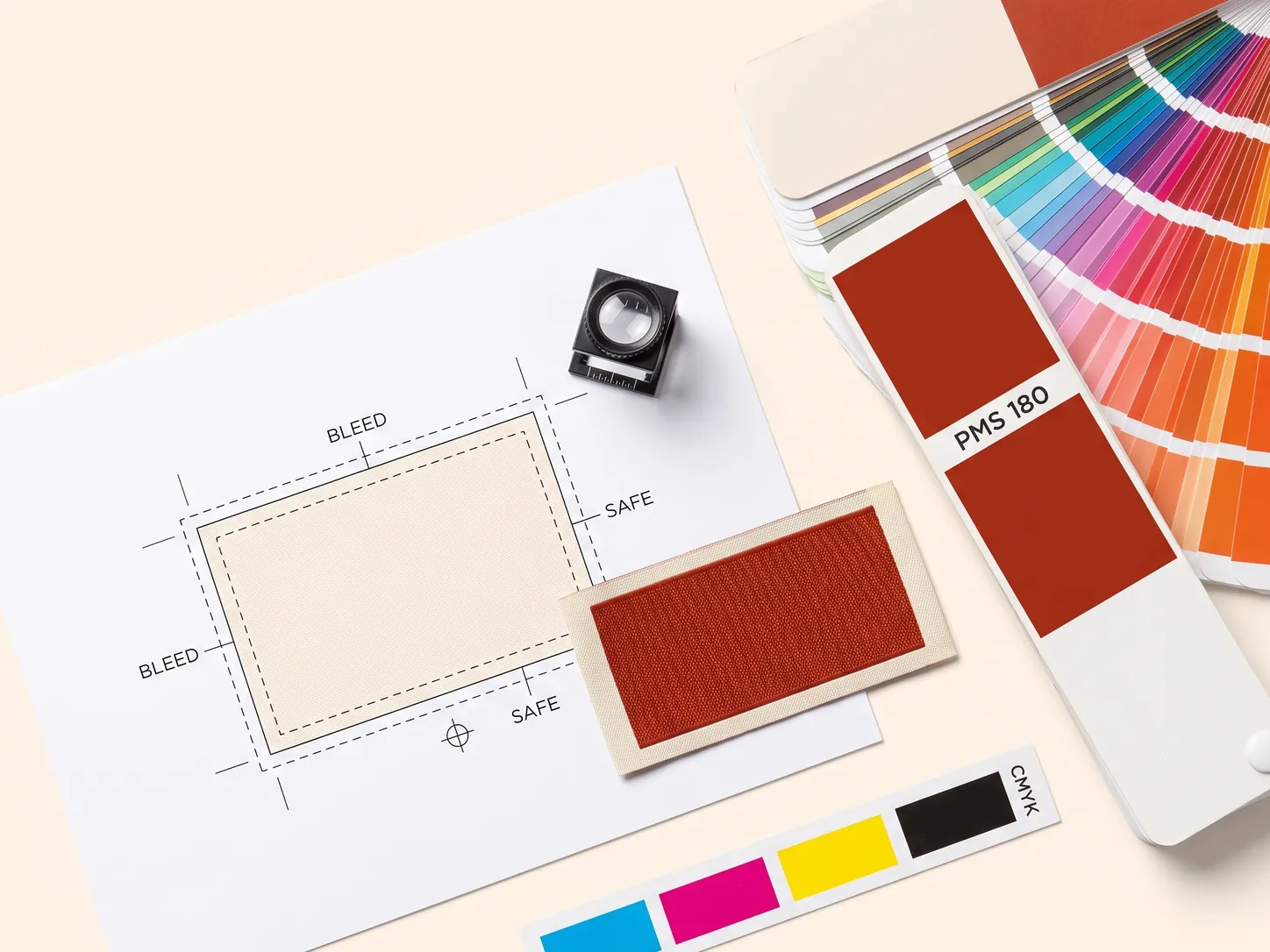
- A fixed, universal colour target
- Not dependent on a screen or memory
- Same code every order
- The exact same file every time
- No re-created or edited versions
- Keep it with your spec
- They have your approved reference
- Ask to match your sample
- Setup & die already exist
Why do reordered labels drift in colour?
Labels drift between batches when the colour was never pinned to a Pantone reference, when a different artwork file or supplier was used, or when there's no approved sample to match against. Small thread dye-lot or ink differences can creep in without a fixed target. An approved sample plus a Pantone code gives the supplier an exact benchmark, and removes the guesswork.
Why are label reorders usually cheaper?
Repeat runs cost less. Reordering the same design is usually more economical than a brand-new label, because the artwork, setup and any die already exist. You mainly pay to produce the new quantity: which is why ordering a reusable core label (like your neck label) a little larger and reordering as needed often works out cheaper overall.
What should you give your supplier for a reorder?
- Original artwork or your previous order reference
- The same Pantone codes
- The label spec and size
- Your approved sample (or its reference) to match against
Referencing your previous approved order makes the reorder fast and keeps it consistent with earlier batches. This is the pay-off for setting things up properly on the first order.
Why colour drifts at all
It helps to know the mechanism, because it explains why a Pantone code alone is not a complete answer.
Woven labels get their colour from pre-dyed thread, and thread is dyed in batches called dye lots. Two lots of the same thread reference, dyed months apart, can differ very slightly, not enough to notice alone, easily enough to notice against last season's label. The mill matches to a thread number rather than to a colour you describe, which is why recording the thread number matters as much as recording the Pantone.
Printed labels drift differently. The ink is mixed to a recipe, and the base it lands on has its own slight variation in whiteness and absorbency. The same recipe on a marginally different substrate gives a marginally different result, so here it is the ink recipe reference you want on file.
The practical rule: Pantone is how you communicate the target; the supplier's own reference is how it gets reproduced. Ask for both to be recorded against your account, and ask for the reference number itself rather than an assurance that it has been kept.
Why should you write a label spec sheet once?
The most useful thing you can do after a first order is spend twenty minutes writing down what you actually bought, not the quote, the specification. Every reorder afterwards becomes a document rather than a memory.
- Material and quality: woven damask, taffeta, printed satin, and the grade if one was quoted.
- Finished size and cut size, with the fold named explicitly.
- Fold type, and for loops the total tape length.
- Colour references: Pantone targets plus the supplier's thread or ink numbers.
- Number of colours, since it drives price and any change is worth spotting.
- Edge finish: heat cut, laser cut or folded.
- Letter height in millimetres for any small text.
- Placement and stitch instruction, so the garment maker repeats it too.
- Artwork filename and version, and where the master file lives.
- Order date, supplier, batch reference and quantity.
Keep it with the physical sample and the artwork in one place. Brands lose consistency far more often through staff turnover than through supplier error. The person who knew what was ordered has moved on, and nobody wrote it down.
How much variation is acceptable?
Perfect identity is not achievable, and demanding it makes reorders slow and expensive. Useful tolerance looks like this:
- Colour: should be indistinguishable held side by side in daylight. Having to look twice is fine. Seeing it across a table is not.
- Size: a fraction of a millimetre on cut length is normal. A visible difference in the finished panel is not.
- Weave or print density: should look identical. Variation here usually signals a changed material rather than tolerance.
- Hand feel: should be the same. Noticeably different stiffness means the base changed.
Always judge against your kept sample rather than against the previous batch, and always in the same light. Comparing each batch to the one before it lets drift accumulate a little at a time, until batch six is visibly different from batch one with no single step you could have objected to. Comparing everything back to the original reference stops that.
How do you keep labels consistent when changing supplier?
Sometimes it is unavoidable. Changing supplier resets everything the four habits protect, so treat the first order with a new one as a first order not a reorder.
- Send the physical sample, not a photograph and not a Pantone code alone. The sample is the only complete reference.
- Send the spec sheet, so they can match material and construction rather than only colour.
- Expect to sample properly, and budget the calendar for it.
- Ask explicitly for a match to the sample, and for their own references to be recorded against your account.
- Accept a small step at the changeover, and schedule it between seasons rather than mid-range.
One practical tactic: make the transition order slightly larger than usual. It buys a buffer while the new relationship settles, and fewer garments end up carrying the changeover.
Why do fewer, larger reorders beat many small ones?
Every reorder is an opportunity for drift, so the arithmetic favours ordering less often. Two orders a year of the same label are two chances for a difference; six are six.
Labels also cost less per piece in larger runs, do not perish, and take almost no space to store. For anything that is not seasonal, your main brand label, usually your care label, ordering to cover a longer horizon is cheaper, more consistent, and takes label lead time out of your production planning at the same time.
Store them sealed, dry, out of direct sunlight and away from anything that could crush the folds. Sunlight is the one that catches people out: a stack left near a window fades unevenly across the pile, and the labels at the top no longer match the ones underneath.
Keep one master artwork file
Artwork drift is quieter than colour drift and harder to spot, because nothing looks wrong. The label is simply a slightly different label from the one before it.
It happens when a file gets rebuilt instead of reused. A designer leaves, the original is not to hand, and someone recreates the logo from a PDF or redraws it from a print. The result is close, and close is exactly the problem: nobody notices at proof stage, and the two versions sit side by side in a wardrobe six months later.
- Keep one master vector file with fonts converted to outlines, so it cannot re-render differently on another machine.
- Name it with a version and never overwrite the approved version in place.
- Keep the working file, not just the export. Each generation of PDF made from another PDF gives up a little more, and a reorder built from the last one starts behind.
- Record which version was approved against each order, so a dispute has an answer.
- Store it with the spec sheet and the sample, not in one person's inbox.
If you genuinely have to change the artwork, a new address, an updated composition, treat it as a new version rather than an edit, keep the old one, and expect to sample again. Our artwork setup guide covers preparing the file itself.
Mistakes that cause drift
- Approving colour from a screen instead of a physical sample.
- Not keeping the approved sample, so there is nothing to match against.
- Recording a Pantone but not the supplier's thread or ink reference.
- Recreating the artwork rather than reusing the master file.
- Comparing each batch to the previous one, letting drift accumulate step by step.
- Splitting a range between two suppliers and expecting the whites to match.
- Ordering small quantities frequently, multiplying the chances of a difference.
- Storing labels where sunlight reaches them.
- Losing the specification when the person who placed the first order moves on.
Reordering from Labelwala
We make woven and printed labels in Ahmedabad, Gujarat, and we have been doing it for 25 years, so a good share of what we run is repeat work against a stored reference.
- Minimum order: 1,000 pieces per design.
- Quotes: usually within 2 hours on a working day. Reorders are faster still, since there is nothing to specify.
- Production: 7-10 days from approval, and a repeat of an unchanged label needs little more than that plus transit.
- Delivery: across India, depending on destination and consignment size.
Quote your previous order reference and ask us to match your approved sample. If anything has changed, a colour, a size, a line of text, say so explicitly, because that turns a reorder back into a sampling job and it is better to plan for it than discover it.
If it has been a long time since the last run, ask for a fresh sample against the stored reference before committing the full quantity. It costs a few days and it confirms the match while the order can still be adjusted.
We are rated 5.0 on Google from 27 reviews.
Checking a reordered batch
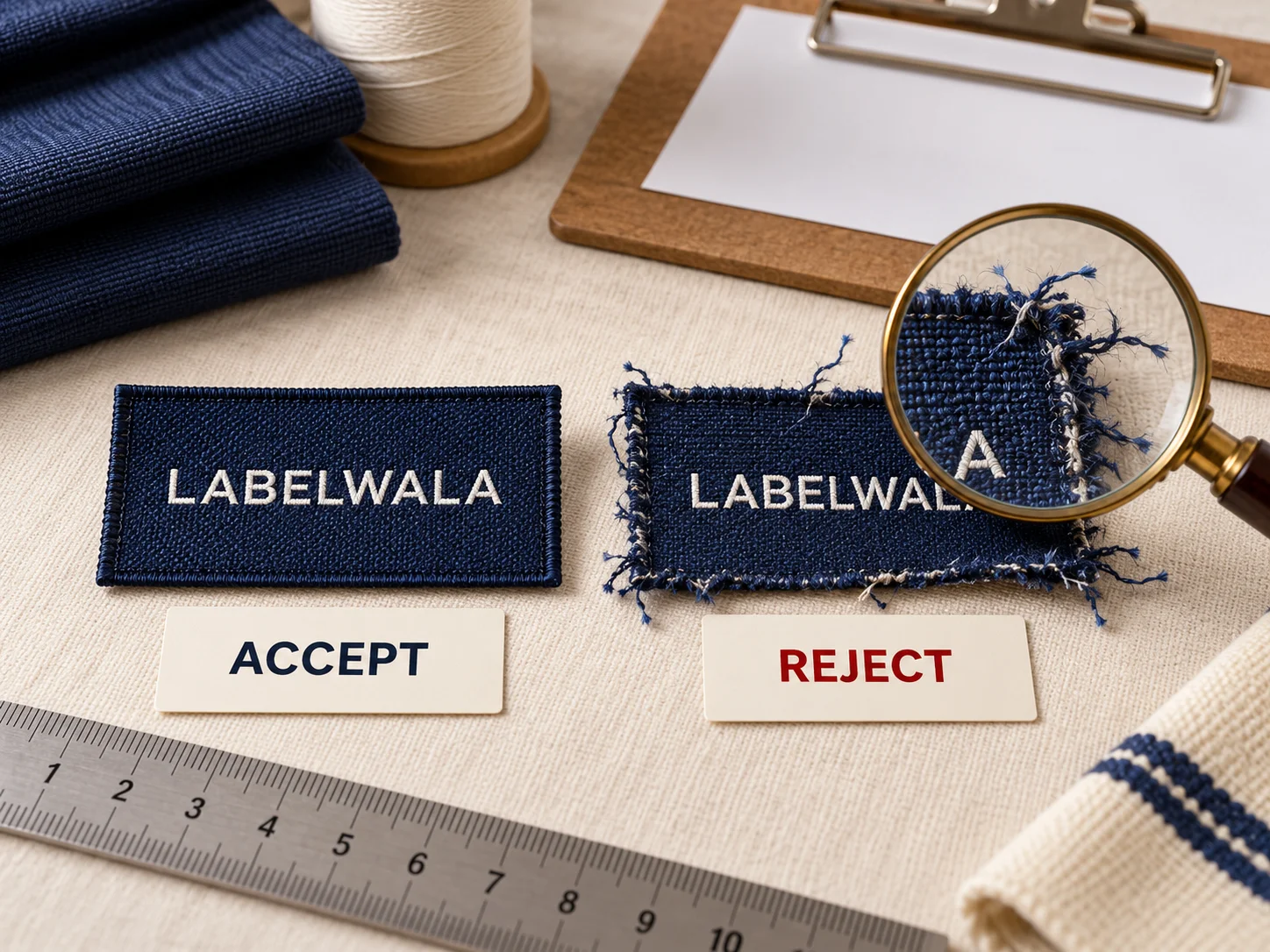
When the reorder arrives, compare it directly against your kept sample and your previous batch (colour, size, print, edges, feel), pulling labels from across the run (see our QC checklist). If anything has drifted from your reference, raise it before accepting, with the sample as your objective benchmark.
The short answer
Keep labels identical across reorders with four habits: keep your approved first sample as a physical benchmark, specify the same Pantone codes every time, reuse the exact artwork file, and reorder from the same supplier and ask them to match your sample. Reorders are usually cheaper than a new label because the setup already exists. Check each new batch against your kept sample before accepting. Store your sample, artwork and spec together, and every batch will match the first.