In brief
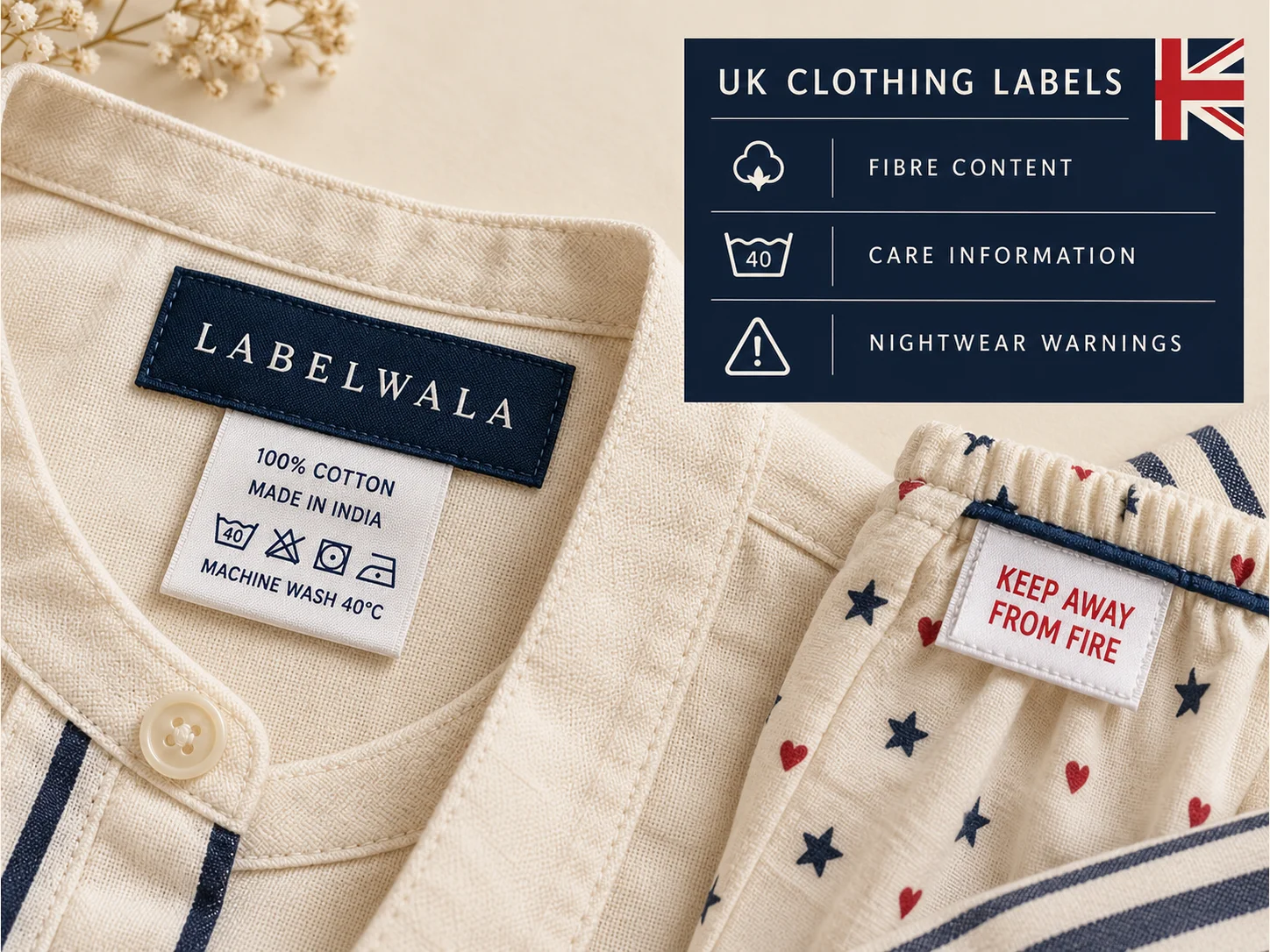
Under the Textile Products (Labelling and Fibre Composition Indication) Regulations 2012, a garment sold in Great Britain must show its fibre composition in English by generic fibre name and descending percentage, on a durable, legible, accessible label, plus the statement "Contains non-textile parts of animal origin" where that applies. Care symbols, size and country of origin are voluntary but universally expected. Children's nightwear must carry a prescribed flammability label. Northern Ireland applies the EU regulation instead, with the same result in English.
This is a guide, not legal advice. It describes the UK rules as they stand at publication and the retailer practice around them. Your importer, your retailer's technical team or a compliance adviser confirms the content for your product. What follows is written for the person who has to turn a UK buyer's label spec into artwork that gets produced correctly in India.
We make labels, so this guide concentrates on the physical label: what must be on it, what is optional, and how material and layout decide whether it still complies after a year of washing.
The law: the Textile Products Regulations 2012
When the UK was in the EU, Regulation (EU) No 1007/2011 applied directly. The UK implemented its enforcement through the Textile Products (Labelling and Fibre Composition Indication) Regulations 2012, and after Brexit that regulation was retained in domestic law, so the substance did not change: the same fibre names, the same percentages, the same tolerances, the same animal-origin statement, with English as the language. Trading Standards officers in local authorities enforce it, and non-compliance is a criminal offence with fines.
| Territory | Rule | Language |
|---|---|---|
| England, Scotland, Wales | Textile Products (Labelling and Fibre Composition Indication) Regulations 2012 | English |
| Northern Ireland | EU Regulation 1007/2011 under the Windsor Framework | English |
For an exporter the practical point is that a label built for the EU with an English fibre line is also right for the UK, and vice versa. The two have not diverged on fibre labelling. Our EU textile labelling guide covers the European side in detail; this one covers what is different or specific in Britain.
The fibre composition line
The composition is the mandatory heart of the label. It is written from the generic fibre names in the regulations' schedule, which matches the EU's Annex I, in descending order of weight, with percentages.
- Generic names only. Polyamide, not nylon. Elastane, not Lycra or spandex. Lyocell, not Tencel. Viscose, not rayon. A brand name may sit beside the generic name, never replace it.
- Order and arithmetic. Largest first; the percentages add up to 100. "65% polyester 35% cotton".
- Small fibres. Under 5% may be grouped as "other fibres" with the combined percentage.
- "100%", "pure", "all". Single-fibre products only, with up to 2% other fibres where technically unavoidable (5% for carded products) and the exempt decorative and antistatic fibres. A trace of elastane ends the "100% cotton" claim.
- Tolerance. 3% of total weight between stated and tested percentages, plus the scheduled moisture allowances. Label what the test says, not what the mill promised.
- Components. Shell, lining and filling declared separately where they differ: "Outer: 100% polyester. Lining: 100% polyamide. Padding: 100% polyester".
- Uniform lettering. The composition must be in uniform type, easily legible, and not obscured by other words or pictures.
- Exempt items. Labels, thread, buttons, zips and other findings need no composition, so the care label does not state its own fabric.
Wool has its usual extra vocabulary: "fleece wool" or "virgin wool" is reserved for wool never previously used; cashmere, mohair and alpaca may be named for the fibre they describe. A cashmere claim that fails a fibre test is a Trading Standards matter, and UK retailers test. Our fibre content guide has the testing side.
Animal-origin parts
Retained from the EU rule: any textile product containing non-textile parts of animal origin must carry the words "Contains non-textile parts of animal origin" on the label. Leather patches, horn or shell buttons, feather or down fillings and fur trims all trigger it. Brands that want a clean label swap to synthetic or textile alternatives, which is one reason paper jacron patches have become standard on UK denim. If the part stays, the statement goes on the care label in English.
What is voluntary: care, size, origin
Three things exporters assume the UK requires are in fact optional under UK law.
| Information | UK law | Market reality |
|---|---|---|
| Care instructions | Not required | Expected by every retailer and marketplace as ISO 3758 symbols, usually with wording; retailer specs make them compulsory in practice |
| Size | Not required | Expected; UK sizes, often with EU and US conversions |
| Country of origin | Not required in Great Britain | Common, required by many retailers and by other export markets; if stated it must be true |
Voluntary is not the same as unregulated. Anything printed must not mislead under consumer protection law, and the Competition and Markets Authority has been active on environmental claims in fashion. "Sustainable", "eco" or "recycled" on a label needs evidence; our sustainable label guide explains the wording that survives scrutiny.
On care symbols: the washtub, triangle, square, iron and circle are the GINETEX system, standardised in ISO 3758 and licensed in the UK through the national GINETEX member. Brands and retailers hold the licence; a label maker reproduces the artwork they specify. The care symbol guide explains what each symbol and each dot or bar means, and the UK convention of pairing the symbols with a short phrase such as "Machine wash 40, do not tumble dry".
Children's nightwear: the mandatory flammability label
The Nightwear (Safety) Regulations 1985 are the one place UK clothing law becomes prescriptive about a label. They apply to children's nightwear, which includes pyjamas, nightdresses, dressing gowns and bathrobes, and they set both a flammability performance requirement and a labelling requirement.
| Garment | Requirement | Label |
|---|---|---|
| Children's nightdresses, dressing gowns, bathrobes | Must meet the low-flammability performance of BS 5722 | "LOW FLAMMABILITY TO BS 5722" in the prescribed format |
| Children's pyjamas, babies' garments, cotton terry towelling bathrobes | Exempt from the performance requirement but must be labelled | Red "KEEP AWAY FROM FIRE" warning in the prescribed format, white lettering on red |
| Adult nightwear | No performance requirement | Must carry "KEEP AWAY FROM FIRE" unless it meets BS 5722 |
| Garments treated with flame-retardant chemicals | Performance as above | Additional wording on washing to preserve the treatment |
The label must be permanent, in the prescribed wording and colours, and visible at the point of sale, which usually means a separate printed label at the neck or a prominent panel on the care label. Red-ground white-text warning labels are a standard job for a label printer, but the wording and the colour are not open to design interpretation. Our kidswear label safety guide covers the wider children's-wear labelling questions, including drawstrings and small-part warnings that come under general product safety rather than nightwear law.
Nightwear is checked. Trading Standards and the large retailers test children's nightwear and inspect the labels, because the risk is a child on fire. A missing or mis-worded flammability label on a shipment of children's pyjamas is a recall, not a relabel. Confirm the garment classification and the exact label with the buyer's technologist before artwork.
What UK retailers add on top of the law
The difference between the UK law and a UK retailer's label spec is large, and it is the spec that governs the label you actually make. A typical high-street or online retailer spec asks for:
- Care wording in a fixed order and phrasing, with the ISO symbols, sometimes with the retailer's own additional symbols or icons.
- A minimum type size, commonly 6 or 7 point for the composition and care text, larger for the size.
- Position: care label in the left side seam at a set distance from the hem, brand label at the centre back neck, size tab in a set place.
- Retailer data: supplier code, style or product reference, department, sometimes a season code, on the care label.
- Country of origin in a set form.
- Material: many ban nylon care-label tape against skin on childrenswear, or require a specific satin or taffeta quality.
- Testing: label print durability and colourfastness to the retailer's method, sometimes with a required wash count.
Get the spec before the brand's artwork. It decides the label size, and the label size decides what the artwork can carry.
Putting it on the label
The law asks for durable, legible, visible and accessible. The spec asks for a particular size, position and type size. Between them the label design is largely decided:
- Printed polyester satin or taffeta for the care label, where the print is fused into the fibre and survives domestic washing. A composition that fades is no longer legible, and UK retailers test for this.
- A woven label for the brand at the neck, carrying the brand and perhaps the size. Mandatory text can live here, but it is usually cheaper and more legible on the printed care label.
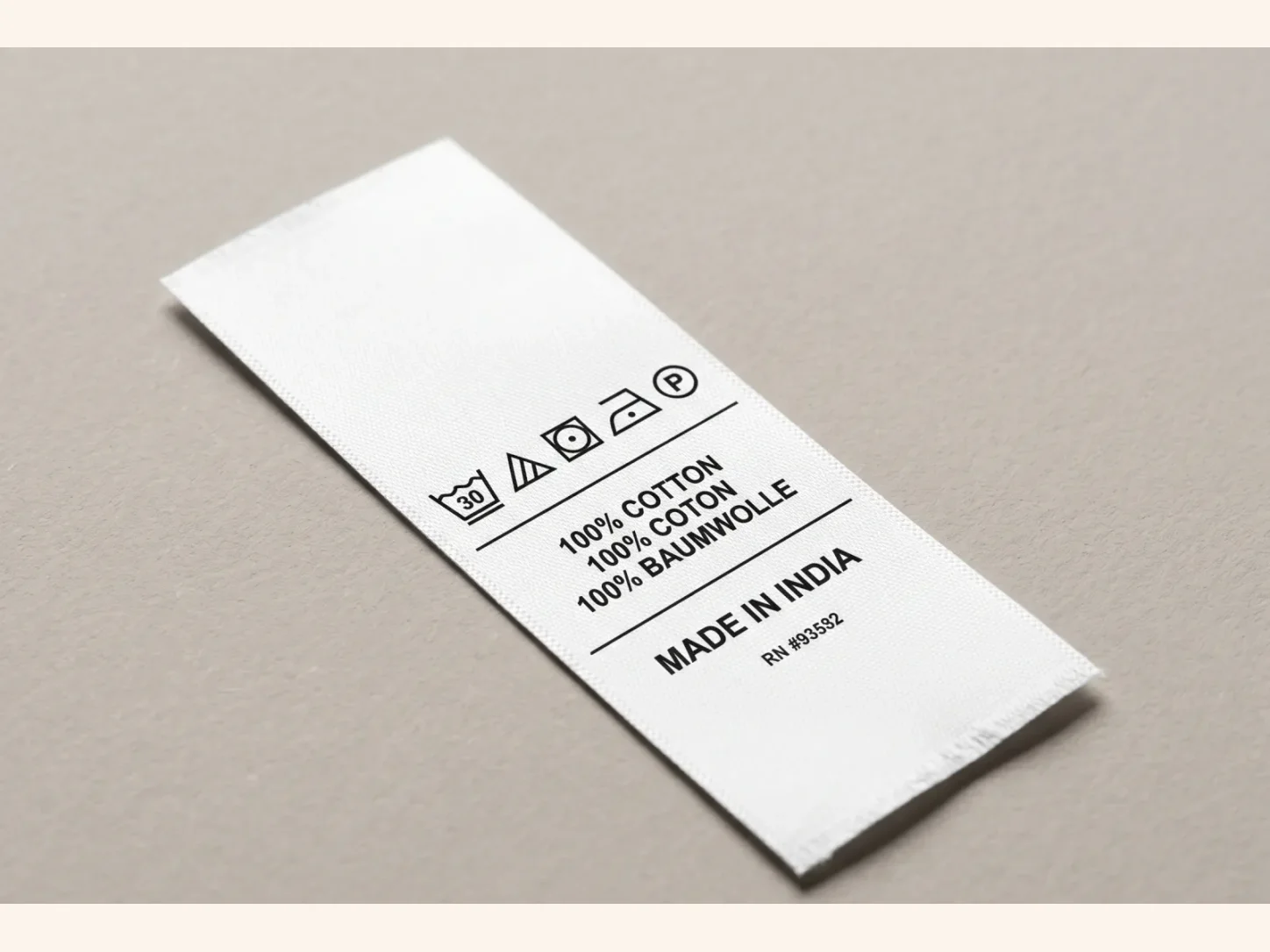
- Layout: composition first in uniform type, animal-origin statement if needed, care symbols with wording, size, origin, retailer codes. Nothing mandatory in a fold or under the seam allowance; our label guide shows the safe areas for each fold.
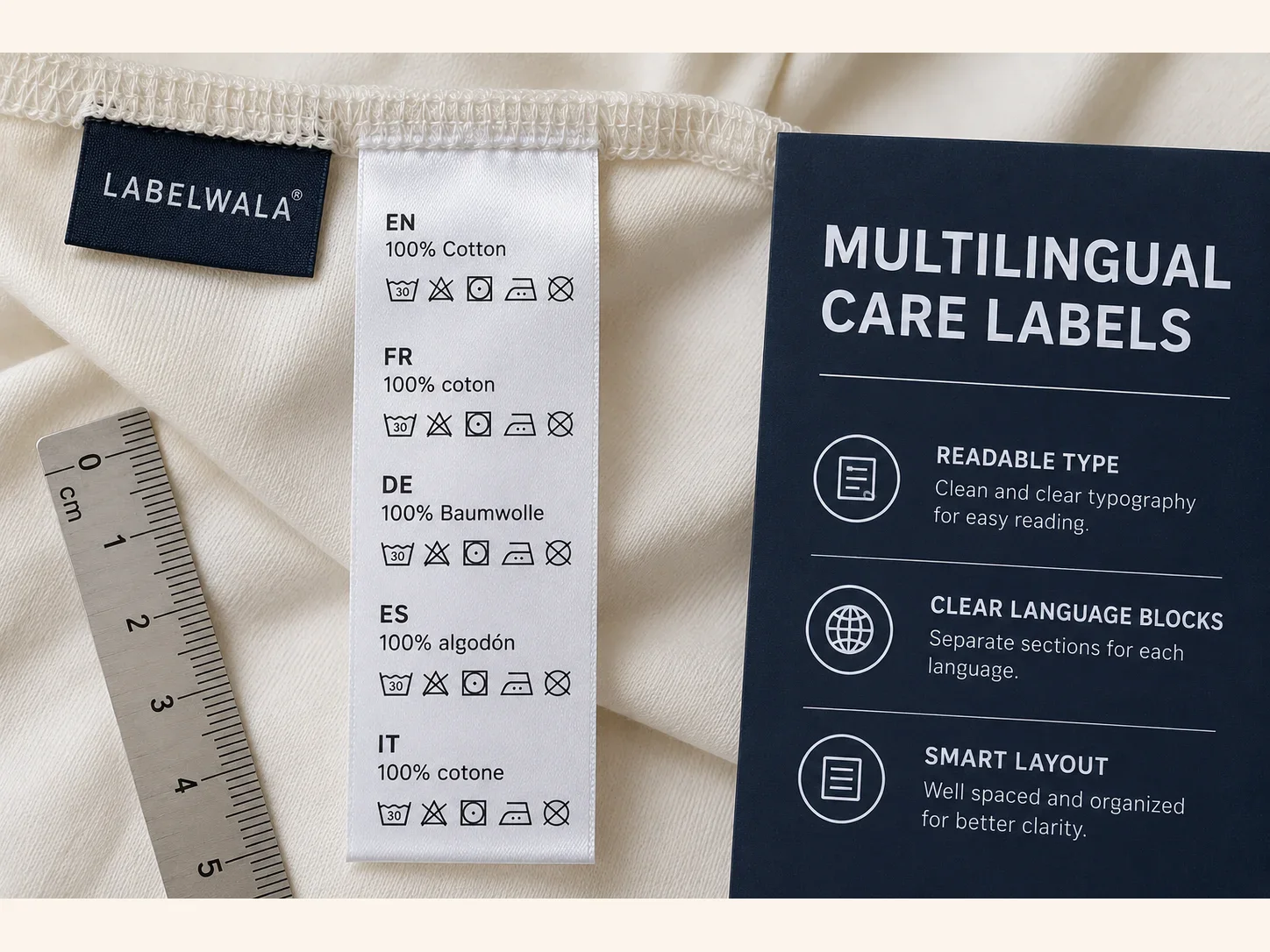
- Bilingual for the EU: a garment sold in the UK and on the continent carries the English composition plus the EU languages, so the UK-only label and the UK-plus-EU label are different sizes. Decide the markets before fixing the size; the multilingual care label guide shows the layouts.
- Nightwear gets its separate, prescribed label, not a line on the care label.
Shipping to the UK, or not
Many UK brands have their garments sewn in India, and for them the label never travels to Britain on its own. We ship the labels to the garment factory in India, the factory sews them in, and the finished garments go to the UK with the label already in place. That saves the international freight entirely and is the pattern most UK brands manufacturing in India use. For labels shipped to a UK address, our United Kingdom guide covers courier, duty and payment.
Getting UK-ready labels made at Labelwala
We make woven and printed labels in Ahmedabad, Gujarat, and have been doing it for 25 years. We print composition, care, size, origin and retailer codes on satin and taffeta care labels, weave or print the neck label, and print nightwear flammability labels to the prescribed wording and colours.
- Minimum order: 1,000 pieces per design.
- Quotes: we usually reply within 2 hours on a working day, in GBP if you prefer.
- Production: 7-10 days once artwork is approved. Rush jobs run 3-5 days.
- Care symbols: set to ISO 3758.
- Wash fastness: grey-scale 4-5 through 50+ wash cycles on printed care labels.
Send the retailer's label spec, the tested fibre composition and the care wording together. We lay them out on the size the spec allows, send a digital sample preview, and go into production only after you approve it. You confirm the content; we make the label that carries it legibly for the life of the garment.
We are rated 5.0 on Google from 27 reviews.
Common mistakes
- "Nylon" or "Lycra" as the fibre name.
- "100% cotton" on a jersey with elastane.
- Composition in a different type size from the rest, or hidden under a fold.
- Leather patch with no animal-origin statement.
- Children's pyjamas without the "KEEP AWAY FROM FIRE" label, or with the wording redesigned.
- A nightdress labelled "LOW FLAMMABILITY TO BS 5722" without a test report.
- Care symbols drawn freehand instead of from licensed artwork.
- "Sustainable" or "eco" printed without evidence.
- Label sized for the UK alone on a style that also sells in the EU.
- Retailer codes missing because the spec arrived after the artwork.
Pre-production checklist for UK-bound labels
- Fibre composition from a lab test, in generic names, descending order, adds up to 100, in English.
- "100%" claims checked; elastane declared.
- Animal-origin statement added if leather, horn, shell, feather, down or fur is present.
- Care symbols from licensed artwork, wording in the retailer's phrase order.
- Size in the retailer's format; origin stated truthfully if used.
- Nightwear classification confirmed; prescribed flammability label specified if it applies.
- Retailer spec in hand: position, type size, codes, material restrictions.
- Markets decided; EU languages added if the style sells on the continent.
- Label material chosen to stay legible after the retailer's wash test.
- Physical sample approved by the buyer's technologist before bulk.
What we would recommend
Get the fibre composition tested and written in generic names; that is the whole of the law for most garments and the thing Trading Standards checks. Get the retailer's label spec before the artwork, because it adds everything else and sets the size. Treat children's nightwear as a separate job with its own prescribed label and a test report behind it. Put the mandatory text on a printed polyester care label, keep the woven label for the brand, and if the style also sells in Europe, size the label for the languages from the start.
The UK label is one of the simplest in the world to get legally right and one of the easiest to get commercially wrong, because the retailer's spec is where the detail lives. Read the spec as carefully as the law and both will be satisfied by the same label.