In brief
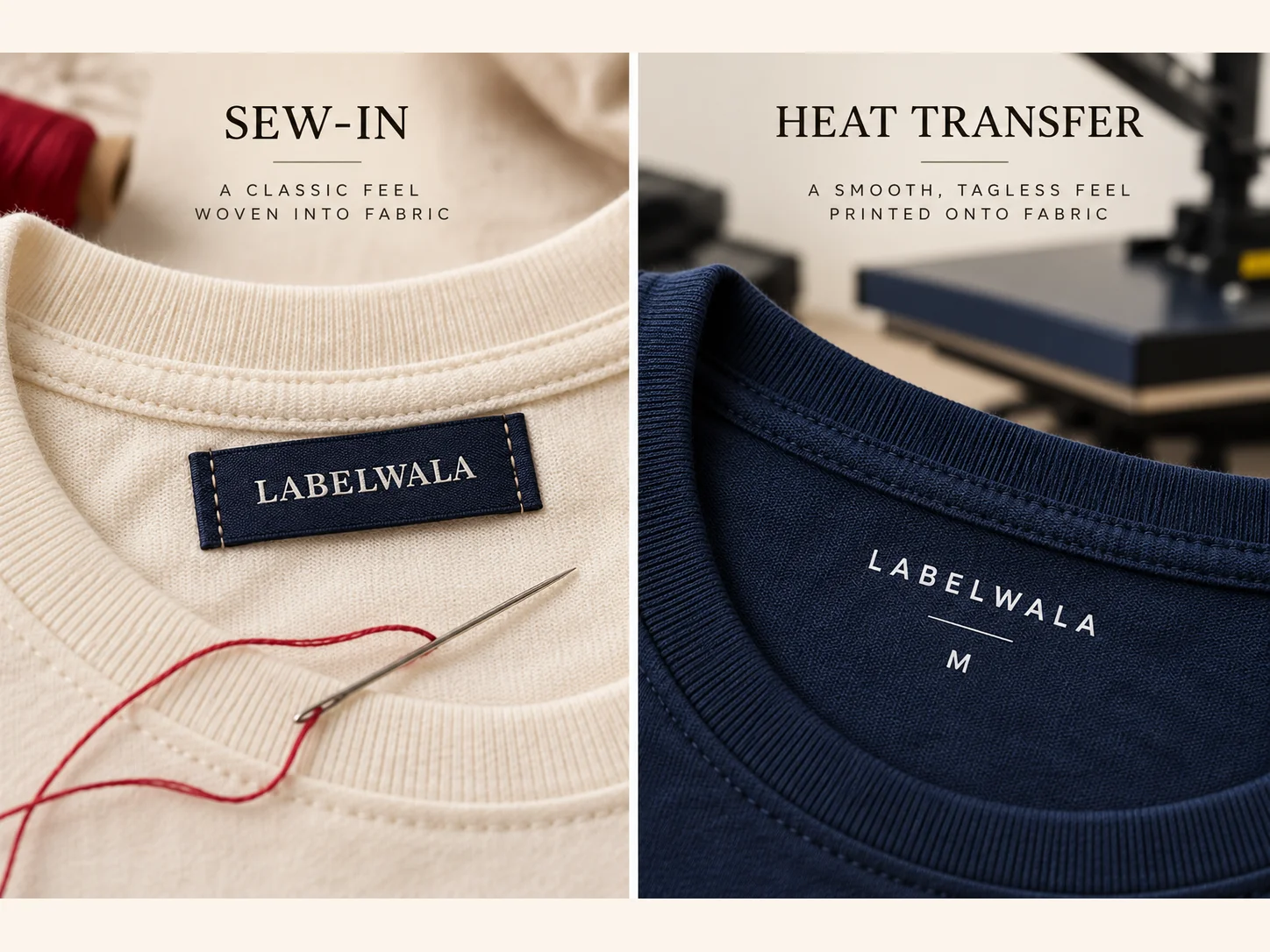
A sew-in label is a woven or printed fabric label stitched into the garment; a heat-transfer label is ink or film pressed directly onto the fabric with heat, leaving no separate label. Sew-in wins on durability, detail, premium feel and simple compliance; heat transfer wins on comfort against skin, speed on the line and a tagless look. Most ranges use both: a stitched brand label where it is seen and a transfer where it touches skin.
The question usually arrives as "should we go tagless?" A founder has worn a T-shirt with a soft printed neck, liked it, and wants to know whether to drop the woven label. The honest answer is that it depends on what the label is for. A label that is there to be seen, touched and trusted wants to be stitched. A label that is there to be forgotten wants to be pressed. Many garments need one of each.
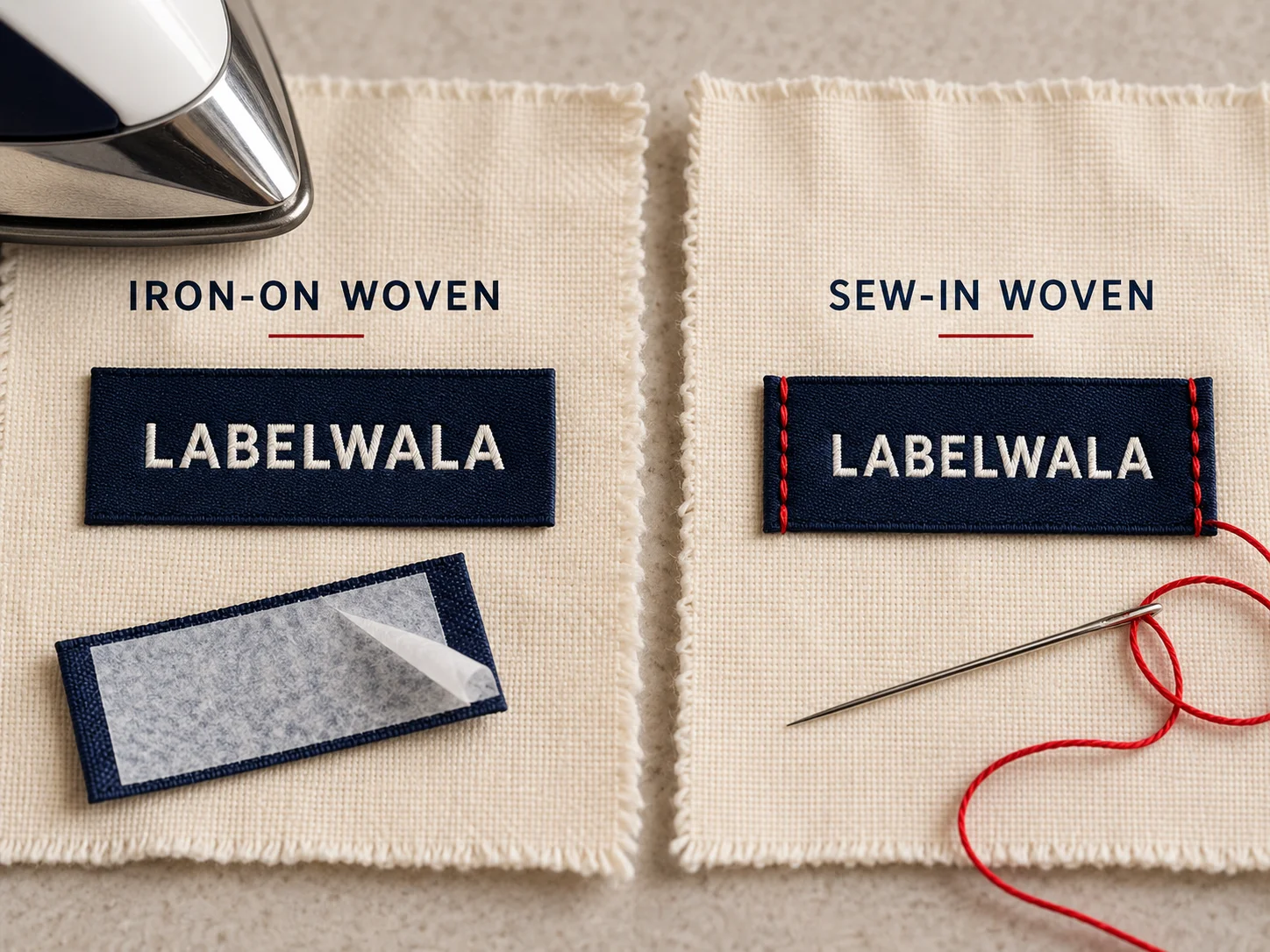
This guide compares the two attachment methods on durability, feel, cost, artwork, compliance and what each demands of the factory, then goes garment by garment. It is about sew-in fabric labels versus heat-transfer prints. The third option, an iron-on woven label with an adhesive back, is a different thing and has its own comparison in iron-on vs sew-in labels.
What each one actually is
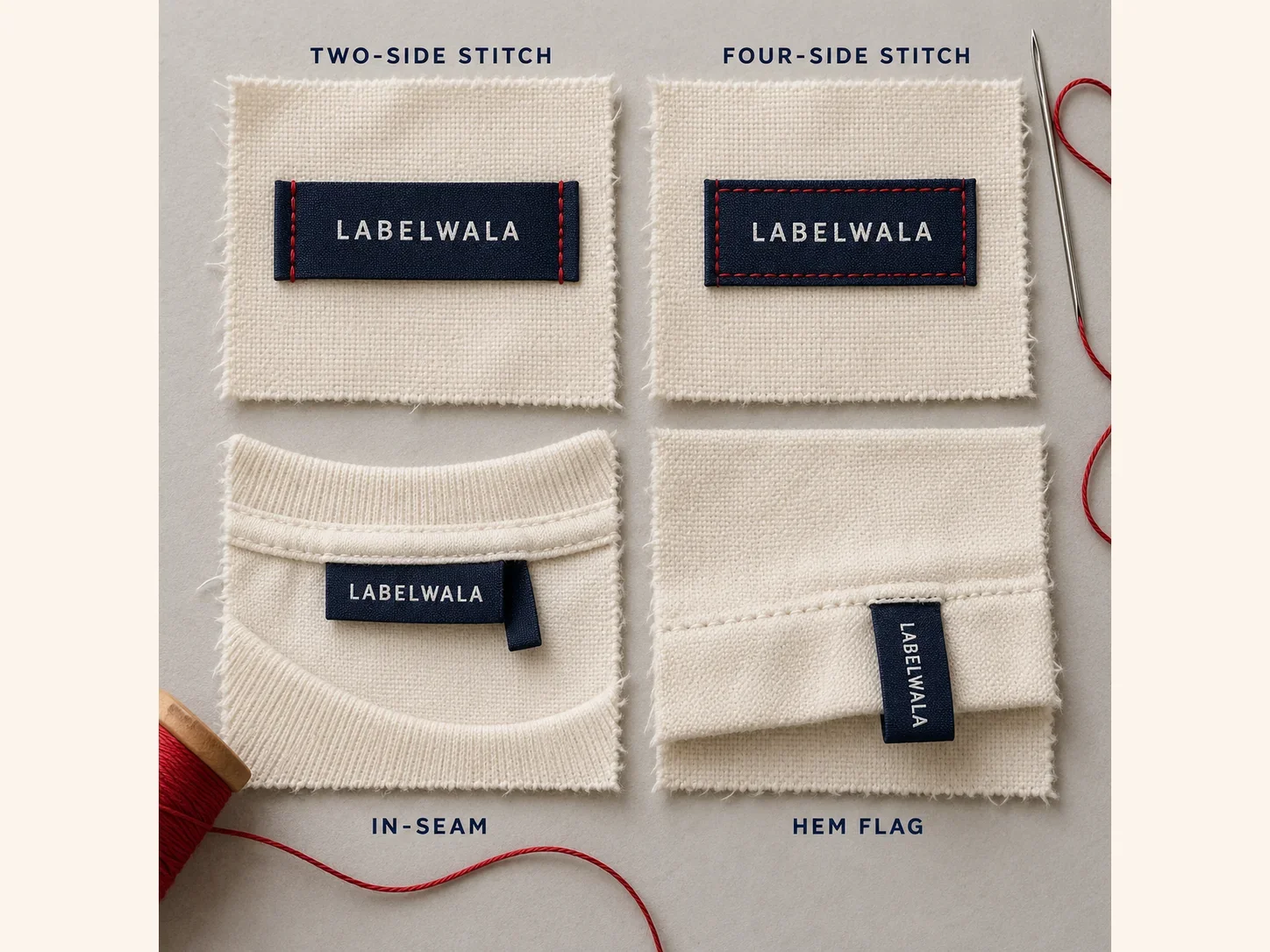
A sew-in label is a separate piece of fabric. It can be woven on a jacquard loom (damask or taffeta), printed on satin or taffeta ribbon, or printed on cotton tape. It is cut, folded and stitched into the garment at the neck, the side seam, the hem or wherever the spec says. The garment and the label are two objects joined by thread.
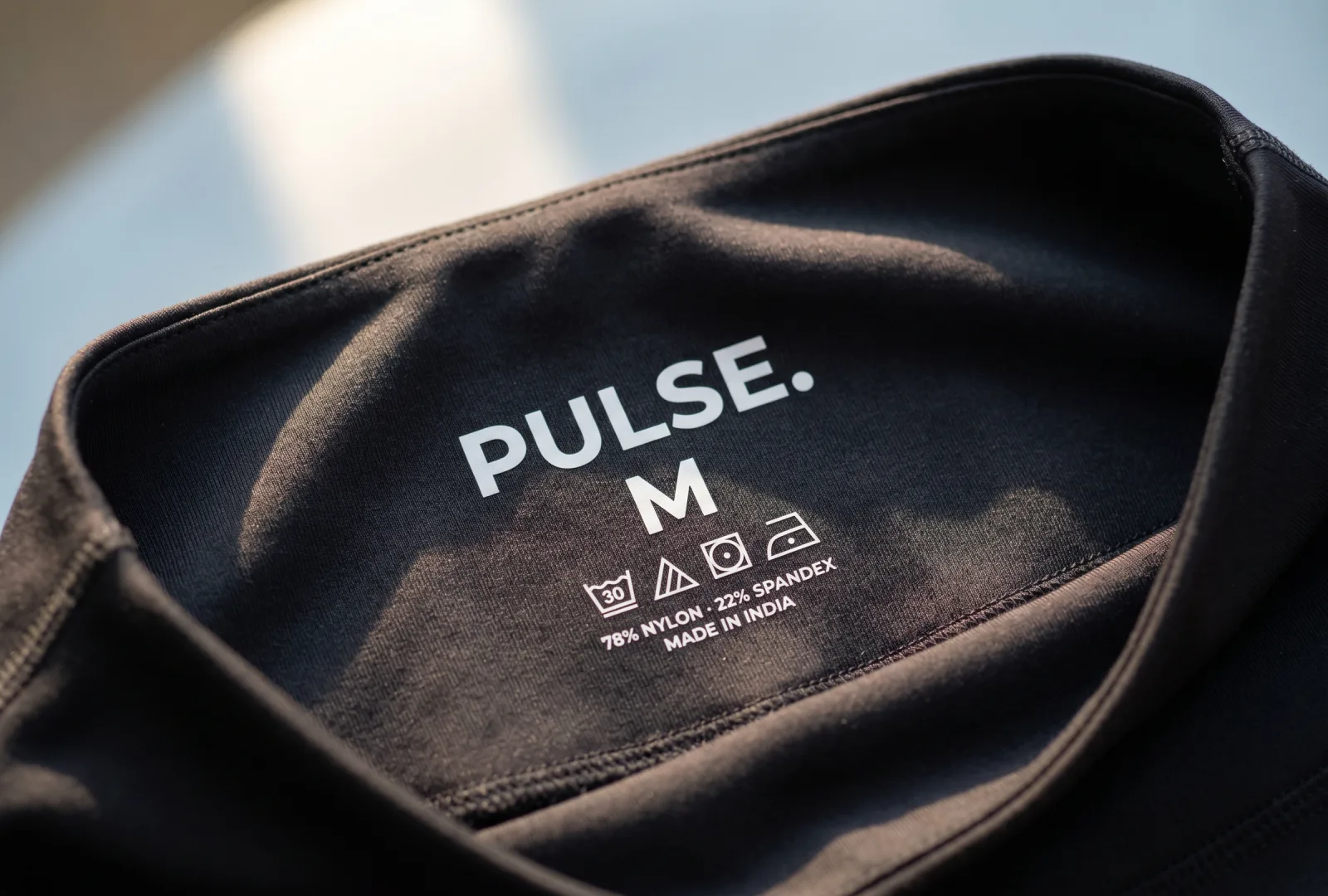
A heat-transfer label is not a label in that sense. The design is printed, usually by screen or digital print, onto a release paper or film. At the factory the film is placed face down on the garment and pressed with a heated plate for a few seconds. The ink or a thin film layer bonds to the fabric, the carrier is peeled away, and what remains is a print on the fabric itself. There is no edge, no fold and nothing to stitch. In the trade it is also called a tagless label, a heat-press label or a heat-seal label.
The difference sounds small and changes everything downstream: how long the mark lasts, how it feels, what artwork it can hold, what the law accepts, and what the factory has to do.
Side by side
| Factor | Sew-in label | Heat-transfer label |
|---|---|---|
| Durability | Woven: outlives the garment. Printed satin: 4-5 grey-scale fastness through 50+ wash cycles | Softens and fades over tens of washes; cracks on heavy stretch; best transfers last the useful life of a tee |
| Feel on skin | An edge and a fold; damask and satin are soft, taffeta can scratch | Nothing to feel when thin and well pressed; thick transfers feel plasticky |
| Look | Tactile, premium, "a real brand" | Clean, minimal, sportswear and innerwear look |
| Artwork | Woven limited by thread resolution (about 2.8 mm letters); printed holds fine detail (about 2 mm) | Fine detail and small type possible; gradients possible but fade first; limited colours per transfer |
| Colour matching | Woven from a thread card; printed from ink | Ink; good match on light fabric, white underbase needed on dark |
| Compliance | Simple: a care label stays legible for the garment's life | Legal text fades with the print; a care transfer may become unreadable |
| Unit cost | Higher per piece for woven; printed satin and taffeta are close to transfer prices | Lower per piece for the film |
| Application cost | A sewing operation on the existing line | A heat press, an operator, settings per fabric; a failed press damages the garment |
| Fabric suitability | Any fabric | Smooth stable knits and performance fabrics; poor on fleece, heavy rib, textured or finished fabrics |
| Relabelling | End-fold labels can be added to finished stock | Can be pressed onto finished stock if the area is flat |
| Removal by customer | Can be unpicked | Cannot be removed |
Read down the table and a pattern appears. Sew-in wins wherever permanence, detail and the brand's physical presence matter. Heat transfer wins wherever the label is a nuisance to the wearer. The job of the label decides the method.
Durability: what happens over a garment's life
A woven label's design is made of dyed polyester threads. Washing does not remove it; the worst that happens over years is a slight softening of the colour. A printed satin label has the design in ink fused into polyester, and holds its colour through the wash cycles a garment will realistically see. Either way, the label is still readable when the garment is worn out.
A heat transfer sits on the surface of the fabric. Every wash flexes it, every tumble dry heats it, and every stretch of the neck opens micro-cracks in the film. A good transfer on a suitable fabric stays presentable for the useful life of a T-shirt; a cheap one on the wrong fabric is peeling at the edges within a season. Our guide to wash testing explains how to compare them properly rather than by eye on a new sample.
This matters most for two things: the care information, which has a legal job to do for as long as the garment exists, and the brand mark on garments that are kept for years, such as denim, jackets and knitwear. For both, stitch.
Feel: the case for tagless
The reason heat transfers exist is that labels itch. A stitched label has an edge and a fold, and on a garment worn next to the skin at the back of the neck, under the arm or at the waist, that edge is what customers cut out. A heat transfer has no edge. Done well, it cannot be felt at all.
That is why transfers dominate babywear, innerwear, loungewear, activewear and anything with a close fit. It is also why a hoodie brand can print the inside neck and still stitch a hem flag: the neck touches skin, the hem does not. Our innerwear labels guide and kidswear guide cover the segments where feel decides.
Two caveats. A thick or heavily layered transfer, especially one with a white underbase on dark fabric, has a plastic hand that some customers dislike more than a soft satin label. And a stitched label can be made very soft: a damask label, end-folded so no cut edge is exposed, or a printed satin label in a loop fold, is comfortable on most adult garments. Tagless is the softest option, not the only soft one.
Artwork: what each can carry
A woven label is drawn in thread, so it has a resolution floor: letters below about 2.8 mm fill in, and fine lines become steps. In exchange it has texture and depth that no print matches. A printed satin label holds detail down to about 2 mm and prints any colour. Our woven design rules and satin design rules cover those limits.
A heat transfer is a print, so it can carry fine type and small symbols, and it can carry photographic detail or gradients where a label cannot. The trade-offs are different:
- Colours cost. Each colour in a screen-printed transfer is a separate screen; one or two flat colours is the economical and most durable choice. Digital transfers print full colour at a higher unit price.
- Dark fabric needs an underbase. A white layer under the colour so it shows on black; it adds thickness and is the first thing to crack.
- Fine detail fades first. Thin lines and small text are the earliest casualties as the print softens, so care text on a transfer should be set larger than it would be on a label.
- No fold or edge to design around. The artwork is placed directly, which simplifies the layout and removes the fold-line mistakes that affect labels.
See the limits before you choose. The free label designer switches its minimum type size as you change material, so you can check whether your logo holds up as a woven label, a printed one or a transfer before you ask for a quote.
Compliance: the care information problem
Fibre content, country of origin and, for most markets, care instructions have to be on the garment and legible. Nothing in the rules says they must be on a stitched label; a tagless print is acceptable. The problem is time. A transfer that was legible at sale and is illegible after a year has stopped doing its job, and on an export shipment it is the brand's problem, not the customer's.
The common solution is to split the roles. Print the brand and the size as a transfer inside the neck, where comfort matters most, and stitch a small printed care label into the left side seam, where it is out of the way and stays legible. The care label can be loop-folded so the only edge against the body is a fold. Our care label requirements guide covers what has to be on it, and the tagless label size guide covers how large a care transfer has to be printed if you do go fully tagless.
Cost: unit price versus total cost
On unit price alone a heat transfer usually beats a woven label and is close to a printed satin or taffeta label. That is not the whole cost.
| Cost element | Sew-in | Heat transfer |
|---|---|---|
| Label or film | Woven highest; printed satin and taffeta mid | Low to mid; digital full-colour higher |
| Attachment | One sewing operation, on equipment every factory has | A heat press and a trained operator; 8 to 15 seconds per press |
| Set-up | Loom or print set-up in the label price | Screens per colour in the transfer price; press settings per fabric |
| Failure cost | A spoiled label | A spoiled garment: scorch, ghosting, misalignment |
| Minimums | 1,000 per design at Labelwala | Similar per design |
| Reorders | Same loom file, same threads, consistent | Same screens; colour depends on ink batch and press |
For a factory already pressing transfers for a sportswear range, adding a tagless label is nearly free. For a small brand whose tailor has a sewing machine and no heat press, a transfer means finding a presser and paying for the operation. Work out the total per garment, not the per-label price. Our label cost guide has the current ranges for stitched labels.
What the factory has to do
For a sew-in label: a stitching operation that every garment factory performs daily. The label arrives cut and folded, the operator places it against a notch and stitches on two sides or into the seam. The main risks are placement and orientation, both solved by a labelling spec; see how labels are sewn into garments.
For a heat transfer: a separate process with its own variables.
- Equipment. A flat heat press with even temperature across the platen. Domestic irons do not give even heat or pressure and are the cause of most peeling transfers.
- Settings. Temperature, time and pressure from the transfer supplier, typically in the region of 150 to 165 degrees Celsius for 8 to 15 seconds, varying by film and fabric. Too cool and the transfer does not bond; too hot and the fabric scorches or shines.
- Peel. Some films peel hot, some cold. Peeling the wrong way lifts part of the print.
- Fabric lot testing. A finish on the fabric (softener, water repellent, silicone) can stop the transfer bonding. Press a test on every new fabric lot.
- Placement jig. A template so every neck print sits at the same height and centre.
- Sequence. Transfers are usually pressed on the cut panel before sewing, or on the finished garment at the end. Decide which, because a transfer pressed near a seam can mark the seam.
None of this is difficult, but it is a process the factory has to own. Ask whether they already run one before specifying transfers.
Garment by garment
| Garment | Brand mark | Size and care | Why |
|---|---|---|---|
| Basic and premium tees | Either: woven for premium, transfer for tagless basics | Transfer inside neck, or stitched care in side seam | Neck comfort versus brand presence |
| Hoodies and sweatshirts | Sew-in woven at neck; woven hem flag | Stitched care in side seam | Fleece takes transfers poorly; hoodies are kept for years |
| Activewear and sports jerseys | Transfer inside neck | Transfer, or small stitched care label | Stretch, sweat and skin contact; smooth performance fabrics press well |
| Innerwear and loungewear | Transfer | Transfer at waistband or side | Nothing against skin |
| Babywear and kidswear | Transfer, or stitched label in side seam | Transfer or side-seam stitched | Skin comfort and no loose edges |
| Shirts, kurtas, dresses | Sew-in woven at neck | Stitched care in side seam | Premium feel; woven fabrics and finishes resist transfers |
| Denim and jackets | Sew-in woven, waistband patch | Stitched care | Kept for years; heavy fabric |
| Uniforms and workwear | Sew-in woven | Stitched care, often taffeta | Industrial laundering destroys transfers |
| Ethnic and occasion wear | Sew-in woven or satin | Stitched care | Delicate fabrics; brand presence |
The segment guides go deeper: activewear, streetwear and hoodies, sports jerseys and industrial laundry, where the transfer question answers itself.
Running both on one range
Most ranges settle on a combination, and the combination is easy to manage if it is written down.
- Brand presence where it is seen: a stitched woven label at the neck of premium pieces, a woven hem flag or sleeve tag on streetwear, a woven patch on denim.
- Comfort where it touches skin: a transfer inside the neck of tees, activewear and innerwear, carrying brand and size.
- Compliance where it lasts: a small stitched printed care label in the side seam of anything that is not fully tagless, loop-folded so only a fold touches the body.
- One labelling spec listing every label and transfer, its position, its attachment method and its point in the sequence.
- Matching artwork. The same logo file drives the woven label, the printed care label and the transfer, adjusted for each method's minimum sizes, so the brand looks the same everywhere.
Design the set together rather than piece by piece. A woven neck label and a transfer that use different versions of the logo look like two brands.
Getting sew-in and heat-transfer labels made at Labelwala
We make woven and printed labels in Ahmedabad, Gujarat, and we have been doing it for 25 years. We supply the stitched woven and printed labels that carry the brand and the care information, and heat-transfer labels for tagless neck and size prints.
- Minimum order: 1,000 pieces per design.
- Quotes: we usually reply within 2 hours on a working day.
- Production: 7-10 days once artwork is approved. Rush jobs run 3-5 days.
- Care symbols: set to ISO 3758 on every care label.
- Wash fastness: printed labels rated 4-5 on the grey scale through 50+ wash cycles.
- Delivery: across India and worldwide for export.
Tell us the garment, the fabric and where the label goes. If the fabric is brushed, heavily ribbed or finished, we will say so before you commit to a transfer; if the position is against skin, we will suggest how to keep a stitched label soft or where a transfer earns its place. Ask for a pressed transfer sample and a stitched sample on your fabric and compare them after a wash.
We are rated 5.0 on Google from 27 reviews.
Common mistakes
- Going fully tagless and putting the legal care text on a transfer that fades.
- Pressing transfers onto fleece, heavy rib or a finished fabric without a test.
- Using a domestic iron instead of a heat press.
- Comparing the per-label price and ignoring the pressing operation.
- A white underbase transfer on a dark tee that cracks at the first stretch.
- Fine care text on a transfer set at label sizes.
- Different logo versions on the woven label and the transfer.
- No fabric-lot test when the mill changes finish.
- Specifying transfers for uniforms that go to an industrial laundry.
- Judging durability on a new sample instead of a washed one.
Decision checklist
- Is the label there to be seen, or to be forgotten?
- Does it touch skin on a close-fitting garment?
- Will the garment be kept for years, or worn out in a season?
- Is the fabric smooth and stable enough to take a transfer?
- Does the factory already run a heat press with per-fabric settings?
- Where will the legal care information live, and will it still be legible in two years?
- Have both methods been sampled on the actual fabric and washed?
- Is the same logo file driving every label and transfer?
- Is each item's position and sequence in the labelling spec?
What we would recommend
Use sew-in woven labels wherever the brand should be seen and the garment will be kept: necks of premium pieces, hem flags, patches, uniforms, denim and anything industrially laundered. Use heat transfers inside the neck of tees, activewear, innerwear and babywear, in one or two flat colours on smooth fabric, pressed on a proper press with tested settings. Keep a small stitched care label in the side seam unless the garment is genuinely tagless end to end, and sample both methods on your fabric and wash them before you decide.
Stitch what should last and be seen. Press what should disappear. Most good ranges do both, deliberately.