In brief
Hotel linen labels disintegrate because chlorine bleach, high-pH detergent, 90°C washes and tumble drying at up to 100°C hit them daily, so a standard satin label is gone in about six months. The fix is a bleach-stable dye, an industrial damask weave and polyester-core thread, with the brand colour matched to a locked recipe for every restock.
If you operate a hotel, resort or hospitality property, you've probably noticed: the linen labels you ordered last year have started disintegrating. Some are missing entirely. The brand colour has drifted. Customer-facing fabric (towels, robes, bedlinen), looks third-hand. The cause isn't the supplier ripping you off. It's a fundamental mismatch between standard labels and what hospitality laundry actually does to them.
What does hospitality laundry actually do to labels?
A typical hotel wash runs chlorine bleach and high-pH detergent at 90°C, daily, followed by high-spin extraction and tumble drying at up to 100°C. A standard satin label rated for a hundred wash cycles reaches that limit in about a hundred days at this frequency. By month six it is gone.
The frequency is the part that surprises people. A shirt in someone's wardrobe might see thirty washes a year. A hotel towel sees three hundred and sixty-five, and each one is harsher than a domestic cycle in every dimension at once. Comparing a hotel label to a retail label is not comparing like with like, it is a different order of demand.
What is actually attacking a hotel linen label?
"Bleach and heat" is the short version. The full picture matters, because each stage attacks a different part of the label and a fix for one does nothing for the others.
- Chlorine (sodium hypochlorite) oxidises. It breaks dye molecules apart, which is why colour goes first, and it attacks the fibre itself over time.
- High-pH detergent in the main wash swells and weakens fibres so the following stages do more damage than they otherwise would.
- The souring step swings the load sharply acidic to neutralise residual alkali. Labels take that pH swing twice a day, every day.
- High-spin extraction is mechanical, not chemical. It is what turns a weakened edge into a frayed one.
- Drying and ironing heat finishes the job, and on flatwork it is more brutal than the wash.
Because the attacks are different, the label has to be upgraded in four places rather than one. A bleach-stable dye on an ordinary base still frays. An industrial base sewn on with domestic thread still falls off.
The flatwork ironer nobody accounts for
Sheets, duvet covers and pillowcases do not go in a tumble dryer at a serious property. They go through a flatwork ironer, a calender that runs damp linen between heated rollers under pressure.
That is a far harder environment than a dryer, and it is the reason bedlinen labels fail differently from towel labels. A label passing under the roller is compressed and heated directly. Printed labels scorch and go brown. Heat-transfer prints soften and offset onto the roller, which then marks every subsequent sheet. Thick labels leave an impression pressed into the linen around them.
The practical consequence is about placement, not material. Keep labels on bedlinen at the hem or in the corner, where the item is folded and the label is inside the fold, rather than anywhere across the open field of the sheet. A label in the middle of a sheet will meet the roller flat every single day.
If your laundry runs a calender, say so at quote stage. It changes the material recommendation and the placement, and it is the single most common thing a hospitality buyer forgets to mention.
Why do standard labels fail in hotel laundry?
- Polyester satin, degrades from chlorine bleach. Threads weaken; the label frays at the edges within months.
- Standard dye, chlorine strips colour. Your brand teal turns sky-blue, then off-white.
- Heat-transfer prints, adhesive softens at 90°C. The print peels in chunks.
- Stitching thread, domestic-grade polyester thread breaks down. The label simply detaches.
The label material, the dye, the print medium and even the stitching thread have to be upgraded for hospitality use. Most suppliers don't do all four: they sell domestic-spec labels with hotel-spec branding.
What is the engineering fix for hotel linen labels?
An industrial-laundry-safe label needs four upgrades, not one:
1. Industrial-grade weave base
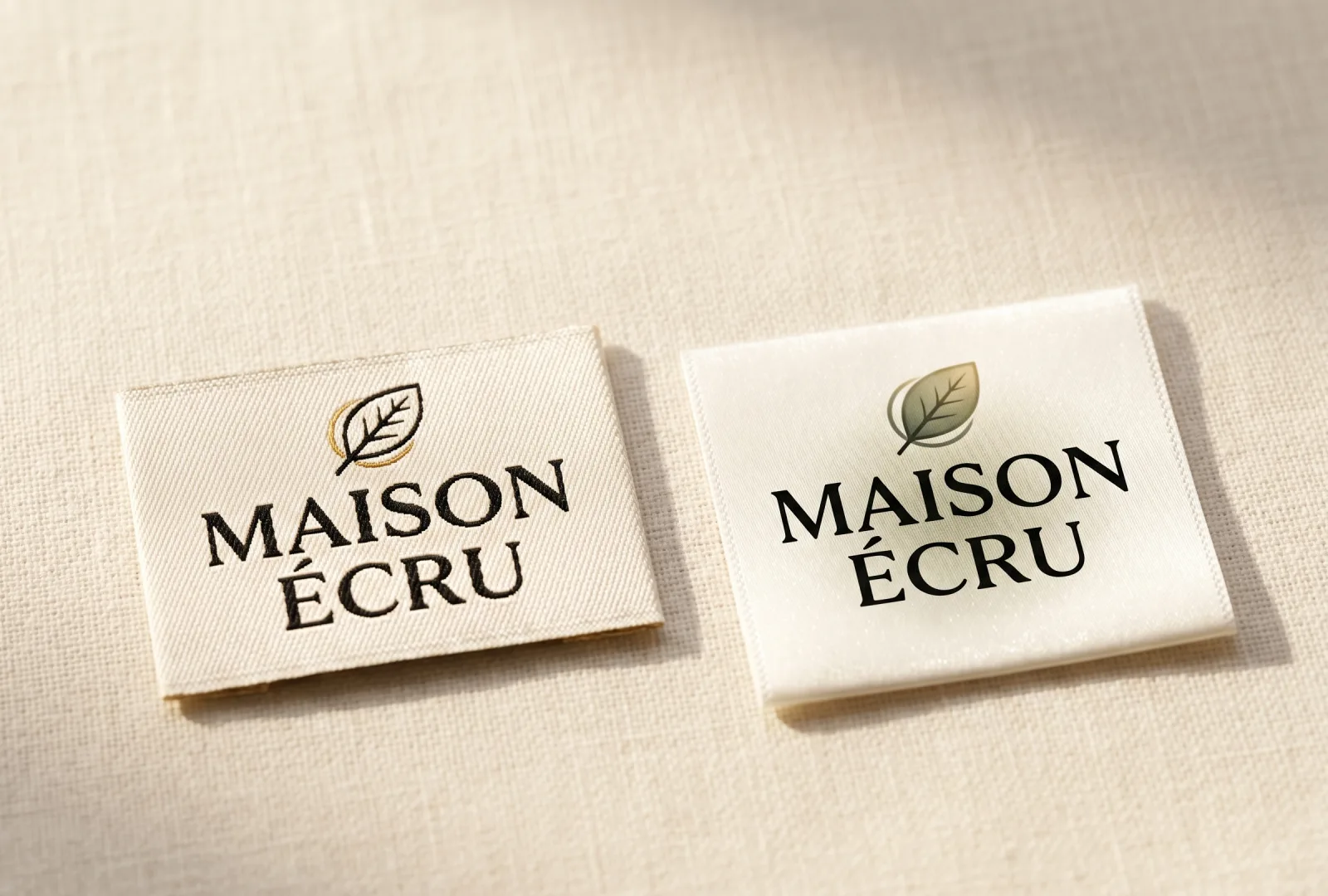
High-density damask weave on bleach-resistant polyester base. Damask's tighter thread structure resists bleach penetration; the high density means chemical attack happens slower and more uniformly. Visible degradation pushes from "6 months" to "5+ years."
2. Bleach-stable dye recipe
Standard dye batches optimise for cost and colour vibrancy. Bleach-stable recipes use dyes engineered to bond at the molecular level with bleach-resistant fibres, they cost 15-25% more but hold colour through chlorine exposure indefinitely.
3. Industrial stitching thread
The label only stays on the linen as long as the thread holds. Use polyester-core thread rated for 90°C wash. Cheap thread is the silent failure point most operators miss.
4. Standardised laundry symbols
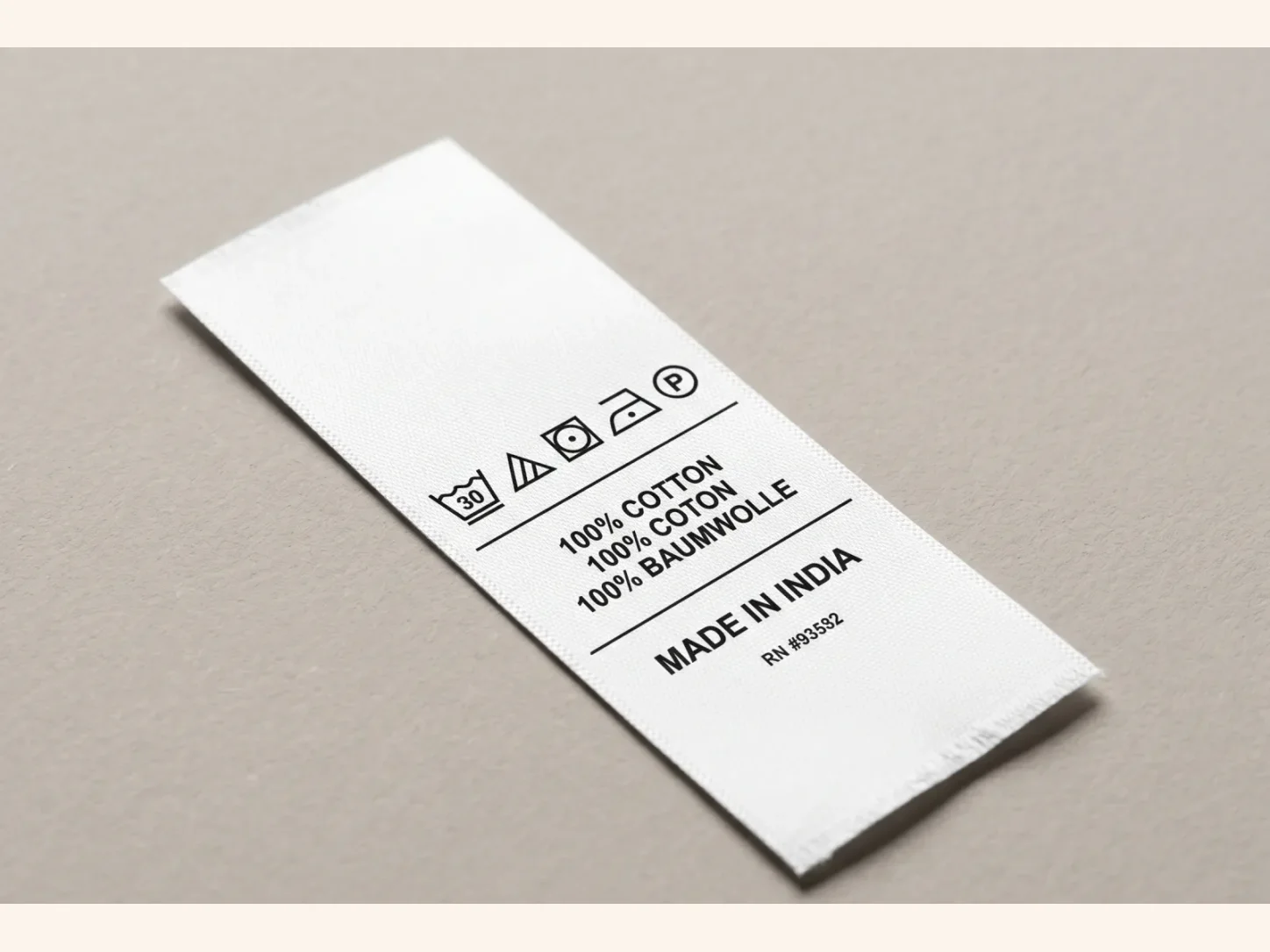
The care label printed on every linen piece needs symbols that match your specific laundry program. Outsourced laundries follow what's printed; if the symbols say "wash 30°C," they ignore your operational reality and you get inconsistent results.
Brand consistency across restocks
The second silent killer: every restock looking different.
If you've ordered linen labels four times from four suppliers, you've probably noticed four slightly different shades of your brand colour. Some teals, some teal-greys, some teal-blues. Guests notice in unconscious ways: your property starts looking subtly off-brand.
The fix is operational, not technical: pick a supplier that locks the dye recipe to your account. Pantone match on the first order, store the recipe, every restock pulls from it. We do this; it's cheap to maintain, expensive to skip.
If you've already locked your spec elsewhere and just need someone to match it for restocks: send the existing label spec, target Pantone, and one of the existing labels for reference. We can replicate to match your historical batches.
What label spec should hospitality properties use?
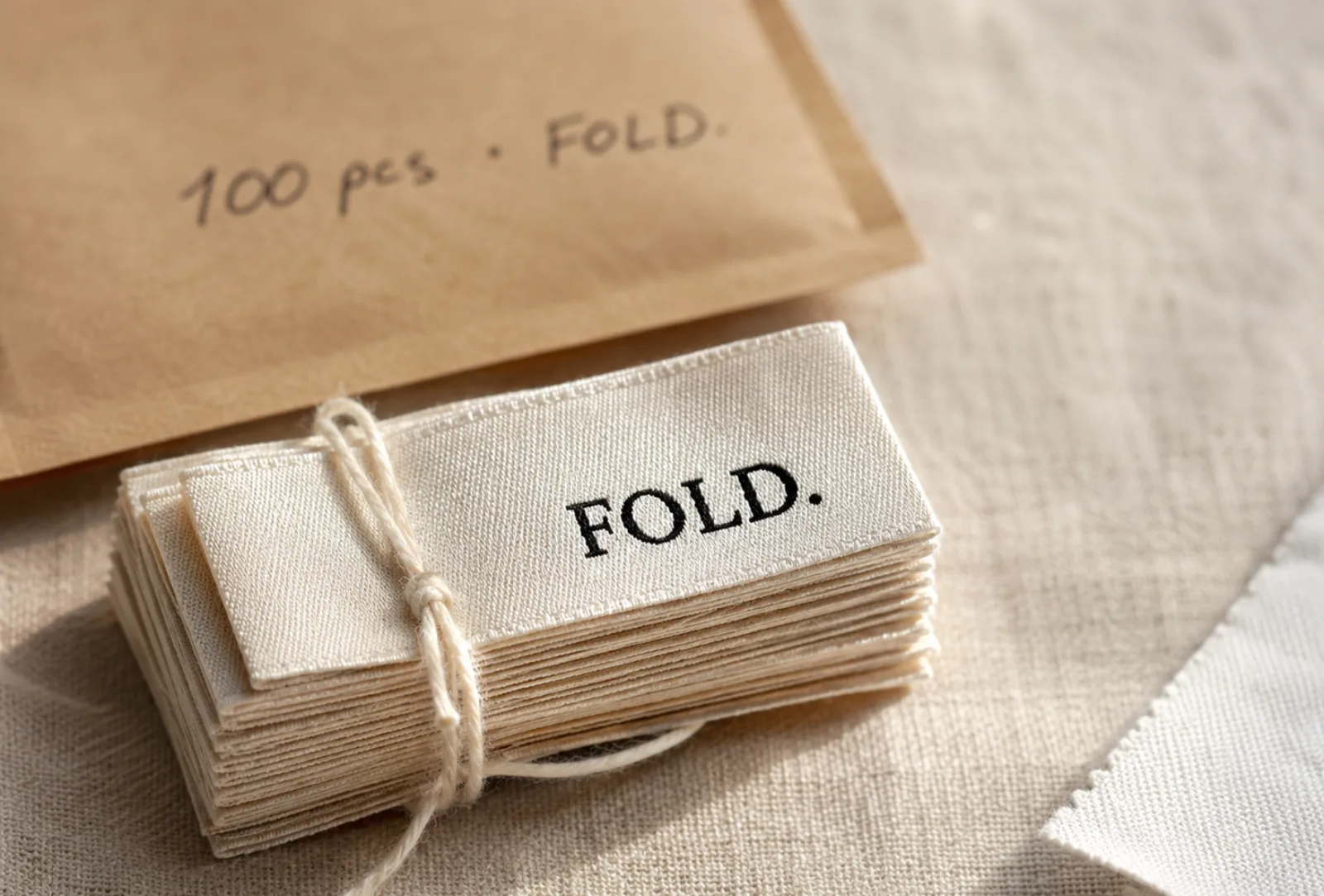
- Linen labels: high-density damask, bleach-stable dye, industrial polyester thread, 30×40mm typical, end-fold or mitre-fold.
- Towel labels: same as linen, often slightly smaller (25×30mm) so they sit cleanly in the corner.
- Uniform labels: softer satin under collars (staff comfort matters during 8-hour shifts), but still bleach-resistant.
- Care labels for outsourced laundry: symbols matched to your specific laundry program, not generic templates.
Fold choice matters more here than in apparel, because the fold decides how much of the label is exposed. An end fold or mitre fold tucks both raw ends under and presents a clean sealed edge, which is what you want when chemistry attacks edges first. A straight-cut label sewn on one side leaves three cut edges facing the wash, and those edges are where fraying starts. Our end-fold guide and fold types explained cover how each behaves.
Where should the label go on each linen item?
Placement does two jobs in hospitality: it protects the label, and it lets housekeeping identify an item quickly from a folded stack.
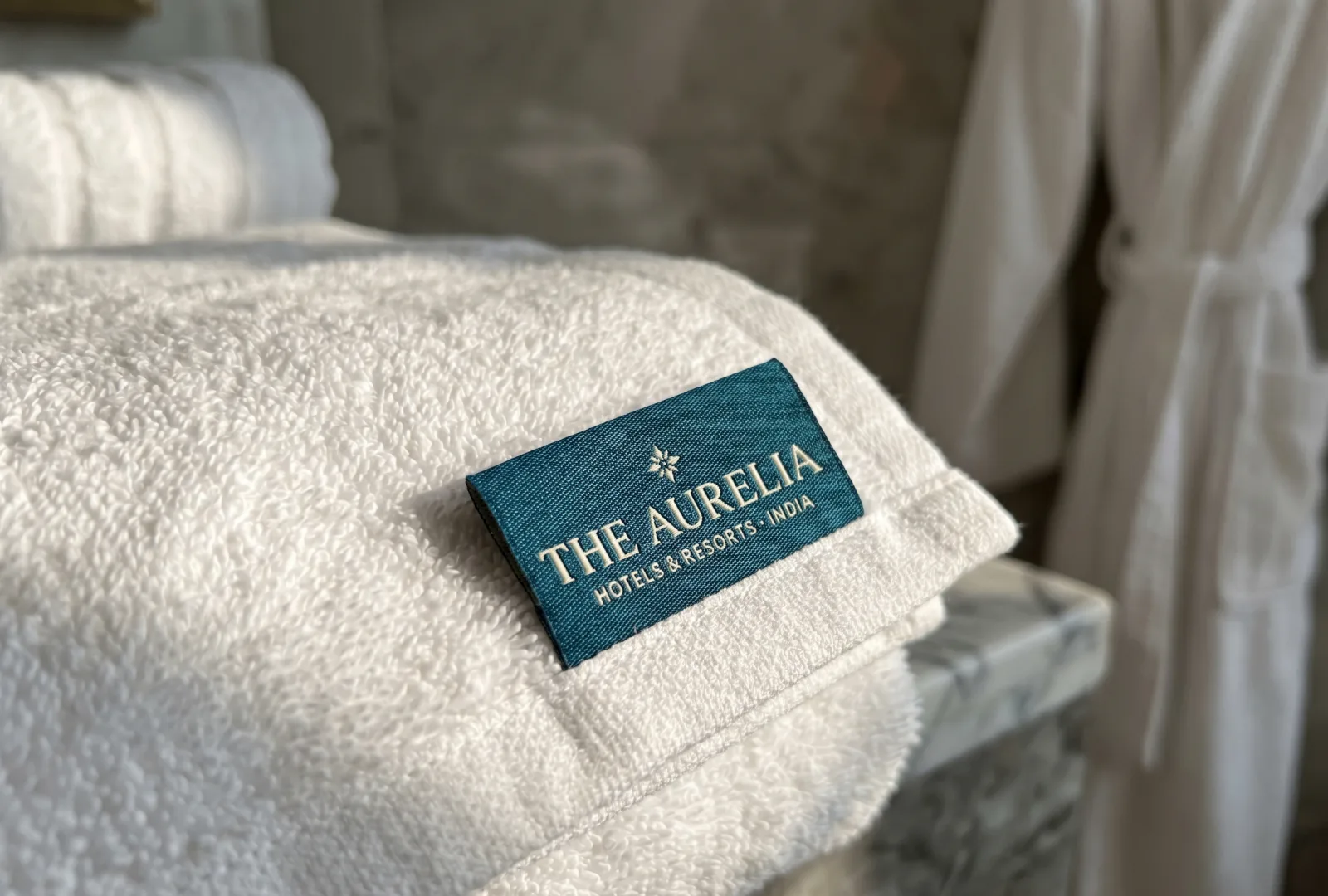
- Towels and bath mats: one corner, on the hem band, stitched on two or four sides. The corner is the least abraded part of the item and stays visible when folded.
- Sheets and duvet covers: the hem, near a corner. Never in the open field, because of the calender.
- Pillowcases: inside the opening hem, so it is invisible when made up but findable by hand.
- Robes: inside the neck for branding, plus a second tab in a side seam that survives when the neck label is worn by shoulder friction.
- Table linen: corner hem, always on the underside, since both faces are customer-visible.
Consistency across the property is worth more than optimising any single position. Housekeeping handles thousands of items a week, and finding the label in the same place every time is what makes sorting fast.
Using labels to track linen age and par stock
This is the part most properties discover late. A linen label does not have to carry only your brand. It can carry the information that makes linen management possible.
- Date coding: a month and year woven into the label tells you the true age of an item at a glance, which is the only reliable way to retire linen on a schedule not on complaints.
- Colour-coded tabs: a small coloured tab per floor, outlet or property stops stock migrating between areas and never coming back.
- Item coding: a short code separating bath sheet from bath towel from hand towel, which otherwise get mixed at the folding table.
- Property coding for chains sharing an outsourced laundry, so returns can be sorted without reading the brand mark.
Date coding in particular changes the economics. Linen is a capital asset with a defined life, and a property that can prove an item is four years old can retire it on schedule and budget for replacement. A property that cannot, replaces on guest complaint, which is both later and more expensive.
The cost of adding a date code to an order you are placing anyway is close to nothing. The cost of ordering a separate marking system later is not.
If your laundry is outsourced
An in-house laundry follows your instructions. A contracted laundry follows the label, because the label is what its operators can see at the sorting table. That makes the care label a contract document not a formality.
Two failures follow from getting it wrong. Print a generic "wash 30°C" care symbol on hotel linen and a diligent laundry will either ignore it, in which case the label is pointless, or follow it, and your linen comes back not hygienically clean. Neither is acceptable, and the second is the one that ends up in a compliance conversation.
Spec the symbols to the programme the linen is actually going to run, using ISO 3758. Note that the ISO 3758 scale tops out at 95°C and has no 90°C step, 90°C is a real industrial process temperature but not a care-symbol value, so the symbol and the written process specification are two different documents. Say both, and keep them consistent.
How to qualify a supplier before you commit
Every supplier will tell you their labels are industrial grade. The way to find out is to make the sample prove it, before an order rather than after a year.
- Ask for a bleach soak, not just a wash test. A sample left in a hypochlorite solution shows colour loss in hours rather than months. It is the fastest honest test there is.
- Ask what the base and thread actually are, by name. "Industrial grade" is a description, not a specification.
- Send the sample through your own laundry stitched to a real towel, for a few weeks. Nothing else reproduces your actual chemistry.
- Ask whether the dye recipe is stored against your account, and get the reference in writing.
- Check the edges after testing, not the face. Faces look fine long after edges have started to go.
A supplier who is comfortable with all five is telling you something a brochure cannot. One who wants to skip straight to a price per piece is quoting a domestic label.
Getting hospitality labels made at Labelwala
We make woven and printed labels in Ahmedabad, Gujarat, and we have been doing it for 25 years. Hospitality orders usually come as a bundle, linen, towel, robe and uniform labels specified together, because the chemistry is the same across all of them.
- Minimum order: 1,000 pieces per SKU. Most properties bundle SKUs into one larger order.
- Quotes: we usually reply within 2 hours on a working day.
- Production: 7-10 days once artwork is approved. Rush jobs run 3-5 days.
- Care symbols: set to ISO 3758, matched to your laundry programme not a template.
- Delivery: across India, dispatched to individual properties on a single account for multi-property groups.
Tell us your wash programme, whether the linen goes through a calender, and whether the laundry is in-house or contracted. Those three answers change the material, the fold and the placement, and they are worth more at quote stage than a target price is.
We are rated 5.0 on Google from 27 reviews. Ask for samples to put through your own laundry before you commit to a property-wide run.
Cost reality
For multi-property chains
If you operate 3+ properties under one brand, lock the recipe centrally and pull restocks against the same spec for all properties. Otherwise the third property quietly drifts off-brand within 18 months. Standing 6-month restock slots are cheaper than emergency reorders.
The drift is rarely a decision. It happens because one property runs short before a season, orders locally to cover, and that batch becomes the reference for its next reorder. Two years later that property's linen is visibly a different colour from the flagship's, and nobody can point to when it changed.
Common mistakes
- Buying a retail-spec label because the price per piece looked competitive.
- Upgrading the base fabric but leaving the stitching thread domestic grade.
- Placing labels in the open field of a sheet that goes through a calender.
- Printing generic care symbols that contradict the laundry programme actually used.
- Not recording the dye reference after the first order.
- Testing a sample by washing it loose instead of stitched to a real item.
- Ordering per property instead of centrally, then wondering why the colours drift.
- Leaving date coding off, then having no way to retire linen on schedule.
All of these are specification decisions rather than manufacturing faults, which is the useful thing about them. They are also all cheap to fix before an order and expensive afterwards, because replacing labels on linen already in circulation means pulling stock out of service to unpick and restitch it.
What we would recommend
Spec all four layers together, high-density damask base, bleach-stable dye, industrial polyester thread, and care symbols matched to your real programme, and treat any quote that only upgrades one of them as a domestic label with a hospitality price.
Add a date code while you are at it. It costs almost nothing on an order you are already placing, and it converts linen from something you replace when guests complain into something you replace on a schedule you control.
Then lock the recipe centrally, test on your own laundry before the full run, and put a standing restock slot in the calendar. The label is a small line on a property's budget and a large part of how the linen reads to a guest in year three.