
In brief
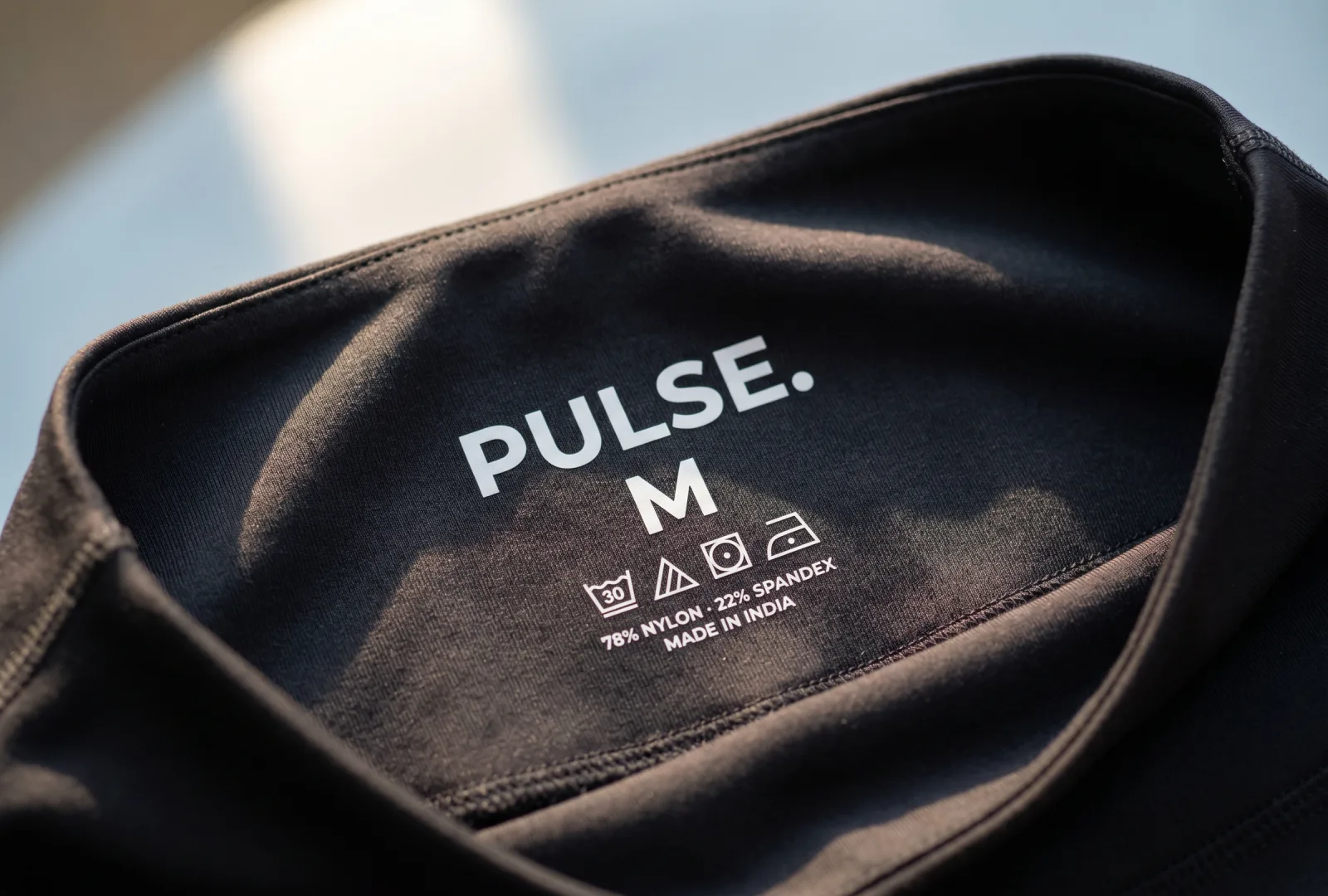
Tagless heat-transfer printing is the best option for loungewear and innerwear, because it puts brand and care information straight onto the fabric with nothing to scratch or itch. Where a fabric label is wanted, use small printed satin with a folded edge, kept out of flatlock and bonded seams and off the neck and waistband.
Loungewear and innerwear are bought for comfort, worn against the skin, and judged on how they feel. So there's no faster way to undo a soft, well-made garment than a stiff, scratchy label at the neck or waistband. On next-to-skin clothing, the label isn't a detail. It's part of the comfort promise.
This guide covers the softest label options, what to avoid, and where to place labels so nothing the skin touches is anything but flat and gentle.
Why is comfort the whole brief?
- Printed straight onto the fabric
- Nothing to scratch or itch
- Lies perfectly flat
- Gentle hand-feel
- Flat, colourful, cheap
- A good alternative to tagless
Why does tagless win next to the skin?
Tagless heat-transfer prints brand and care information straight onto the inside of the garment, so there's no tag to scratch, itch or leave a mark. For garments worn purely for comfort, sitting directly on the body, this removes the single most common complaint and lies perfectly flat at the neck, waistband and seams. It's why premium loungewear and innerwear brands favour it. See our tagless heat-press guide for how it works.
What should you avoid on innerwear labels?
Keep stiff labels off contact points. Avoid stiff woven labels with hard edges, coarse taffeta, and rough selvedge anywhere the skin touches: especially the neck, waistband and side seams. These cause itching and marks and undo a comfortable garment.
If you want a branded woven look, keep it to the outside of a waistband or a hang tag, where the wearer never feels it, and use tagless or soft printed labels where the garment meets the skin.
One framing helps throughout. In this category the label is not competing with other labels, it is competing with nothing. The comparison a customer makes is against a garment with no label at all, which is why tagless keeps winning, and why every fabric-label decision here is about minimising what the body can detect rather than choosing the nicest-looking cloth. A label that is merely "not bad" against the skin has still lost to the alternative of no label at all.
That is also why this is one of the few categories where the labelling decision is worth taking before the garment is finalised rather than after. If the range is going tagless, the neck construction, the seam type and the print position all interact, and settling them together is far easier than retrofitting a print onto a garment that was designed around a tag.
Where should loungewear labels go?
Tagless print: flat, invisible to the touch.
Tagless inside; any woven branding on the outside.
Printed tagless, or low in a side seam if a label is used.
Feel every option against skin before bulk.
Care info without the scratch
A tagless heat-transfer print can carry brand, size and care information directly on the garment: keeping innerwear comfortable while still meeting the need for care and fibre details (which must remain accurate and permanent; see our origin & fibre-content guide). Combining brand and care into one tagless print is a common, comfortable solution where a separate care label would irritate.
The label has to respect the seams
Good innerwear is engineered to have as little structure against the skin as possible. Flatlock and bonded seams exist precisely so there is no ridge for the body to feel, and then a conventional label is stitched into one, which puts back the exact bump the construction was designed to remove.
That is the argument for tagless in one sentence. It is not that labels are uncomfortable in general; it is that on this category the label is often the thickest thing in the garment. A 0.3 mm satin label sewn into a bonded seam is, proportionally, a significant object.
- Flatlock seams lie flat by design. Do not interrupt one with a label.
- Bonded and glued seams have no stitching at all, so a stitched label is doubly out of place. It adds thread holes to a garment built without them.
- Elastic bindings and waistbands stretch and recover; a label sewn across one restricts that locally and shows as a pucker.
- Where a label is unavoidable, put it in a conventional overlocked side seam low on the garment, not at the neck or waist.
Why do these fabrics make tagless harder?
There is an awkward tension in this category. The garments that most need tagless printing are made from the fabrics that are hardest to print on.
Loungewear and innerwear run on modal, micromodal, bamboo viscose, cotton-elastane and nylon-elastane. Every one of those has a constraint:
- Elastane is heat-sensitive. Standard heat-press temperatures can glaze or permanently damage it, and once elastane is broken the garment never recovers its stretch. Low-temperature transfer films exist for exactly this and should be specified.
- Modal and viscose are weak when wet and heat-sensitive when pressed. They mark easily, and a press platen can leave a visible sheen around the print.
- Dark polyester and poly blends migrate dye. The garment's own colour gasses into the transfer at press temperature, so a white print on a navy set can turn grey weeks after it shipped. Ask whether a blocker film or a low-temperature transfer is being used.
- Nylon is smooth and low-energy, so general-purpose adhesives slide off it. It needs a film specified for nylon.
None of this makes tagless the wrong answer. It makes it an answer that has to be specified properly rather than ordered generically. Send your exact composition, including the elastane percentage, and every colour in the range, dye migration is colour-specific, so a print approved on the black set proves nothing about the red one. Our tagless heat-press guide covers the application variables in detail.
If you do use a fabric label, the fold matters more than the material
Plenty of loungewear brands want a physical label for the brand moment, and that is a legitimate choice. The mistake is assuming softness comes from the cloth. It mostly comes from the edges.
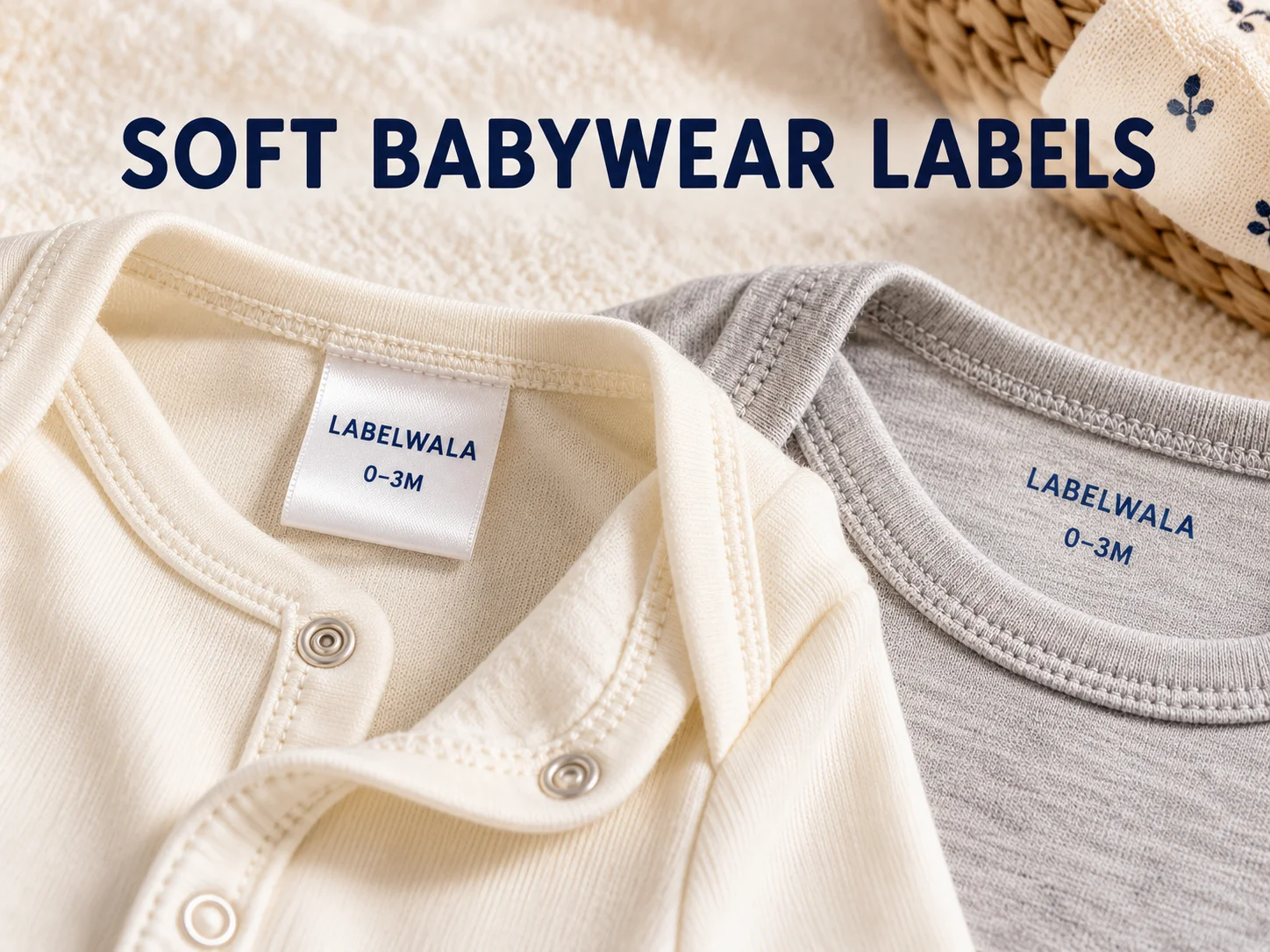
A straight-cut label has sealed edges on all four sides, and on synthetics that seal is made by melting, which leaves a firm and sometimes sharp edge. That edge is what a customer feels, not the face of the label. Replace it with a folded edge, end fold, centre fold or mitre, and the same material in the same design becomes markedly more comfortable.
- Printed satin with a folded edge is the softest fabric-label option and the usual choice here.
- Printed cotton tape suits organic and natural positioning, and folds softly, but must be folded, since a cut cotton edge frays.
- Avoid coarse taffeta and high-density damask against skin. Both are hard-wearing and both are stiff.
- Keep it small. A large soft label is worse than a small firm one, because area is what the body notices.
- Sew it down on all sides where it sits flat, rather than leaving a free edge to lift and catch.
See our fold types guide for how each edge behaves. If a customer ever complains that a label scratches, check the fold before you change the material.
Bras and structured innerwear
Bras are the hardest case in the category, because there is almost nowhere a label can go that the body does not touch.
- Centre gore, the panel between the cups, is the conventional position for brand and size, and increasingly it is printed rather than stitched.
- Under the band at the back, near the hook and eye, is the usual place for care and composition.
- Inside the cup lining works for a printed brand mark on moulded styles.
- Never on the strap or under the band edge, where pressure and friction are highest.
Size marking needs more room here than elsewhere. A code like "34B" or "85C / 34B" dual-sized is longer than a letter size, so allow around 20 × 30 mm if it is on a tab, and set letters at 4-5 mm so they stay readable after washing. Size is the single piece of information a customer will look for again months later, so it has to survive.
What care information does this category need?
Going tagless removes the tag, not the obligation. Fibre composition, country of origin and care instructions still have to be on the garment, and the tagless print has to carry all of it legibly.
The care itself is dictated by the elastane, however small its percentage. Five per cent elastane in an otherwise cotton garment removes hot washing and tumble drying entirely, because heat breaks the fibre and the garment never regains its shape. Beyond the ISO 3758 symbols, three text lines prevent most of the returns in this category:
- No fabric softener, it coats elastane and moisture-managing yarns and destroys exactly the property the customer paid for.
- No bleach. It attacks elastane directly, and there is elastane in nearly everything here.
- Wash in a bag, cool, gentle, particularly for bras, where hooks catch other garments and moulded cups deform in a hot wash.
None of those has a symbol, so they only exist if you write them. Keep the type legible: the print has to stay readable for the life of the garment, and small type on stretch fabric is the first thing to go. See our care symbol guide for choosing the symbols themselves.
Test it on a body, not in your hand
Comfort cannot be assessed at a desk. A label that feels like nothing between finger and thumb can be obvious under a waistband after two hours, because skin judges pressure and duration not texture.
- Wear the sample for at least a few hours, ideally a full day.
- Test warm and damp, not just fresh. Anything stiff becomes more noticeable against damp skin.
- Wash it several times first, edges stiffen and prints can harden slightly after laundering.
- Stretch the print hard across its width repeatedly and look for crazing in raking light.
- Leave a dark coloured sample somewhere warm for two weeks and check for dye migration.
- Check it on the smallest size, where everything sits tighter.
The two-week migration test is the one that gets skipped because it needs calendar time, and it is the one that catches a fault which would otherwise appear after the garments have shipped.
Common mistakes
- Stitching a label into a flatlock or bonded seam and undoing the construction.
- Ordering a generic heat transfer for a fabric with 15% elastane in it.
- Approving a tagless print on one colour and assuming the rest of the range behaves the same.
- Choosing a soft material but a straight-cut edge, and getting a scratchy label anyway.
- Using a large label because the artwork looked better big.
- Going tagless and quietly dropping the composition or origin information.
- Setting size text small enough that it fades before the customer needs to read it.
- Judging comfort by hand rather than by wearing the garment.
Getting loungewear labels made at Labelwala
We make woven and printed labels in Ahmedabad, Gujarat, and we have been doing it for 25 years. Next-to-skin ranges usually come to us as a mix, tagless where the garment touches the body, a woven or printed piece where it does not.
- Minimum order: 1,000 pieces per design.
- Quotes: usually within 2 hours on a working day.
- Production: 7-10 days once artwork is approved. Rush jobs run 3-5 days.
- Care symbols: set to ISO 3758.
- Delivery: across India, depending on destination and consignment size.
Send a swatch of your actual fabric with the enquiry if you can. In this category a piece of cloth answers more questions than a specification does, it settles the film choice, the press temperature and the dye-migration risk together.
We are rated 5.0 on Google from 27 reviews. Ask for samples you can wear before committing to a run.
The short answer
For loungewear and innerwear, comfort is the whole brief, so choose the softest, flattest option. Tagless heat-transfer printed onto the fabric is best, with soft printed satin a close second. Keep stiff woven labels, coarse taffeta and rough edges away from the neck, waistband and seams: move any woven branding to the outside or a hang tag. A tagless print can carry brand and care together, keeping the garment smooth against the skin. Always feel a sample before bulk. Send us your artwork and we'll sample soft, comfort-first options.