In brief
Sew-in labels last longer, because they are held by thread with no adhesive to soften, lift or peel, and they work on any fabric. Iron-on labels bond with heat-activated glue in seconds and survive normal home washing on cotton and blends, but hot washes, tumble drying and industrial laundry gradually weaken them.
Iron-on or sew-in isn't a quality question. Both can be excellent. It's a question of how the label holds on, and what that means once the garment starts getting worn and washed.
One bonds with heat-activated glue and takes seconds. The other is stitched in and never lets go. The right pick depends entirely on your fabric, your laundry and the job the label is doing.
The core trade-off
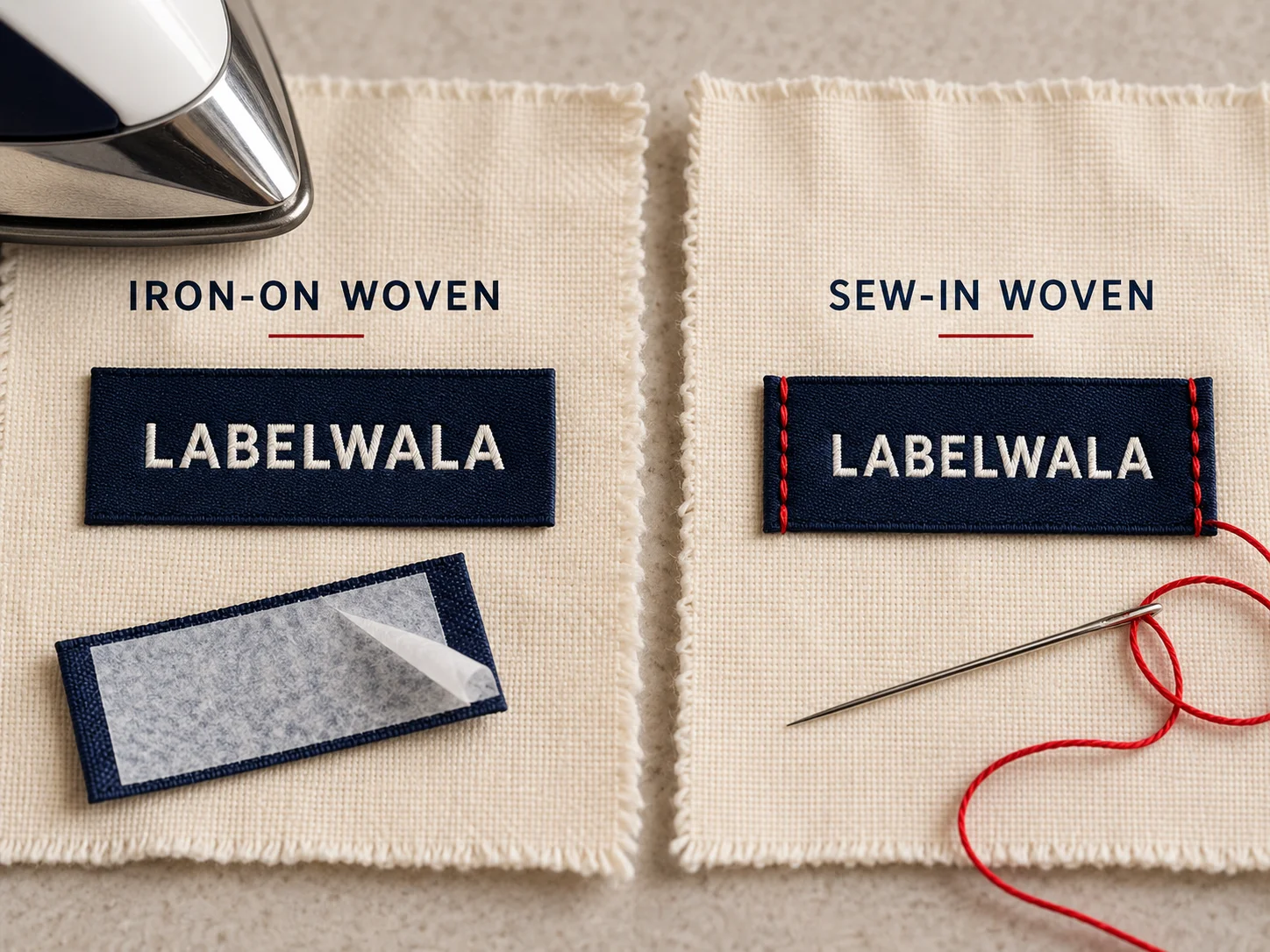
A heat-seal adhesive on the back bonds to fabric under a hot iron. Fast, needle-free, but the glue is the weak link over heat and time.
Stitched into a seam or onto the fabric with thread. Permanent and fabric-agnostic: the retail standard for brand labels.
How do iron-on labels attach to fabric?
An iron-on label carries a thin layer of heat-activated adhesive on its back. Apply heat and pressure and that glue melts, flows into the surface fibres of the fabric, and sets as it cools: bonding the label in place with no stitching at all.
That's its whole appeal: anyone can do it at home with a household iron, and a full set of name labels goes on in minutes. The catch is that the bond is only ever as strong as the adhesive, and adhesive responds to the same thing that applied it, heat.
How do sew-in labels attach to a garment?
A sew-in label is stitched into the garment: most often folded into a seam so both raw edges are hidden, or stitched flat onto the fabric. Because it's held by thread, not glue, there's nothing to soften, lift or peel.
It's easiest to add during garment construction, when the label is caught in a seam as the piece is sewn. That's exactly why brand neck labels are almost always sewn in at the factory. The fold you choose (end-fold, centre-fold or loop), changes how it sits; our label fold types guide walks through each.
Which survives washing better, iron-on or sew-in?
This is where the two genuinely part ways. A sew-in label survives essentially any wash, because there's no bond to break. An iron-on label applied well to a suitable fabric handles normal home laundry fine, but heat and time work against the glue.
Industrial laundry? Sew it in. Hotel linen, workwear and hostel clothing go through cycles hot and harsh enough to defeat most adhesives over time. See why hotel linen labels disintegrate for what that punishment looks like.
Which fabrics can take an iron-on label?
Iron-on needs heat to bond, and not every fabric can take that heat. This is the constraint people most often miss.
Cotton, cotton blends and most everyday woven fabrics: they tolerate the iron's heat and let the adhesive grip.
Nylon and heat-sensitive synthetics (can scorch), plus waterproof, coated or highly water-repellent fabrics (won't bond). Also anything delicate.
Test on a hidden spot first. If you're not sure your fabric can handle the iron, press a corner where it won't show. A scorch mark on a test corner is a cheap lesson; one on the garment isn't.
Speed, labour and cost
Beyond durability, the practical difference is time and hands.
- Iron-on is quick and needs no machine or skill: ideal for parents labelling uniforms or a founder doing a small batch by hand.
- Sew-in adds a stitching step. It's effortless when the label is caught in a seam during production, but fiddly to add by hand to a finished garment.
Making garments from scratch? The sewing "cost" of a sew-in label all but disappears, because it goes in as the seam is stitched anyway. Iron-on's speed advantage matters most when you're applying to garments that are already made.
When should you choose iron-on or sew-in labels?
- You're naming uniforms, kit or camp clothing at home
- The fabric is cotton or a cotton blend
- Items are washed normally at home
- You want speed with no sewing machine
- It's a small batch you're applying by hand
- It's a brand label in a garment you're producing
- The fabric is heat-sensitive, coated or delicate
- Items face industrial or heavy laundry
- You want a permanent, retail-grade finish
- The label is caught in a seam during construction
How do you apply an iron-on label that stays on?
Set the iron to the fabric's heat with steam off, moisture stops the adhesive setting.
Hold firm pressure straight down for the full time given, usually 10-15 seconds.
A thin cloth or the supplied sheet spreads heat evenly and protects the label.
The bond finishes as it cools. Touching or wearing it warm is the top reason edges lift.
Who is actually attaching them
The two methods are often compared on durability alone, and the more useful question at the start is who does the work and how many pieces they are doing it to.
A parent labelling one child's kit has perhaps thirty items, a domestic iron and no sewing machine. Iron-on is genuinely faster here, and the durability gap matters less because the kit is outgrown within a year or two anyway.
A hostel or school labelling an intake has hundreds of garments and a tailor available. Stitching is quick when it is done in one sitting on a machine, and the labels then survive institutional laundry for years rather than a season. The per-item labour looks worse and the total cost over time is far better.
A brand labelling production has no choice to make. The label goes in during assembly, caught into a seam by the same operator making the garment, and it costs essentially nothing extra because the seam was being sewn regardless.
That last case is worth stating plainly, because it is where the comparison stops being a comparison. Iron-on exists for labelling garments that already exist. If your garments are still being made, the label is sewn in, and the question never arises.
Between those cases sits the small brand printing onto blanks bought in, and that is where the choice is genuinely open. The garments already exist, so sewing means paying someone to unpick nothing but still to stitch a hundred labels by hand, while iron-on can be done in an afternoon with a heat press you may already own for the prints. The trade is speed now against a bond that will eventually let go, and for a garment sold at a low price point that trade is often worth making. For anything premium it is not, because the neck label is one of the few places a customer physically inspects.
Whichever way that goes, decide it before the first run rather than per batch, because a range with iron-on labels on some garments and sewn labels on others is impossible to describe honestly to a customer.
Position decides more than preference does
Most of this comparison is settled by asking where the label goes, because the two methods have very different requirements of the surface they attach to.
An iron-on needs a flat, single layer of fabric that a press can reach with even heat and pressure across the whole label. That rules out more of a garment than people expect: anywhere near a seam, a zip, a waistband, a gathered panel or a pocket edge has uneven thickness, and an edge that sits over a step in the fabric is the edge that lifts first.
A sew-in has no such constraint. It goes into a seam, which is where most labels belong, and the seam itself does the holding. A neck label caught into the collar seam is mechanically part of the garment rather than something stuck to it.
- Inside the collar: sew-in, caught into the seam.
- Side seam, for care information: sew-in, folded into the seam allowance.
- Flat back panel or chest of a tee: iron-on works well here, and is the position it was designed for.
- Anywhere with a waistband, elastic or a hem step: neither an iron-on nor a happy result.
What happens when the label has to come off
Almost nobody considers removal at the point of choosing, and it decides the answer for a whole category of garments.
A sew-in label is unpicked in under a minute. What is left is a line of stitch holes that close up in the next wash, and a new label can go into the same seam. That is why school uniform passed between siblings, hostel kit reissued between intakes and anything intended for resale is nearly always sewn.
An iron-on cannot be removed cleanly. Reheating lifts most of it, but a shadow of adhesive stays in the weave, and on light or fine fabric it shows as a slightly stiff, slightly darker patch. Applying a second label over that residue rarely bonds properly.
So the practical rule is: if the garment will only ever belong to one person, an iron-on is a reasonable convenience. If it will be handed on, reissued, resold or rebranded, sew it in.
Common mistakes
- Ironing onto a fabric that cannot take the heat, which is most performance synthetics and anything with a coating.
- Applying over a seam, a zip or a waistband, where pressure is uneven and the edge lifts.
- Using a domestic iron in a sliding motion. Iron-on adhesive needs steady pressure held in one place, not movement.
- Washing the garment before the bond has fully cooled and set.
- Putting permanent care and composition information on an adhesive bond.
- Choosing iron-on for garments that will be handed down.
- Judging either from one sample rather than after several washes at the temperature the garment actually gets.
Getting either made at Labelwala
Labelwala has been making woven and printed labels in Ahmedabad, Gujarat, for 25 years.
- Minimum order: 1,000 pieces, counted per design rather than per order.
- Production: 7-10 days once artwork is approved. Rush jobs run 3-5 days.
- Delivery: anywhere in India; timing follows the destination and the size of the consignment.
Tell us the garment, the fabric and where the label sits. Those three usually answer the question before price is even discussed.
We are rated 5.0 on Google from 27 reviews.
The short answer
Iron-on and sew-in are both good, they just hold on differently. Iron-on bonds with heat-activated glue: fast, needle-free, perfect for naming cotton clothing washed at home, but limited by heat-sensitive fabrics and heavy laundry. Sew-in is stitched in: permanent, works on any fabric, survives any wash, and is the retail standard for brand labels built into a garment. If you're branding a product line, sew in. If you're labelling finished garments quickly and they're cotton washed at home, iron on, and apply it properly so it never peels. Want a woven or printed label with an iron-on backing? Tell us when you order and we'll build it that way, then sample it before bulk.