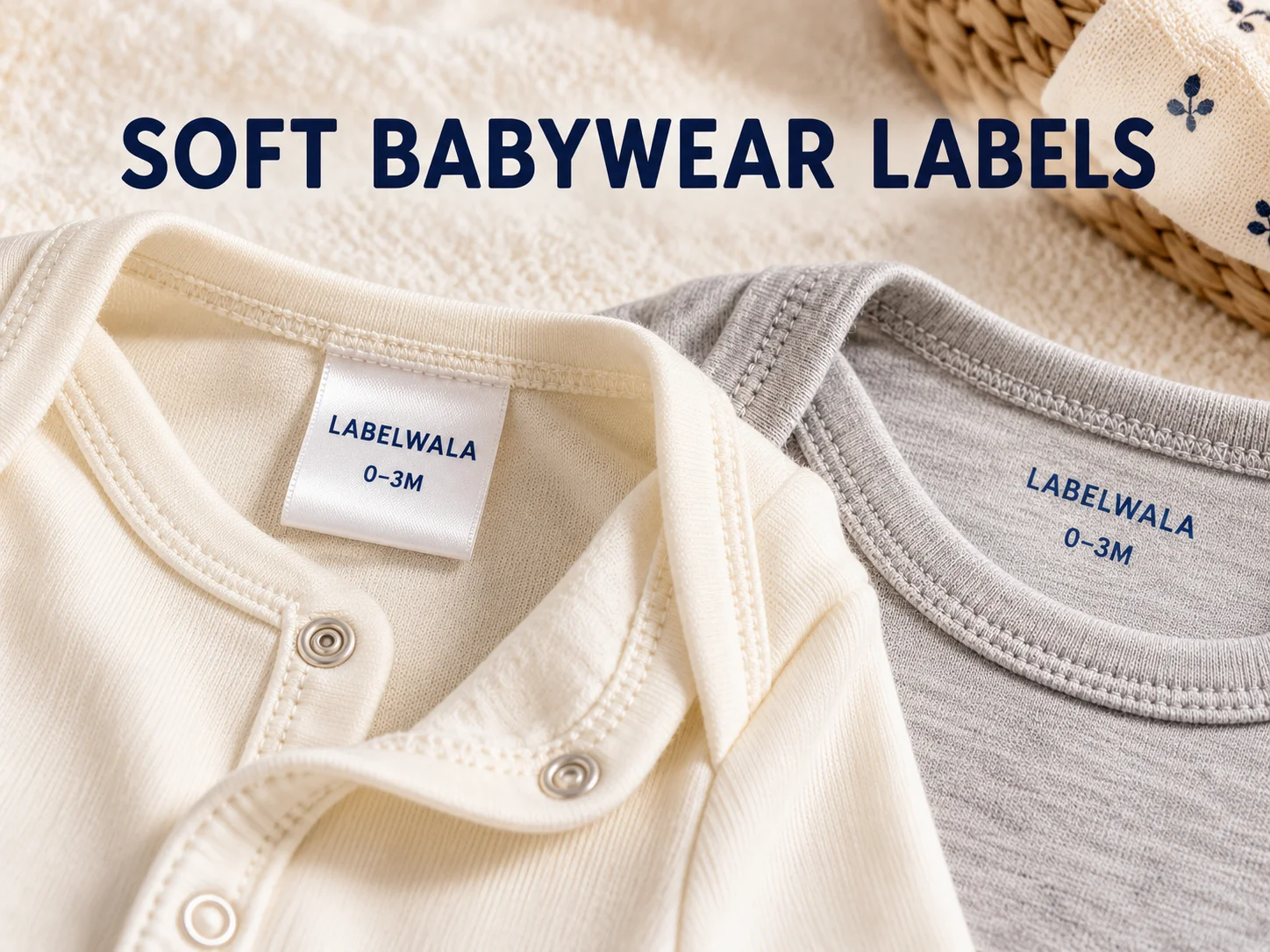
In brief
The safest labels for baby and kids' clothing are tagless heat-transfer prints, soft printed satin or ultra-soft cotton, sewn flat and securely attached. Avoid stiff woven labels with hard edges at the neck, coarse taffeta, sharp corners and any small part that could detach and become a choking hazard.
Labelling a kids' garment isn't just a smaller version of labelling an adult one. Babies and young children have delicate skin, can't tell you when something itches, and put things in their mouths. That changes the rules: for kidswear, softness and safety come before a premium woven look.
This guide covers the best label types for children's clothing, the materials to avoid, where to place labels, and the safety points to keep in mind, especially if you're exporting.
Why are kidswear labels different from adult labels?
Three things make children's labelling its own category:
- Thin, delicate skin irritates easily
- A stiff neck label can leave marks
- Softness beats everything
- A baby can't say "this itches"
- Discomfort shows as fussing
- Comfort is your responsibility
- Small detachable parts = choking risk
- Loose threads and sharp corners
- Labels get chewed
- Soft, flat, securely attached
- Tagless wherever possible
- Nothing that can detach
What are the best label types for kids and babies?
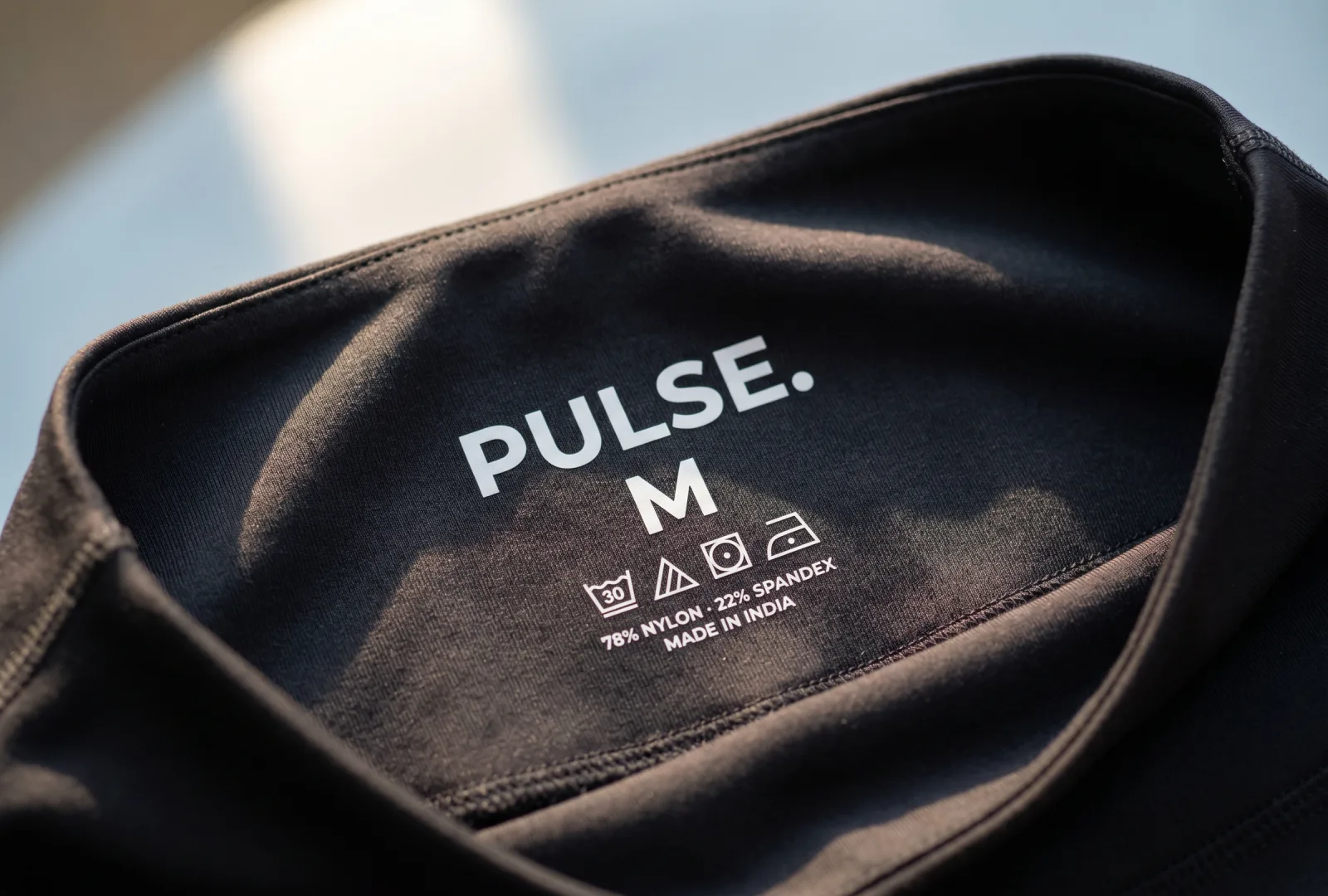
Brand & care printed straight onto the fabric: no physical label to scratch or chew. Lies perfectly flat. What most babywear brands choose for exactly this reason.
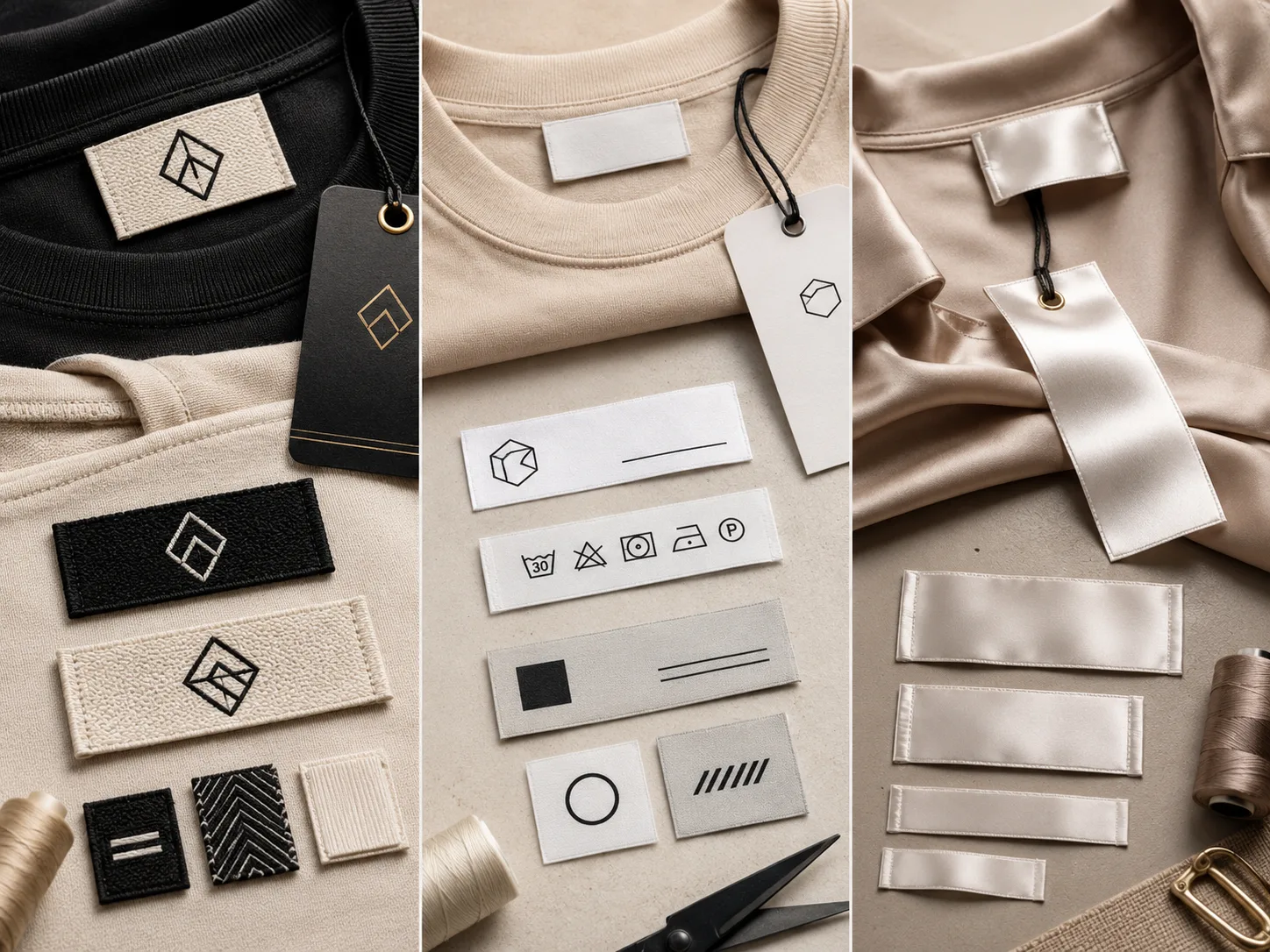
A printed satin label with a gentle hand-feel. Soft, colourful and cheap: a great choice when you want an actual label.
Natural, breathable and soft against skin. Good for organic and eco kids' brands. Sew it flat with no hard edges.
Coarse woven or taffeta with hard edges at the neck is the #1 comfort complaint. If you must, use high-thread-count, folded-edge, sampled on skin.
Go tagless at the neck. The back neck is the most sensitive contact point. Printing the brand there tagless removes the single most common source of irritation. Learn more in our tagless heat-press labels guide.
What label materials should you avoid for kids?
- Stiff or scratchy edges at the back neck: the most common cause of fussing
- Sharp corners and rough selvedge against the skin
- Small detachable parts: anything that can come off is a choking hazard
- Loose threads that little fingers can pull or wrap
- Large tags that a baby can fold into their mouth
Safety & compliance notes
Baby and children's clothing still needs the standard garment information: fibre content, wash care and country of origin (see our care label requirements guide). On top of that, keep children's product safety in mind:
Exporting? Check the destination rules. Many markets (US, UK, EU) have stricter children's product safety requirements, including on small parts and neck attachments. If you sell abroad, confirm the target market's rules before you print.
Where should labels go on kids' clothing?
Keep it flat: tagless print or soft satin only. No stiff tags here.
Care & size low in the side seam, tagless or soft, where it won't rub.
Want a woven look? Put it on a hang tag the child never feels.
Feel every label against skin before you commit to bulk.
Why is tagless the default for kidswear labels?
In adult apparel, tagless printing is one option among several. In babywear it is closer to the starting assumption, and a fabric label is the thing that needs justifying.
The reason is what happens when a label fails in this category. An adult who finds a label irritating cuts it out and carries on. A parent cuts it out too, and with it goes the size, the composition and the care instructions, which is precisely the information they will need when the garment is handed down or resold. A cut-out label is not a comfort complaint; it is the permanent loss of everything the label existed to say.
Printing the information directly onto the garment solves both problems at once: nothing to feel, and nothing that can be removed. That is why the softest ranges in this category are almost entirely tagless.
Where a physical label is genuinely wanted, for a brand moment, or because the customer expects one, the practical compromises are:
- Move it out of the neck to a side seam, low on the garment, where it is out of contact with the most sensitive area.
- Use a folded edge, never a cut one. On synthetics a heat-sealed edge is firm and sometimes sharp, and that edge is what a child actually feels.
- Keep it small. Area is what the body notices, so a small soft label beats a large one.
- Sew it down on all sides where a child can reach it, so there is no free edge to chew or pull.
- Choose printed satin or cotton over damask and taffeta, both of which are hard-wearing and stiff.
Sizing needs more room than adult labels
Children's size labels carry more information than adult ones and have less space to do it in, which is the tension at the heart of this category.
Adult sizing is one or two characters. Kids sizing is often an age and a height, sometimes a chest measurement too, on a garment that is physically smaller. A tab reading “6Y / 116 cm” has far more characters than “M” and sits in a much smaller neck.
- Age only (2Y-6Y): 15 × 20 mm is comfortable.
- Height only (98-116 cm): around 15 × 25 mm.
- Age and height on one line: around 20 × 30 mm.
- Age and height on two lines: 20 × 25 mm with 4 mm letters.
- Newborn sizes in months (0-3M): around 15 × 25 mm.
Height matters more than age for actual fit, and parents increasingly shop on it, so if you only have room for one, height is the more useful number. Keep letters at 4-5 mm, below about 3 mm the enclosed gaps in characters like 8, 6 and 0 fill in after washing, and a size that cannot be read is a garment that cannot be handed on.
What extra label requirements apply when exporting kidswear?
Children's clothing is more heavily regulated than adult clothing in most export markets, and some of those requirements land on the label rather than on the garment.
- Nightwear flammability. Several markets require a specific warning or compliance statement on children's nightwear labels, with prescribed wording. This is a labelling requirement, not just a fabric one.
- Cords and drawstrings on children's garments are restricted in a number of markets, and buyers commonly ask for a compliance declaration covering them.
- Age grading may need to appear in a specific format for the destination market.
- Restricted substances. The label is part of the garment, so its base and inks fall inside the same chemical testing as the fabric, and limits for children's products are typically tighter.
- Small parts. Anything that can detach is assessed as a choking hazard, which affects how labels are attached as much as what they are.
Ask early, too. These requirements affect wording that has to appear on the label itself, so discovering one late means new artwork and a new sampling round not a small adjustment.
Confirm the specifics with your buyer rather than assuming, because they vary by market and change over time. What is consistent is that children's requirements are stricter than adult ones, so a label set designed for an adult range should never simply be scaled down and reused.
Care instructions parents will actually follow
Children's clothes are washed constantly, often hot, and frequently in a hurry. The care label has to survive that and has to be realistic about it.
Parents wash babywear hot because they want it hygienic, so a 30 °C instruction on a garment covered in something unpleasant will simply be ignored. If the fabric can genuinely take 40 or 60 °C, say so. A higher stated temperature that the garment survives is far better than a lower one that gets overridden.
- Set symbols to ISO 3758 and to the temperature the garment really tolerates.
- Add text where symbols cannot speak: wash inside out for printed graphics, no fabric softener on anything with stretch.
- Account for prints. A rubber or plastisol print rules out ironing over it regardless of the base fabric.
- Expect the tumble dryer, because parents use one. If the garment cannot take it, say so clearly rather than relying on a crossed symbol alone.
- Keep it legible for years, since kidswear is handed down and the second owner has only the label to go on.
Common mistakes
- Scaling down an adult label set and reusing it on a kids range.
- Choosing damask or coarse taffeta for a neck position on babywear.
- Leaving a heat-cut edge against a child’s neck instead of specifying a fold.
- Attaching a label on one edge, so there is a free corner to chew or pull.
- Setting size text small enough that it becomes unreadable before the garment is handed down.
- Stating a wash temperature so low that parents ignore it.
- Going tagless and quietly dropping the composition or origin information.
- Assuming export requirements match the adult range.
The through-line is that kidswear is a stricter brief in every direction at once: softer, safer, more legible for longer, and more heavily regulated. Anything carried over unexamined from an adult range is where the problems come from.
Getting kidswear labels made at Labelwala
We make woven and printed labels in Ahmedabad, Gujarat, and we have been doing it for 25 years. Kidswear ranges usually come to us as a mix, tagless or soft printed where the garment touches skin, a conventional label where it does not.
- Minimum order: 1,000 pieces per design.
- Quotes: usually within 2 hours on a working day.
- Production: 7-10 days once artwork is approved. Rush jobs run 3-5 days.
- Care symbols: set to ISO 3758.
- Delivery: across India, depending on destination and consignment size.
Tell us the age range, whether you are exporting, and how the label is attached. Those three answers change the material, the placement and the construction, and they matter far more here than the artwork does.
We are rated 5.0 on Google from 27 reviews. Ask for samples you can feel against a real garment before committing to a run.
The short answer
For baby and kids' clothing, choose the softest, flattest, safest option: tagless heat-transfer printing is best, with soft printed satin or ultra-soft cotton close behind. Avoid stiff woven edges, sharp corners and anything that can detach. Keep the back neck flat and tagless, put care information low in a side seam, and always feel a sample against skin before bulk. If you export, check the destination market's children's safety rules first. Send us your artwork and we'll sample soft, safe options you can feel before ordering.