In brief
Wedding wear needs a label set that matches its price and survives its construction. Use a high-density damask brand label, in gold or silver thread if the garment calls for it, sewn onto the lining at the two ends and never through embroidery; a printed satin care label that says dry clean only and lists the shell and lining separately; a Made to Measure size label with the order number on bespoke pieces; and ribbons, badges and care cards for the trousseau box.
The wedding season runs from November to February, with a second peak around April and May, and most bridal and occasion-wear studios do the bulk of a year's business in those months. Labels are a small line in the cost of a lehenga that sells for a lakh or more, but they are the one part of the garment the customer reads up close, on the day the outfit is unpacked and every time it is taken out afterwards. A thin, curling label on a hand-embroidered blouse undoes the impression the embroidery was meant to make.
Wedding wear also has its own problems. The fabrics are the hardest in the trade to sew a label onto: net, tissue, raw silk, velvet and brocade, most of them covered in zardozi, sequins, stones or thread work. The garments are often made to measure, so standard sizing does not apply. The care is nearly always dry clean only, and the garment is stored for years between wearings. And the sale comes with packaging, bags and boxes that carry the brand as much as the outfit does. Our boutique and ethnic-wear guide covers the general case for Indian occasion wear; this article is about the wedding order specifically.
The label set for a wedding outfit
A bridal or groom's outfit is several garments, and each piece needs its own label, because the pieces are stored, cleaned and sometimes resold separately.
| Piece | Brand label | Care / composition | Size |
|---|---|---|---|
| Lehenga skirt | Inside the waistband, centre back | Waistband lining, beside the brand label or in a side seam | Custom or size code, same spot |
| Blouse / choli | Back-neck lining or inside the back opening | Lining side seam | Under the brand label |
| Dupatta | Small flat label on one corner | Same label, or a hang tag on that corner | None |
| Saree | Corner of the pallu, inside | Same label, or hang tag | None |
| Sherwani / bandhgala | Inside breast facing or back-neck lining | Lining side seam or inside pocket | Chest size or Custom |
| Kurta, churidar, trousers | Back neck (kurta), waistband (bottoms) | Side seam or waistband | Under the brand label |
| Stole, safa, potli, shoes | Small label or woven badge | Hang tag | None |
Two labels do most of the work: a brand label that appears on every piece, and a care label that appears on every piece that will be cleaned. Keep the brand label identical across the set, in the same material and the same threads, so a blouse and a lehenga from the same studio read as one outfit when they are laid out together. Our guide to the full label and tag checklist covers what each type carries.
Materials that match the garment
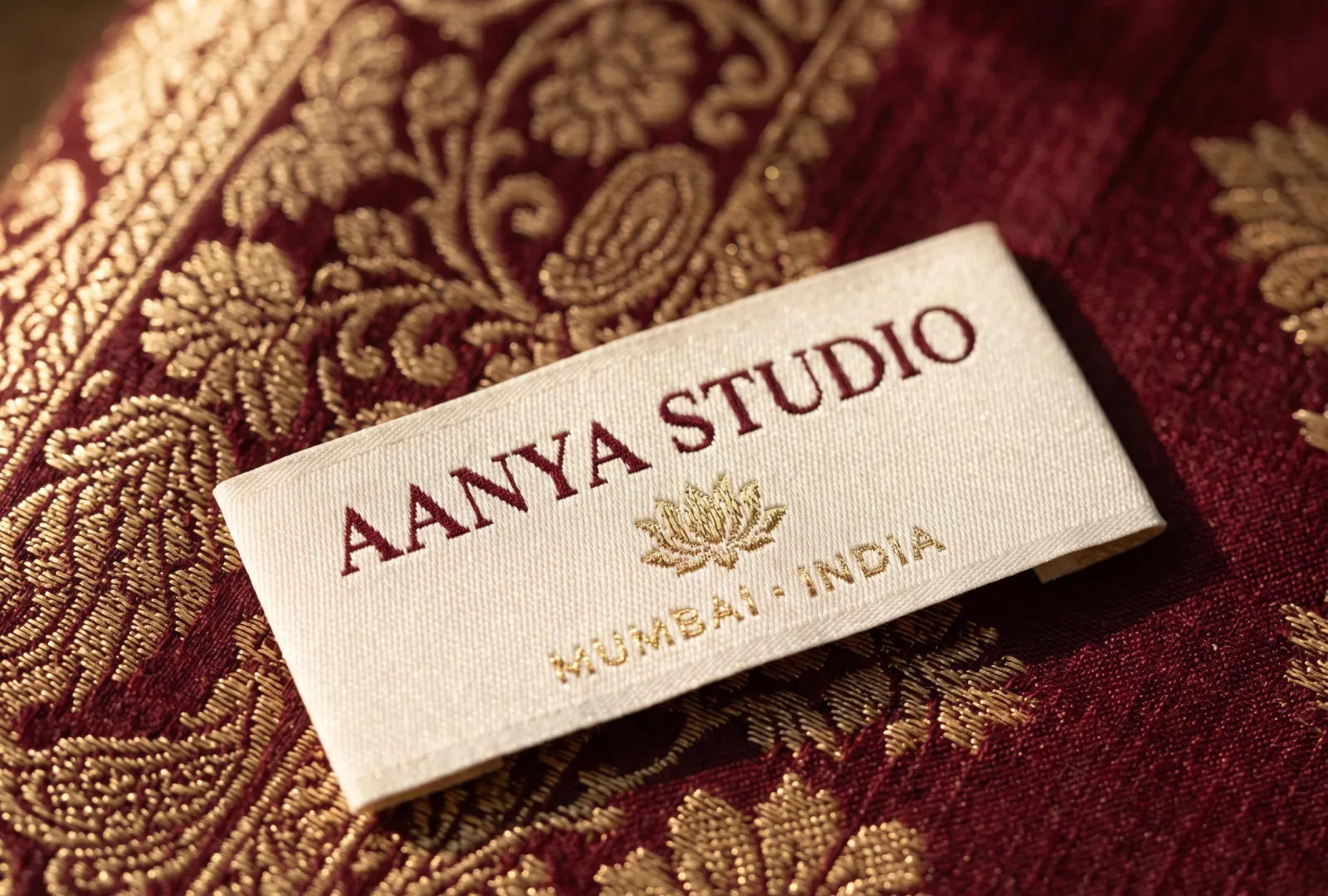
A premium woven label is the right starting point for bridal, and within woven labels the material is damask: the highest thread density, the sharpest detail and the softest finished feel. The choice beyond that is about colour and thread.
- Ground colour: ivory, cream, black, deep maroon or bottle green suit most bridal palettes. A white ground looks cheap against ivory silk; a cream ground does not.
- Metallic thread: gold, silver, antique gold and copper lurex-type threads weave in as one of the label's colours and give the logo the sheen bridal buyers expect. They are polyester-based, so they dry clean like the rest of the label, and they work best in bold strokes: a thin metallic hairline breaks up on the loom.
- Two colours, rarely three: a metallic logo on a dark ground, or a dark logo on cream with a metallic border, is the classic bridal label. Each extra colour is another weft thread and more cost without more effect at label size.
- Satin-finish woven: an option for the softest skin contact, on a blouse lining for example, where a slight satin sheen suits the garment.
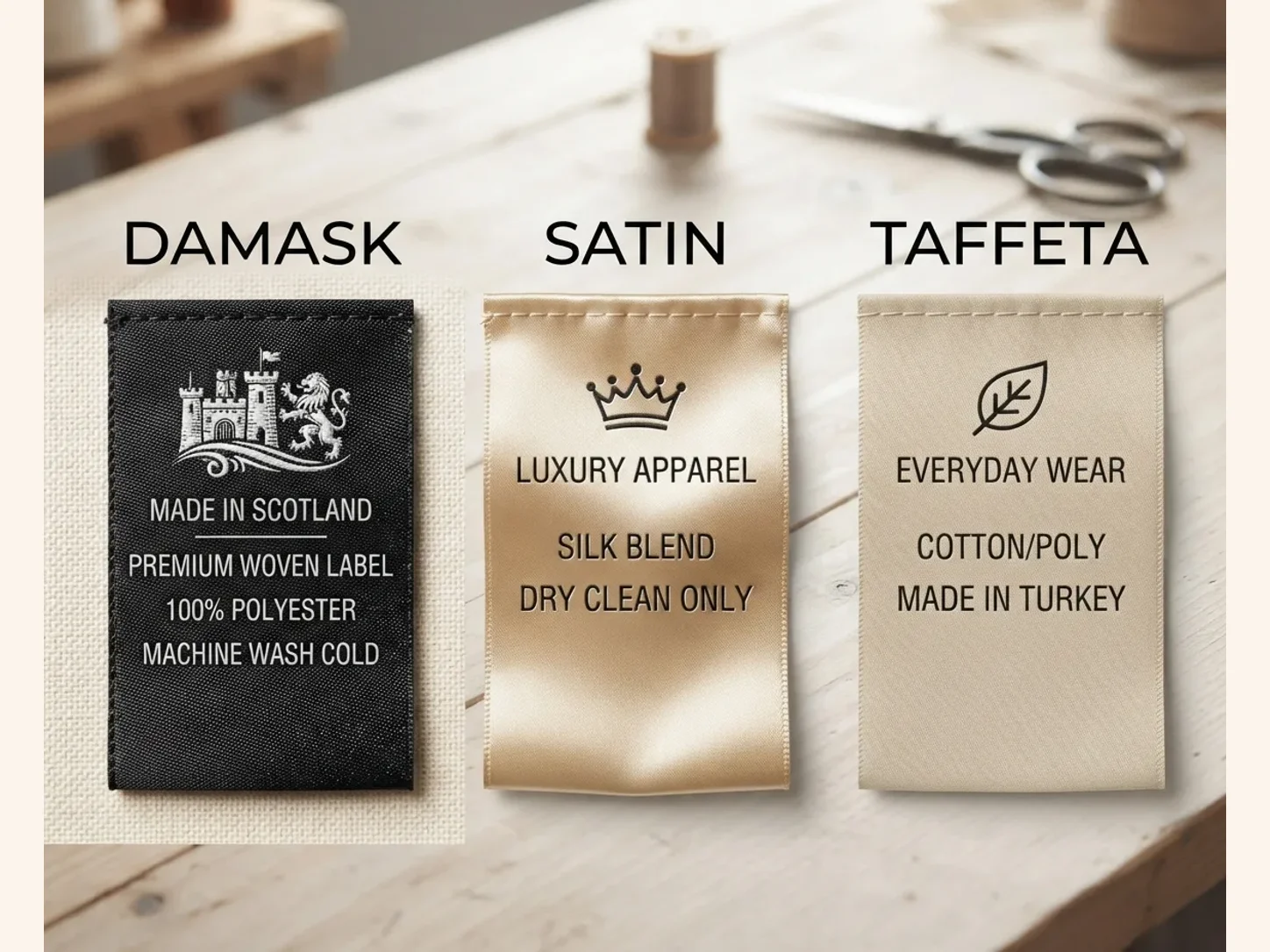
- Printed satin: for the care label, where small symbols and several lines of text need to stay sharp. Not for the brand label on a bridal piece: it reads as a standard ready-to-wear label.
For the trade-off between the two premium routes, read damask vs satin labels; for how a Pantone or thread shade is matched, see our colour matching guide. Ask to see your gold on an actual thread card before approving: there are several golds, and the one that suits antique zardozi is not the one that suits a modern pastel lehenga.
Sizes and folds for bridal pieces
| Piece | Brand label (finished) | Fold | Care label |
|---|---|---|---|
| Blouse, choli | 45 x 18 mm to 55 x 22 mm | End fold | 25 x 50 mm to 30 x 60 mm, loop fold |
| Lehenga waistband | 50 x 20 mm to 60 x 25 mm | End fold | 30 x 60 mm, loop fold or flat |
| Dupatta, saree corner | 25 x 12 mm to 40 x 18 mm | End fold or centre fold | Combined, or hang tag |
| Sherwani, bandhgala | 60 x 25 mm to 80 x 35 mm | End fold or four-side stitch on a facing | 35 x 70 mm, loop fold |
| Garment bag, box | Woven badge 50 to 80 mm, or printed ribbon | Flat | Care card |
End fold is the standard: both cut ends are turned under, so the label has no raw edge and the only stitches are at the two ends. On a sherwani, where the label sits on a stable facing, a four-side stitched label is acceptable and gives a tailored look. Our fold types guide explains each construction.
See the label at true size. The free label designer draws your brand label at real millimetre scale on the fold you choose, so you can compare a 45 mm blouse label and a 70 mm sherwani label before ordering samples.
Attaching labels to zardozi, net and tissue
The construction rule for wedding wear is simple: labels go on the lining, never on the shell. A needle through zardozi breaks the metal wire, a needle through sequins cracks them, and a needle through net or tissue leaves a hole that runs. The lining, usually a cotton, silk or satin, is where the label lives.
- Blouse: onto the back-neck lining or the inside of the back opening, stitched at the two ends only. On a thin silk lining, a small square of fusing or fabric behind the label spreads the stitches.
- Lehenga: onto the inside of the waistband, which is usually a firm canvas or double layer, so it takes stitches well. Keep the label clear of the hook, zip or drawstring.
- Dupatta and saree: these have no lining, so the label goes on the hem corner, where the fabric is doubled by the hem or the border. Use the smallest label that still carries the logo, with folded ends, and sew it by hand on net or tissue.
- Sherwani: onto the inside breast facing or the back-neck lining, the same way a tailor labels a jacket. The facing is stable, so a larger label and a four-side stitch are fine here.
- Order of work: the label is attached after the lining is set and before the garment is closed. Tell the karigar or tailoring unit where the labels go and get them there before the outfit reaches finishing, because adding a label after a bridal piece is complete means opening the lining.
Our guide to how labels are sewn into garments covers the stitches and machines; for wedding wear the difference is that much of the attaching is done by hand.
Made to measure: the size label on bespoke pieces
Most bridal lehengas and sherwanis are cut to the customer's measurements, so a size code is meaningless and a size label that says M on a bespoke piece looks wrong. Studios handle this in one of three ways:
- A Made to Measure or Bespoke label in place of the size tab, in the same material as the brand label. It is a small piece of branding in its own right and customers like it.
- The order number on a small printed satin label beside the brand label, so that an alteration months later can be traced to the original measurement sheet. This is the single most useful label a studio can add; it saves the argument about which measurements were taken.
- A standard size label on the ready-to-wear line, if the studio also sells sized pieces through stores or online. Marketplaces require it; our marketplace requirements guide lists what each platform checks.
Studios that make dozens of bespoke outfits a season can also use name and number labels inside the pieces during production, so that a blouse, skirt and dupatta for the same bride stay together through embroidery, dyeing and finishing at different workshops. Those can be removed before delivery or left in place as the order number.
Care labels for garments that are kept for decades
A wedding outfit is cleaned rarely and stored for a long time, often folded in a box in a cupboard. The care label is the only instruction the family will have in ten years, so it should be complete and plain.
| Fabric and work | Typical care text |
|---|---|
| Zardozi, dabka, sequin, stone work | Dry clean only. Do not wash. Do not bleach. Do not tumble dry. Iron on reverse, low heat. Do not iron over embellishment. |
| Raw silk, tissue, brocade, velvet | Dry clean only. Do not wash. Iron on reverse, low heat, with a cloth. |
| Georgette, chiffon, net with light work | Dry clean recommended. Do not wring. Iron on reverse, low heat. |
| Cotton or linen occasion wear | Gentle hand wash cold, or dry clean. Dry in shade. Medium iron on reverse. |
Set the symbols to ISO 3758 and write the key instructions in words as well: "Dry clean only" in text is understood by every family member and every dry cleaner; the circle symbol on its own is not. List the fibre content of the shell and the lining separately, for example Shell: 100% silk. Lining: 100% cotton. If the outfit will be exported or sold to NRI customers, the composition must follow the destination's rules; our care label requirements guide and fibre content guide cover India and the main export markets.
Two additions earn their space on a bridal care label or care card. A storage line, such as "Store flat in a muslin bag, away from direct light", prevents the fading and crease damage that generate most complaints about outfits worn a second time. And a line about embellishment, "Metallic work may tarnish with moisture; keep dry", manages expectations for zardozi, which darkens naturally over the years.
Trousseau packaging: bags, boxes, ribbons and cards
The outfit leaves the studio in a garment bag or a box, and the packaging is as much a part of the purchase as the embroidery. None of this is legally required; all of it is where the brand lives after the sale.
- Garment bag badge: a woven badge or a larger woven label, 50 to 80 mm, sewn or heat-sealed onto the bag. Cotton or canvas bags take a cotton label well; our patch comparison covers the options.
- Printed ribbon: a satin or grosgrain ribbon printed with the brand name ties the box, bundles the dupatta or forms the hanger loop on the garment bag. Our printed ribbons come in widths from 10 mm to 50 mm.
- Hang tag and care card: a heavier card than a ready-to-wear hang tag, carrying the care and storage advice and a note on the work in the outfit. Our hang tag guide covers paper weights, shapes and strings.
- Personalisation: the bride's name, the couple's initials or the wedding date on a printed ribbon or a card. This is where one-off text belongs, because a woven label has a minimum run of 1,000 pieces per design.
Keep the whole set in one colour family: the gold on the brand label, the ribbon and the card should be the same gold. The simplest way to get that is to send the same reference to every supplier, or to order the label, ribbon and tag from one supplier.
Rental, resale and export
Three channels have grown around wedding wear and each puts an extra demand on the label.
- Rental: an outfit rented out for a season goes through many cleanings. The brand label and the care label must survive repeated dry cleaning, and a durable order number lets the rental business track each piece. Woven labels handle this; a printed care label should be tested through several cleaning cycles first.
- Resale: pre-owned bridal wear sells on the strength of its label. A clear, well-sewn brand label is what a resale buyer looks for to confirm the piece is what the listing says. Ready-to-wear bridal lines increasingly add a QR code to the care label that links to the outfit's details.
- Export and NRI orders: outfits shipped abroad need the destination's fibre and origin labelling. The US requires fibre content, country of origin and care instructions; the EU requires fibre content on each component. Our US, EU and UK guides list the requirements, and the international ordering page explains how we ship labels abroad.
Ordering before the season
Bridal orders are placed months before the wedding, and embroidery, dyeing and tailoring are spread across different workshops, so the label has to be at the tailoring unit before the lining goes in. Working back from a November to February season:
- August to September: finalise the brand label artwork and thread colours, approve a sample on a lined swatch, and place the order. Our production time is 7-10 days after approval; add a sample round before it.
- September to October: care labels per care instruction, printed ribbons, hang tags and bag badges, so packaging is ready when the first outfits are finished.
- Through the season: keep the approved artwork and thread references on file so a top-up order matches the first batch. Our guide to consistent reorders lists what to record.
- March to April: reorder for the summer wedding peak, and review which pieces of the set the studio actually used.
Rush jobs run 3-5 days, which rescues a studio that discovers it is short of labels in December, but a rushed metallic-thread label is a gamble on thread availability. Order the brand label early and in enough quantity for the whole season.
Getting bridal labels made at Labelwala
We make woven damask, satin and cotton labels, printed ribbons and hang tags in Ahmedabad, Gujarat, and we have been doing it for 25 years. Metallic-thread brand labels for designer studios and bridal boutiques are a regular order before every wedding season.
- Minimum order: 1,000 pieces per design. One brand label used across the set, and one care label per care instruction, is the usual way to use the minimum well.
- Quotes: we usually reply within 2 hours on a working day.
- Production: 7-10 days once artwork is approved. Rush jobs run 3-5 days.
- Care symbols: set to ISO 3758 on every care label we print.
- Delivery: we ship across India and export worldwide.
Send us your logo, the ground colour and the gold or silver you have in mind, and tell us which pieces the label goes on and what the lining fabric is. That decides the size, the fold and whether we recommend a damask or a satin-finish weave. If you want the ribbon and hang tag to match the label, say so, and we will match them to the same thread shade.
We are rated 5.0 on Google from 27 reviews. Ask for a physical sample with the metallic thread on it; gold looks different on screen, on a thread card and on a woven label, and the woven label is the one that counts.
Common mistakes
- A standard printed label on a lakh-rupee lehenga.
- Sewing the label through zardozi, sequins or net instead of onto the lining.
- A size code on a made-to-measure outfit.
- No order number anywhere on a bespoke piece.
- A thin metallic hairline in the logo that breaks up on the loom.
- White ground on an ivory garment.
- A care label with symbols only and no "Dry clean only" in words.
- Shell and lining lumped into one fibre percentage.
- Different golds on the label, the ribbon and the hang tag.
- Ordering the brand label in October for a November wedding season.
Sample checklist
Approve the set on a lined swatch of the actual garment fabric, and on one finished piece if you can.
- Does the gold or silver thread match the embroidery when both are in daylight?
- Does the logo weave cleanly, with no broken metallic strokes?
- Is the ground colour right against the lining and against the shell?
- Does the label lie flat on the lining with end stitches only?
- Is the corner label on the dupatta small and soft enough not to show or scratch?
- Does the care label say "Dry clean only" in words and symbols?
- Are shell and lining listed separately in the fibre content?
- Does the Made to Measure label match the brand label in material and colour?
- Has a printed care label survived three dry-cleaning cycles?
- Do the ribbon, hang tag and bag badge match the label's gold?
What to send your supplier
- Vector logo, fonts outlined, and the ground and thread colours (Pantone or a physical swatch).
- The metallic shade you want: gold, antique gold, silver or copper.
- The pieces the label goes on and the lining fabric of each.
- Finished sizes in mm and the fold for each label.
- Full care text per care instruction, with shell and lining compositions.
- Whether you need Made to Measure labels, order-number labels or standard size tabs.
- Ribbon widths, hang tag size and bag badge size if you want them matched.
- Quantities per design for the season, not per outfit.
A brief that works: "Bridal studio. Brand label 55 x 22 mm end fold damask, cream ground, antique gold logo, for blouse lining, lehenga waistband and sherwani facing. Dupatta corner label 35 x 15 mm, same design. Care label 30 x 60 mm loop fold printed satin, dry clean only, text attached. Made to Measure label 35 x 15 mm, same threads. 25 mm printed satin ribbon in matching gold."
What we would recommend
For a bridal or wedding-wear studio: one damask brand label, cream or dark ground with a single metallic thread, used on every piece in the set and sewn onto the lining at the two ends only; a Made to Measure label with the order number on bespoke pieces; a printed satin care label that says Dry clean only in words and lists shell and lining separately; and a ribbon, hang tag and bag badge matched to the same gold.
Order the brand label by September in enough quantity for the whole season, sample the gold on a real woven label before approving it, and brief the tailoring unit on where each label goes before the linings are set. An outfit labelled that way looks right on the day and still reads as the studio's work when it comes out of the box years later.