In brief
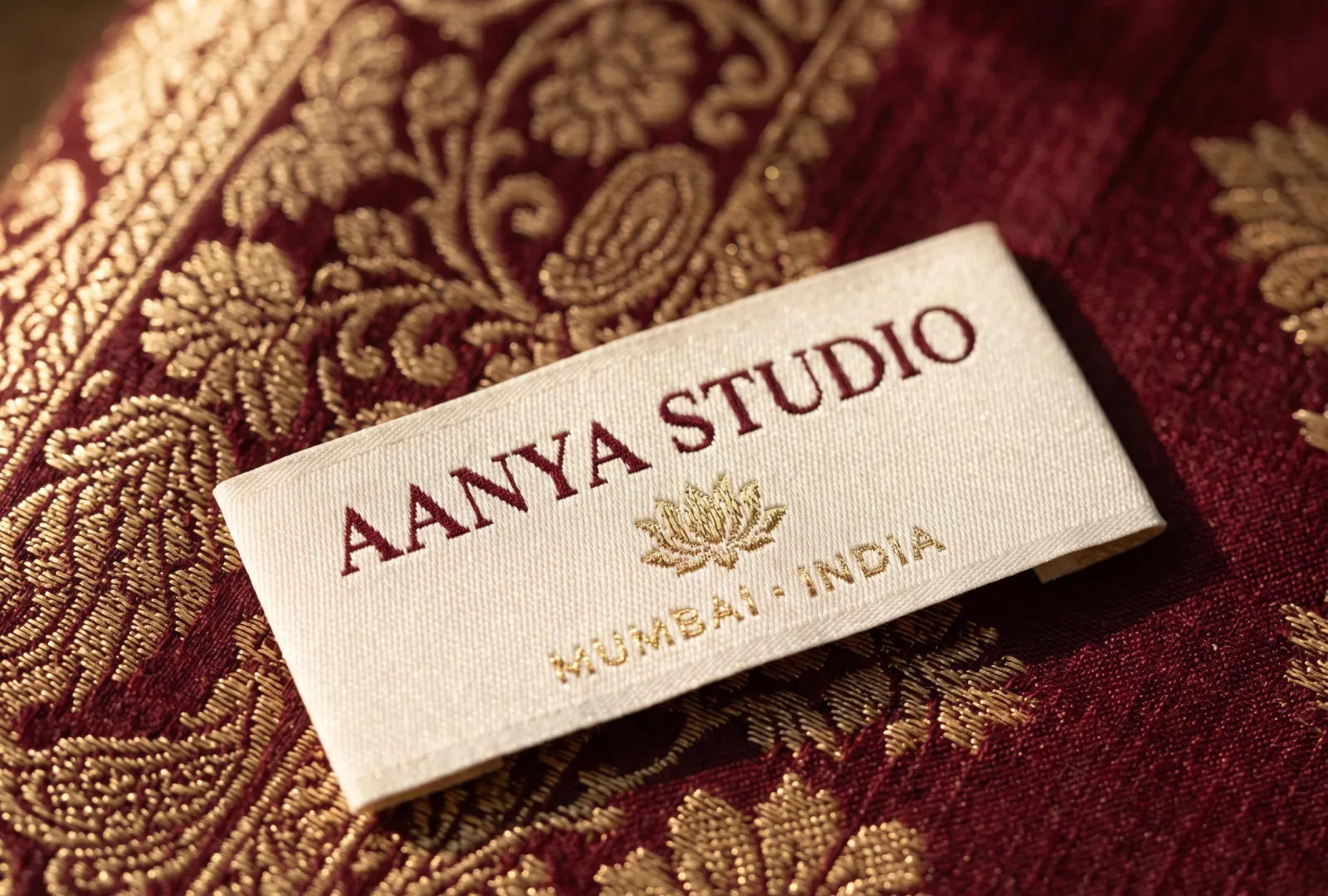
Boutique ethnic wear usually carries a woven damask neck label in gold or maroon thread, a satin hem tab, a printed care label and a paper or fabric hangtag. Match the label fabric to the garment: soft damask or satin on silk, cotton or satin on kurtas, and a centre-fold satin tab on sheer net or georgette.
Indian boutique shoppers feel a label before they read it. A heavy gold-thread damask tab inside a ₹15,000 lehenga reads premium. A flimsy printed sticker on the same garment reads "knock-off." If you're building a saree, lehenga or kurta brand, the label spec is part of your price tier, not an afterthought.
What does "boutique-grade" actually mean?
Mass-market kurta brands use polyester satin labels with 2-3 thread colours. Boutique brands need three things mass brands don't: heavier ribbon weight (damask, not flat satin), a metallic accent thread (gold or silver lurex), and a fold that sits flat under the neckline. The combined cost difference per garment is ₹15-25, trivial against a ₹3,000+ price tier, but the perceived value lift is large.
If your retail price is below ₹1,500, treat boutique-grade labels as optional. Above ₹3,000, treat them as table stakes.
Where does each label go on a boutique garment?
Boutique garments use 3-4 label touchpoints, each with a different job:
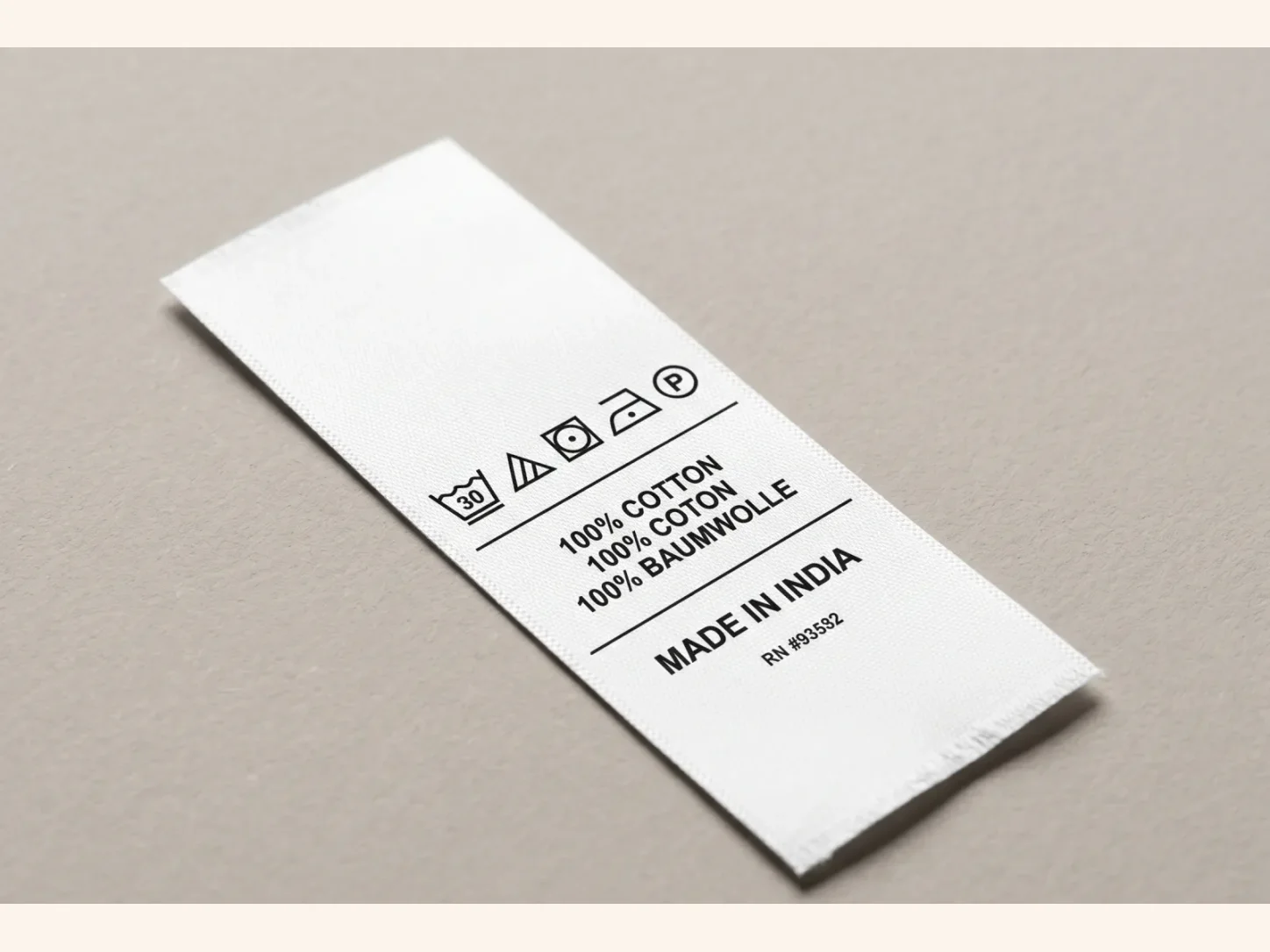
The neck and hem tags are the brand layer. The care label is the legal layer (fabric content, wash). The hangtag is the retail layer, what the customer sees before unwrapping.
Which weave and thread suit ethnic fabrics?
Different garment fabrics need different label fabrics. The wrong pairing scratches the wearer or looks cheap against the cloth.
- Silk sarees / pure silk lehengas: Mitre-fold satin or damask, soft hand-feel, gold or maroon thread on cream. Never a stiff polyester satin, it scratches against silk.
- Banarasi / brocade lehengas: Damask weave with metallic thread reads as a match for the brocade. A flat satin label looks plain against the brocade pattern.
- Cotton kurtas / chikan / khadi: Cotton or satin label with khaki/maroon/indigo thread. Soft hand-feel. Skip lurex, it clashes with the fabric's earthy texture.
- Net / georgette / chiffon: Centre-fold satin tab so the label edge is fully tucked. The fabric is too sheer for a stiff end-fold.
- Embroidered / mirror-work pieces: Small woven tab on the side seam, not the neck. The neckline is already busy with embroidery.
What does a boutique-grade label realistically cost?
Indicative per-piece pricing for a boutique-grade neck label (30×40mm damask woven, gold lurex thread, end-fold, 6 thread colours):
Add a satin hem tag (₹2-3), a printed care label (₹1-2) and a paper hangtag with string-tie (₹6-12), the full label set lands between ₹17-27 per garment at 100 pieces. At a ₹3,000+ retail price, that's under 1% of cost.
What is the MOQ for boutique brands?
Most boutique brands stitch in small batches (10-50 pieces per design). You don't need labels per design: you need labels per brand, used across designs.
Order one brand label in 1,000 pieces; stitch it into every SKU you produce for the next 4-8 months. Order care labels separately per fabric type (silk, cotton, georgette) since wash symbols vary.
The hangtag question
For boutique pieces above ₹2,500, a hangtag is non-negotiable. Three options ranked by perceived value:
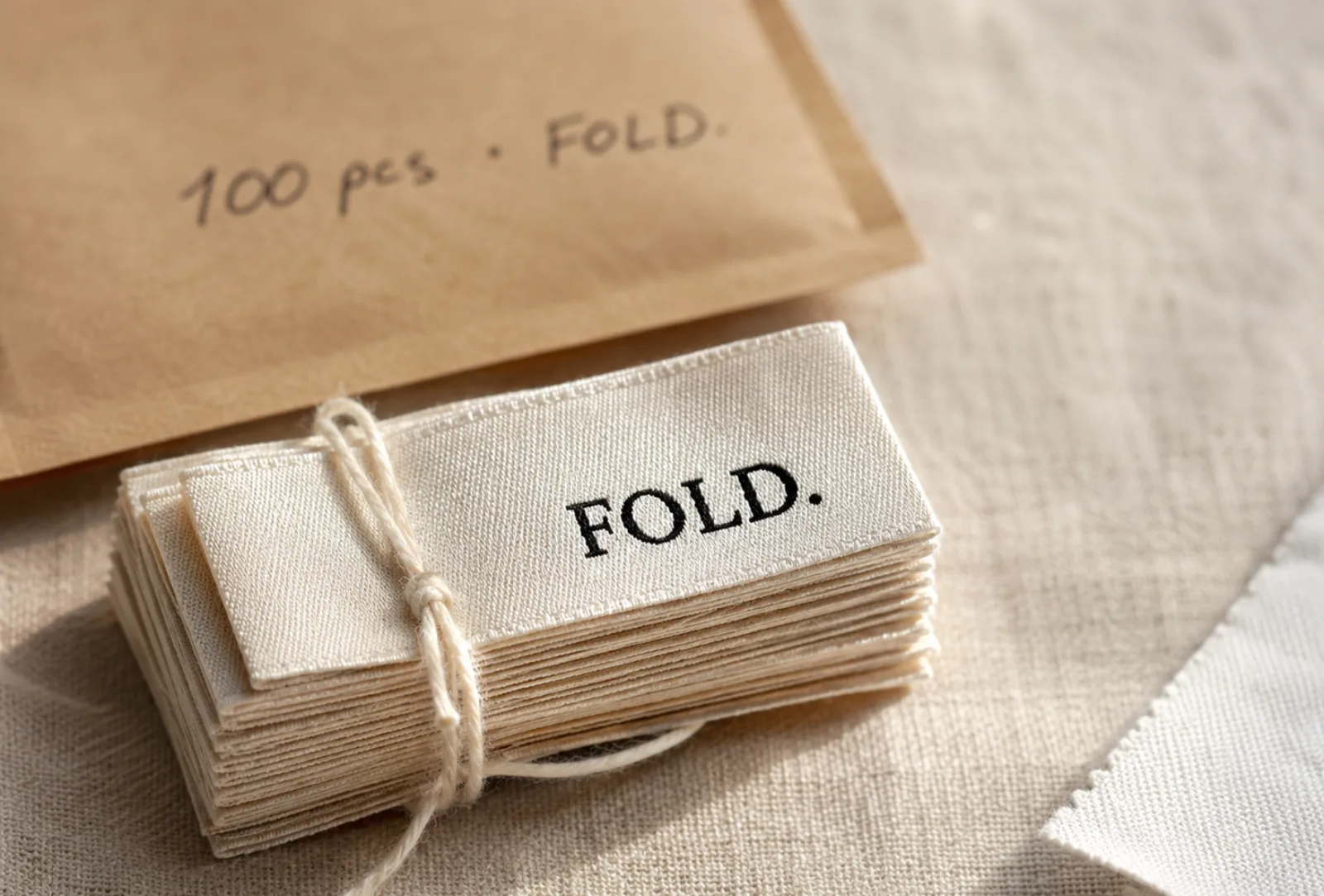
- Printed paper hangtag with string-tie, ₹6-12 per piece. Best value-for-perception. Use 300 GSM kraft or matte art paper, gold-foiled brand mark on front, care + price + size on back.
- Fabric (satin / cotton) hangtag with bead, ₹14-22 per piece. Premium feel; takes another 7 days to produce. Use for ₹8,000+ pieces.
- Letterpress / foil-stamped paper hangtag, ₹18-30 per piece. Best-in-class. Couture-only price tier.
The string-tie matters too, twisted cotton beats nylon. The hangtag is the first physical touchpoint after the box opens.
What to send for a quote
- Brand logo: vector preferred (AI / EPS / PDF / SVG). 300+ DPI PNG works.
- Garment type + fabric: saree / lehenga / kurta + silk / cotton / georgette. Drives weave and fold choice.
- Retail price tier (under ₹1,500 / ₹1,500-3,000 / ₹3,000-8,000 / ₹8,000+). Sets the spec ceiling.
- Where it goes: neck, hem, side seam, hangtag. Each needs different dimensions.
- Quantity, even rough. 100 / 300 / 500 / 1000.
- Thread colours: pick from a Pantone reference or send swatches. Gold / silver / maroon / cream most common for ethnic.
Avoid these boutique label mistakes: a generic printed sticker on a ₹10,000 lehenga; a stiff polyester satin label scratching against silk; a 5-language care label crowding out the brand mark; a hangtag with the retail price printed in marker.
Order sequence for first-time boutique orders
Logo + price tier + garment type
Weave, thread, fold, size · 2h
Image preview before approval · same day
7-10 days production, 1-3 days transit
Total: ~10-14 days from first message to receiving labels. Restock orders run in 7-10 days because spec is already locked.
What does the boutique premium actually buy?
The cost difference between a mass-market label and a boutique-grade one is small in absolute terms, and it is worth knowing exactly what the money goes on.
- Weave density. A damask label uses finer yarn at a higher thread count, so more picks go in per centimetre and the loom runs slower. That is the largest part of the difference and the one you feel.
- Metallic thread. Lurex and metallic yarns cost more than standard polyester and are slower to run.
- The fold. A mitre fold is an extra finishing step, and a centre or loop fold roughly doubles the material behind the visible panel.
- Colour count. Each thread colour is a separate setup, and this is usually the lever that moves a quote most.
Against a garment in the several-thousand-rupee tier none of that is material. Against a garment at a few hundred rupees all of it is, which is why the sensible advice is to match the label tier to the price tier rather than upgrading everything by default.
If you need to bring the cost down without losing the effect, cut the colour count before you cut the weave. A restrained two-colour damask label reads more expensive than a busy five-colour satin one, and it costs less.
Sizing and the label set
Ethnic wear carries a sizing problem most categories do not, and the label is where it shows.
A blouse, a lehenga and a kurta from the same brand often use different sizing logic, and many boutique pieces are semi-stitched or made to measure. That means the size label frequently has to carry more than a letter: a measurement, a made-to-order reference, or an indication that the garment can be altered.
- Allow width for dual sizing. A tab carrying both a letter and a bust or waist measurement needs around 20 by 35 mm at a readable letter height.
- Note alteration allowance where the garment has it, since that is a selling point buyers look for.
- Keep the size findable at a side seam as well as at the neck, because boutique stock is often folded on a shelf.
- Use one system across the range. Mixing letters on kurtas with numbers on blouses is a returns problem, not a design choice.
Whichever system you use, apply it consistently across every garment type you sell. Write the sizing convention down and keep it with the artwork, so it survives a change of production partner. Where garments are made to measure, an order or reference code woven or printed on the tab is worth more than a size. It links the piece back to the customer’s measurements, which matters when an alteration is requested a season later.
Common mistakes
- Writing care for the fabric when the embellishment is the delicate component.
- Permitting a domestic wash on a garment with zari, sequins or mirror work.
- Using a thick label on georgette or chiffon, where the bulk shows through from the face.
- Leaving a sealed cut edge at a neckline that sits close to the skin.
- Specifying metallic thread on a garment that will be washed at home.
- Approving the label loose rather than sewn into the actual garment.
- Spending on a heavy damask label for a piece below the price tier where anyone notices.
- Mixing sizing systems across garment types in the same range.
Care labelling for occasion wear
This category has the most expensive care mistakes in Indian apparel, because the garments are costly and the failures are irreversible.
The rule is that the decoration decides the care, not the cloth. A silk kurta may be washable; the same kurta with zari, sequins or mirror work is not. Real zari tarnishes in water and synthetic zari can lose its coating, while machine agitation pulls threads and loses stones.
- Zari and metallic embroidery: dry-clean, mild solvent.
- Sequins, beads, mirror work: dry-clean, or hand wash cold only if genuinely designed for it.
- Plain silk and georgette: hand wash or dry-clean, and beware water spotting, where even a drop can dry as a visible ring.
- Deep-dyed fabric: dry in shade, since direct sun on a wet dark garment fades it faster than washing does.
Where a garment genuinely must be dry-cleaned, say so plainly. Returning a heavily worked outfit that bled in a domestic wash is the costliest failure in this category, and it is entirely preventable at artwork stage.
Fine fabrics change the construction
Boutique fabrics are thinner and less forgiving than jersey or twill, and that constrains the label more than the design does.
- Bulk shows through. On georgette, chiffon or fine silk a thick label reads as a lump from the outside, so a mitre fold earns its cost by reducing thickness at the corners.
- A sealed cut edge can be sharp against skin at a neckline that sits close. A folded edge is the fix, not a softer material.
- Stitching shows. On sheer cloth the thread holding the label is clearly visible from the outside face, so placement has to account for what the customer sees.
- Weight matters. A heavy damask tab can drag a light fabric out of shape at the point where it hangs from the seam.
Approve the sample sewn into the finished garment, never loose in the hand. On this category a label that is perfect in the hand can be visibly wrong once it is attached to a fine fabric.
Ordering boutique labels from Labelwala
Labelwala has been making woven and printed labels in Ahmedabad, Gujarat, for 25 years.
- Minimum order: 1,000 pieces per design.
- Quotes: normally back inside 2 hours if you send the brief on a working day.
- Production: 7-10 days once artwork is approved. Rush jobs run 3-5 days.
Tell us the fabric and the embellishment as well as the label spec. On occasion wear both change the care symbols and the construction, and they matter more than the artwork does. If the garment is embellished after stitching, tell us, because that changes where the label can safely go.
We are rated 5.0 on Google from 27 reviews.
The compounding return
A boutique customer who unboxes a saree with a gold-thread woven neck label, a satin hem tab, a thoughtful care guide and a letterpress hangtag will remember the brand. They'll post the unboxing on Instagram. They'll come back for the next lehenga. The label spec costs ₹20-30 per garment. The repeat order it earns is worth thousands.
This is the highest-leverage ₹20 spend in a boutique line item, and most founders skip it.
Ready to spec your boutique labels? See our full boutique & ethnic wear labels page for portfolio examples, or jump to the woven labels and care labels product pages. For pricing, use the price calculator or send a brief via quick quote.