In brief
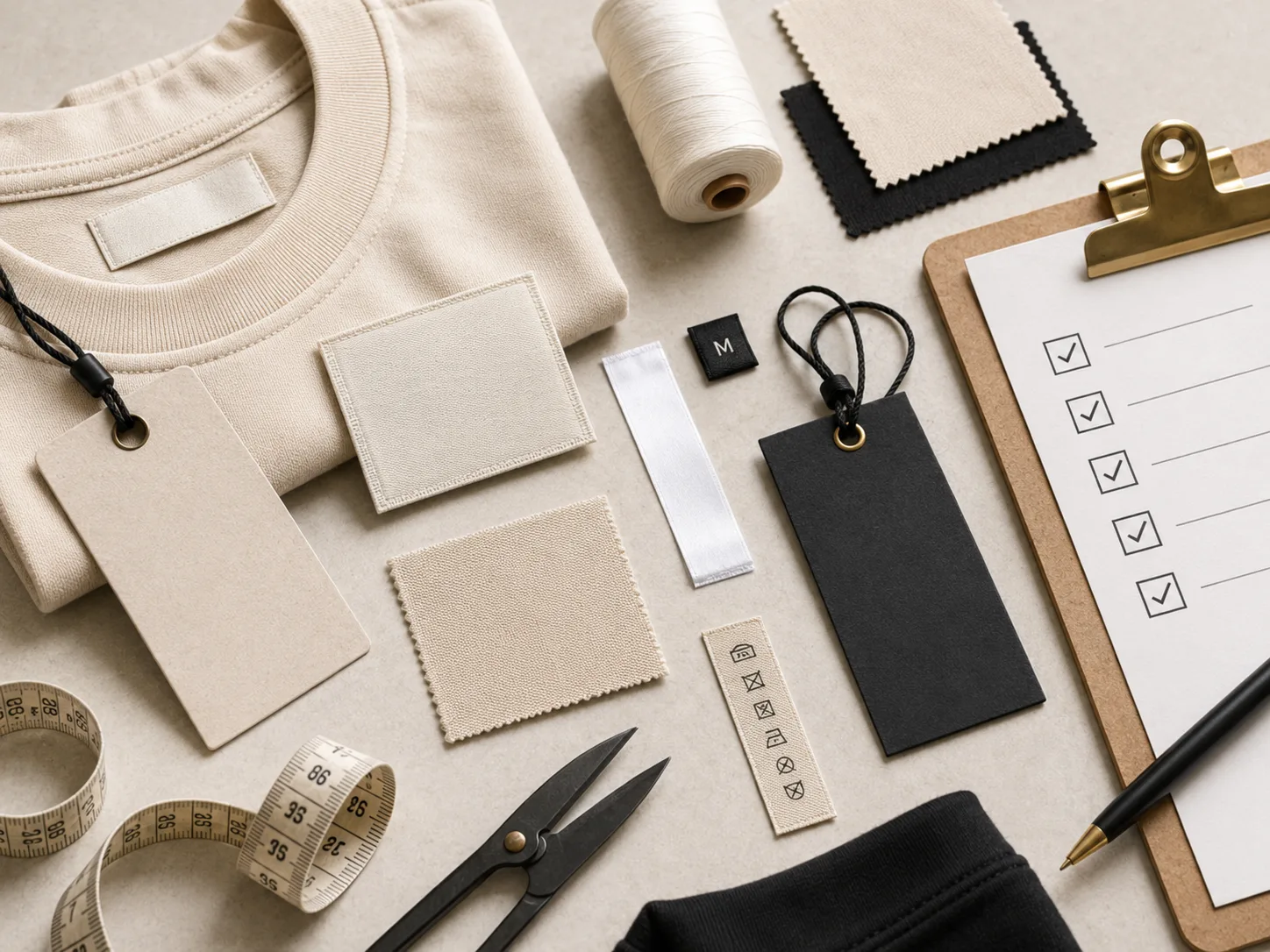
A new clothing brand needs five pieces: a woven or satin neck label, a printed taffeta care and content label, a size tab, a hang tag for retail and an optional packaging insert. Order the whole kit from one supplier, order more labels than garments to cover wastage, and have them in hand before stitching starts.
There's a moment, somewhere between finalising your designs and your first production run, when you realise a garment isn't finished without its labels. The neck label, the care label, the size tab, the hang tag. Each is a separate decision, and most first-time founders discover them one painful reorder at a time.
This checklist puts all of it in one place. Work through it once, order the full set together, and your first collection ships looking like it came from an established brand, not a side project.
What is the 5-piece label kit every brand needs?
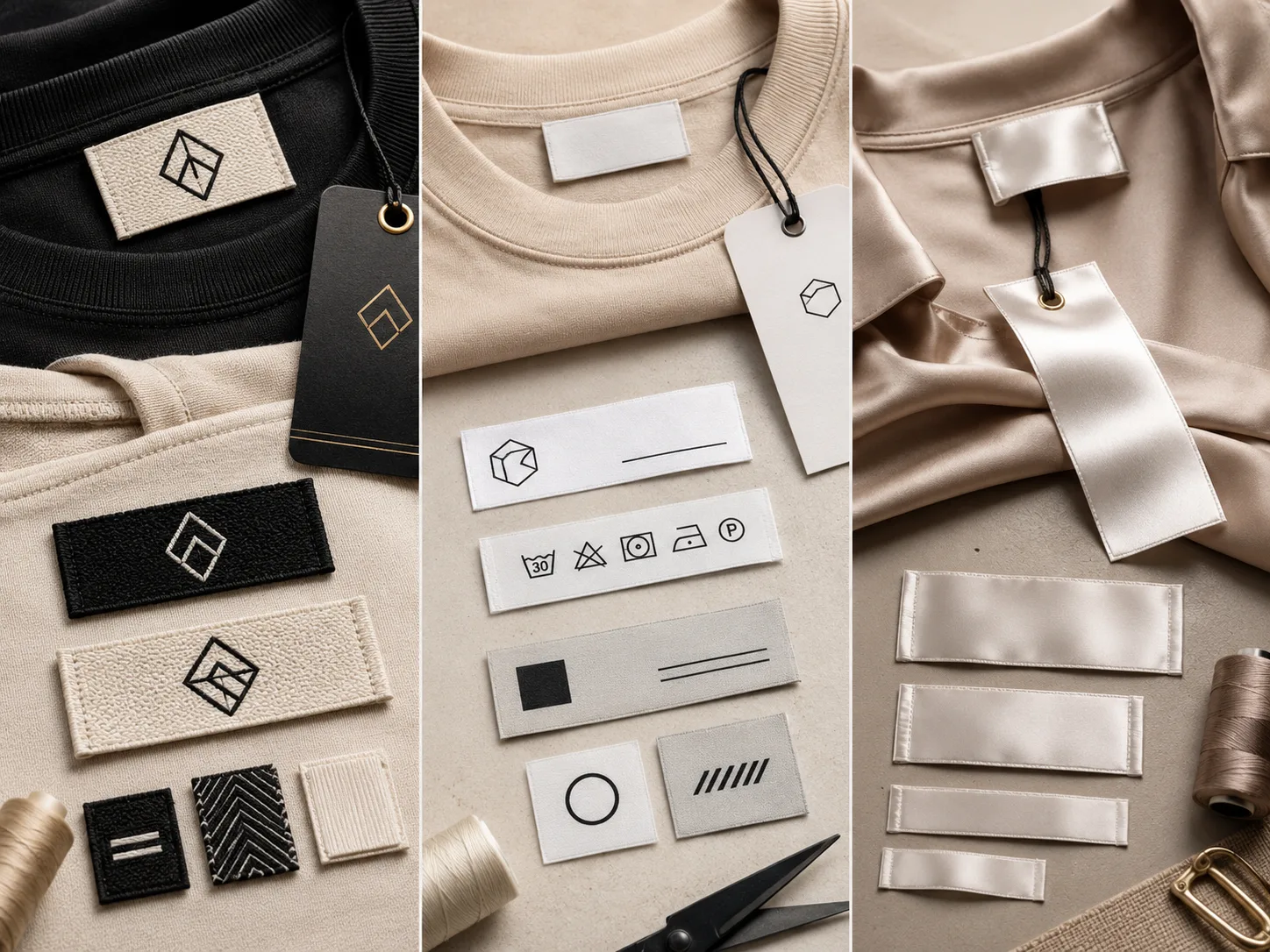
Items 1 and 2 are essential for almost every brand. Items 3-5 depend on where and how you sell. Let's go through each.
Skip the artwork back-and-forth. Design your label in the free label designer and send the design and spec to our studio for a quote in one step.
1. The neck / brand label
This is your brand's face: the label a customer sees first when they pick up the garment. Keep it simple: logo or brand name, maybe the size. It should feel like your brand.
- Material: woven for a premium textured look; satin printed for a soft, colourful logo
- Placement: centre back neck (most common) or inside the collar
- Keep off it: care symbols and fibre content, those belong on the care label
Not sure which material? See woven vs printed vs satin labels.
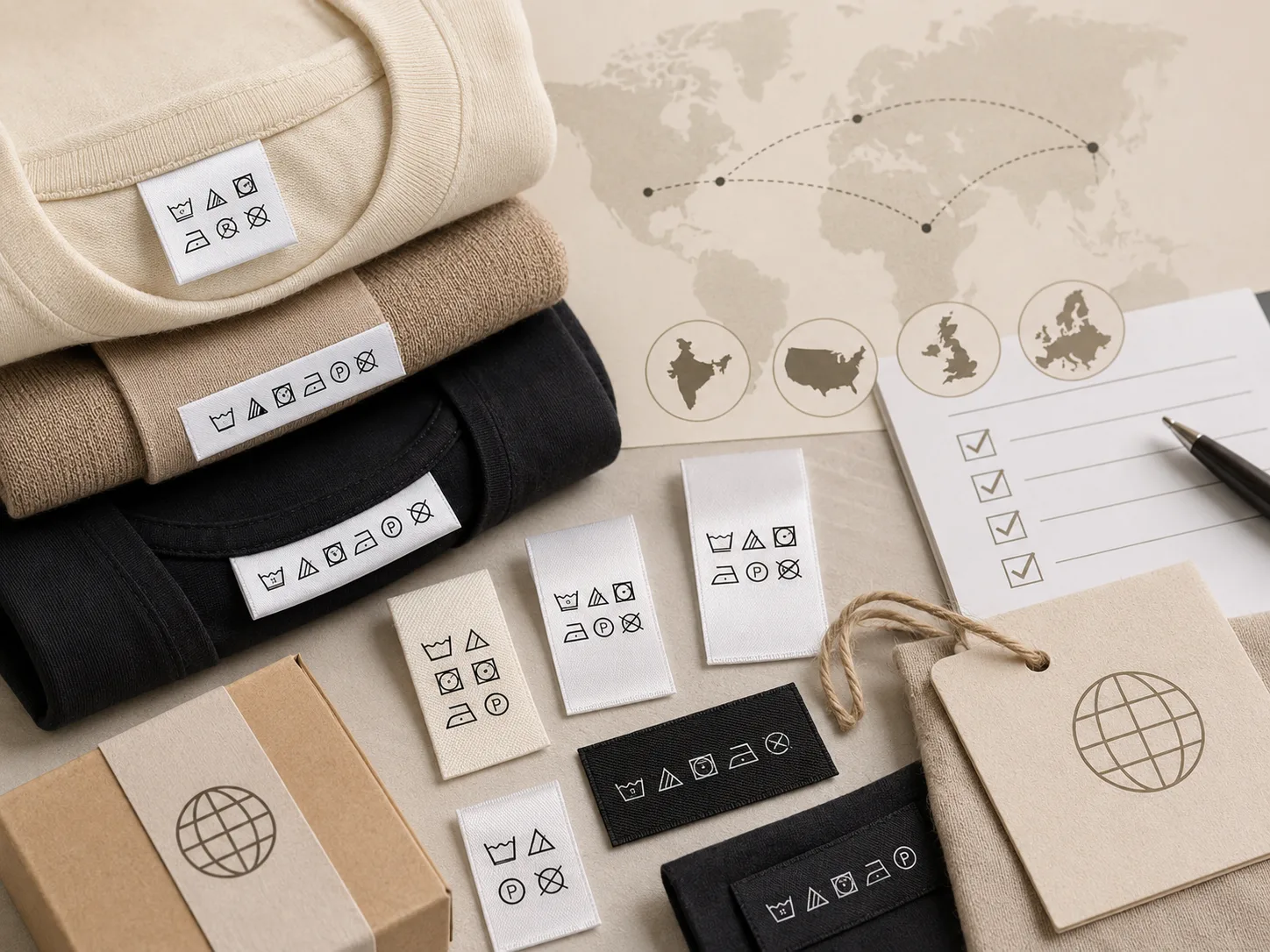
2. The care & content label
The legally required one. It carries wash instructions, fibre content and country of origin, and skipping it gets listings blocked on marketplaces and shipments held at export customs.
- Material: printed taffeta (sharp small symbols, low cost, survives washing)
- Must include: fibre content, care/wash info (ISO 3758 symbols), country of origin, brand identity
- Placement: inside side seam at the hip, or back neck under the brand label
Full legal detail is in our care label requirements guide.
3. The size tab
A tiny label showing S / M / L / XL or numeric sizing. Some brands print the size onto the neck label instead, but a separate size tab lets you reuse one neck-label design across every size, cheaper at scale.
- Material: printed taffeta or a small woven tab
- Placement: under the neck label, or at the side seam next to the care label
- Tip: order size tabs as a set (S, XXL) so you're never short of one size
4. The hang tag
The card tag that hangs off the garment in retail. It carries your brand, price, a short story and often a QR code. It's optional for pure online D2C but essential for retail, exhibitions and a premium unboxing.
- Material: thick art paper or kraft card, often with string and a metal eyelet
- Carries: logo, price/barcode, brand story, social handle, QR code
- Lifts: perceived value, a good hang tag makes a garment feel finished
5. Packaging insert (optional)
A thank-you card, care tip or discount slip dropped into the parcel. Pure marketing, but for D2C it's one of the cheapest ways to drive repeat orders and reviews.
- Material: small printed card or sticker
- Use it to: say thanks, share a discount code, ask for a review, point to your Instagram
What does it cost to label one garment?
Representative all-in label cost per garment (neck + care + size tab), 2026:
Hang tags add roughly ₹3-10 each depending on paper and finish. For exact numbers on your sizes and colours, use our price calculator.
When should you order labels for a launch?
Vector logo (AI/PDF) ready. This is the only artwork the neck label needs.
Get exact fibre composition from your fabric supplier. The care label can't be finalised without it.
Order samples of all labels together (~₹250-400 each). Approve feel and print before bulk.
Labels are sewn in during production. Have them in hand before garments hit the machines.
Founder tips
Order the whole kit from one supplier. Neck label, care label, size tab and hang tag from a single source keeps colours and branding consistent and usually costs less than sourcing them separately.
Don't over-order size tabs of one size and under-order another. Order size tabs as a balanced set so your run isn't bottlenecked waiting for "M" labels.
Quick start: send us your logo, fabric composition and size range. We'll quote the full label kit (neck, care, size tab and hang tag), with per-garment pricing. Message Labelwala or use the quote form.
When to place the order
Timing is the part of this checklist that costs money when it is wrong, because labels have a lead time and cut garments do not wait.
The sequence that works is to settle the artwork while fabric is being sourced, approve a physical sample while cutting is being planned, and have the labels in the factory before stitching starts. A neck label goes in early in assembly, so it is needed sooner than people expect. Labels that arrive after the garments are made mean unpicking finished seams, which costs more in labour than the labels did.
- Work backwards from the stitching date, not the dispatch date.
- Build in a sampling round. Approving from a screen and skipping the physical sample is where colour surprises come from.
- Order hang tags last if you must. They attach at the end, so they have the most slack in the schedule.
- Keep the artwork files. A reorder from an existing approved file is quick; a reorder that starts by rebuilding artwork is not.
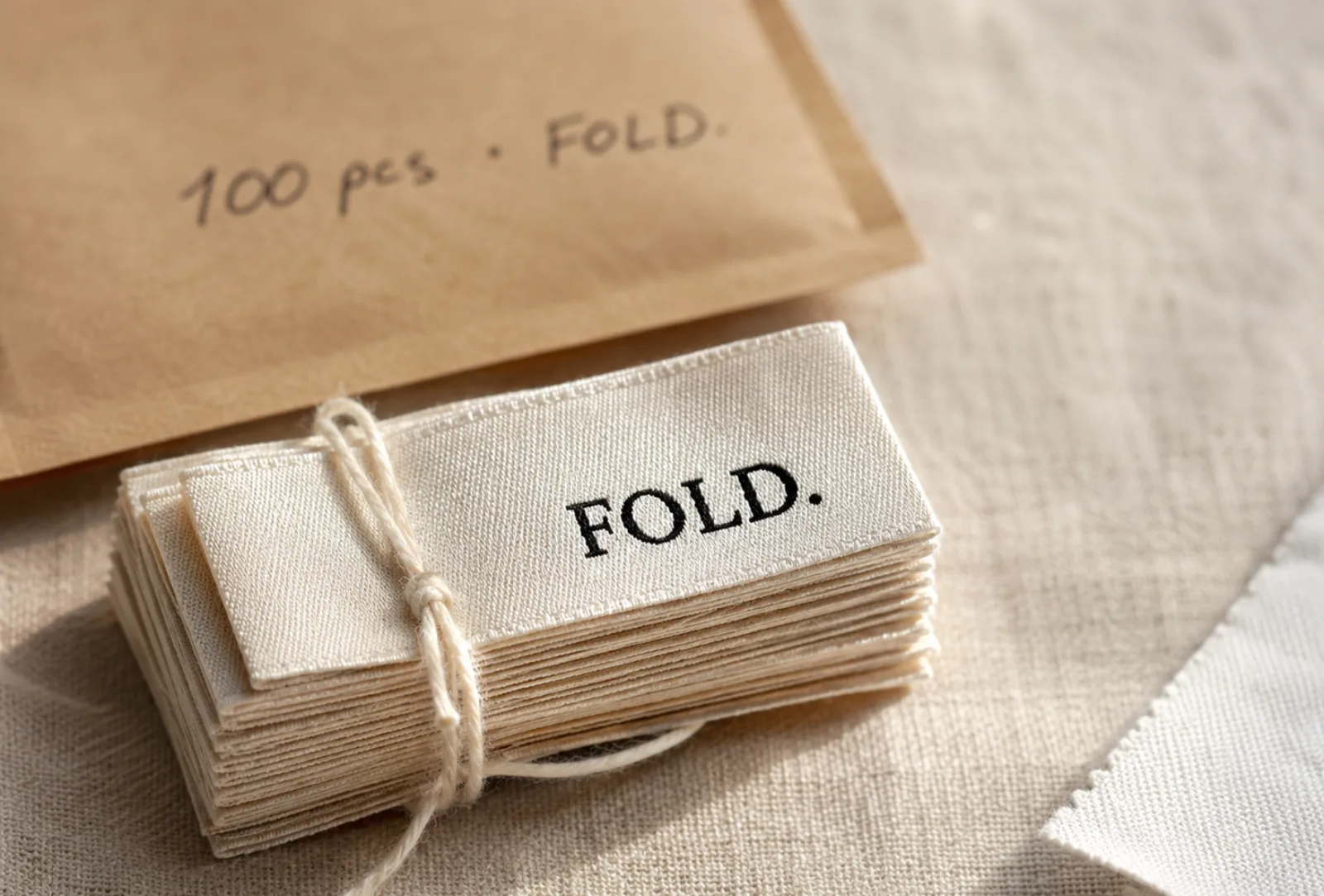
Why order more labels than garments?
This catches nearly every first-time brand, and it is the cheapest mistake on the list to avoid.
If you are making a hundred garments you do not need a hundred labels. Labels get mis-stitched, cut crooked or caught in the wrong seam and unpicked. Samples and photography consume garments before anything is sold. And running short mid-production is the expensive failure, because a small top-up run costs nearly what a large one would: the setup does not scale down.
- Add a comfortable margin over your garment count and hold the surplus for the next run.
- Order the reusable pieces further ahead. A brand label does not change between seasons and does not perish.
- Order size tabs to your real size split, which is never even, rather than equally across the range.
- Store them sealed, dry and out of sunlight, which fades a stack unevenly from the top down.
Overstock on labels is one of the cheapest inventory mistakes available. Running out mid-production, with garments cut and a dispatch date fixed, is one of the most expensive.
The same logic applies to hang tags, with one difference: they are attached last and are easier to reprint, so a shortage there is inconvenient rather than costly. The sewn-in labels are the ones to over-order.
A sensible rule of thumb is to treat the surplus as stock rather than waste. Brand labels and size tabs do not date between seasons, so anything left over goes straight into the next run and reduces what you have to order then.
Why does each piece have a different lifespan?
The five pieces get discussed as one purchase, and thinking about how long each has to survive explains most of what separates them.
The sewn-in labels live as long as the garment. They go through every wash and every wear, so they are made from woven or printed polyester and judged on whether they are still legible after a season. Everything about how they are specified follows from a multi-year life.
The hang tag lives from the packing table to the customer's bin, which is weeks. That is why card is fine there, why finishes like foil and embossing make sense there and nowhere else, and why nobody wash-tests a hang tag.
That difference should shape the budget. Money spent making a hang tag beautiful buys a few weeks of impression; money spent on the sewn-in labels is spread across years of ownership and every time the garment is handed on or resold.
Which label can carry compliance information?
This is the distinction most often missed, and it decides what must go where.
Fibre composition, country of origin, care instructions and manufacturer or importer details have to stay with the garment permanently. That puts them on the sewn-in care label, not on a hang tag that is removed at purchase and not on a sticker on the packaging.
You can repeat any of it on a hang tag for the shopper, and many brands do because it helps at the point of sale. What you cannot do is put it only there. If the permanent label does not carry it, the garment is not properly labelled however good the tag is.
The corollary is a practical one: the care label usually has to be printed rather than woven, because that volume of small text will not weave legibly at care-label size in any material. It is a legibility decision, not a cost one.
Common mistakes
- Putting composition or care information only on a hang tag.
- Ordering the pieces separately and finding the whites do not match.
- Combining brand, care, size and origin onto one label to save money, creating a stiff stack at the neck.
- Specifying a different label per size instead of one brand label plus a size tab.
- Weaving a care label, where the small text will not hold.
- Leaving out manufacturer or importer details, which marketplaces expect.
- Ordering exactly as many labels as garments, with nothing for sewing wastage.
- Leaving the label order until the garments are already cut.
Ordering the full set from Labelwala
Woven and printed labels, made by us in Ahmedabad, Gujarat, for 25 years.
- Minimum order: 1,000 pieces, counted per design rather than per order.
- Quotes: usually within 2 hours on a working day.
- Production: 7-10 days once artwork is approved. Rush jobs run 3-5 days.
- Care symbols: drawn to ISO 3758.
Quote the whole set in one enquiry rather than piece by piece. It is cheaper, it is faster, and it is the only way to confirm the pieces sit together as a family before anything is manufactured.
We are rated 5.0 on Google from 27 reviews.
The short answer
Every new clothing brand needs at minimum a brand neck label (woven or satin) and a care & content label (printed taffeta). Add a size tab to reuse one neck design across sizes, a hang tag if you sell in retail or want a premium unboxing, and a packaging insert to drive repeat D2C orders. Finalise your logo and fabric composition, sample the full set, and order in bulk before stitching: ideally all from one supplier to keep it consistent and cheap.