In brief
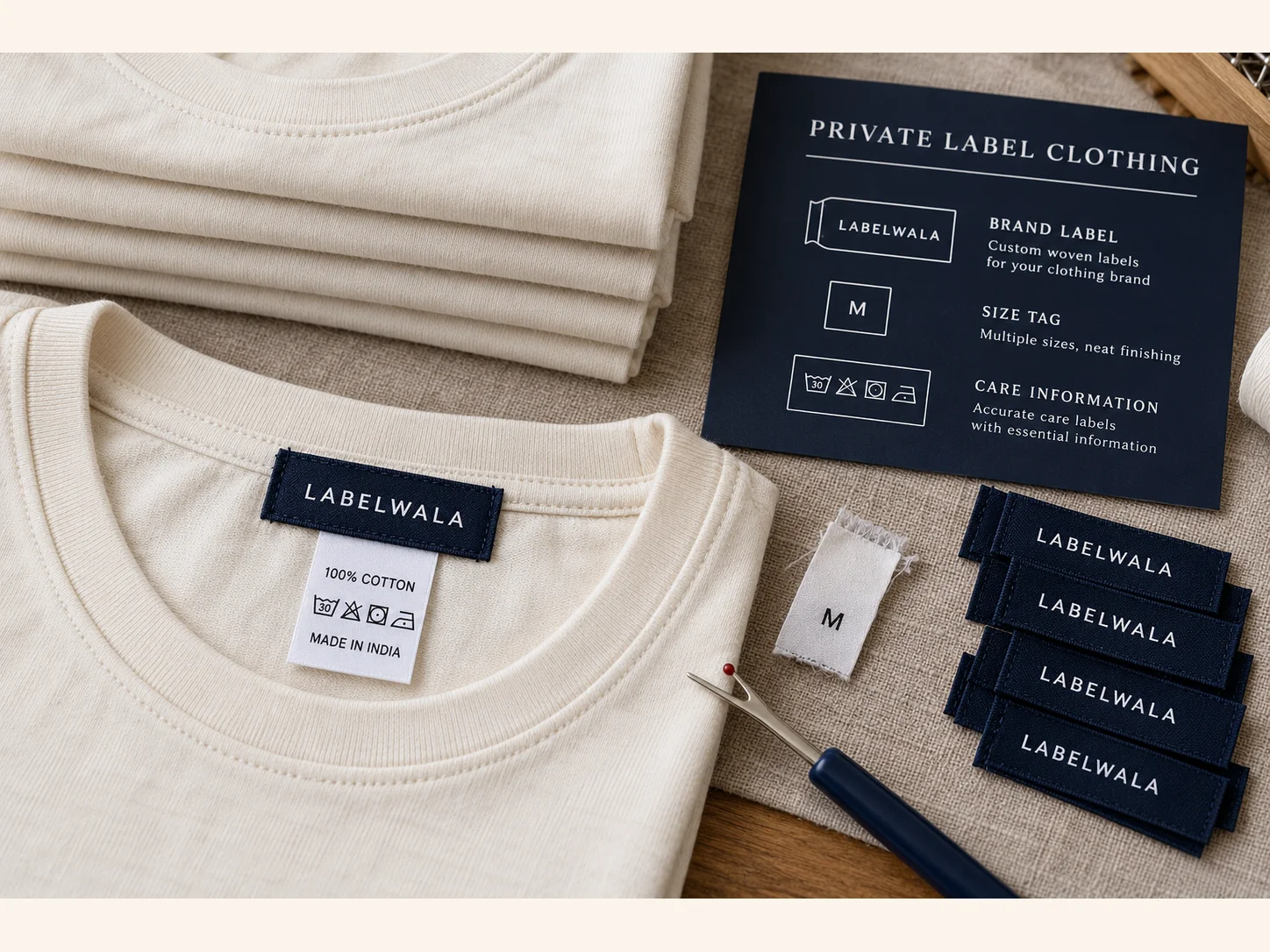
Private labelling means buying finished or semi-finished garments from a manufacturer and selling them under your brand. You can do it legally in India if the garment carries your brand name as the marketer, the correct fibre content, size, country of origin and the retail declarations. The clean route is to have the manufacturer sew your woven neck label and printed care label during production; relabelling finished stock afterwards is possible but slower and needs a seam-friendly label construction.
Most new clothing brands in India do not make clothes. They buy blanks or finished styles from manufacturers in Tirupur, Ludhiana, Delhi, Surat or Ahmedabad, add their brand, and sell on Instagram, their own store or a marketplace. The garment is the same one a dozen other sellers could buy. The label is the part that is yours.
That makes the label decision more important for a private label brand than for a brand that manufactures. It is the only physical thing on the product that says who you are, it is what the marketplace checks against your listing, and it is what a customer sees when they wonder whether the brand is real. This guide covers the three questions founders ask us most: what has to be on the label, how to get it onto the garment, and what to order so the whole range works from one set of labels.
Private label, white label and relabelling
The terms get mixed up, and they describe different situations with different label needs.
| Term | What it means | Label implication |
|---|---|---|
| Private label | A manufacturer makes a garment to your spec, or a catalogue style, and sells it only under your brand | Your labels are sewn in during production; you control every position |
| White label | A standard garment sold unbranded to many sellers, each adding their own mark | Blanks usually arrive with a plain size and care label or a tear-away label; you add a brand label |
| Relabelling | Removing an existing label from a finished garment and sewing in a new one | You are working on a closed garment, so the new label has to be a construction that does not go into a seam |
The practical difference is when your label meets the garment. During production, any fold and any position is available, because the neck and seams are still open. After production, you are limited to labels that can be stitched onto a finished surface. Decide which situation you are in before you order, because it changes the fold you need.
What the law expects on a private label garment
Private labelling is legal and ordinary. The rules that apply are the same ones that apply to any garment sold in India, and they care about accuracy, not about who stitched the seams.
- Who is responsible. The brand marketing the garment can appear as the marketer or packer with a name and address. You do not have to name the manufacturer on the label, but you take on responsibility for the claims on it.
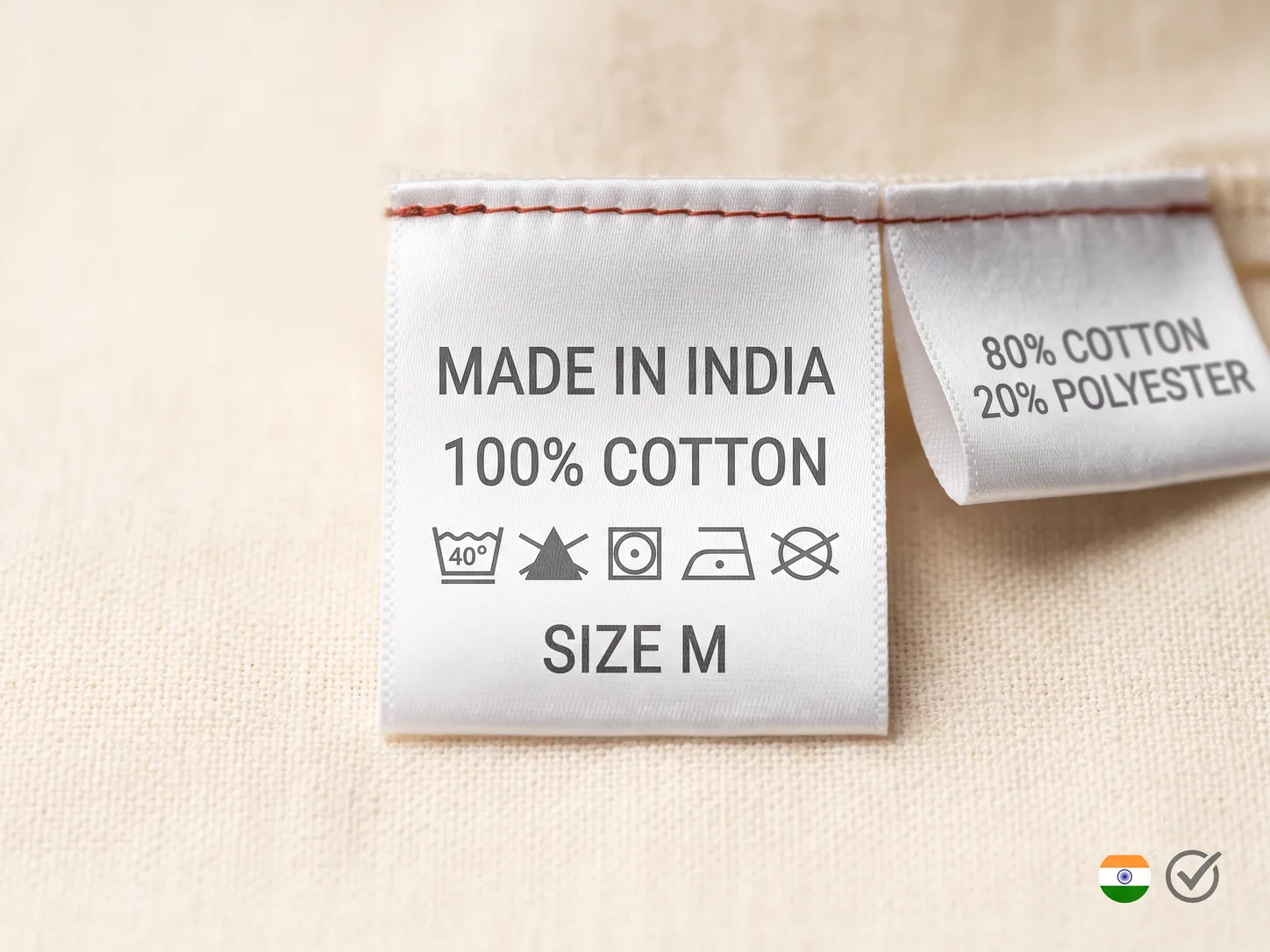
- Fibre content. The composition by percentage, taken from the manufacturer's spec, not guessed. "100% cotton" on a cotton-polyester blend is the most common private label error and the easiest to catch.
- Country of origin. "Made in India" for garments made here. If you import blanks, the origin stays with the country of manufacture; adding your label in India does not change it.
- Size. A size code, and for packaged garments the measurement it refers to.
- Retail declarations. For garments sold in a package, the packaging needs the MRP, net quantity, month and year of packing and consumer-care details. Many brands print these on a sticker or hang tag rather than the sewn label.
- Care instructions. Not strictly required for domestic sale, but every marketplace and every export market expects them, and a garment without them generates returns.
Our country-of-origin and fibre content guide goes through the wording in detail, and the marketplace requirements guide explains what Amazon, Flipkart and Myntra check when they compare your label to your listing. If you export, see the care label requirements guide for what the US, UK and EU add.
Get the composition in writing from the manufacturer. Ask for the fabric spec on the invoice or a separate sheet, keep it with your records, and print exactly that. If a marketplace or a buyer questions the label, the spec is what you will be asked for.
Route one: the manufacturer sews your labels
This is the way to do it if you can. Every garment manufacturer attaches labels as a routine step, and attaching yours instead of theirs costs them nothing extra in most cases. Set it up like this:
- Agree it before the order. Tell the manufacturer you will supply labels and which positions you want: neck label, size tab, care label, and any hem flag or sleeve tag.
- Get their fabric spec and size chart. You need the composition for the care label and the size codes for the tabs.
- Order the labels. Woven brand label, printed care label, size tabs. Allow 7-10 days for production once the artwork is approved.
- Send a placement sketch. One drawing showing where each label goes and how far from each seam. Without it, every batch and every operator does it slightly differently.
- Deliver the labels before cutting starts. Side-seam labels and hem flags go in before seams are closed; if the labels arrive late, those positions are gone.
- Approve one sewn sample. Have the factory send a photo or a physical piece with all labels attached before they run the bulk.
A well-run factory will ask you for a labelling spec anyway. Our guide to how labels are sewn into garments gives you the vocabulary to answer: which fold, which stitch, how many sides.
Route two: relabelling finished stock
Sometimes you already have the garments: a wholesale lot bought in a hurry, a sample run, or stock from a maker who would not sew your labels. Relabelling is the answer, and it is more work than it looks.
Removing the old label. Use a seam ripper, not scissors. Lift every third stitch along one side, then pull the thread from the other side. Work slowly on rib necks: a nick in the rib is permanent. Pull out every loose thread end afterwards, because a stray white thread under a dark label is visible.
What you cannot remove. A label sewn into a closed seam (a centre-fold label at the neck or a loop-fold care label in the side seam) is inside the seam. Removing it means opening the seam. Usually it is better to cut it flush and leave the stub inside, then sew the new label over or beside it.
The new label. On a closed garment you are stitching onto a surface, so the construction must suit that:
| Construction | Works on finished stock? | How it attaches |
|---|---|---|
| End fold | Yes | Straight stitch across the two folded ends; the standard relabelling choice |
| Four-side stitch (no fold, heat-cut) | Yes | Straight stitch around all four edges; flattest result, needs a clean cut edge |
| Centre fold | No | Both raw ends must go into a seam that is already closed |
| Loop fold | No | Same problem: the loop is caught in a seam |
| Iron-on woven label | For trials | Heat-applied; fine for a test run, lifts on rib and fleece over repeated washing |
Sew with a straight stitch, a fine needle (size 70 or 80 for knits) and a thread that matches the label ground, not the garment. Keep the stitch line inside the folded end of the label by 1 to 2 mm. If you are relabelling more than a few hundred pieces, a tailor with a lockstitch machine will do it faster and straighter than a domestic machine, and the per-piece charge is small.
Our iron-on vs sew-in guide explains why we steer brands away from heat-applied labels once they are past the trial stage.
Keep or replace the existing care label?
A finished wholesale garment usually arrives with one of three things in the neck or seam, and the right move differs for each.
- Another brand's label. Remove it. Two brand names on one garment is confusing to a buyer, a problem on a marketplace, and usually a condition of the manufacturer's sale.
- A plain care label with composition, symbols and origin but no brand. Keep it, if the information is correct. It saves you a label and leaves the legal facts in a seam where they belong. Add your brand label at the neck.
- A tear-away label, the perforated kind designed to be removed. Tear it off and replace it with your own care label, because the garment now has no composition or care information.
One rule across all three: the care information that ends up on the garment must match the fabric. A relabelled garment with the wrong composition is your liability, not the manufacturer's.
Designing one label set for a mixed range
Private label brands rarely sell one style. The same brand goes on tees from one maker, hoodies from another and joggers from a third, in different fabrics and sizes. Design the labels so that one set covers all of it.
- Brand label carries only the brand. No fibre content, no size, no origin. Then one design works on every garment you ever source, and the minimum order is spread across the whole range instead of one style.
- Care label per fabric, not per style. Three fabric compositions means three care label designs, however many styles use them. Write the care text generously ("wash cold, inside out, do not tumble dry") so it stays true across similar fabrics.
- Size tabs as stock labels until your volume justifies custom. A plain black-on-white "L" tab is a plain tab whoever made it. Our stock label guide covers what is available off the shelf.
- End fold for the brand label. It works sewn at the neck during production and sewn onto finished stock, so you are never caught with the wrong construction.
- One size that fits every garment. A 50 x 20 mm or 60 x 25 mm end-fold label sits comfortably in a tee neck and does not vanish in a hoodie. Check it against your largest and smallest garment before you order.
Design the brand label and the care label side by side. The free designer lets you set the fold, size and material for each and shows them at true scale, with a care-label generator that writes the composition and symbols for you.
Which materials to choose
The material choice for private label is the same as for any brand, with one extra consideration: your label will be the only quality signal on a garment the customer could buy cheaper elsewhere. A thin, curling printed label undoes the work your photography did.
| Position | Recommended | Why |
|---|---|---|
| Brand neck label | Woven damask, end fold | Dense weave holds the logo sharply, soft against the neck, reads as a real brand |
| Care label | Printed satin or taffeta, loop fold in production or flat sew-in for relabelling | Print holds small symbols and several lines of text; taffeta is cheaper where the label hangs in a seam |
| Size tab | Same material as the neck label, or stock | Matching material makes the set look like one supplier |
| Hem flag (optional) | Woven damask, centre fold | Visible brand mark; production route only, since it goes into the side seam |
Our woven vs printed vs satin comparison covers the trade-offs in depth. If your range is cotton-led and sustainability is part of the positioning, see organic cotton and eco labels.
Working with the manufacturer
A few things make the relationship smoother and the labels more consistent.
- Ask whether they already offer private label. Many do and have a labelling spec form; filling it in is faster than explaining from scratch.
- Agree who holds label stock. If the manufacturer keeps your labels for repeat orders, agree how many they hold and who pays for shortfalls.
- Agree the labelling charge, if any. It is usually small, but it should be on the quote.
- Protect your artwork. Your labels are your brand. Send labels, not label artwork, to the factory, and keep the artwork and the supplier relationship with you.
- Check a label on every delivery. Pull five pieces from each carton and confirm the label, the position and the size tab match. It takes two minutes and catches the batch where someone ran out of your labels and used stock.
Our label QC checklist lists what to look for on the labels themselves when a run arrives.
How many to order
Minimums apply per design, and private label brands are usually small when they start, so the structure of the order matters.
- Brand label: one design, ordered at the full minimum or more. It is used on every garment and never changes, so it is never wasted.
- Care labels: one per fabric composition. If you have three fabrics, that is three minimums, which is why many brands start with one or two fabrics and add more as volume grows.
- Size tabs: stock until you are ordering thousands a season.
- Wastage: add 3 to 5 percent on labels going to a factory and 8 to 10 percent on labels for hand relabelling, where more get spoiled.
The MOQ guide explains why the minimum exists and how to plan around it, and the guide for D2C founders covers the stock-plus-custom approach in more detail.
Getting private label garment labels made at Labelwala
We make woven and printed labels in Ahmedabad, Gujarat, and we have been doing it for 25 years. Private label sellers are a large share of the new brands we work with, and the brand-label-plus-care-label set is the order we quote most often.
- Minimum order: 1,000 pieces per design.
- Quotes: we usually reply within 2 hours on a working day.
- Production: 7-10 days once artwork is approved. Rush jobs run 3-5 days.
- Care symbols: set to ISO 3758.
- Delivery: across India, directly to your manufacturer if you prefer, and worldwide for export.
Tell us whether the labels are going to a factory during production or onto finished stock, because that decides the fold we recommend. If you are relabelling, send a photo of the existing label and neck and we will suggest a size that covers the old stitch line.
We are rated 5.0 on Google from 27 reviews.
Common mistakes
- Printing "100% cotton" from memory on a blended fabric.
- Ordering centre-fold or loop-fold labels for garments that are already sewn.
- Leaving the manufacturer's brand label in and adding yours beside it.
- Putting fibre content on the brand label, so it only fits one garment.
- Sending labels to the factory after the side seams are closed.
- Cutting the rib while unpicking a label.
- Relabelling with an iron-on and finding it lifts after the third wash.
- Changing the origin on imported blanks because the label was sewn in India.
- No placement sketch, so every batch looks different.
- Not checking the first carton of a repeat order against the first.
Pre-order checklist
- Fabric composition confirmed in writing by the manufacturer for each fabric.
- Decided: production route or relabelling, and the fold chosen to match.
- Brand label artwork contains only the brand.
- One care label design per fabric composition, text written generously.
- Size codes and the split across sizes agreed with the manufacturer's size chart.
- Placement sketch drawn and sent to the factory.
- Label delivery date set before the factory's cutting date.
- Wastage added to the quantity.
- One sewn sample approved before bulk.
What we would recommend
Go the production route whenever the manufacturer will cooperate: a 60 x 25 mm end-fold woven damask brand label, a printed satin care label per fabric, and stock size tabs, all delivered to the factory before cutting with a placement sketch. If you are relabelling stock you already hold, use the same end-fold brand label stitched on two sides, keep any correct plain care label that is already there, and replace tear-away labels with your own.
Whichever route you take, the label is where your brand becomes real on the garment. Order it once, order it well, and reuse the same design across everything you sell.