In brief
Most established Indian label suppliers set a minimum of around 1,000 pieces per design, because digitising artwork, threading the loom and running trial picks cost the same at any volume. Combine neck, care and size labels into one order, use stock labels for size and care, and expect 10 to 14 days for a first order.
If you've messaged five label suppliers and three replied with "come back when you have 1,000 pieces," welcome to the first-time D2C founder club. The label sourcing market in India is built around bulk garment factories, not capsule launches. This guide explains why those minimums exist, how to structure an order so the number stops being a problem, and what to do when you genuinely need fewer labels than any supplier will make.
Our own minimum is 1,000 pieces, and most established suppliers sit in the same place. Rather than pretend otherwise, the useful thing is to show you what that number is made of, because once you understand it, there are several legitimate ways to make a small brand's order clear it comfortably.
Why do most suppliers ignore small orders?
Label production has fixed setup costs. Design digitisation, loom programming, ribbon priming, sample iteration, dispatch coordination. These don't scale with quantity. So a supplier earning ₹500 net on a 100-piece order is doing the same admin work as on a 5,000-piece order earning ₹15,000. The economics force them to focus on volume.
The good news is that the minimum applies to a label, not to your brand. A founder making 200 garments almost always needs more than 200 labels once the set is counted properly. A brand label, a care label and a size tab across a size range is already three artworks and several hundred pieces each. Structured as one order instead of three, a small range clears a 1,000-piece minimum more often than founders expect.
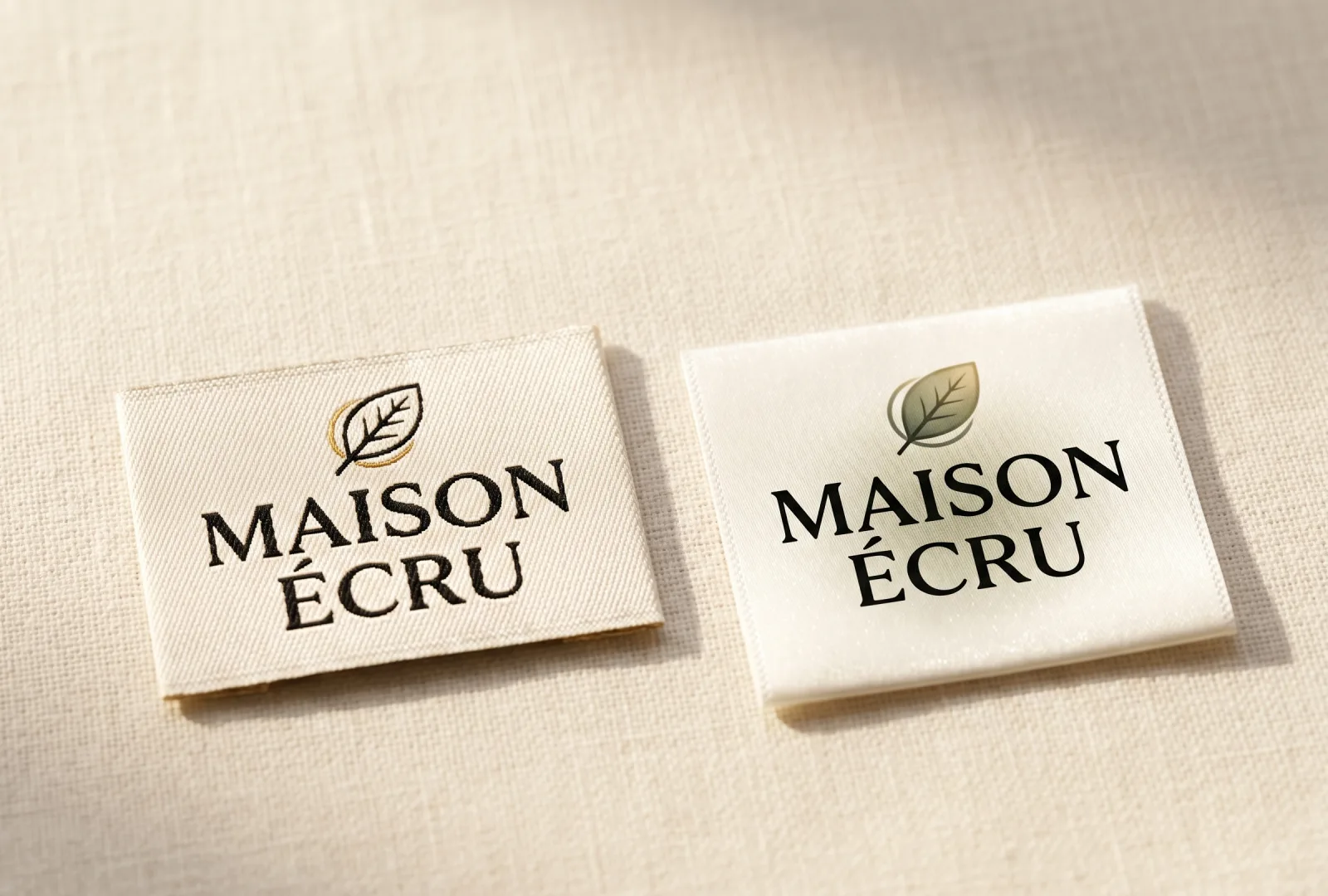
It helps to know exactly what "setup" means, because it is not one thing. On a woven label it is digitising your artwork into a weave file, threading the loom with your specific thread colours, running trial picks until the density and registration are right, then cutting and folding to your finished size. On a printed label it is colour separation, plate or file preparation and a press make-ready. Every one of those steps costs the same whether the run that follows is a hundred labels or fifty thousand.
Understanding this changes how you negotiate. Asking a supplier to drop their price at 100 pieces is asking them to absorb setup, and they will mostly say no. Asking how to reduce the setup, fewer colours, a standard size, a stock base material, is a question they can actually act on.
Skip the artwork back-and-forth. Design your label in the free label designer and send the design and spec to our studio for a quote in one step.
Should you use stock labels for the first run?
If you are making fifty or a hundred pieces to test a concept, a custom woven label may be the wrong thing to buy at all. Premade stock labels, size tabs, care labels, blank ribbon, carry no setup cost because the setup already happened for someone else.
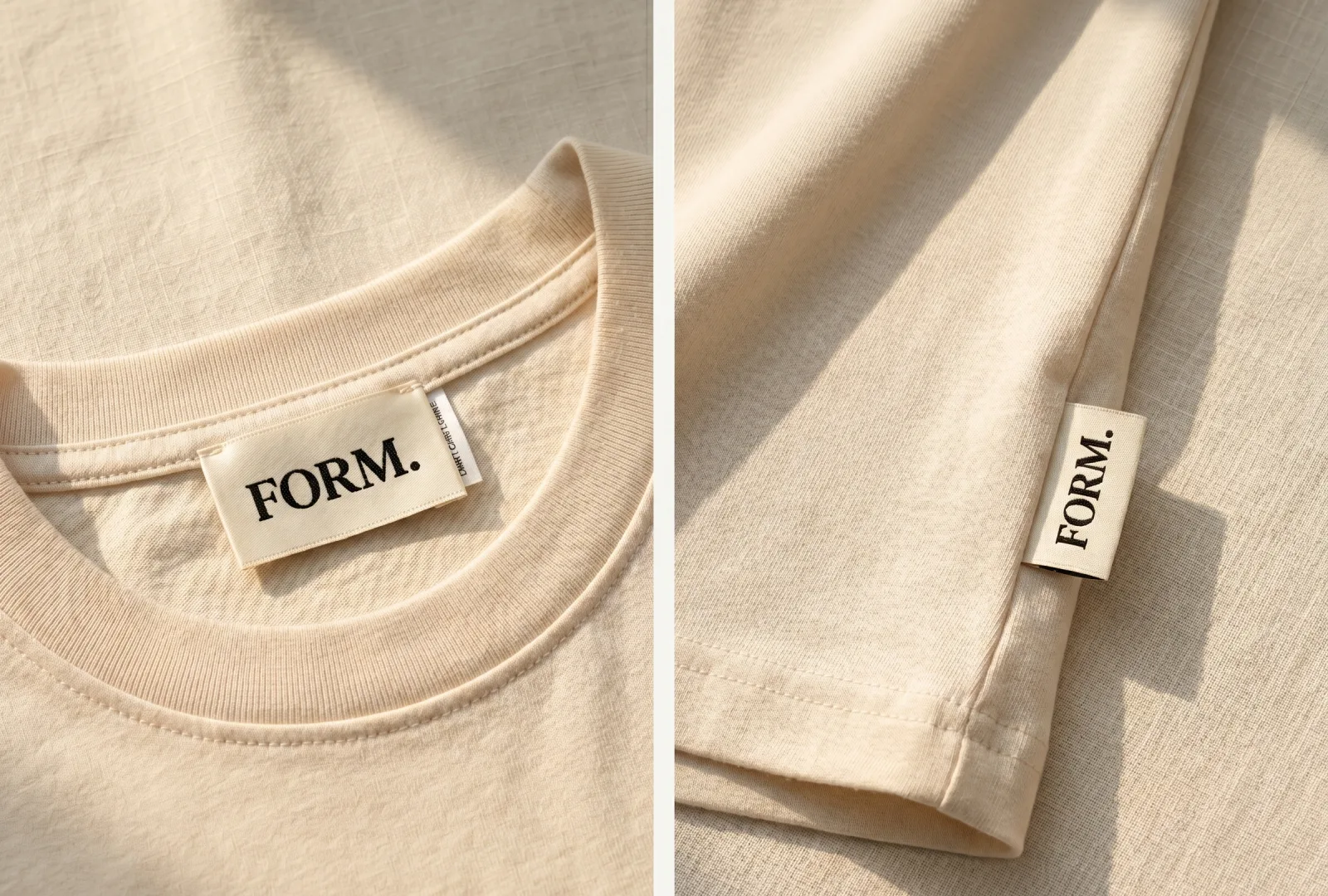
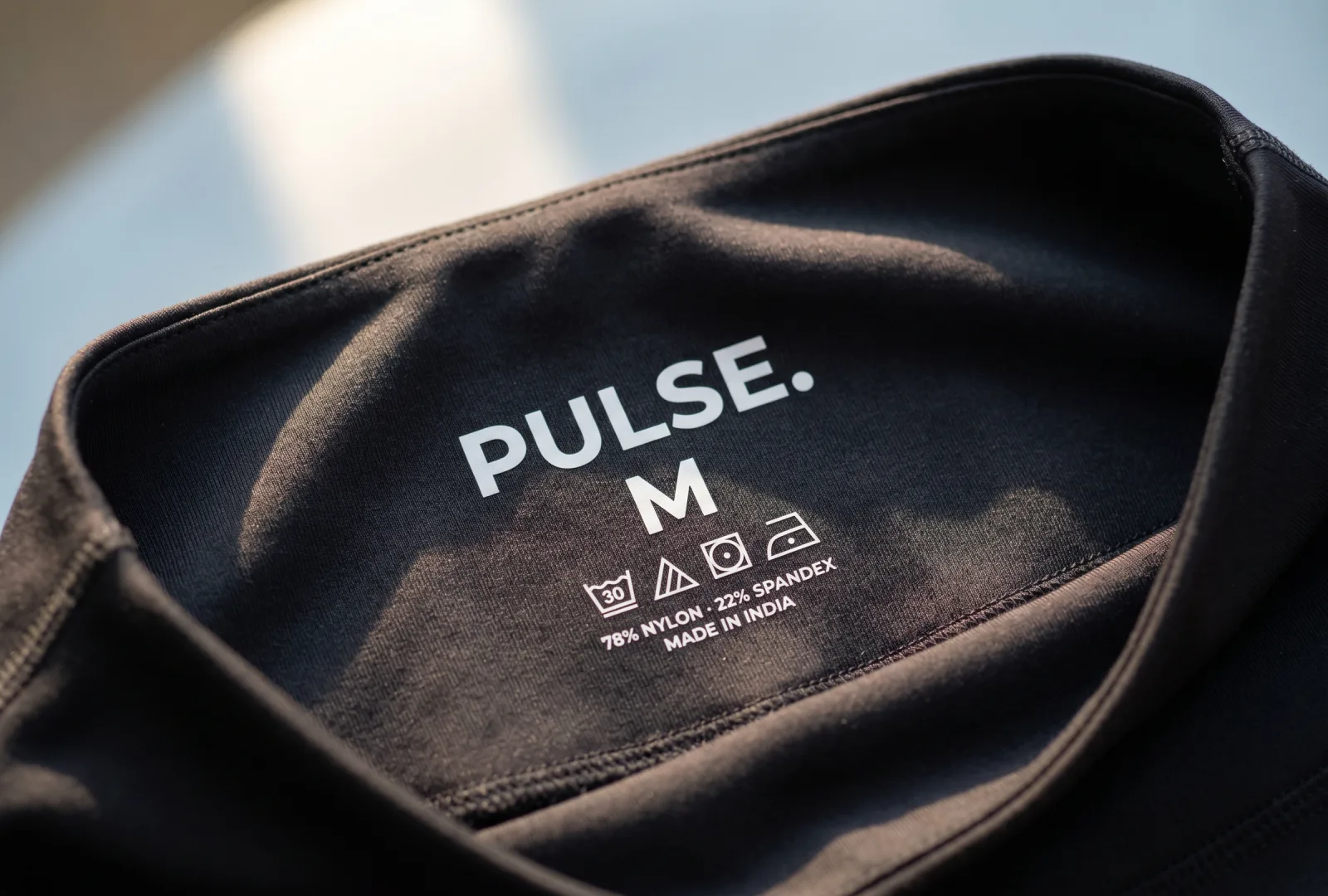
The sensible split for a first capsule is often a custom brand label plus stock everything else. Your brand mark is the part that has to be yours; a size tab reading "M" does not. That puts your money into the one label a customer actually associates with you and takes the rest off the setup bill entirely. See premade and stock size labels for what is available off the shelf.
Founders often resist this because it feels like a compromise. It is worth remembering that a stock size tab in a customer's garment is indistinguishable from a custom one, because it says the same word in the same place.
How can you lower your effective minimum?
Rather than hunting for a supplier with a lower number, most founders do better by restructuring the order so the number stops mattering.
- Combine every SKU into one order. Neck labels, care labels and size tabs quoted together are one job with one setup, not three.
- Use one label across your whole size range, with the size on a separate small tab. Then your expensive label has a single artwork and only the cheap tab varies.
- Cut your colour count. On woven labels each thread colour is a setup step. Two colours is not a lesser design than four; it is usually a better one.
- Take a standard finished size. Asking for 23 mm when the mill works in 5 mm steps buys you a special size and a special price.
- Order for two seasons at once if the label is not seasonal. Labels do not perish and storage is free.
- Keep the care information generic where it can be. One care label covering several styles with the same composition is one artwork instead of four.
The second and sixth are the ones founders most often miss, and they compound. A brand running eight sizes and four styles can easily specify thirty-two different labels, or four, depending only on how the set is structured.
What's a realistic MOQ in India?
Most established suppliers in India settle around 1,000 pieces per design, and the reason is the setup cost above not a lack of interest in small brands. A supplier quoting a far lower minimum on a custom woven label is either absorbing that setup in a much higher unit price, or is a reseller placing your order with someone else.
Neither is necessarily bad, a higher unit price on 200 labels may be exactly the right trade for a first drop. It is just worth knowing which one you are buying, because it changes what happens on your reorder.
If you genuinely need fewer than a minimum allows, the honest answer is stock labels rather than a custom run, and that is covered below.
What should you expect to pay per label?
Indicative per-piece pricing for a basic woven satin neck label (30×15mm, 4 thread colours, end-fold):
Care and printed labels run 30-50% cheaper at the same volume. Damask weaves are 30-60% more expensive than satin. Add a hangtag and you're looking at another ₹3-6 per piece.
Read that ladder as a picture of how the market prices quantity, not as our order book, our own runs start at 1,000 pieces per design. What it is useful for is showing the shape of the curve: the steep part is between the smallest quantities and about a thousand, and it flattens out well after that. That is why pushing from 800 to 1,000 changes your unit cost noticeably and pushing from 5,000 to 6,000 barely moves it.
How long does a first label order take?
The full sequence, quote → sample preview → approval → bulk production → dispatch, should take 10-14 days for a first-time order. After that, restock orders skip the sample step and run in 7-10 days.
Suppliers quoting "next-day delivery" on custom labels are using pre-stocked generics or cutting corners on quality. Suppliers quoting 4-6 weeks are either bulk-only and not interested in your scale, or running at capacity. The 10-14 day window is the honest middle.
Which supplier red flags should you watch for?
- Quote by email after 3 days. Decent suppliers reply within 24 hours, ideally within 2.
- "Send a courier sample for ₹X." Modern suppliers send digital sample images on WhatsApp. Paid physical samples are an old-economy tax.
- Paying before you've seen a sample. Advance payment is normal in this trade. What protects you is approving a clear sample image of your label first. Never pay for a run before you've signed off on the sample.
- No sample preview before bulk. If they refuse to show you a sample image before producing 1,000 labels, walk.
- "Setup charge" plus "die charge" plus "ribbon charge." Honest suppliers quote one number per piece. The hidden line items add up.
A useful counter-test: ask for the delivered total, not the per-piece rate. A quote of two rupees a label sounds better than two-fifty until the first one adds setup, courier and taxes at the bottom and lands higher. The delivered total is the only number you can actually compare between two suppliers, and asking for it tends to make hidden line items appear early rather than late.
Be equally wary of a quote that arrives with no questions attached. A supplier who has not asked what garment the label is going into, or whether your stated size is flat or finished, is quoting a generic label and will discover the mismatch at sampling, on your calendar.
What you'll need to send for a quote
- Design: vector preferred (AI / EPS / PDF / SVG). PNG works if 300+ DPI.
- Quantity, even rough; you can confirm later.
- Size, width × height in mm. If unsure, share a reference photo.
- Fabric of the garment, drives material recommendations.
- Fold style: end-fold (most common), centre-fold, mitre-fold (for fine fabrics), or straight-cut.
- Delivery pincode, affects shipping cost.
Send all six in the first message. Every one you leave out turns the quote into a conversation, and a conversation costs you days for no benefit. The single most useful line you can add is what the garment actually is, "cotton jersey tee", "rayon kurta", because that answers material, fold and placement questions before they are asked.
How much of your garment cost should the label be?
Founders tend to look at label pricing in isolation and conclude it is expensive. The number that matters is the label set as a share of what the garment costs you to make.
On a garment costing a few hundred rupees to produce, a full label set, brand label, care label, size tab, typically lands in low single-digit percentages of that cost. It is one of the smallest lines on the sheet, and it is also the only one the customer reads. Trimming it is rarely where the margin is.
Where founders genuinely overspend is on complexity not quantity: a six-colour damask label on a first capsule of a hundred pieces, when a clean two-colour woven label would carry the brand just as well and cost a fraction. Spend on getting the label right, not on getting it elaborate.
Order more than your garment count
This catches nearly every first-time founder. If you are making 100 garments, you do not need 100 labels.
- Sewing wastage is real. Labels get mis-stitched, cut crooked, or caught in the wrong seam and unpicked.
- Samples and photography consume garments before anything is sold.
- Running short mid-run is the expensive failure. A reorder for forty labels costs nearly what four hundred would, because setup does not scale down.
- Spares cost almost nothing at the margin. The step from 500 to 600 pieces is small; the step from zero to a second order is not.
Add a comfortable margin over your garment count, and hold the surplus for the next run. Overstock on labels is one of the cheapest inventory mistakes available; running out mid-production is one of the most expensive.
What to ask before you commit
- Is the quoted price per piece all-in, or are there setup, die or ribbon charges on top?
- Is the size you have quoted the flat size or the finished size after folding?
- What material exactly, damask, taffeta, satin, cotton, and in what weight?
- Will I see a sample or a clear sample image before bulk runs?
- Are my thread or ink references recorded for reorders?
- What happens if the delivered labels do not match the approved sample?
- What is the price at the next quantity tier up?
That last question is worth asking every time. The jump from your quantity to the next tier is often smaller than founders expect, and knowing the number lets you decide deliberately rather than discovering it on the second order.
Don't send these mistakes: low-res JPG screenshots of your logo, undecided quantity ranges ("maybe 500 maybe 5000"), "I'll pick fabric later." The clearer your brief, the faster and tighter the quote.
The order sequence that works
WhatsApp design + quantity + fabric
Per-piece + total + delivered
Clear image, same day
5-8 days production, 1-3 days transit
Total: ~10-14 days from first message to delivery. Faster if you approve the sample on day 1.
What changes between order #1 and order #5
- By order #2, your spec is on file: no re-pitching design, fold or weave.
- By order #3, you're getting bulk pricing tiers automatically.
- By order #5, you're emailing or WhatsApp-ing one line and the order runs.
The first order does the work. Every order after is leverage.
This is the strongest argument for choosing a supplier you can imagine staying with, rather than the cheapest quote on your first hundred pieces. The relationship compounds: recorded specs, recorded colours, no sampling round, better tiers. Switching supplier resets all of it, and you pay the first-order tax again.
First-order mistakes worth avoiding
- Designing the label before deciding its finished size, so the artwork has to be redrawn to fit.
- Approving a digital proof and skipping the physical sample on a material you have never handled.
- Ordering exactly as many labels as garments.
- Specifying a different label for every size when a separate size tab would do.
- Choosing damask for the look without feeling it against the fabric it will sit on.
- Not writing down thread or ink references, then finding season two does not match season one.
- Leaving the label order until the garments are already cut.
Every one of these is decided before anything is manufactured, and none of them is expensive to get right at that stage. That is the general shape of label sourcing: the money is made or lost in the brief, not in the negotiation.
What we would recommend for a first capsule
Put a custom woven or printed brand label in the neck, keep it to two colours and a standard finished size, and use stock size tabs alongside it. Quote the whole set as one job. Order comfortably more than your garment count.
Then treat the first order as the expensive one, because it is. You are paying for setup, sampling and a relationship that does not exist yet. Get the specification right once and the next four orders are a message and a delivery date.