In brief
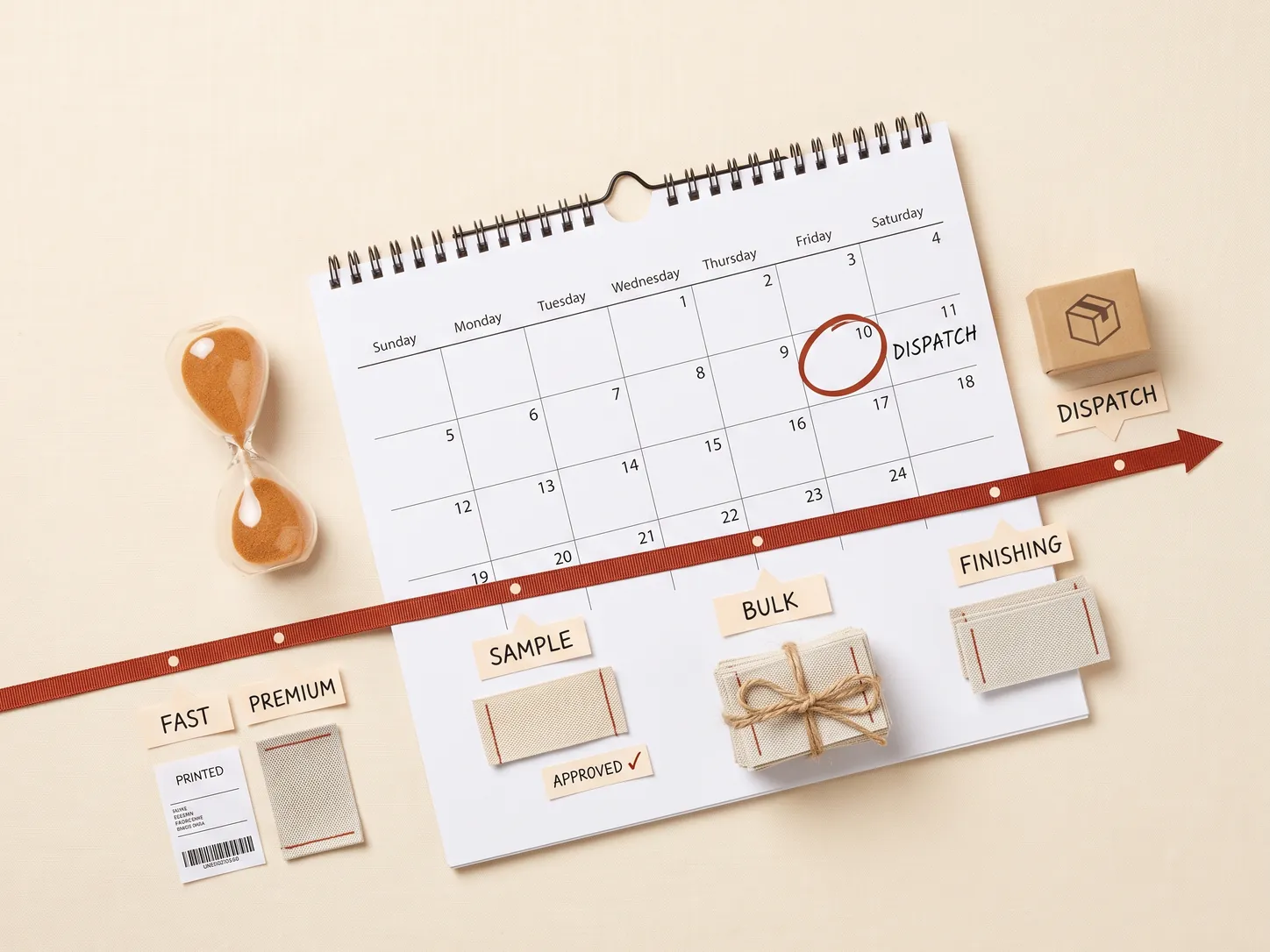
Count back twelve weeks from the launch date. Order the brand label and size tabs at week 12, lock the fabrics and order care labels at week 10, hang tags and pack stickers at week 8, and have every label at the garment factory by week 5 so labelled samples exist for the photo shoot at week 4 and the marketplace listings at week 5. Light summer fabrics need thinner, softer labels in smaller sizes, and the care text for linen, rayon and mulmul is longer than for cotton jersey.
A launch is four streams running at once: the garments, the labels and packaging, the content (photo shoot, website, listings) and the marketing. The garment stream gets the attention because it is the biggest. The label stream is the one that silently gates the other two, because the shoot needs a garment with the real neck label in it and the listing needs the care text that is printed on it. Our labels and tags checklist covers what a brand needs in general; this article is the dated version for a summer launch, with the dependencies drawn in.
The dates below assume a garment factory that needs four to five weeks from receiving labels to shipping finished stock, a label maker working to 7-10 days after artwork approval, and a brand selling online through its own site and at least one marketplace. Adjust the factory weeks to your own; the order of the steps does not change.
The twelve-week countdown
| Weeks before launch | Labels and packaging | What it unblocks |
|---|---|---|
| Week 14 | Label set decided; brand label artwork final as vector; size range and size codes fixed | Everything below |
| Week 12 | Brand label and size tab samples approved on a swatch; bulk ordered | Labels at factory by week 9 |
| Week 10 | Fabrics confirmed per style; care text written per composition; care labels sampled and ordered; pack sticker text drafted | Care labels at factory by week 7; listing copy |
| Week 8 | Hang tag design final; hang tags, strings, pack stickers and polybags ordered | Packaging at factory by week 5 |
| Week 7 | Short label run for photo-shoot samples if the bulk is not yet in; pre-production samples labelled | Shoot at week 4 |
| Week 5 | All labels and packaging at the factory; marketplace listings built from the care label and pack sticker text | Factory labelling and packing; onboarding |
| Week 4 | Photo shoot with fully labelled and tagged samples; wash test of a labelled garment | Website and listing images |
| Week 2 | Finished stock inspected: label placement, size tab against actual size, hang tag attached, pack sticker present | Dispatch to warehouse or fulfilment centre |
| Week 0 | Launch; spare labels held for returns relabelling and the second drop |
Two rules make the table work. The brand label goes first because it depends on nothing but your logo, and it is the piece that appears in every product photograph. The care label goes second and only after the fabrics are confirmed, because the fibre content and the wash instruction are printed on it, and a reprint costs more time than the fabric decision did. Our guide to label lead times gives the production numbers behind each row.
What summer fabrics change about the labels
A summer range is built on light fabrics: cotton voile, mulmul, cambric, linen, rayon, modal, light knits and blends with a little elastane. They change three label decisions.
| Fabric | Brand label | Care text to expect |
|---|---|---|
| Cotton voile, mulmul, cambric (60 to 120 GSM) | Thin satin-finish woven or printed satin, 40 x 15 mm to 50 x 18 mm, end fold, ends only | Gentle wash cold, do not bleach, dry in shade, medium iron; "may shrink 3 to 5 percent" if not pre-shrunk |
| Linen and linen blends | Fine damask or satin-finish woven, 45 x 18 mm; natural or cream ground | Machine wash cold gentle or hand wash, do not tumble dry, iron damp on reverse; "creases are natural to linen" |
| Rayon, viscose, modal | Printed satin or thin woven; avoid stiff taffeta on drapey fabric | Hand wash cold or dry clean, do not wring, dry flat, cool iron; rayon loses strength when wet |
| Light cotton jersey, tees | Standard damask 45 x 15 mm, or tagless print | Machine wash cold, do not bleach, tumble low or line dry, wash inside out |
| Innerwear, loungewear, swim | Tagless print or a soft side-seam label | Per fabric; swimwear adds rinse after use, do not leave wet, shade dry |
- Weight and show-through. A standard damask label on a 90 GSM voile shows as a rectangle from the outside and pulls the neckline. Go thinner and smaller, stitch the two ends only, and hold the sample up to the light. Our guide to label materials compares the options.
- Longer care text. Linen, rayon and un-pre-shrunk cotton need more instruction than a tee, and a summer collection usually spans three or four fabrics, so it needs three or four care label designs. Size the label from the longest text; our care label size guide shows the widths.
- Colour. Summer palettes are light. A white label on an ivory voile looks cheap; a cream or natural ground does not. Dark labels on light fabrics must be colourfast, because these garments are hand washed. Our satin colour guide covers grounds and inks.
Photo-shoot samples: the hidden dependency
Most brands shoot three to four weeks before launch, on pre-production samples, and most discover at the shoot that the samples have the factory's temporary label or none at all. The inside-neck shot and the hang-tag shot are standard listing images, and a sample without the real label means a reshoot or a listing without those images.
- Order a short run of the brand label and hang tag for the samples at week 7 if the bulk will not have arrived. A few dozen pieces printed or cut from the bulk setup is a normal request.
- Have the factory label the samples exactly as production: same position, same stitch, same hang tag string. The shoot is also your first placement check.
- Wash one labelled sample before the shoot and photograph it after. It is the only wash test most launches get, and it catches a bleeding label or a curling care label before 500 garments are sewn. Our wash-testing guide explains what to look for.
Marketplace onboarding and the pack sticker
Amazon, Flipkart, Myntra and Ajio build the listing from the product data and check it against the physical product when it reaches the warehouse. The data they check is on the labels and the pack:
- Fibre content on the care label, matching the listing attribute.
- Country of origin, manufacturer or packer name and address, net quantity, MRP and the customer-care contact on the pack sticker, as the Legal Metrology rules require for packaged goods sold online.
- Size on the size tab and the pack, matching the size chart.
Build the listings at week 5 from the final care text and the pack sticker artwork, not from the design brief, so the listing and the label say the same thing. Our marketplace requirements guide lists what each platform checks, and the fibre content and origin guide the wording.
Check the label size at true scale. The free label designer draws your brand label at real millimetre size on the fold you choose, so you can see whether a 40 mm or a 50 mm label suits a voile neckline before you order the sample.
Quantities under the minimum
A first summer collection is often 300 to 800 pieces across 8 to 15 styles, and the label minimum is 1,000 per design. The plan that works:
- Brand label: custom, one design, 1,000 pieces. It covers this drop and most of the next, and it is the piece in every photograph.
- Size tabs: stock for the first drop, or custom in the real size split if the range is big enough. Summer ranges skew to M and L; equal quantities waste the ends.
- Care labels: stock care labels in the right compositions for the first drop where they exist (100 percent cotton is always available), custom from the second drop once the fabrics are stable. A custom care label per fabric before the fabrics are proven is the most common wasted order we see.
- Hang tags: printed in paper, where minimums are lower, one design with the style and size written or stickered on.
- Add 5 to 10 percent above garment count on every line for stitching wastage, samples and the influencer seeding that precedes a launch.
Our guide to low-MOQ label sourcing goes into how to use the minimum well, and the stock label guide into what is available off the shelf.
A worked example: launch on Saturday 20 March 2027
| Date | Milestone |
|---|---|
| By Fri 11 December 2026 | Label set and size codes decided; brand label vector final (week 14) |
| By Fri 25 December 2026 | Brand label and size tab sample approved; bulk ordered (week 12) |
| By Fri 8 January 2027 | Fabrics confirmed; care text per fabric written; care labels ordered; pack sticker text drafted (week 10) |
| By Fri 22 January 2027 | Hang tags, strings, pack stickers and polybags ordered (week 8) |
| By Fri 29 January 2027 | Short run of labels for photo-shoot samples if needed (week 7) |
| By Fri 12 February 2027 | All labels and packaging at the factory; listings built from final label text (week 5) |
| Week of 15 February 2027 | Photo shoot on labelled samples; one labelled garment washed and checked (week 4) |
| By Fri 5 March 2027 | Finished stock inspected and dispatched to the warehouse (week 2) |
| Sat 20 March 2027 | Launch, the weekend before Holi week |
Two things about the calendar. The week-12 and week-10 dates fall over Christmas and New Year, when label makers and fabric mills run normally but brand teams often do not; order before the break rather than after it. And Holi falls on 22 March 2027, so a launch on 20 March meets the pre-festival shopping weekend; a brand launching in April instead shifts every date by the same number of weeks.
After launch: returns, the second drop and reorders
- Returns relabelling. Marketplace returns come back with hang tags missing. Hold 5 percent of hang tags and strings to re-tag returned stock before it is relisted.
- Second drop. Reuse the brand label and size tabs from the first order; order custom care labels now that the fabrics are proven; change only the hang tag for the new colourways.
- Reorder consistency. Keep the approved sample, the thread or ink references and the artwork in one file so the second run matches the first. Our guide to consistent reorders lists what to record.
Launch labels from Labelwala
We make woven, printed, satin and cotton labels, size tabs, care labels and hang tags in Ahmedabad, Gujarat, and we have been doing it for 25 years. Spring launches are our busiest season for new brands, and the twelve-week plan above is what we ask founders to follow.
- Minimum order: 1,000 pieces per design; stock size and care labels alongside a custom brand label for a first drop.
- Quotes: we usually reply within 2 hours on a working day.
- Production: 7-10 days once artwork is approved. Rush jobs run 3-5 days.
- Photo-shoot runs: short runs of the brand label and hang tag for samples while the bulk is in production.
- Care symbols: set to ISO 3758 on every care label we print.
- Delivery: to your garment factory anywhere in India, or worldwide.
Send us the launch date, the fabric list and the logo, and we send back a dated label plan with the latest order date for each piece. Our guide to ordering custom labels walks through the sample and approval steps.
We are rated 5.0 on Google from 27 reviews. Ask for the brand label sample stitched onto your lightest fabric, and hold it up to a window before you approve it.
Common mistakes
- Ordering care labels before the fabrics are confirmed, then reprinting them.
- A standard damask label on a 90 GSM voile that shows through from the outside.
- Photo-shoot samples with the factory's temporary label or no label.
- Listings built from the design brief instead of the printed care text.
- No pack sticker with origin, manufacturer, net quantity and MRP on marketplace stock.
- A white label on an ivory garment.
- Equal size tab quantities across a range that sells mostly M and L.
- Ordering at week 8 and asking for week-12 delivery.
- No wash test before the bulk is sewn.
- Letting the week-12 date slip into the New Year break.
Launch label checklist
- Launch date fixed and the twelve-week countdown written out with real dates?
- Brand label artwork as vector, size and fold chosen for the lightest fabric in the range?
- Brand label and size tabs ordered at week 12?
- Fabrics confirmed and care text written per composition by week 10?
- Care labels sampled on the actual fabric and ordered by week 10?
- Hang tags, strings, pack stickers and polybags ordered by week 8?
- Short label run for photo-shoot samples arranged by week 7?
- All labels and packaging at the factory and listings built by week 5?
- One labelled garment washed and checked before the bulk is sewn?
- 5 to 10 percent spare on every line, and 5 percent of hang tags held for returns?
What we would recommend
For a summer 2027 launch: a custom brand label ordered at week 12, thin and small enough for your lightest fabric; care labels ordered at week 10, only after the fabrics are confirmed, one design per composition, or stock care labels for the first drop; hang tags and pack stickers at week 8; and everything at the factory by week 5 so the photo shoot at week 4 and the listings at week 5 have the real labels to work from.
Put the dates in the calendar now, order before the New Year break rather than after it, and wash one labelled sample before the bulk is sewn. A collection planned that way launches on the date it was meant to.