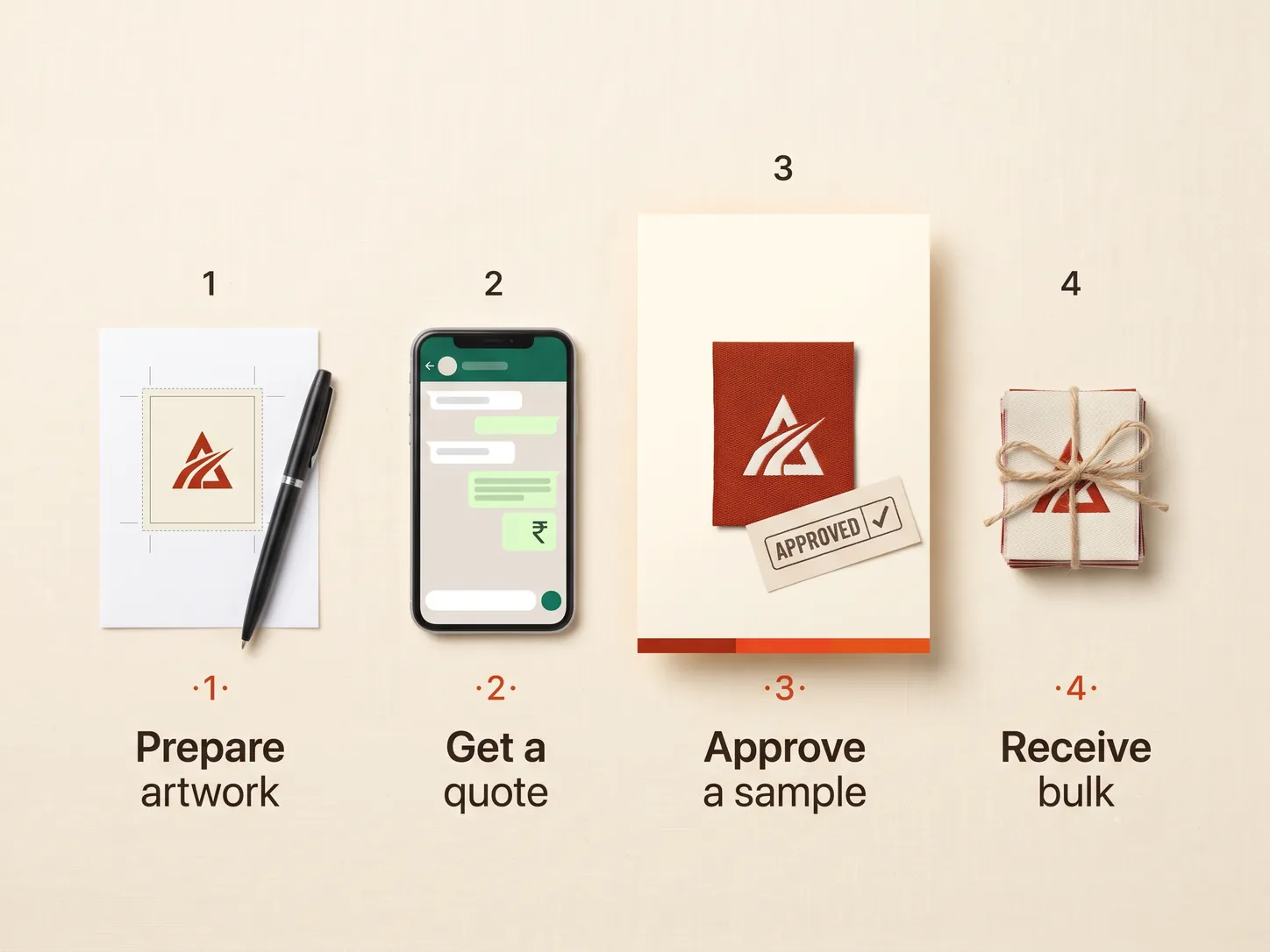
In brief
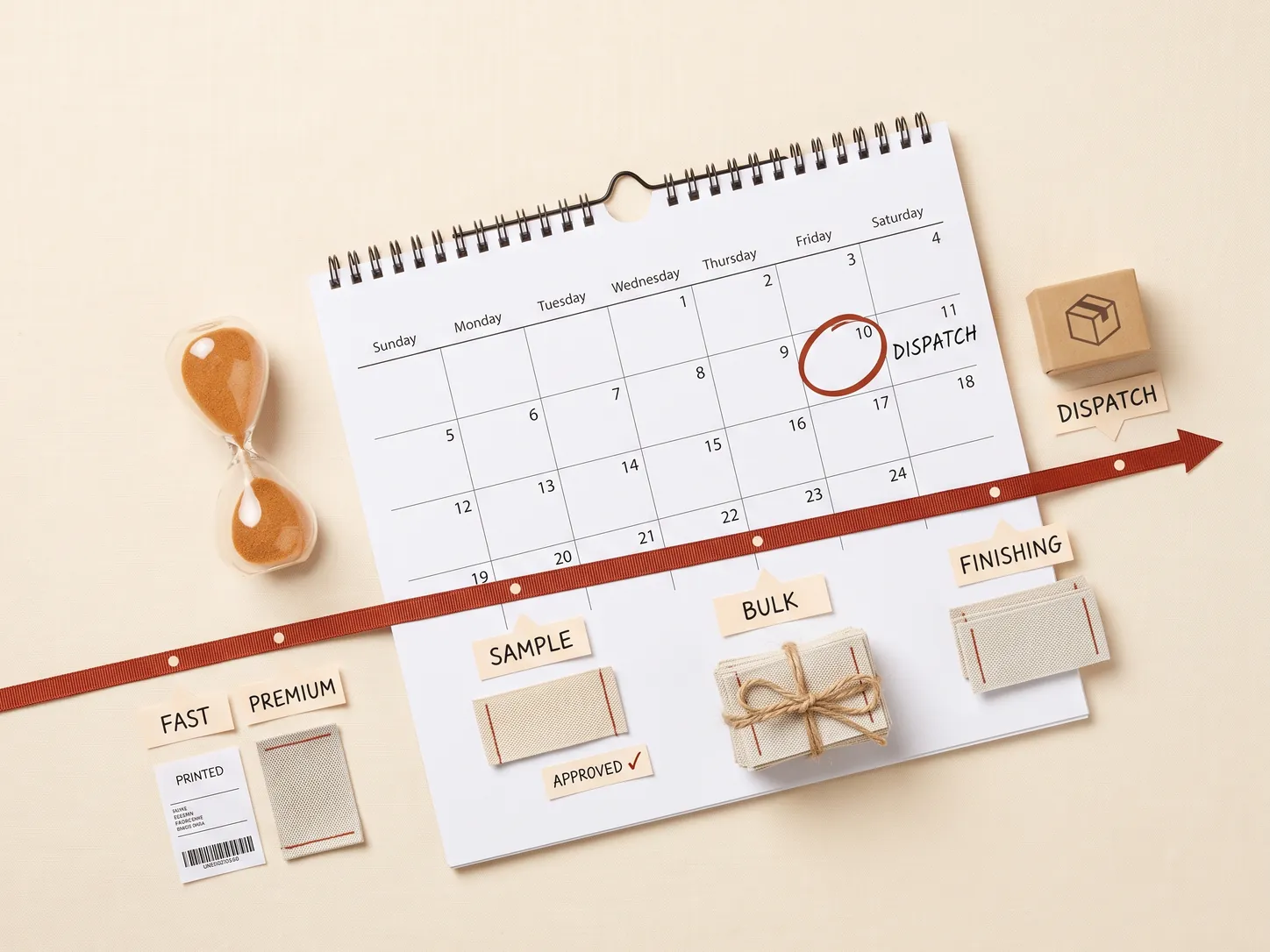
Label turnaround has two parts: sampling, which adds a few days for you to approve colour and feel, and bulk production, which varies by label type and quantity. Woven labels take longer than printed or heat-transfer because of weaving setup, and the bulk clock starts from artwork approval, so a fast sign-off shortens everything.
Here's a scenario every new brand hits once: the fabric's cut, the garments are ready to finish, and the labels haven't arrived. Because labels are sewn in during production, a late label delivery holds up the entire run. Understanding lead times means you order at the right moment and never get caught out.
This guide covers the two parts of label turnaround, what affects the speed, and how to plan labels into your production schedule.
What are the two parts of label turnaround?
- Adds a few days
- You approve colour, feel, size
- Time well spent, prevents wrong bulk
- Varies by type & quantity
- Woven takes longer than printed
- Larger runs take longer
The actual numbers
Most suppliers answer this question with "it depends", which is true and useless. Here is what our own timeline looks like, so you have something concrete to plan against:
The number that matters is 7-10 days from artwork approval, not from your first email. Everything before approval, quoting, artwork, proofing, sampling, your own sign-off, sits outside that window and is where most of the calendar actually goes.
That distinction is the source of nearly every scheduling argument between a brand and a label supplier. The brand counts from the day they made contact. The supplier counts from the day the artwork was signed off. If those two dates are three weeks apart because a logo file was missing, both parties are telling the truth and the garments are still late.
Every stage, in order
Knowing which stage you are in tells you whether you are actually behind or just impatient.
- Enquiry and quote. Fast if your brief is complete, we usually reply within 2 hours on a working day. Slow if the quantity, size, material or fold is missing, because then it is a conversation and not a quote.
- Artwork. Entirely on your side. Vector files with fonts outlined move straight through; a JPEG of a logo means someone has to redraw it first.
- Digital proof. You see layout, size and colour references before anything is made. Quick to produce, and quick to check.
- Physical sample. The real thing on the real material. This is the stage worth waiting for, because it is the only one that shows you how the material handles your artwork.
- Your approval. The single most variable stage in the whole process, and the one entirely within your control.
- Bulk production. 7-10 days once approved, or 3-5 days on a rush.
- Dispatch and transit. Depends on destination and consignment size.
Stage five is where schedules quietly die. A sample that sits in someone's drawer for a week over a bank holiday has added a week to the lead time, and it will not feel like it did. It will feel like the supplier was slow.
What affects label lead time in India?
- Label type: woven needs weaving setup; printed and heat-transfer are usually faster
- Quantity, larger runs take longer to produce
- Finish & fold, special finishes add steps
- Approval speed: how fast you sign off the sample
- Production load, current demand
Two levers are in your control. A complete brief up front (so the first sample is close) and fast sample approval are the two things that most reduce your total lead time. Everything else is largely fixed by type and quantity.
Why are printed labels faster than woven ones?
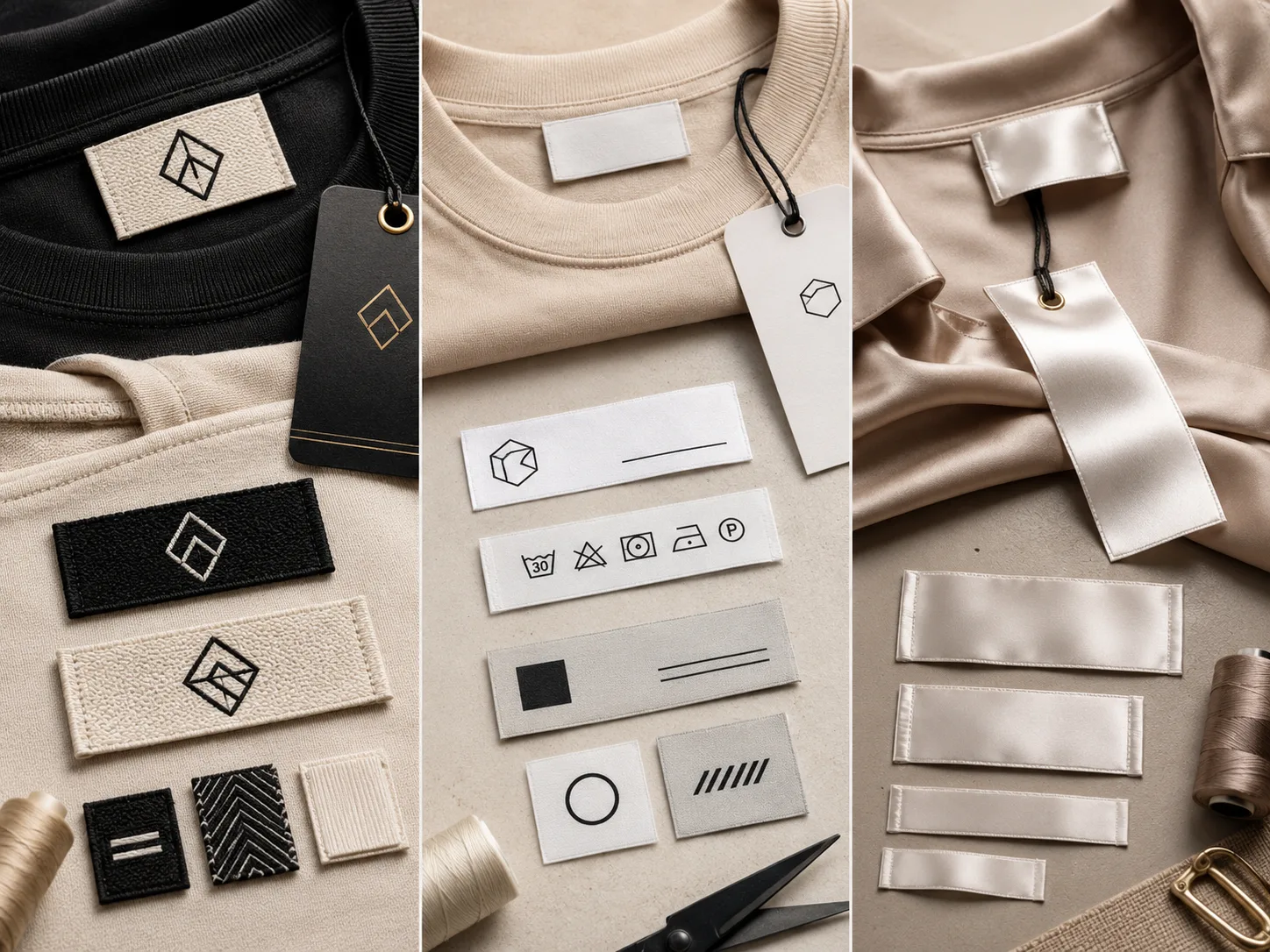
Printed and heat-transfer labels are generally quicker because they skip the weaving setup woven labels need. For a tight deadline, a printed or heat-transfer label can be the faster choice; woven is worth the extra time when you want its premium look and durability. Compare the trade-offs in our woven vs printed vs satin guide.
The reason is physical rather than administrative. A woven label is not printed onto cloth. The design is the cloth, formed as the label is woven. That means the loom has to be threaded with your specific colours and the jacquard set to your specific design before a single label exists. Change a thread colour and that setup is done again.
Printing is the opposite. The base material already exists on a roll, and the design goes onto it. Adding a colour is a plate or a file, not a re-threading. This is also why woven labels get relatively cheaper at volume while printed labels are more forgiving at small quantities. The setup is a fixed cost spread across the run.
Why are label reorders faster than first orders?
Almost everything that makes a first order slow is a one-time cost. On a repeat of the same label, the artwork is approved, the loom setup is recorded, the thread or ink references are on file and there is nothing to sample.
Plan your calendar around this. Your first order needs a generous buffer; your third does not. Brands that treat every order like the first one carry weeks of unnecessary slack, and brands that treat the first one like a reorder get caught out.
The condition is that nothing changes. A "small tweak" to the artwork, a moved word, a slightly different shade, puts you back through proofing and sampling, and it is worth deciding whether the tweak is worth the calendar before asking for it. Our guide to reorders and keeping labels consistent covers what to record so a repeat stays a repeat.
How does the season affect label lead times in India?
Label production runs on the same calendar as everything else in Indian garment manufacturing, and demand is not spread evenly across the year.
- Ahead of the festive season, when ethnic and occasion wear all needs finishing at once.
- Wedding season, for the same reason, concentrated into a few months.
- Export deadlines, where whole clusters of manufacturers work to the same overseas ship-by dates.
- Immediately after a long holiday, when a week of accumulated orders arrives at once.
None of these change the production time itself. They change how much slack exists in the queue, and therefore how likely a rush request is to be accommodated. If your season coincides with everyone else's, the fix is ordering earlier rather than pushing harder later.
Planning labels into your schedule
Work backwards from your dispatch date:
When garments must ship.
Labels are sewn in here. They must have arrived.
Allow production and shipping time.
Order early enough to sample and approve calmly.
The classic mistake: leaving labels to the last minute and holding up an otherwise-ready garment run. Order as soon as your artwork is final and build a buffer for sampling and approval.
A worked example
Say your garments reach the finishing line on the 30th, and this is a first order for a woven neck label.
- Labels must be in hand by the 28th, two days before finishing and not the same morning, because a delivery that arrives on the day is a delivery that can arrive a day late.
- Allow transit back from that, depending on where you are.
- Bulk production is 7-10 days, so approval has to land around the middle of the month.
- Before that, sampling and your own sign-off. Give this a week even though it might take two days, because it is the stage that slips.
- Before that again, quote and artwork. A couple of days if your files are ready, a fortnight if the logo needs redrawing.
Working it through, a first order wants roughly a month of runway from enquiry to labels-in-hand, and most of that month is not production. A repeat order of the same label, with nothing changed, needs little more than the 7-10 days plus transit.
The useful discipline is putting the buffer before approval rather than after it. Slack sitting after production has been booked does nothing; slack sitting in the sampling window absorbs exactly the problems that actually occur.
Getting labels faster
- Pick a faster method, printed or heat-transfer for tight deadlines
- Send complete artwork, so the first sample is right
- Approve immediately: the biggest lever on speed
- Keep it simple: fewer special finishes, fewer steps
- Share your deadline up front, so production is planned around it
Rush production runs 3-5 days rather than the usual 7-10 days, but a rush only compresses the manufacturing stage. It cannot compress your approval, and it cannot recover a week lost to artwork that needed redrawing. A rush requested on day one is a plan; a rush requested on day twenty is a hope.
What actually causes label delays?
In practice, delays cluster into a short list, and almost none of them are production problems:
- Artwork arriving as a screenshot or a JPEG, so it has to be redrawn and re-approved before anything starts.
- An incomplete brief, turning a quote into three rounds of questions.
- Colour indecision. Each additional round of colour approval is a full cycle, not an email.
- Approval sitting with someone on leave, which is the most common single cause and the most avoidable.
- Changing the size or fold after sampling, which restarts sampling.
- Not knowing the garment's finishing date, so the labels were never scheduled against a real deadline.
Read that list again as a planning document rather than a complaint. Every item is fixed before production starts, which means your lead time is largely decided in the first week, long before anyone is weaving anything.
Hold a buffer if you reorder regularly
If you run the same neck label across seasons, the cheapest insurance is simply owning more of it than you currently need. Labels are small, they do not perish, and storing them costs almost nothing.
A buffer of a few months' usage removes label lead time from your production schedule entirely. You order the next batch when stock hits a trigger level rather than when a garment run is already cut, which converts an urgent problem into a routine one.
This works best for the parts of your label set that do not change: the main brand label, and often the care label. Size tabs are the exception, because the split across sizes shifts with what actually sells, see our guide to minimum order quantities for how that interacts with per-size minimums.
Ordering from Labelwala
We make woven and printed labels in Ahmedabad, Gujarat, and we have been doing it for 25 years, so the timeline below is what we actually work to rather than a best case.
- Quotes: usually within 2 hours on a working day, provided the brief has quantity, size, material and fold in it.
- Production: 7-10 days from artwork approval. Rush jobs run 3-5 days.
- Minimum order: 1,000 pieces.
- Delivery: across India, with transit depending on destination and consignment size.
Tell us the date your garments reach finishing, not the date you would like the labels. We can plan backwards from a finishing date and tell you honestly whether it is achievable; we cannot do much with "as soon as possible", which is what most enquiries say.
We are rated 5.0 on Google from 27 reviews. If your timeline is tight, say so in the first message rather than the fifth.
The short answer
Label turnaround is sampling (a few days to approve colour and feel) plus bulk production (varies by type and quantity, with woven slower than printed). Because labels are sewn in during production, order early enough that they arrive before finishing: work backwards from your dispatch date and build a sampling buffer. The two speed levers in your control are a complete brief and fast sample approval. Tell us your deadline up front and we'll plan production to hit it.
Concretely: a quote within 2 hours, then artwork, proof and sample, then 7-10 days of bulk production from the day you approve, 3-5 days if it is a rush. Count from approval, not from your first email, and put your buffer before that point rather than after it.
Before you place the order
- Do you know the date your garments reach finishing?
- Is the artwork final, vector, and with fonts outlined?
- Have you decided size, fold, material and colour, or are any still open?
- Who approves the sample, and are they available in that window?
- Is this a first order or a repeat of something already on file?
- Does your deadline fall inside a festive, wedding or export peak?
- Have you ordered enough to cover sewing wastage and a few spares?
Answer those seven before you enquire and the quote comes back in one round instead of three. That alone usually saves more calendar time than a rush charge buys.