In brief
A garment sold in the UAE or Saudi Arabia needs a permanently attached label in Arabic, or Arabic and English, carrying the garment type, fibre content by percentage, size, manufacturer or brand, care symbols to ISO 3758 and the country of origin. The importer certifies the product through ECAS (UAE) or SABER (Saudi Arabia) using test reports and label mock-ups, so the label must be right before the shipment leaves India.
The Gulf buys a lot of what India makes. Abayas, kanduras and modest wear, hotel and hospital uniforms, school uniforms, workwear for construction and facilities companies, and ready-to-wear for the malls all come out of Indian factories, and a large share of the labels we make for export go to Dubai, Sharjah, Riyadh and Doha. The six GCC countries share a customs union and a standards body, the GCC Standardization Organization (GSO), so a label that is right for the UAE is close to right for the rest of the region, with Saudi Arabia adding its own certification layer.
What makes the Gulf different from the US or Europe is that the label is part of a product certificate rather than something checked after the garment is on the shelf. The importer cannot clear the goods without the certificate, and the certificate is issued against test reports and the label artwork. A wrong Arabic fibre name or a missing origin line holds up the whole consignment. This guide follows the shape of our US, EU, UK, Australia and Canada guides. It is a working outline for a label order, not legal advice; the rules are administered by MoIAT in the UAE and SASO in Saudi Arabia, and your importer and their certification body confirm the final wording.
The rules and bodies behind a Gulf garment label
| Rule or standard | What it governs | Who runs it |
|---|---|---|
| UAE Cabinet Resolution 54 of 2019, the textile control scheme | Which textile products need a conformity certificate, what the label carries, Arabic language | Ministry of Industry and Advanced Technology (MoIAT), through ECAS |
| Saudi Technical Regulation for Textile Products | Scope (80 percent textile by weight), fibre naming, label content and language, testing | Saudi Standards, Metrology and Quality Organization (SASO), through SABER |
| SASO 1173 | Identification labels for textile products | SASO, adopted from the Gulf standard |
| ISO 3758 (adopted as SASO ISO 3758 and in the UAE) | Care labelling symbols | GSO member bodies |
| GSO 1956 and GSO 1957 | Harmful substances in textiles and their test methods: formaldehyde, azo dyes, pH, heavy metals | GSO |
| GSO EN 14682:2021 | Cords and drawstrings on children's clothing up to age 14 | GSO |
| GCC Common Customs Law and the India-UAE CEPA | Import duty, origin documents and the duty preference for Indian goods | Federal Customs Authority, Dubai Customs, ZATCA (Saudi) |
One point to get straight at the briefing stage, because we see it in buyer emails every season: GSO 1956 is not the labelling standard. It is the harmful-substances standard, and its test report is one of the documents behind the certificate. The label content comes from the UAE resolution and the Saudi regulation, with SASO 1173 as the label standard they cite. If a buyer asks for "labels to GSO 1956", they mean labels that will pass the certificate, and the sections below are what that takes.
What the label must carry
The UAE and Saudi lists overlap almost completely. A label that meets both is the sensible target for any garment that might be sold across the region.
| Item | UAE (Cabinet Resolution 54) | Saudi Arabia (Textile TR) |
|---|---|---|
| Garment type | Required | Required, as product name or description, with model name or number |
| Fibre content | Required | Required, generic names from the regulation's annex, by mass percentage in descending order |
| Size | Required | Required for clothing; size standards EN 13402 and ISO 8559 are cited |
| Manufacturer or brand | Manufacturer name and/or brand | Brand or manufacturer name; the importer's name and commercial registration may also be required, see below |
| Care instructions | Required; symbols accepted | Required; symbols to ISO 3758 |
| Country of origin | Required | Required, as "Made in [country]" |
| Language | Arabic, or Arabic and English | Arabic, or Arabic and English |
| Attachment | Components label in a visible place | Sewn or firmly attached, not easily removable; legible before purchase, including online |
The UAE scheme also asks for a marketing label that shows the country of manufacture, the manufacturer's name, the importer and the approved trademark, and for the outer packaging to repeat the garment information plus the product name and the number of units. In practice the importer's name and the trademark go on the hang tag or the carton, and the sewn-in label carries the rest.
Saudi Arabia has been tightening the identity side. SASO's Circular 247 requires the supplier's name and commercial registration number on labels for products under a set of technical regulations from 1 October 2026, and a draft amendment to the textile regulation would require a Saudi address for the importer where the manufacturer is abroad. Whether your garment is caught depends on its category; ask the importer's certification body before artwork, and leave room on the label for a Saudi importer line if they say yes.
Arabic on the label: names, layout and script
Arabic is the requirement; English is the common addition. Almost every Gulf importer wants both, because the retail staff, the inspector and the customer may read either. Getting the Arabic right is where most label artwork from India fails, for reasons that have nothing to do with the law.
| English | Arabic | English | Arabic |
|---|---|---|---|
| Cotton | قطن | Wool | صوف |
| Polyester | بوليستر | Silk | حرير |
| Nylon | نايلون | Linen | كتان |
| Viscose | فيسكوز | Elastane | إيلاستين |
| Acrylic | أكريليك | Made in India | صنع في الهند |
Use the fibre names in the Saudi regulation's annex rather than a translation app; the annex is the list an inspector compares against. Then watch the mechanics:
- Direction. Arabic reads right to left. A line that mixes Arabic and a percentage, such as 100% قطن, has to be set with a layout engine that handles bidirectional text, or the number ends up on the wrong side of the word. Ask your label maker to show you the Arabic in a proof, not just the English with "Arabic to follow".
- Letter joining. Arabic letters change shape depending on their position in the word. Artwork exported from software without Arabic support shows the letters separated, which reads as gibberish to an Arabic speaker. Outline the text in a proper Arabic font before sending it.
- Digits. Western digits (0 to 9) are standard on labels in the UAE and widely used in Saudi Arabia; Eastern Arabic numerals are not required. Use one system consistently.
- Equal prominence. Set the Arabic at the same size as the English. A shrunken Arabic line is the first thing an inspector notices.
- Content limits. The Saudi regulation prohibits Quranic verses and the name of God on labels, and bans words that suggest a material the product does not contain, such as "silky" on polyester or "wool-like" on acrylic.
The layout that works is two columns or two blocks, Arabic on the right and English on the left, with the fibre lines matched so the percentages line up, and one row of care symbols shared by both. Our multilingual care label guide covers the general problem of fitting more than one language; the Arabic specifics are the direction and the font.
قميص رجالي
MEN'S SHIRT
100% قطن
100% COTTON
المقاس: L
SIZE: L
صنع في الهند
MADE IN INDIA
[ wash 40 ] [ no bleach ] [ tumble low ] [ iron medium ] [ dry clean P ]
غسيل آلي 40 درجة
MACHINE WASH 40°C
ECAS and SABER: the certificates that check the label
Both schemes are the importer's job, but the label maker and the garment factory supply what goes into them, and a shipment cannot leave until they are in place.
- UAE, ECAS. For textile products, which the resolution defines as ready-to-wear clothing, knitted fabrics, home textiles and anything at least 80 percent textile by weight, the manufacturer or its UAE agent has samples tested in an ISO/IEC 17025 laboratory, submits a technical file that includes mock-ups of the labels, and obtains a certificate of conformity from MoIAT that is attached to the products. One certificate currently covers up to 100 models or barcodes. Home-made items, disposable textiles and garments made by independent tailors are outside the scheme.
- Saudi Arabia, SABER. The importer registers the product on the SABER platform and obtains a product certificate from a SASO-notified certification body, then a shipment certificate for each consignment. Test reports must come from an accredited laboratory. Underwear of all ages and children's garments also require a factory audit, which affects Indian factories supplying those categories directly.
- The tests behind both. Harmful substances to GSO 1956 and GSO 1957 (formaldehyde, pH, azo dyes, heavy metals, nickel on fastenings), fibre analysis to the ISO 1833 series to confirm the label's composition, colour fastness and, for children's wear, cords and drawstrings to GSO EN 14682.
What this means for the label order: the artwork has to be final before testing starts, because the fibre analysis confirms what the label says and the mock-up goes into the file. Changing the fabric supplier after certification changes the composition and, strictly, the certificate. We supply true-size label mock-ups as PDF for the technical file with every Gulf order, and we can print a short sample run so the importer has physical labels to photograph.
Country of origin and the customs papers
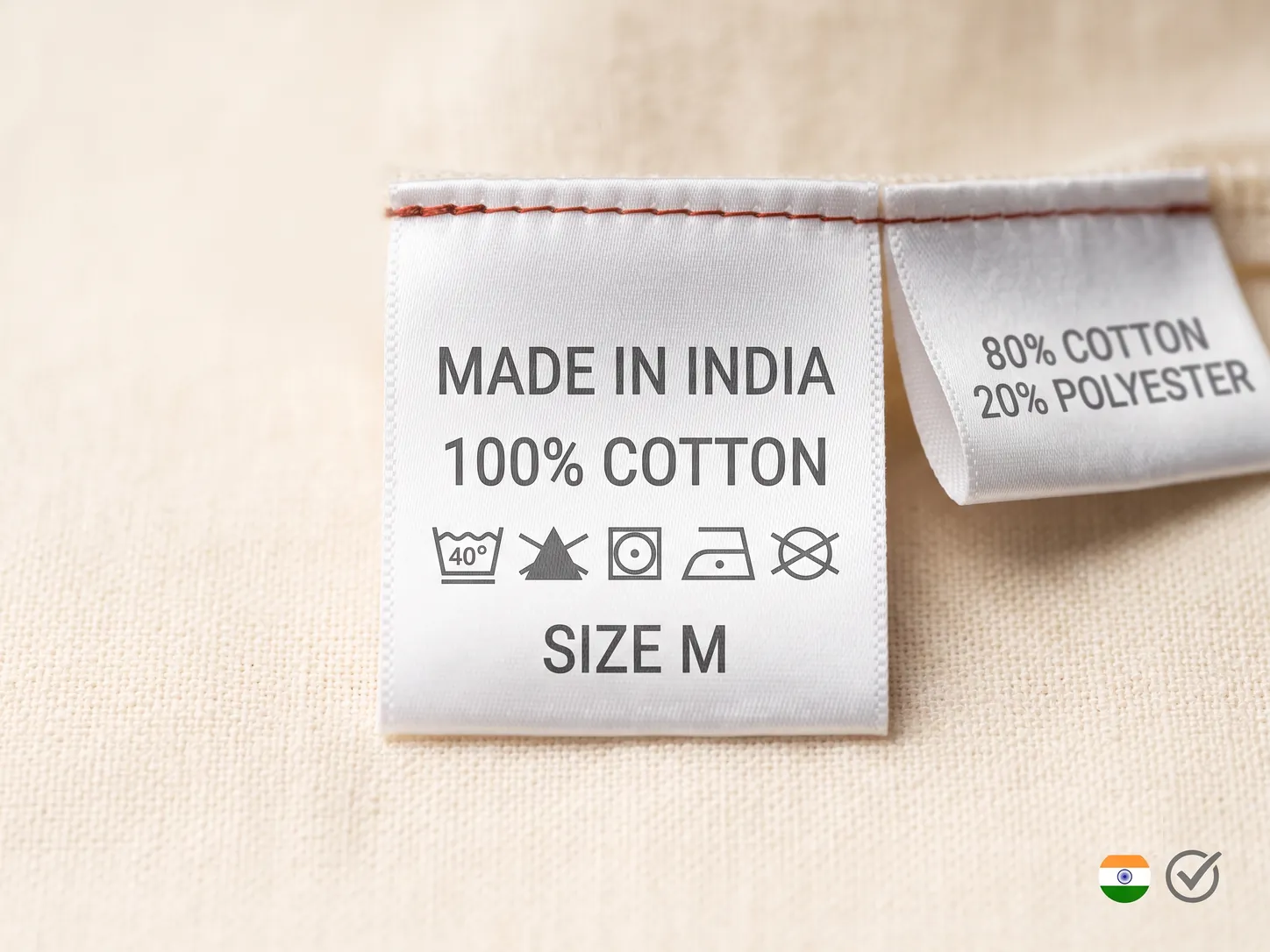
"Made in India" goes on the sewn-in label, in English and in Arabic, and the same origin appears on every document in the shipment. Gulf customs compare them.
- Certificate of origin from an authorised Indian chamber of commerce or export promotion council, naming the exporter, the goods and India as origin. For the India-UAE CEPA duty preference, the certificate must be the CEPA form issued by the designated Indian authority.
- Commercial invoice and packing list with HS codes. Knitted garments fall in chapter 61 and woven garments in chapter 62. Labels shipped on their own, for example to a Dubai garment factory, fall under HS 5807 (woven labels under 5807.10).
- Duty. The GCC common external tariff is 5 percent on most goods. Under the India-UAE Comprehensive Economic Partnership Agreement, in force since May 2022, most Indian garments and textile products enter the UAE duty free when the importer claims the preference. There is no equivalent agreement with Saudi Arabia, so the 5 percent applies there.
- VAT is charged at import: 5 percent in the UAE, 15 percent in Saudi Arabia. The importer pays it and recovers it as a registered business.
- Origin rules. Under the CEPA, a garment counts as Indian when it meets the agreement's rule of origin for its tariff line, which for most apparel means the fabric was made into the garment in India. Fabric imported into India and cut and sewn there generally qualifies; a garment sewn elsewhere and only finished in India does not.
For what the origin line itself should say and how it interacts with Indian rules, see our country of origin and fibre content guide; for how we document a label shipment, see international ordering.
Care symbols, sizes and children's wear
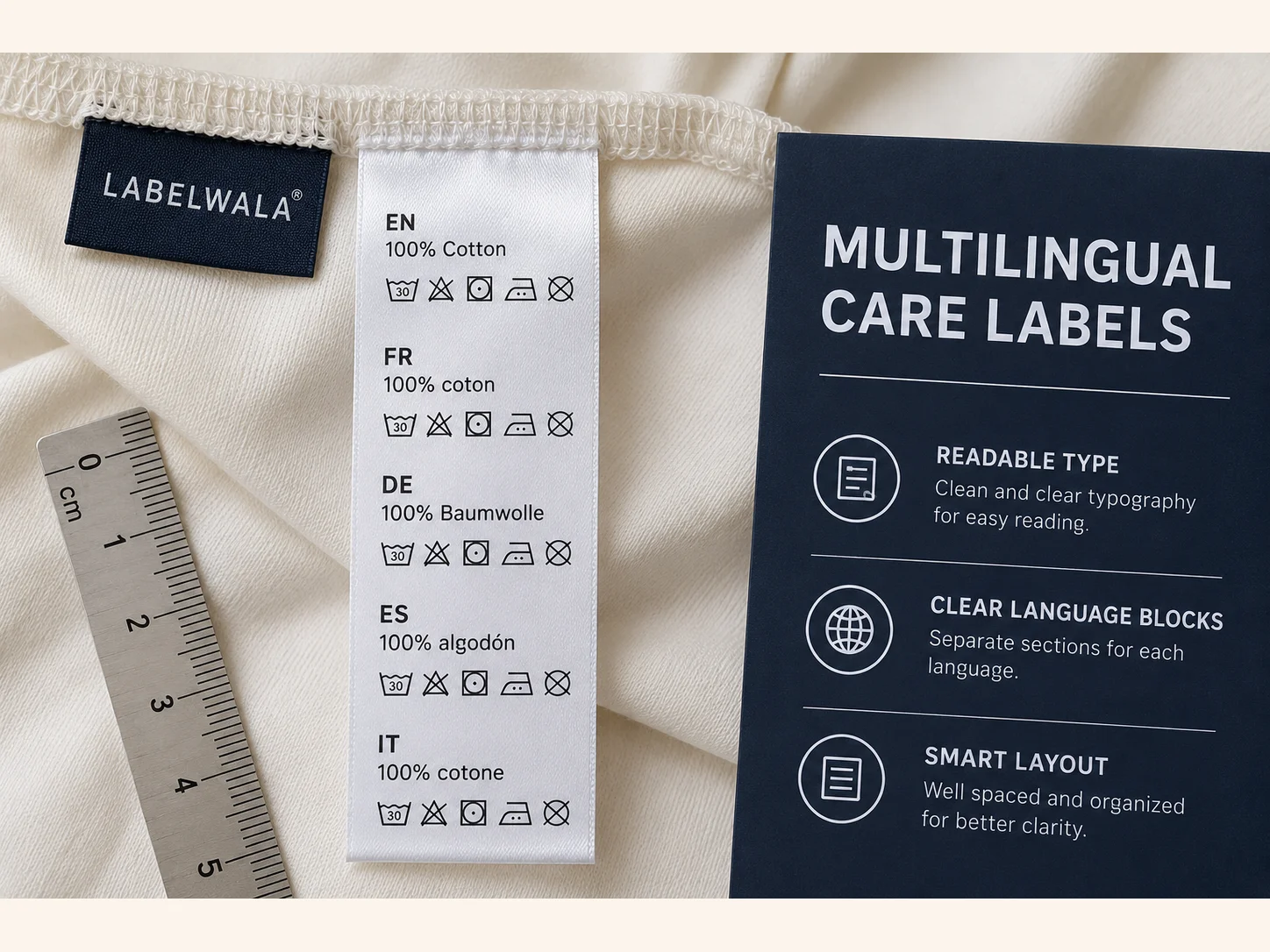
- Care symbols. Both markets use ISO 3758, the same system Indian label makers print by default, so a care label set to ISO 3758 is accepted across the Gulf. Add the key instructions in Arabic and English words beside the symbols; symbols alone satisfy the UAE rule, but a bilingual word line is what retailers expect. Our care symbols guide matches symbols to fabrics.
- Uniform and linen labels. Hotels, hospitals and facilities companies in the Gulf run industrial laundries at 90°C, and the care label and the brand label both have to survive it. Our industrial laundry guide explains which materials hold up.
- Sizes. Ready-to-wear uses the brand's own size system, typically S to XXL or European numeric sizes; the Saudi regulation points to EN 13402 and ISO 8559 for garments sized by body measurement. Abayas are sized by length in inches (52, 54, 56, 58, 60 are the common run), and kanduras and thobes by length and collar. Put the size on a separate tab so the care label does not change per size.
- Children's clothing. Cords and drawstrings must meet GSO EN 14682:2021, which applies up to age 14 and restricts cords at the hood, neck and waist. In Saudi Arabia children's garments need a factory audit for the SABER certificate. The label carries the age or size range as well as the fibre content, and our kidswear label guide covers the label-specific safety points.
Putting it on the garment: materials and layout
- Brand label: woven damask at the neck or, on an abaya or kandura, on the inside facing or the lining. Black ground with gold or silver thread is the Gulf modest-wear standard; our bridal and occasion-wear guide covers metallic thread on dark grounds.
- Care and composition label: printed satin in the side seam, 30 mm wide and 70 to 90 mm long for two languages, loop folded. Satin holds the Arabic letterforms and the small symbols sharply through washing; taffeta is acceptable for uniform labels that live inside a lining.
- Order on the label: garment type, fibre content, size, manufacturer or brand, origin, then the symbols and the bilingual care words. Some importers want the Arabic block first; follow their artwork.
- Uniform identification: department codes, staff names or numbers on name and number labels, and heavy-duty care labels, for hospitality, healthcare and security contracts.
- Hang tags and packaging: the importer's name, trademark and the unit count go on the hang tag or carton, in Arabic and English, so the sewn-in label can stay the same across importers.
Check the bilingual label at true size. The free label designer draws a care label at real millimetre scale, so you can see whether Arabic and English care text still read at the width your side seam allows before you order samples.
Timing: Ramadan, Eid and the school year
Gulf retail peaks around Ramadan and Eid, which fall in February and March in 2027 and move about eleven days earlier each year, and around the September school intake. Certification takes time on top of production, so the label order should be placed with the fabric order, not with the finished garments.
- Three to four months before the season: fibre composition final, label artwork approved in both languages, mock-ups sent to the importer for the technical file.
- Two to three months before: testing and certificate application by the importer; label production (7-10 days after approval) and delivery to the garment factory.
- Six weeks before: garments sewn, labelled and shipped with the certificate, certificate of origin, invoice and packing list.
Rush label jobs run 3-5 days, but a rushed label cannot rescue a shipment whose certificate was applied for late. Our guide to label lead times explains what each step takes.
Getting Gulf-ready labels made at Labelwala
We make woven, satin and cotton labels in Ahmedabad, Gujarat, and we have been doing it for 25 years. Arabic and English bilingual care labels, woven brand labels for modest wear and laundry-proof uniform labels for Gulf hospitality and facilities groups are regular orders, shipped to the UAE and Saudi Arabia or straight to the garment factory in India.
- Minimum order: 1,000 pieces per design. One brand label across the range and one care label per fibre composition is the usual way to use the minimum.
- Quotes: we usually reply within 2 hours on a working day, in AED if you prefer.
- Production: 7-10 days once artwork is approved. Rush jobs run 3-5 days.
- Care symbols: set to ISO 3758 on every care label we print.
- Mock-ups: true-size label PDFs for the ECAS or SABER technical file with every Gulf order.
- Delivery: across India and worldwide by tracked courier. See the UAE ordering page for shipping and payment.
Send us the English fibre content and care text and the Arabic your importer has approved, or ask us to set the Arabic from the regulation's fibre names for the importer to confirm. We lay out both scripts at equal size, with the Arabic set right to left in a proper Arabic typeface, and send a proof at true scale before production.
We are rated 5.0 on Google from 27 reviews. Ask for a physical sample of the bilingual label so the importer can approve the Arabic on the actual printed satin, and so you have a photograph for the technical file.
Common mistakes
- English-only labels on garments bound for the Gulf.
- Arabic with the letters disconnected because the artwork software could not join them.
- A percentage on the wrong side of the Arabic fibre name because the line was set left to right.
- Arabic set smaller than the English.
- Briefing the label maker for "GSO 1956 labels" when the need is the label content for the certificate.
- Changing the fabric supplier after the fibre analysis and certificate are done.
- Origin on the label that does not match the certificate of origin and invoice.
- "Silky", "wool-like" or similar words on a label for a garment that contains no silk or wool.
- A hang tag carrying the fibre content instead of a sewn-in label.
- Ordering the label with the finished garments, after the certificate deadline has passed.
Pre-production checklist for Gulf-bound labels
- Garment type, fibre content, size, manufacturer or brand, care and country of origin all on the sewn-in label?
- Arabic present, and English alongside it at the same size?
- Arabic fibre names taken from the regulation's annex, letters joined, lines reading right to left?
- Fibre percentages by mass in descending order, matching the fibre analysis report?
- Care symbols to ISO 3758, with bilingual words beside them?
- "Made in India" in both languages, matching the certificate of origin and invoice?
- Label sewn in or firmly attached, legible before purchase?
- No religious text, and no words suggesting a fibre the garment does not contain?
- Room for the Saudi importer's name and commercial registration if the certification body asks for it?
- True-size label mock-ups sent to the importer for the ECAS or SABER technical file?
What we would recommend
For garments going to the UAE or Saudi Arabia: a woven damask brand label at the neck or on the facing, and a printed satin care and composition label in the side seam, 30 x 70 mm or longer, loop folded, carrying the garment type, fibre content, size, brand, "Made in India / صنع في الهند", ISO 3758 symbols and care words in Arabic and English at equal size, with the Arabic set right to left in a real Arabic typeface. Put the size on a separate tab and the importer's details on the hang tag.
Finalise the composition before testing, get the Arabic approved by the importer in writing, send mock-ups for the certificate file, and order the labels with the fabric rather than with the finished garments. Labelled that way, the shipment gets its certificate the first time and clears Jebel Ali or Jeddah without a relabelling job at the port.