In brief
A garment sold in Canada needs a permanent label with the fibre content by generic name and percentage in English and French, the dealer's name and postal address or CA identification number, and, if imported, the country of origin. Care instructions and sizes are voluntary; when given, care uses CAN/CGSB-86.1 symbols, which match ISO 3758, and any words appear in both languages.
Canada is a growing market for Indian garment exporters, and most of the labels we make for it go on winter wear, workwear, uniforms and fashion basics shipped to importers in Ontario, Quebec and British Columbia. The labelling rules are shorter than the American ones: there is no equivalent of the US care rule, and no long list of exemptions to work through. What catches exporters out is the bilingual requirement, which doubles the text on the label, and the dealer identity, which must belong to a business in Canada.
This guide follows the same shape as our US, EU, UK and Australia guides. It is a working outline for a label order, not legal advice; the rules are administered by the Competition Bureau and the Canada Border Services Agency, and your importer confirms the final wording for your product.
The laws behind a Canadian garment label
| Law or standard | What it governs | Who administers it |
|---|---|---|
| Textile Labelling Act and the Textile Labelling and Advertising Regulations | Fibre content, dealer identity, how and where the label is attached, how fibres are named | Competition Bureau |
| Customs Tariff, Marking of Imported Goods Regulations | Country of origin marking on imported goods, including most apparel | Canada Border Services Agency |
| CAN/CGSB-86.1 | The voluntary care labelling symbols | Canadian General Standards Board |
| Charter of the French Language (Quebec) | French on product inscriptions and packaging sold in Quebec | Office québécois de la langue française |
| Canada Consumer Product Safety Act, Textile Flammability and Children's Sleepwear Regulations | Flammability of textiles and children's sleepwear | Health Canada |
The Textile Labelling Act applies to "consumer textile articles", which covers clothing and most household textiles sold to consumers. It does not apply to goods sold only to industry, so uniforms supplied under a contract to an employer are often outside it, though most uniform buyers want the same label anyway. The Act's label is called a disclosure label, and the three sections below cover what it discloses.
Fibre content, in English and French
The fibre content is the heart of the Canadian label. Each fibre that makes up 5% or more of the garment by mass is named by its generic name, with its percentage, in descending order, and the whole statement appears in both English and French.
- Generic names only. Cotton, polyester, nylon, wool, silk, linen, rayon, acrylic, elastane and so on. Trade names such as LYCRA or TENCEL may appear beside the generic name, never in place of it, and no larger.
- Percentages by mass, to the nearest whole number, largest first.
- Fibres under 5% may be grouped as "other fibre" or "other fibres", unless the fibre has a functional role that is worth naming, such as elastane for stretch; then it is named with its percentage.
- Linings, interlinings and trims are declared separately when they are a distinct part of the garment and differ in fibre from the shell, for example a quilted jacket's shell, lining and filling.
- Both languages are required for the fibre content wherever the garment is sold in Canada. The usual layouts are English and French on consecutive lines, or the French block below the English block.
Some of the French generic names are not simply the English word with an accent, and a wrong one is the most common error we see on artwork sent for Canada:
| English | French | English | French |
|---|---|---|---|
| Cotton | Coton | Wool | Laine |
| Polyester | Polyester | Silk | Soie |
| Nylon | Nylon | Linen | Lin |
| Elastane (spandex) | Élasthanne | Rayon | Rayonne |
| Acrylic | Acrylique | Viscose | Viscose |
| Cashmere | Cachemire | Other fibres | Autres fibres |
The Regulations carry the official list of generic names in both languages; use it rather than a dictionary, because the Competition Bureau treats an unlisted name as a non-compliant label. For how fibre content is worded in India and the other main markets, see our fibre content and country of origin guide.
Dealer identity: name and address, or a CA number
The label must identify the dealer, which is the person or business in Canada who is responsible for the garment: the manufacturer, importer or retailer. There are two ways to do it.
- Name and postal address. The dealer's name and a postal address in Canada where they can be contacted. A full street address is not needed; the name, city and province are enough for the post to find them.
- A CA identification number. A five-digit number issued by the Competition Bureau to a Canadian dealer, shown on the label as "CA" followed by the number, for example CA 12345. It replaces the name and address entirely and is the format most Canadian brands and importers prefer, because it does not change when the company moves or rebrands.
The point that matters for an Indian exporter: a CA number is issued only to a dealer with a Canadian address. An Ahmedabad or Tiruppur manufacturer cannot obtain one. The label therefore carries the Canadian importer's CA number, or the importer's name and address, and the importer gives you that information with the purchase order. If you sell direct to Canadian consumers online, without an importer, you need a Canadian presence to hold the number, and many exporters use a Canadian fulfilment or agency partner for that reason. The Bureau issues the number against an online or mailed application for a one-time fee of CAD 100, and the holder must keep the registered details up to date.
The CA number works the same way as the RN number in the United States, which we explain in the US requirements guide; a brand selling in both countries usually puts both on the same label.
Country of origin: required for imports
The Textile Labelling Act itself does not require a country of origin. Canada's customs rules do. The Marking of Imported Goods Regulations under the Customs Tariff list goods that must be marked with their country of origin when imported, and most wearing apparel is on that list.
- Wording: "Made in India" or "Fabriqué en Inde". Either language is acceptable for the origin mark on its own; most exporters print both so the label reads consistently with the bilingual fibre content.
- Placement: legible, in a conspicuous place, and in a way that will not come off before the garment reaches the consumer. On a sewn-in label alongside the fibre content is the normal route.
- "Made in India" means made in India. The country of origin for customs purposes is where the garment was substantially transformed, which for clothing is where it was cut and sewn. Fabric imported into India and made into garments there is Indian origin; a garment sewn elsewhere and only finished in India is not.
A garment made in Canada does not have to say so, and "Made in Canada" or "Product of Canada" claims are policed by the Competition Bureau under their own guidelines. That does not concern an exporter, but it is why you should never put a Canadian flag or "Canadian design" on a label for a garment sewn in India without the importer's approval.
Care labelling: voluntary, with a Canadian standard
Unlike the United States, Canada does not require care instructions on clothing. In practice every retailer and every importer asks for them, so the question is not whether to include care but how.
- Symbols: the Canadian standard is CAN/CGSB-86.1, which uses the same five basic symbols (wash tub, triangle, square, iron, circle) as the ISO 3758 system used on labels made in India. Temperatures may be shown as a number or as dots. Symbols set to ISO 3758 are accepted across the Canadian market, and we use them unless an importer specifies otherwise.
- Words: if you add written instructions, make them bilingual. Federal law does not require this, but Quebec's Charter of the French Language requires French on product inscriptions, and a national retailer will not accept an English-only care text. Symbols alone avoid the question, which is one reason Canadian labels lean on symbols.
- Accuracy: there is no Canadian equivalent of the US "reasonable basis" rule, but the Competition Act's general prohibition on misleading representations applies. A care instruction the fabric does not survive is a problem under that Act and, more practically, a returns problem.
For which symbols suit which fabric, see our care label symbols guide; for laying out two languages of care text, see multilingual care labels.
Quebec is the reason for most of the French. The Charter of the French Language requires that inscriptions on a product, its container and its packaging be in French, and that no other language be given greater prominence. The fibre content is bilingual by federal law anyway; the Charter is what makes the care text, the hang tag and the packaging bilingual too if the garment will be sold in Quebec, which a national retailer's stock always is.
Permanent labels, exemptions and the small print
The Regulations require the disclosure label on most garments to be sewn in or otherwise permanently attached, and the Competition Bureau's test for a permanent label is that it stays affixed and legible for at least 10 cleanings. A printed satin or woven label in a side seam meets this; a hang tag, wrapper or sticker is a non-permanent label and does not.
Some articles may carry the information on a non-permanent label instead. The Bureau's labelling guide lists which articles need a permanent label and which are eligible for a non-permanent one, and the Regulations' schedules exempt a further set of articles altogether, including one-time-use items and textile products that form part of footwear, luggage and toys. Articles made for commercial or industrial enterprises or government bodies, such as uniforms supplied under contract, are also exempt from the labelling requirement, though most uniform buyers specify the same label anyway. Confirm with the importer before relying on an exemption rather than sewing the label in.
A few other points that come up on export orders:
- Sizes are voluntary. Canada has voluntary size standards and no required size label. Retailers use their own size systems, often the US alpha and numeric codes, sometimes with a metric chest or waist measurement. Put the size on a separate tab so it can change without reprinting the care label.
- Children's sleepwear must meet the Children's Sleepwear Regulations under the Canada Consumer Product Safety Act, which set flammability requirements by fit. These are product standards, not label wording, but importers ask for test reports and some ask for the sleepwear style to be identified on the label.
- Down and feather fillings are declared as part of the fibre content of the filling, for example "Filling: 80% down 20% feathers", with the French beside it. The importer may ask for a certification such as RDS on the hang tag.
- Fur and leather trims fall under separate rules and must be identified as real fur or leather where used.
Putting it on the label: a bilingual layout that fits
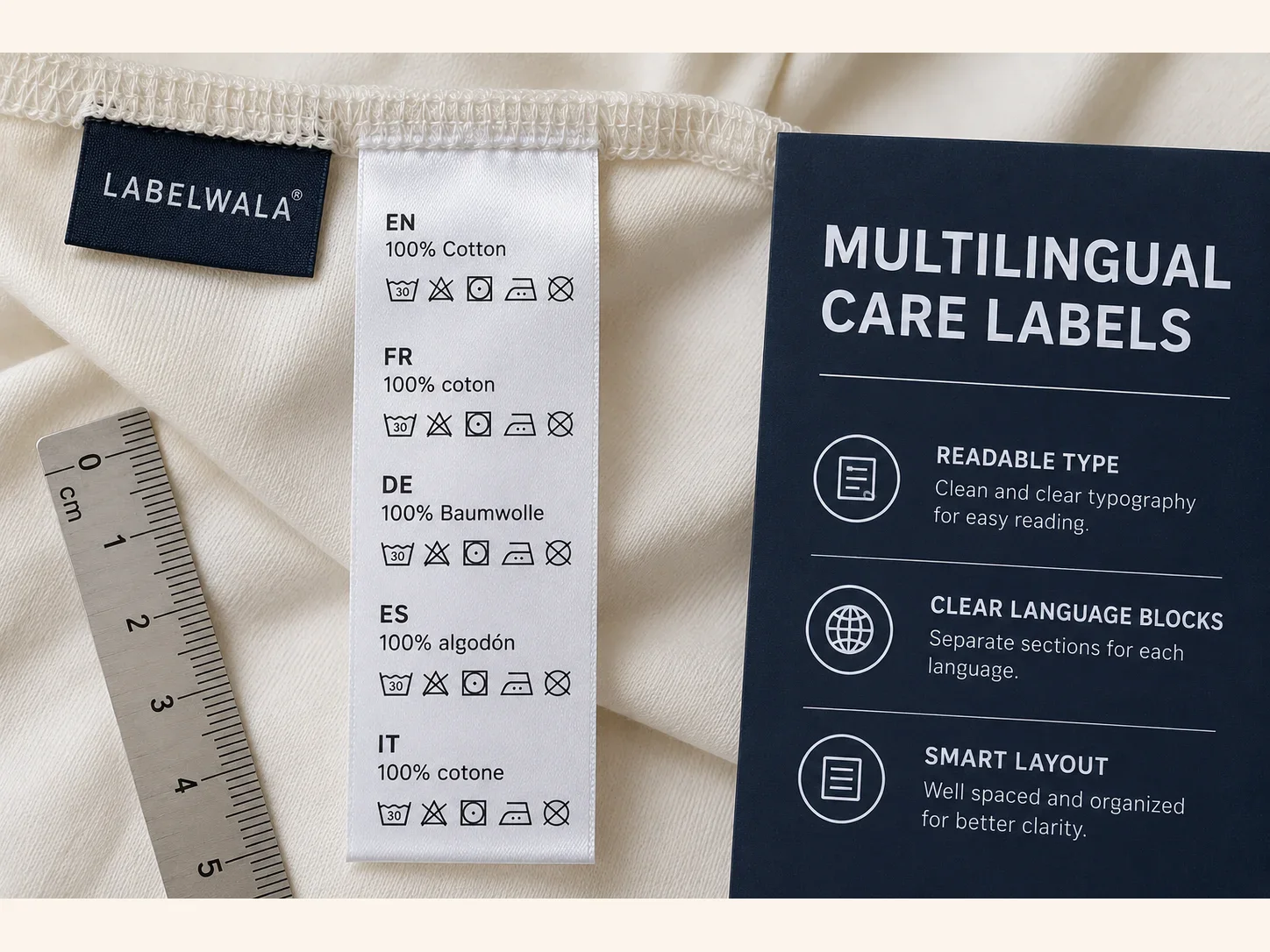
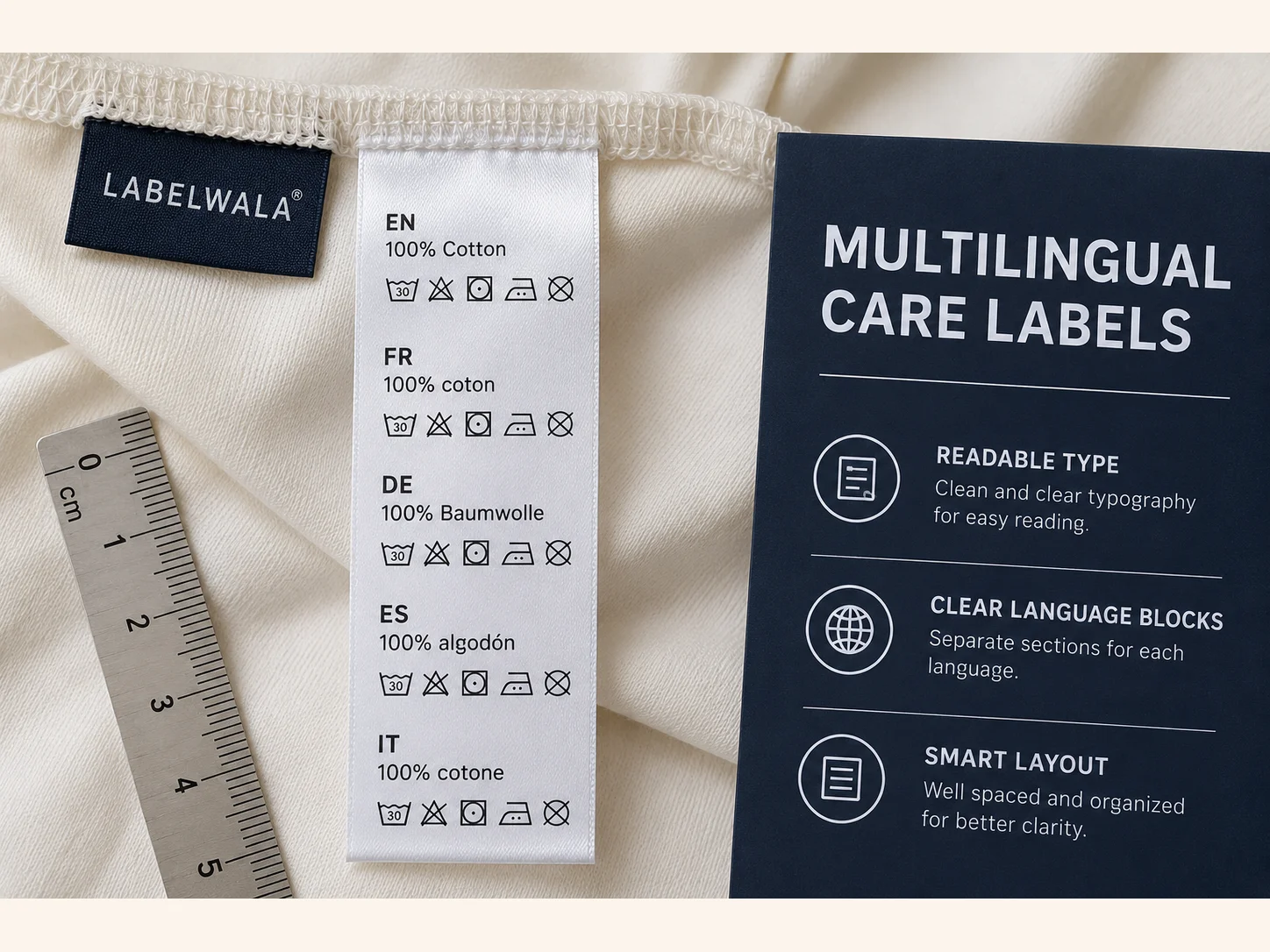
Two languages double the text, and a Canadian care label can run 20 to 30 mm longer than the English-only version of the same garment. The usual arrangement puts the fibre content, dealer identity and origin on one printed satin label in the side seam, and the brand on a separate woven label at the neck.
80% COTTON 20% POLYESTER
80% COTON 20% POLYESTER
CA 12345
MADE IN INDIA / FABRIQUÉ EN INDE
[ wash 30 ] [ no bleach ] [ tumble low ] [ iron low ] [ no dry clean ]
MACHINE WASH COLD · DO NOT BLEACH · TUMBLE DRY LOW
LAVER À LA MACHINE À L'EAU FROIDE · NE PAS JAVELLISER · SÉCHER PAR CULBUTAGE À BASSE TEMPÉRATURE
- Order: fibre content first, English then French, then the CA number or address, then origin, then the symbols, then any care words in both languages. Some importers specify French first for Quebec stock; follow their artwork.
- Size: 30 mm wide by 70 to 90 mm long, loop folded, is typical for a garment with four to six care lines in two languages. A jacket with shell, lining and filling can need 100 mm or more. Our care label size guide shows the width that fits each amount of text.
- Type size: keep the French as large as the English. Shrinking one language to fit is a Charter issue in Quebec and is what retailers' inspectors look for.
- Material: printed satin for the care and composition label, because it holds small type and symbols sharply through washing. Woven damask for the brand label. Our printed satin buyer's guide covers the options.
- One label or two: a brand selling in the US and Canada often uses one care label with the RN and CA numbers both on it and English, French and sometimes Spanish care text, so a single garment can go to either market.
Check the bilingual label at true size. The free label designer draws a care label at real millimetre scale, so you can see whether two languages of care text still read at the width your side seam allows.
Hang tags, packaging and the rest of the French
The sewn-in label is the legal minimum. The rest of what reaches the Canadian consumer is governed mostly by Quebec's language rules and by the retailer's own standards.
- Hang tags: any product description, feature claim or care note on the tag should be in French as well as English, with the French no less prominent. A brand name on its own does not need translating.
- Packaging and polybags: the same rule applies to printed text on bags and boxes. Warning text on polybags (the suffocation warning most retailers require) is printed bilingually in Canada.
- Size tabs: S, M, L and numeric sizes need no translation. Words like "Small" or "Tall" do.
- Retailer tags: Canadian retailers often require their own ticket or RFID tag, specified in their vendor manual, in addition to your label. Ask the importer for the manual before you finalise the label set.
Getting Canada-ready labels made at Labelwala
We make woven and printed labels in Ahmedabad, Gujarat, and we have been doing it for 25 years. Bilingual English and French care labels for Canadian importers are a regular job, and we ship labels to Canada or straight to the garment factory in India.
- Minimum order: 1,000 pieces per design. One brand label across the range and one care label per fibre composition is the usual way to use the minimum.
- Quotes: we usually reply within 2 hours on a working day, in Canadian dollars if you prefer.
- Production: 7-10 days once artwork is approved. Rush jobs run 3-5 days.
- Care symbols: set to ISO 3758, compatible with CAN/CGSB-86.1, on every care label we print.
- Delivery: across India and worldwide by tracked courier. See the Canada ordering page for shipping and payment.
Send us the English fibre content and care text, the French translation your importer has approved, and the importer's CA number or name and address. We lay the label out in the Canadian order, size it to the text and send a proof at true scale before production. If you also sell in the US, send the RN number and we put both on one label.
We are rated 5.0 on Google from 27 reviews. Ask for a physical sample of the bilingual label so your importer can approve the French on the actual printed satin.
Common mistakes
- Fibre content in English only.
- "Spandex" translated as "spandex" instead of élasthanne, or "rayon" left as rayon instead of rayonne.
- Putting the Indian manufacturer's name and address as the dealer: the dealer must be in Canada.
- No CA number or address at all on a direct-to-consumer order.
- Leaving the country of origin off because "the Textile Labelling Act does not require it".
- French care text set smaller than the English to make it fit.
- A hang tag instead of a sewn-in label on a garment that needs a permanent one.
- A trade name (LYCRA, TENCEL) shown without the generic fibre name.
- Lining and filling lumped into the shell's fibre percentage on a jacket.
- Ordering the care label before the importer has approved the French.
Pre-production checklist for Canada-bound labels
- Fibre content in generic names, percentages by mass, descending order, in English and French?
- Every fibre at 5% or more named; smaller ones grouped or named with a reason?
- Lining, interlining and filling declared separately where they differ from the shell?
- Dealer identity present: the Canadian importer's CA number, or their name and postal address?
- Country of origin on the label, in English or French or both?
- Care symbols to ISO 3758 / CAN/CGSB-86.1, and any care words in both languages at equal size?
- Label sewn in or otherwise permanent, on a material that stays legible through washing?
- Trade names shown only beside the generic name?
- Hang tag and packaging text bilingual if the garment will be sold in Quebec?
- French approved by the importer before the label goes to print?
What we would recommend
For garments going to Canada: a woven damask brand label at the neck and a printed satin care and composition label in the side seam that carries the fibre content in English and French, the importer's CA number, "Made in India / Fabriqué en Inde", ISO 3758 symbols and bilingual care words at equal size, loop folded at 30 x 70 mm or longer to fit the text. Put the size on a separate tab.
Get the French and the CA number from the importer in writing before artwork, treat Quebec's language rule as applying to everything printed, and keep one label format that also carries the RN number if the same garment goes to the United States. Labelled that way, the shipment clears the border and the retailer's inspection without a reprint.