In brief
Home textiles carry a sewn-in label with the brand, fibre content, care and origin, placed on a hem corner, a towel border or a curtain header tape, plus a pack label with the number of pieces, finished size, MRP and packer details that Indian law also wants on the online listing. The label must survive hot washes and tumble drying, so polyester woven or printed satin is the material. For export, the US adds a state law label on filled bedding and the EU applies its fibre regulation to bed linen, towels and curtains.
A bedsheet is washed every week for five years. A towel is washed warm and tumble dried a few hundred times. A hotel sheet goes through a 90°C alkaline wash several times a week until it is retired. The label has to last as long as the product, be readable at the end, and carry more measurement information than a garment label ever does: a sheet is sold by its finished size, a towel by its size and weight, a curtain by its width and drop. None of that fits the neck-label template, which is why home textile brands end up with a label that fades by the tenth wash and a pack that fails a marketplace listing check.
This guide goes product by product through where the label sits and what it says, then covers the Indian pack rules, the two export regimes that treat home textiles differently from clothing, and the material choice that makes the label outlast the product. Our guides to care label requirements and fibre content and origin cover the wording that applies to any textile; this one is about what is particular to the home.
Where the label goes, product by product
| Product | Label position | Usual label | Extra marker |
|---|---|---|---|
| Flat sheet | One corner of the wide top hem, inside | Combined brand and care, printed satin or woven, 30 x 60 to 40 x 80 mm, end fold or flat | None |
| Fitted sheet | Inside one corner, at the elastic | Same combined label | A small "side" or "head" tab at the corner so the sheet is fitted the right way round |
| Pillowcase | Inside the open end hem | Small brand label, 30 x 15 mm; care on the sheet label if sold as a set | None |
| Duvet cover, quilt cover | Inside, beside the opening or at a corner | Combined brand and care | Corner ties and a "top" marker help the user |
| Comforter, quilt, mattress pad | One corner of the edge binding | Brand and care label, plus the law label for the US | Filling statement |
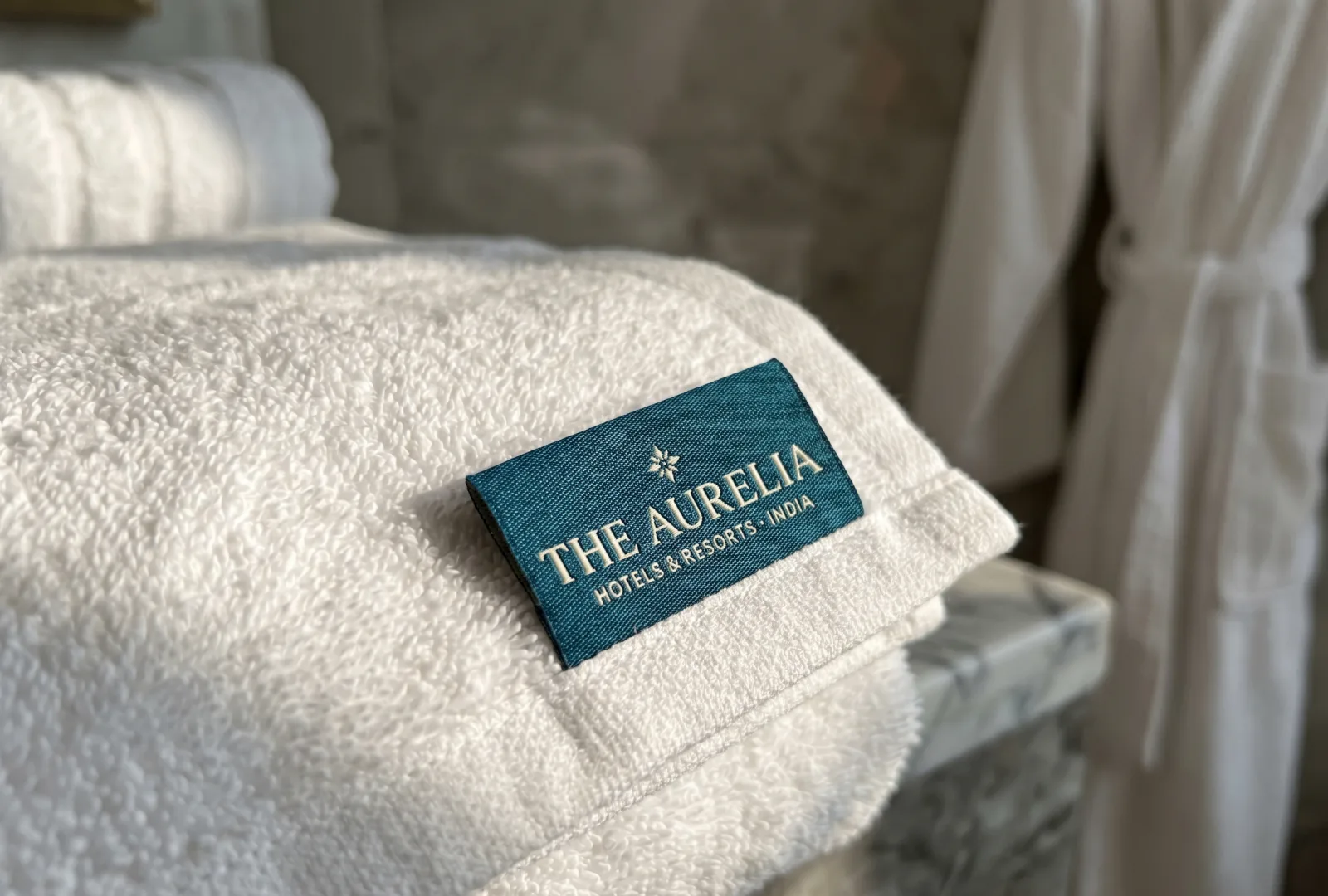
| Towel, bath sheet, hand towel | Loop label in the side hem, or flat in the dobby border near a corner | Polyester woven loop, 15 to 20 mm wide; care printed on the loop or a second label | GSM on the hang card, not the sewn label |
| Bath mat | Edge binding, one corner | Woven or satin, heat-cut edges | Non-slip backing care note |
| Curtain, drape | Top corner, on or beside the header tape, inside | Printed satin, 30 x 70 mm or longer: fibre, size, heading, care, FR if treated | Pair marker (left/right) for patterned curtains |
| Cushion cover | Inside, beside the zip | Small brand and care label | Pad size the cover fits |
| Table linen, napkins | One hem corner, inside | Small flat label; napkins may use one label per pack | None |
The rule behind the positions is simple: the label goes where it will not be felt, seen in use or caught in the laundry, and where the user can find it in ten seconds. On a towel that means the hem or the flat border, never the pile; on a sheet it means the top hem, which is the only part the sleeper's face does not touch; on a curtain it means the header, which faces the wall. Our guide to how labels are sewn in covers the stitches; for home textiles the attaching is almost always a straight stitch through a hem, which is the most durable of all of them.
Sizes: how home textiles are declared
Garments carry a size code. Home textiles carry a measurement, and the measurement has to be right because the customer is buying it to fit a bed, a rail or a bath. Indian retail still mixes inches, feet and centimetres by product.
| Product | How it is sized in India | Common sizes | Export convention |
|---|---|---|---|
| Bedsheets | Inches, width x length | Single 60 x 90, double 90 x 100, king 100 x 108 or 108 x 108 | By bed size name (twin, full, queen, king; UK single, double, king, super king) with cm |
| Fitted sheets | Inches, mattress size plus pocket depth | 72 x 78 x 8, 72 x 72 x 10 | Bed size name plus mattress depth in cm or inches |
| Towels | Inches, plus GSM | Bath 27 x 54, 30 x 60; hand 16 x 24; face 12 x 12; GSM 400 to 700 | cm, plus GSM |
| Curtains | Feet by length, pair or single | Window 5 ft, door 7 ft, long door 9 ft, usually 4 ft wide | Width x drop in cm or inches, per curtain, with heading type |
| Comforters, quilts | Inches | Single 60 x 90, double 90 x 100 | Bed size name with cm |
| Cushion covers | Inches, square | 16 x 16, 18 x 18, 20 x 20 | cm |
Put the size on the pack and the hang card, where the buyer reads it, and on the sewn-in label for curtains and fitted sheets, where it is needed after the pack is gone. Declare the finished size after hemming and, for cotton that is not pre-shrunk, say so; a 90 x 100 sheet that measures 87 x 96 after the first wash is the most common home textile complaint on marketplaces. Our shrinkage and wash-testing guide covers how to measure it before you print the size.
Care text that matches how the product is really washed
Home textiles are washed harder than clothes, and the care label should say what the product survives, not what a template says.
| Product | Care text that works | Why |
|---|---|---|
| Cotton sheets and pillowcases | Machine wash warm (40°C), do not bleach, tumble dry medium, warm iron; wash dark colours separately | Sheets are washed weekly and hot; say the real temperature |
| Cotton towels | Machine wash warm, do not bleach, tumble dry medium, do not iron, do not use fabric softener, wash before first use | Softener coats the loops and kills absorbency; the first wash removes loose lint |
| Microfibre or polyester sheets | Machine wash cool, no bleach, tumble low, do not iron | Heat sets creases and damages the fibre |
| Comforters, quilts | Machine wash cold gentle in a large machine, tumble low with dryer balls, or dry clean; shake and air regularly | Filling clumps if dried hot; domestic machines are too small |
| Curtains, cotton or linen | Gentle cold wash or dry clean, do not tumble, iron damp on reverse, rehang while slightly damp | Shrinkage shows as a drop that no longer reaches the sill |
| Blackout and lined curtains | Dry clean only, do not iron the lining | Coated linings crack in the wash and melt under an iron |
| Bath mats with rubber backing | Machine wash cold, line dry, do not tumble | Heat perishes the backing |
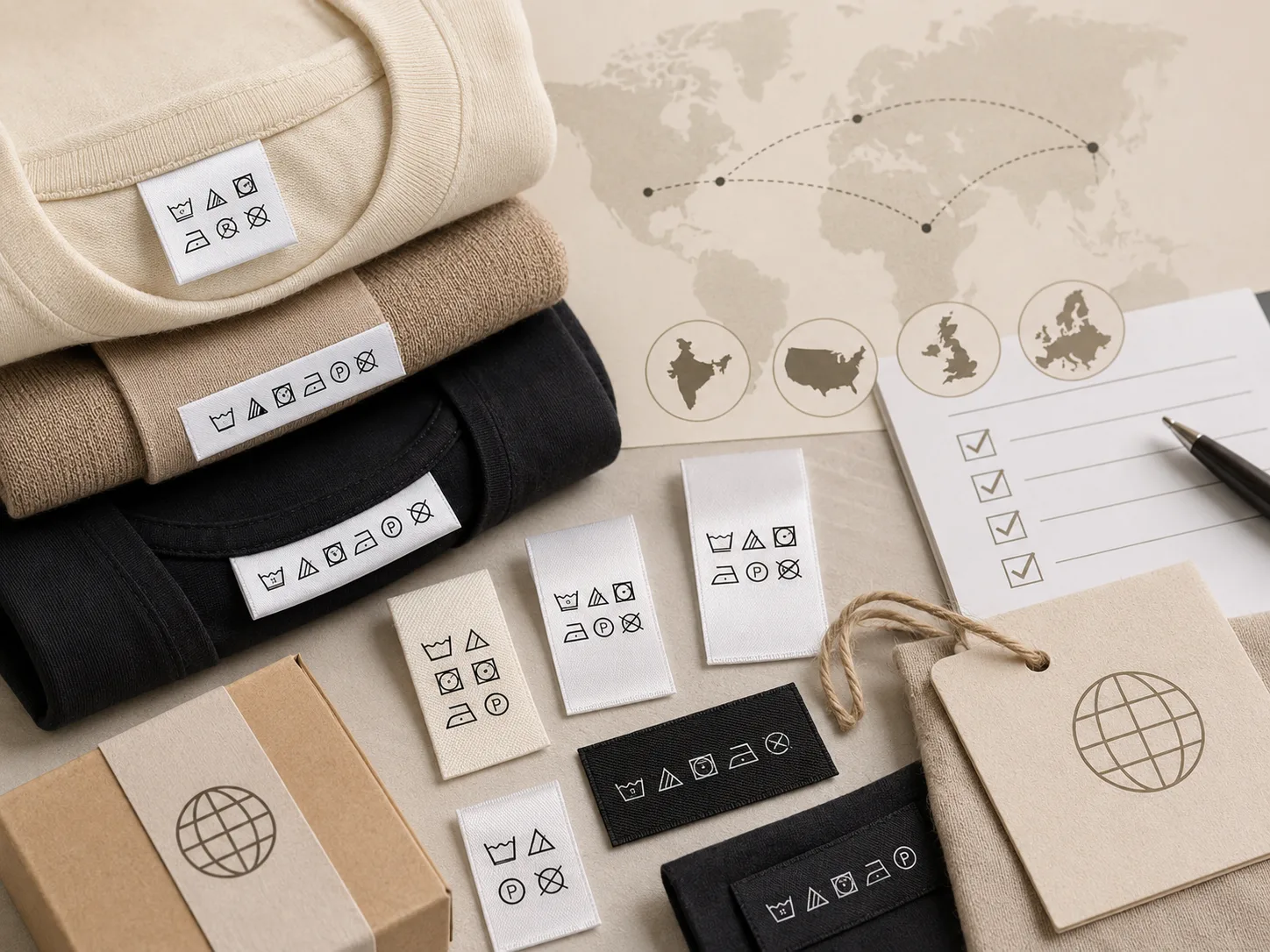
Set the symbols to ISO 3758 and add the words that matter, because a towel label with five symbols and no "no fabric softener" line has not done its job. Our care symbols guide matches the symbols to fibres.
A label that outlasts the product
The same washing that tests the product tests the label. A cotton or taffeta label on a towel frays at the edges within twenty washes and the print on it fades; a label sewn with cotton thread rots in a hot wash before the towel does.
- Material: a high-density polyester woven label for the brand, with heat-cut or folded edges, and a printed satin label with a wash-tested ink for the care text. For hotel and hospital linen, both have to survive 90°C washes; our industrial laundry guide tests the options.
- Thread: polyester, not cotton, and a straight stitch through the hem on at least two sides.
- Colour: a dark label on white linen must be colourfast at the wash temperature on the care label, because the bleed shows on a white sheet and nowhere else. Our guide to thread colours covers fastness.
- Size: bigger than a garment label is fine. A 40 x 80 mm combined label on a sheet hem is normal and reads easily; the text is longer and the product is larger.
- Test: wash a labelled sample 50+ cycles at the care-label temperature before approving. For home textiles that is the only test that means anything.
Check the combined label at true size. The free label designer draws a label at real millimetre scale on the fold you choose, so you can see whether a brand mark, fibre content, care text and size all read at 40 x 80 mm before you order the sample.
The pack: what Indian law wants on a bedsheet set
Home textiles are sold pre-packed, and the Legal Metrology (Packaged Commodities) Rules apply to the pack. For a bedsheet set, a towel pack or a curtain pair the declarations are:
- Name and address of the manufacturer, packer or importer.
- Generic name of the product.
- Number of pieces and the finished size of each; if the pieces differ in size, each size and its price.
- Month and year of packing.
- MRP inclusive of all taxes, in rupees.
- Consumer care name, phone and email.
Since 2018 the same declarations, except the month and year, must appear on the online listing, and Amazon, Flipkart and Myntra check the listing against the pack when the stock reaches the warehouse. A set listed as 90 x 100 whose pack says 88 x 98 gets held. Our marketplace requirements guide covers the process; put the pack sticker artwork and the listing on the same spreadsheet so they cannot drift.
Claims on the pack are checked too. Thread count is counted as single yarns per square inch, not plies, and inflating it by counting plied yarns has drawn enforcement in the United States and complaints in India. Egyptian, Pima and Supima cotton need the mill's documentation. OEKO-TEX and GOTS marks are used only with a current licence number. The hang card is the right place for GSM, thread count and fibre origin, with the proof in the file.
Export: the rules that are different for the home
Clothing exporters know the US and EU rules for garments. Home textiles meet two more.
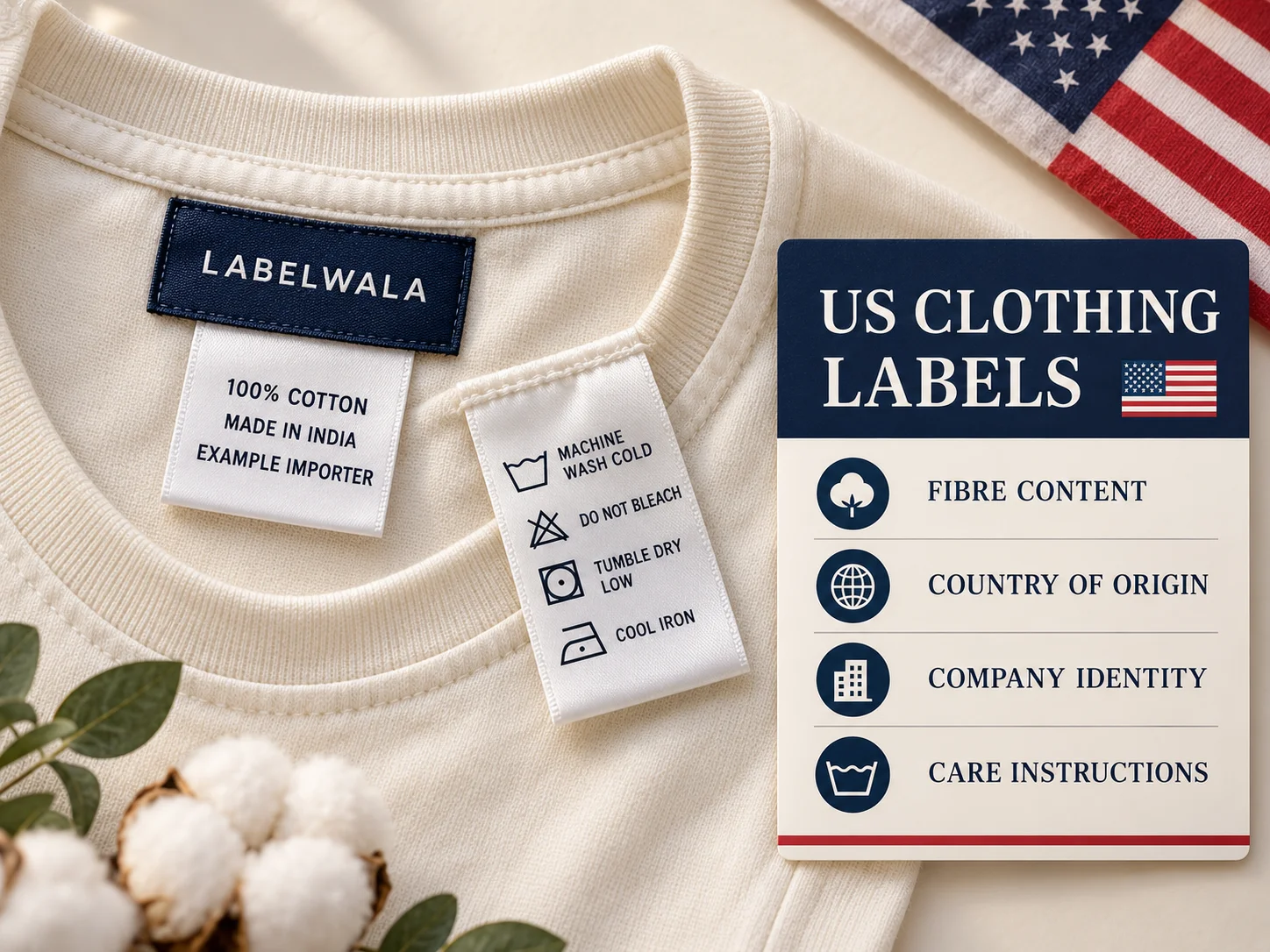
- United States, federal. The FTC's textile rules cover household textiles, naming sheets, blankets, comforters, pillows, pillowcases, quilts, bedspreads and pads, so every item needs the fibre content, the RN or company name and the country of origin on a label. The Care Labeling Rule does not cover bedding, so care text there is voluntary, though every retailer expects it. Our US requirements guide covers the fibre and origin wording.
- United States, state law labels. Filled items, meaning comforters, quilts, pillows, mattress pads, cushions and anything with a stuffing, need a law label under state bedding laws: a white label in black ink in the IABFLO format, attached to the product, reading "Under penalty of law this tag not to be removed except by the consumer", stating the filling material by percentage, "all new material", the manufacturer or importer and a Uniform Registry Number issued by one of the registering states and accepted by most of the others. Some states add a sterilisation permit number. The importer holds the URN; an Indian factory prints it on the label. Flat sheets, towels and curtains are not filled and do not need one.
- European Union and United Kingdom. Regulation (EU) 1007/2011 and its UK copy apply to any product at least 80 percent textile by weight, and bed linen, towels and curtains are not among the exemptions in Annex V, so the fibre composition goes on the label in the language of the country of sale. Multipacks of small items such as face flannels and cleaning cloths may carry one label on the pack under Annex VI. Our EU guide and UK guide cover the fibre names and languages.
- Flammability for contract buyers. Hotels, hospitals and offices in the UK and the US ask for curtains and drapes that meet a flame-retardant standard (BS 5867 Part 2 in the UK, NFPA 701 in the US are the ones named on most tenders) and for the treatment to be stated on the label. Domestic curtains do not need it; contract curtains do, and the label is where the buyer's inspector looks.
- Gulf and others. Home textiles fall inside the UAE and Saudi textile control schemes at the same 80 percent threshold as clothing, with Arabic on the label. Our UAE and GCC guide covers the certificates.
Hotel, hospital and institutional linen
Contract linen is the largest home textile order most label makers see: a property's name woven onto every sheet, towel and bathrobe, often with a department or floor code, on a label that will see several hundred 90°C washes. Three things change from retail:
- One label for the property, in one design, across sheets, towels, duvet covers and bathrobes, so the minimum of 1,000 pieces is used across the whole linen inventory.
- Durability over appearance. Woven polyester with folded edges and polyester thread. A printed satin care label on hotel linen fades long before the sheet is retired, so the care information goes to the laundry's own specification, not the label.
- Identification over branding. The label's job is to return the linen to the right property, floor or department after a shared laundry. Numbering or colour coding on the label does that; our industrial laundry guide and the hotels and hospitality segment cover the systems.
Home textile labels from Labelwala
We make woven and printed labels in Ahmedabad, Gujarat, and we have been doing it for 25 years. Bedsheet hem labels, towel loop labels, curtain labels and hotel linen labels are regular orders from the home textile clusters and from brands selling on marketplaces and abroad.
- Minimum order: 1,000 pieces per design. A combined brand-and-care label is one design.
- Quotes: we usually reply within 2 hours on a working day.
- Production: 7-10 days once artwork is approved. Rush jobs run 3-5 days.
- Care symbols: set to ISO 3758 on every care label we print.
- Wash testing: labelled samples tested to 50+ cycles at the care-label temperature on request; industrial laundry samples at 90°C.
- Export: US law labels printed to the importer's URN and format, EU and Arabic fibre labels, shipped worldwide or to the factory in India.
Send us the product list with finished sizes, the fibre content per product, the wash temperature the product is designed for and, for export, the importer's details and the market. We lay the label out to fit the longest text, size it for the product, and send a washed sample before bulk.
We are rated 5.0 on Google from 27 reviews. For towels, ask for the loop label sample sewn into your actual hem and run it through a tumble dryer before you approve it.
Common mistakes
- A garment-weight cotton or taffeta label on a towel.
- Cotton thread on a label that will be washed at 60°C or more.
- A towel care label without "do not use fabric softener".
- Finished size declared before shrinkage, so the washed sheet is smaller than the pack.
- Pack says one size, listing says another.
- Thread count counted in plies.
- No law label on a comforter or pillow shipped to the United States.
- Fibre content only on the pack for EU-bound bed linen, not on the product.
- A curtain label with no width, drop or heading type.
- A dark label that bleeds onto a white sheet in the first hot wash.
Pre-production checklist
- Label position chosen per product: hem corner, towel border or header tape?
- Polyester woven or printed satin, polyester thread, folded or heat-cut edges?
- Fibre content for face fabric and lining or filling where they differ?
- Care text matched to the real wash temperature, with the product-specific lines (softener, first wash, rehang damp)?
- Finished size measured after a wash and declared on the pack, and on the label for curtains and fitted sheets?
- Pack declarations complete: packer, generic name, pieces and sizes, month and year, MRP, consumer care?
- Listing matches the pack, declaration by declaration?
- Thread count, cotton origin and certification claims backed by documents?
- Law label with the importer's URN on every filled item for the US; fibre label on the product for the EU and UK?
- Labelled sample washed 50+ cycles at the care temperature and still legible?
What we would recommend
For a home textile range: a combined brand-and-care label in printed satin or woven polyester, 30 x 60 mm to 40 x 80 mm, on the top hem corner of sheets and covers; a woven polyester loop label in the hem of every towel, with the care on it or beside it and "no fabric softener" in words; a printed satin label with fibre, size, heading and care on the header of every curtain; all sewn with polyester thread and wash-tested at the temperature on the label. Put the size, pieces and MRP on the pack and the listing from one sheet of data.
For export, add the importer's URN law label to anything with a filling for the US and put the fibre composition on the product itself for Europe. A home textile labelled that way is still readable when the product is retired, and the pack clears the marketplace check the first time.