In brief
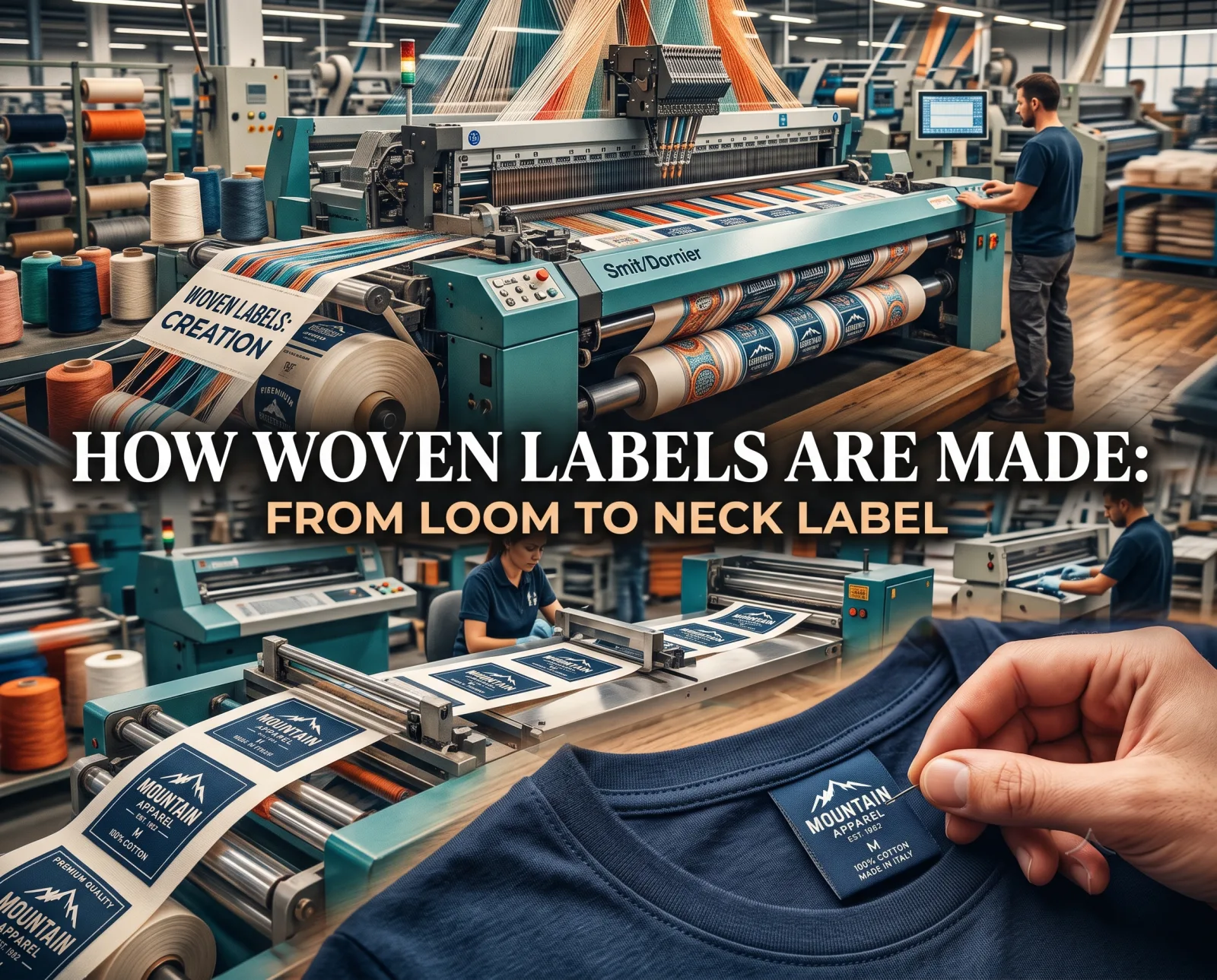
A woven label is made on a narrow-fabric loom, where polyester warp threads run the length and weft threads cross the width, so the design is part of the fabric, not printed on top. A jacquard head lifts individual warp threads on each pass to build the logo row by row, then the strip is cut and folded or sealed.
Pick up a good woven label and run a fingernail across it. There's no ink sitting on the surface, no coating to catch. The logo is the fabric. That single fact is the whole story of how woven labels are made, and why they behave the way they do.
This is the plain-English version: what happens on the loom, what warp and weft actually mean, why a jacquard head is the clever bit, and the full run of steps from your artwork to a finished label in your hand.
Why is a woven label fabric rather than print?
Start with the key distinction. A printed label takes a blank base tape and lays ink on top of it. A woven label has no separate "blank" and no ink at all. The coloured threads are interlaced so that the design emerges as the cloth is made. The colour goes all the way through because the colour is the thread.
Everything good about woven labels flows from that: the crispness that survives the wash, the clean feel with no plasticky coating, and the fine detail a tight weave can hold. It's also why woven can't do photographic gradients the way print can, but that's a design trade-off, covered in our woven design rules.
What are warp and weft in a woven label?
Every woven fabric is built from two sets of threads crossing at right angles. Labels are no different.
Threads running the length of the label, held taut on the loom. Usually the background colour of your label.
The thread that shuttles across the width, one row at a time, weaving over and under the warp. Carries the design colours.
Here's the trick that makes a logo possible: on each pass, certain warp threads are lifted up and out of the way so the coloured weft shows on the surface exactly where you want it. Lower those threads and the background shows instead. Do that thousands of times, row by row, and a detailed logo builds up like a very fine tapestry.
How does the jacquard head weave a logo?
Simple looms can only lift warp threads in fixed groups, which gets you stripes and checks, not a brand mark. Custom woven labels are made on a jacquard loom, fitted with a mechanism that can raise each warp thread independently on every single pass of the weft.
That independent control is everything. Your artwork is converted into a weave file, essentially a row-by-row map of which threads to lift, and the jacquard head follows it exactly. It's the same principle Joseph Marie Jacquard invented two centuries ago, now run by a computer. This is why you'll sometimes see custom woven labels called "jacquard woven labels"; they're the same thing.
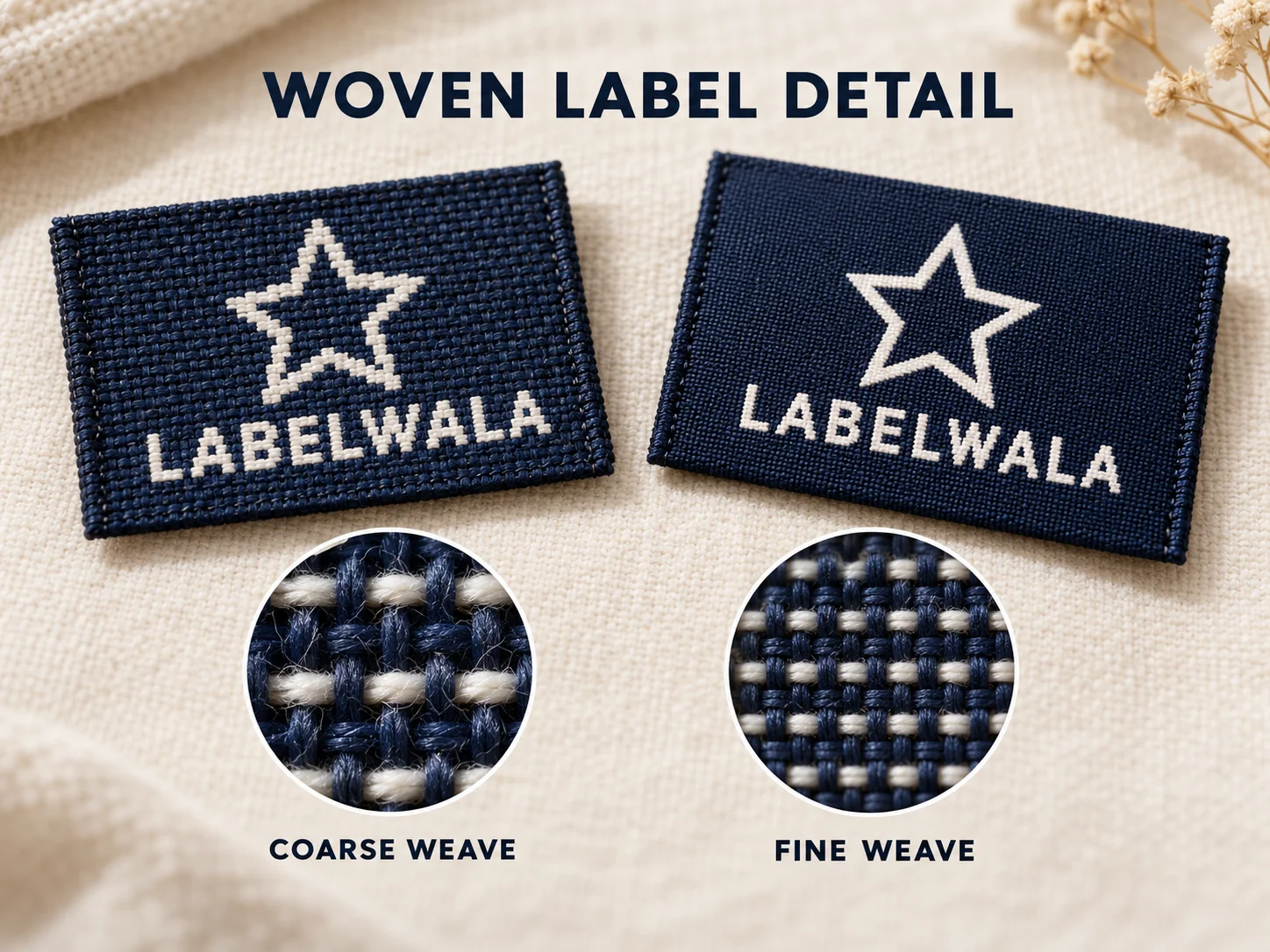
The finer the threads and the tighter the weave, the more detail the loom can hold. That's the single lever behind quality tiers: explained in woven label weave density.
Where does damask fit in woven label making?
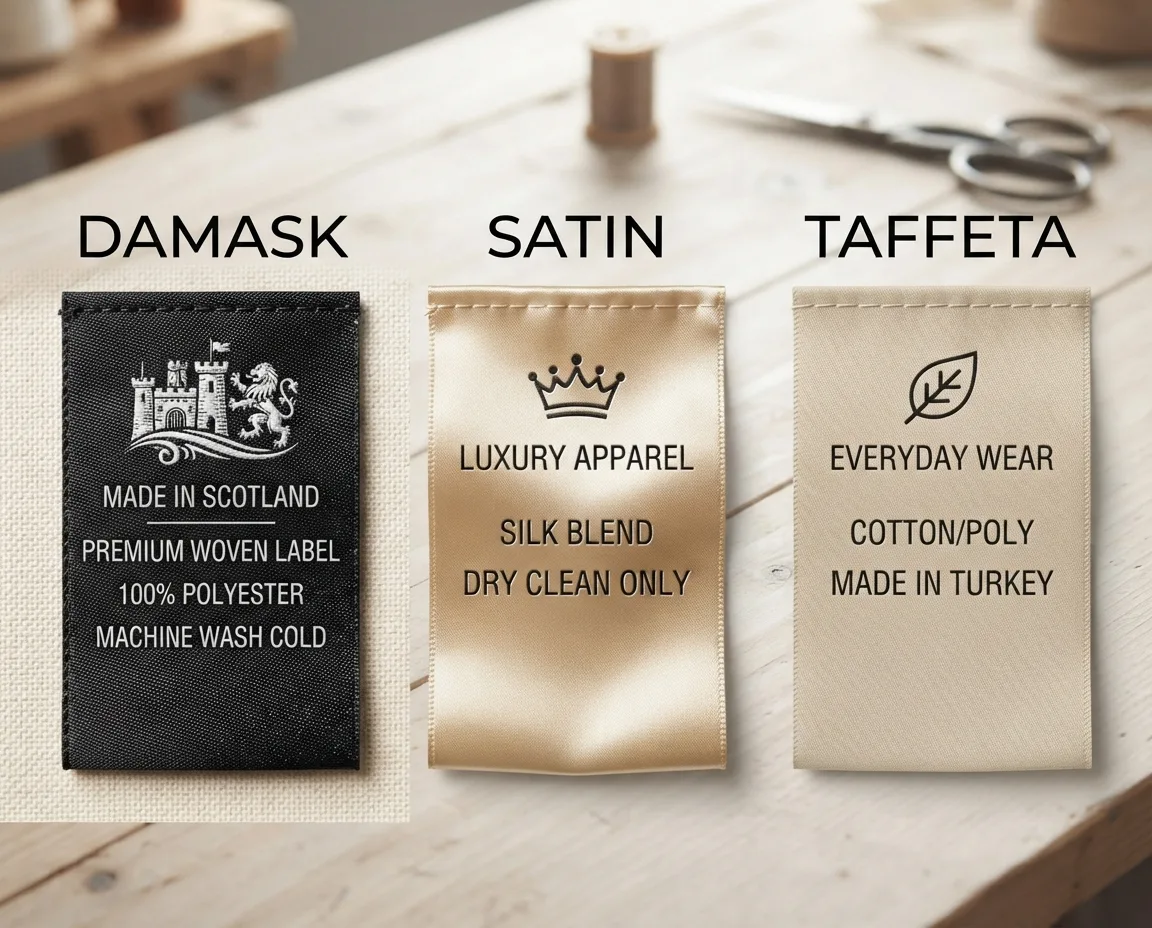
People often ask whether damask is a different product. It isn't. A damask label is made on the same jacquard loom, just with finer yarn packed at a higher density. More, thinner threads in the same space means smaller text, sharper edges and a smoother, more premium hand-feel. That extra fineness is also why damask sits at the top of the woven price range. Standard woven, satin-weave and taffeta are the other common variations: see woven label materials for how they compare.
The full process, step by step
From your logo to labels in a box, here's the real sequence.
Your logo is converted into a row-by-row weave map and thread colours are matched to your brand, see Pantone to thread.
The loom is threaded and colour-set, and a physical sample is woven for you to approve before bulk.
Approved, the loom weaves a continuous strip carrying your labels side by side, fast and consistent.
The strip is cut into labels, edges are sealed or folded, and each batch is quality-checked before dispatch.
That last stage matters more than people expect. How the label is cut and folded decides whether it frays and how it sits in a garment. The options are covered in woven label edges & cuts and fold types.
Why does the weaving process make labels so durable?
Now the payoff. Because the design is locked into the weave rather than printed on top, there's simply no layer to fade, crack or peel. A woven neck label washed hundreds of times keeps its logo crisp, which is exactly why woven is the default for anything that lives inside a garment.
Always approve a physical sample. A weave file can look perfect on screen and still surprise you in thread: small text closing up, a colour reading differently. The sample is where you catch it, before bulk.
How long the whole thing takes
The weaving is the fast part, which surprises people who assume the loom is the bottleneck.
What takes time is everything around it: translating artwork into loom instructions, threading the specific colours, running and checking a trial length, then the finishing operations after the tape comes off. A run of a few thousand labels can weave in a fraction of a day and still take the better part of a fortnight from approval to delivery, because the queue, the setup and the finishing dominate.
The practical implication is about ordering, not patience. Labels go into a garment early in assembly, so they are needed before stitching starts rather than before dispatch. Work backwards from the stitching date, allow a round for sampling, and treat the artwork approval as the point the clock starts.
Reorders move faster than first orders, because the programming already exists and only the threading is repeated.
Keep the approved sample and the artwork file for that reason. A reorder that starts from an existing approved file skips most of the setup; one that starts by rebuilding artwork does not, and pays the full lead time again.
Judge each new batch against that original sample rather than against the batch before it, which lets small differences accumulate a step at a time.
What happens after the loom
The weaving gets all the attention and it is only half the job. What comes off the loom is a continuous tape with your design repeating along it, and turning that into labels is a separate set of operations that often takes longer than the weaving did.
- Slitting. Several designs commonly run side by side across the loom width, so the tape is first separated into individual bands.
- Cutting to length. Each label is cut from the band, and because the base is polyester the cut is heat-sealed as it is made, either ultrasonically or with a laser. That seal is why a woven label cannot fray.
- Folding. End fold, centre fold, mitre and the rest are formed and set here. A fold is a separate operation, which is why it appears on the quote.
- Checking and counting. Labels are inspected against the approved sample and counted into bundles.
This is also where the flat size matters. A folded label has to be woven larger than it finishes, because the folded-under portion is still fabric that had to be made. Quote the fold with the size, not after it.
Why does woven label setup cost what it does?
The economics of woven labels follow directly from the process, and understanding that explains both the minimum order and the shape of the price curve.
Before any label exists, the design has to be translated into instructions the jacquard head can follow, the loom has to be threaded with your specific thread colours, and a trial length has to be run and checked. That is skilled work, and every hour of it happens once regardless of how long the run is afterwards.
So the cost of a job is a large fixed block plus a small amount per metre. Spread the fixed block over a thousand labels and it dominates the price. Spread it over ten thousand and it nearly disappears, which is why the second figure often looks implausibly cheap next to the first.
- Colour count is the biggest thing you control, because each colour adds setup that does not scale down.
- Quantity is the second, and the curve is steepest at the low end.
- Reorders are cheaper, because the programming already exists and only the threading is repeated.
What the process asks of your artwork
A weave is a grid, and artwork that ignores the grid comes back looking coarser than expected. Three consequences are worth designing around.
There is a minimum stroke. The finest line a weave can hold is a thread wide, so hairlines either thicken to that minimum or vanish. Check the thinnest part of your mark, not the overall impression.
Diagonals and curves step. A horizontal or vertical edge lands on the grid exactly; anything at an angle has to approximate it. Script, fine serifs and small circular counters show this first, and higher density is what buys you out of it.
Colour changes in steps. There is no ink to blend, so gradients, soft shadows and photographic elements have no route through the process. A weave can suggest a blend by mixing two colours in a fine pattern, and that is not the same thing.
None of this is a limitation to work around so much as a material to design for. Marks drawn with the weave in mind tend to look better woven than they do on screen.
Getting woven labels made at Labelwala
We make woven and printed labels in Ahmedabad, Gujarat, and we have been doing it for 25 years.
- Minimum order: 1,000 pieces per design.
- Quotes: usually within 2 hours on a working day.
- Production: 7-10 days from artwork approval, or 3-5 days on a rush job.
Send the artwork with the finished size and the fold. Those three decide the loom setup, and settling them together avoids requoting later.
We are rated 5.0 on Google from 27 reviews.
The short answer
A woven label is made by interlacing fine coloured threads on a jacquard loom, so the logo, text and border are formed as the fabric itself rather than printed onto it. Warp threads run the length, weft threads carry the colours across, and a jacquard head lifts individual warp threads to place the design row by row. Damask is simply the same process with finer, denser thread. The strip is then cut, folded or edge-sealed, and checked. Understanding that one idea (woven is fabric, not print), explains its durability, its detail limits and its price. If you're weighing woven for your brand, send us your logo and we'll weave a sample so you can feel the difference before you commit.