In brief
Satin labels split four ways: printed or woven satin, single-face or double-face ribbon, high-gloss or semi-matte finish, and the job the label does, whether main label, care label, size label, hem tag or hanging loop. Most orders are printed, single-face, high-gloss polyester satin, and the fold should be specified alongside the finished size.
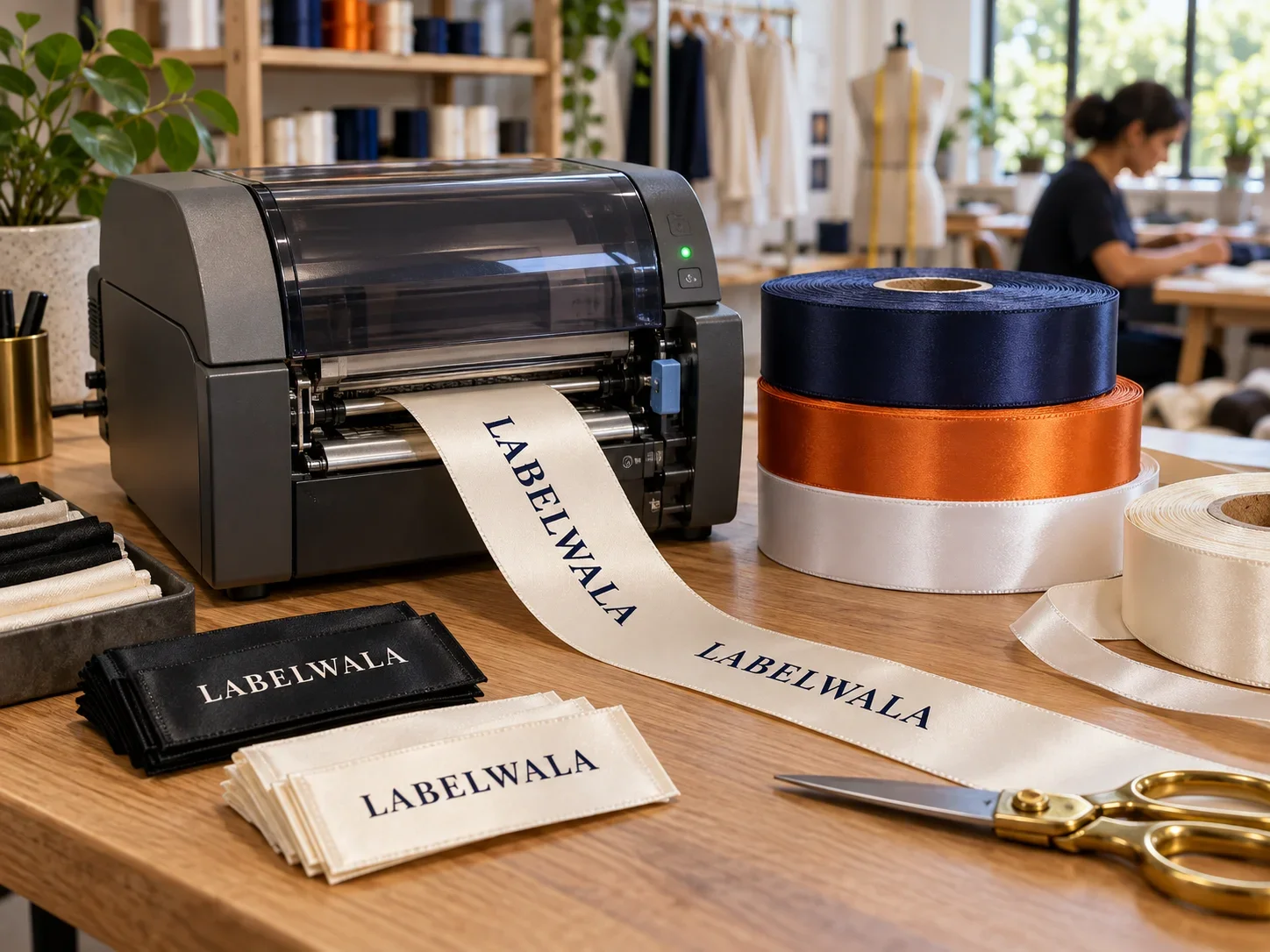
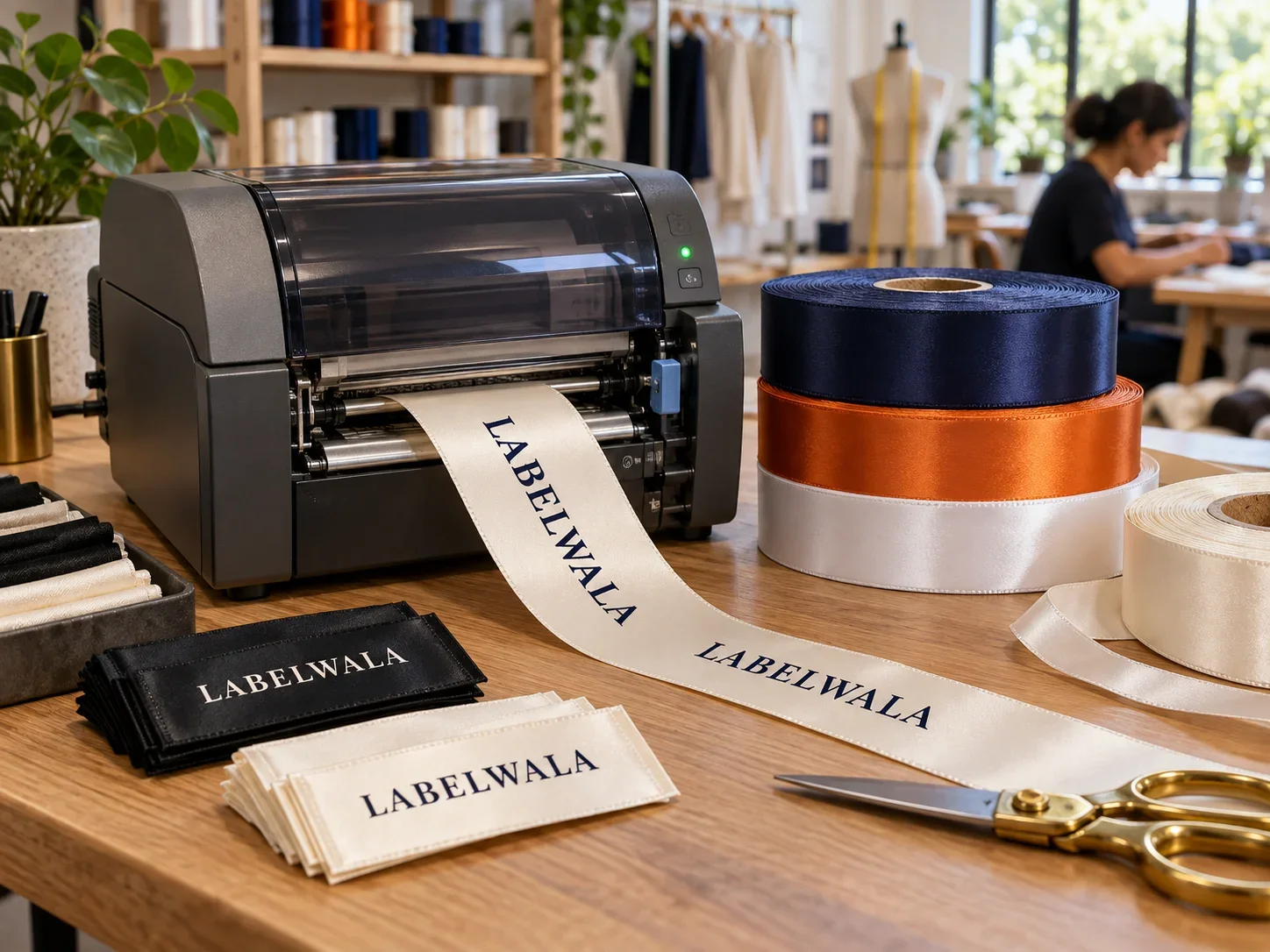
"Satin label" is a category, not a product. Two suppliers can both quote you satin and send back labels that differ in how the design was applied, whether the back is shiny, how much they gleam and how wide they can be. None of them is wrong. You just didn't specify.
There are four decisions hiding inside the word. Make them on purpose and you get the label you pictured; leave them to the factory and you get whatever is on the shelf.
Why is satin a weave and not a fibre?
This trips up almost every first-time buyer. Satin describes how the threads interlace, not what they're made of. In a satin weave, warp threads float over four or more weft threads before tying down, so most of the surface is uninterrupted thread: which is exactly why it feels smooth and catches light.
The fibre underneath is almost always polyester, chosen because it holds colour, survives washing and doesn't yellow. You'll occasionally be offered acetate satin, which feels softer and drapes better but handles heat and repeated laundering far worse. For garment labels, polyester is the right default. Compare it against the other woven bases in woven label materials explained.
Choice 1: printed satin or woven satin
This is the big one, and the two products behave completely differently.
- Design is ink applied to the ribbon surface
- Unlimited colours, gradients, even photographs
- Cheaper at low volumes, low minimums
- Durability depends entirely on ink and curing
- Design is woven into the ribbon: no ink at all
- Colour can't crack, rub or wash off
- Limited to a few thread colours, no gradients
- Reads as more premium; costs more to set up
When someone says "satin label" without qualifying it, they mean printed satin. That's the default quote you'll receive. If you want the design woven in, you have to ask for a woven satin label by name. The full comparison lives in satin vs woven labels.
Choice 2: single-face or double-face
Single-face satin is glossy on one side and noticeably duller on the reverse. Double-face is glossy on both. The price difference is small; the visual difference is not, and it only bites in specific situations.
The label is end-folded and stitched flat against the garment, so the reverse is never seen. This covers most neck and size labels.
The label is centre-folded, hangs as a loop, or floats loose at a hem. Anywhere the back can flip into view.
The classic mistake: ordering single-face for a centre-fold hem tag. The label looks perfect on the approval photo and dull-backed on the finished garment. Decide the fold style first, then the face.
Choice 3: high-gloss or semi-matte
Standard satin ribbon is high-gloss. It's bright, it catches light and it signals "fashion label" instantly. That's a look, and it isn't every brand's look.
Semi-matte satin, sometimes sold as peach-skin or soft-touch satin: keeps the smooth hand but softens the shine to a quiet lustre. Natural-toned, minimal and slow-fashion brands almost always prefer it, because full gloss can read as synthetic next to linen, khadi or undyed cotton.
Judge gloss on the garment, not on paper. A satin label that looks refined on a white desk can look plasticky against a textured natural fabric. Lay the sample on the actual cloth in daylight before you sign off.
Choice 4: what job the label does
The last split is functional, and it drives size, fold and often the printing method.
- Main / neck label: your brand mark. Usually the widest ribbon on the order, end-folded, and the one where gloss and face type matter most.
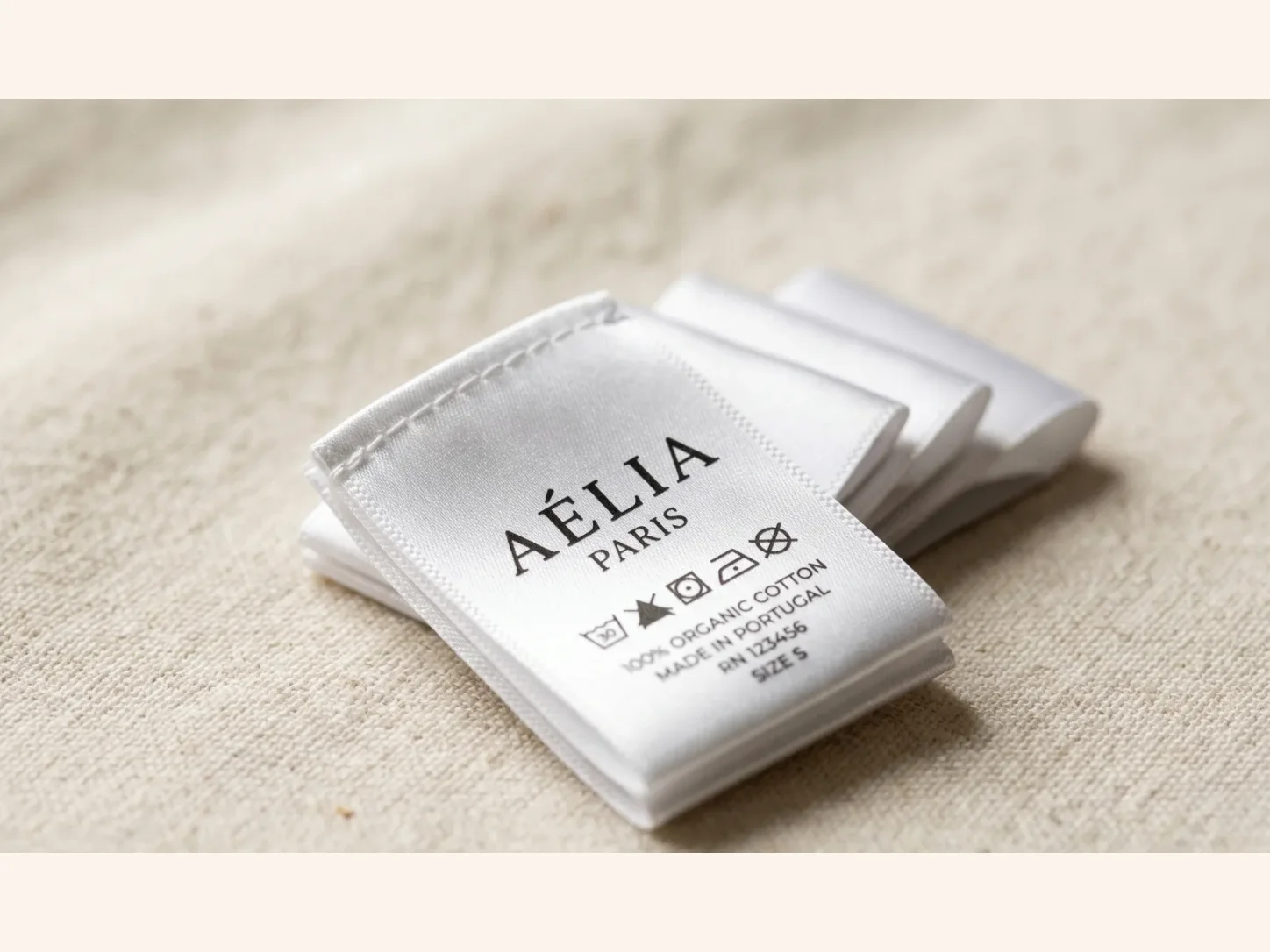
- Care label: wash symbols, fibre content, country of origin. Narrow, often thermal-transfer printed for crisp small type, and frequently double-sided to fit everything legally required.
- Size label: tiny, one or two characters, cheapest item on the order, but the one most often reordered mid-season.
- Hem tag: a small folded label at the hem or side seam. Centre-fold is common, so double-face earns its keep here.
- Hanging loop / ribbon tab: a satin loop stitched into the neckline. Both faces show, so double-face is effectively mandatory.
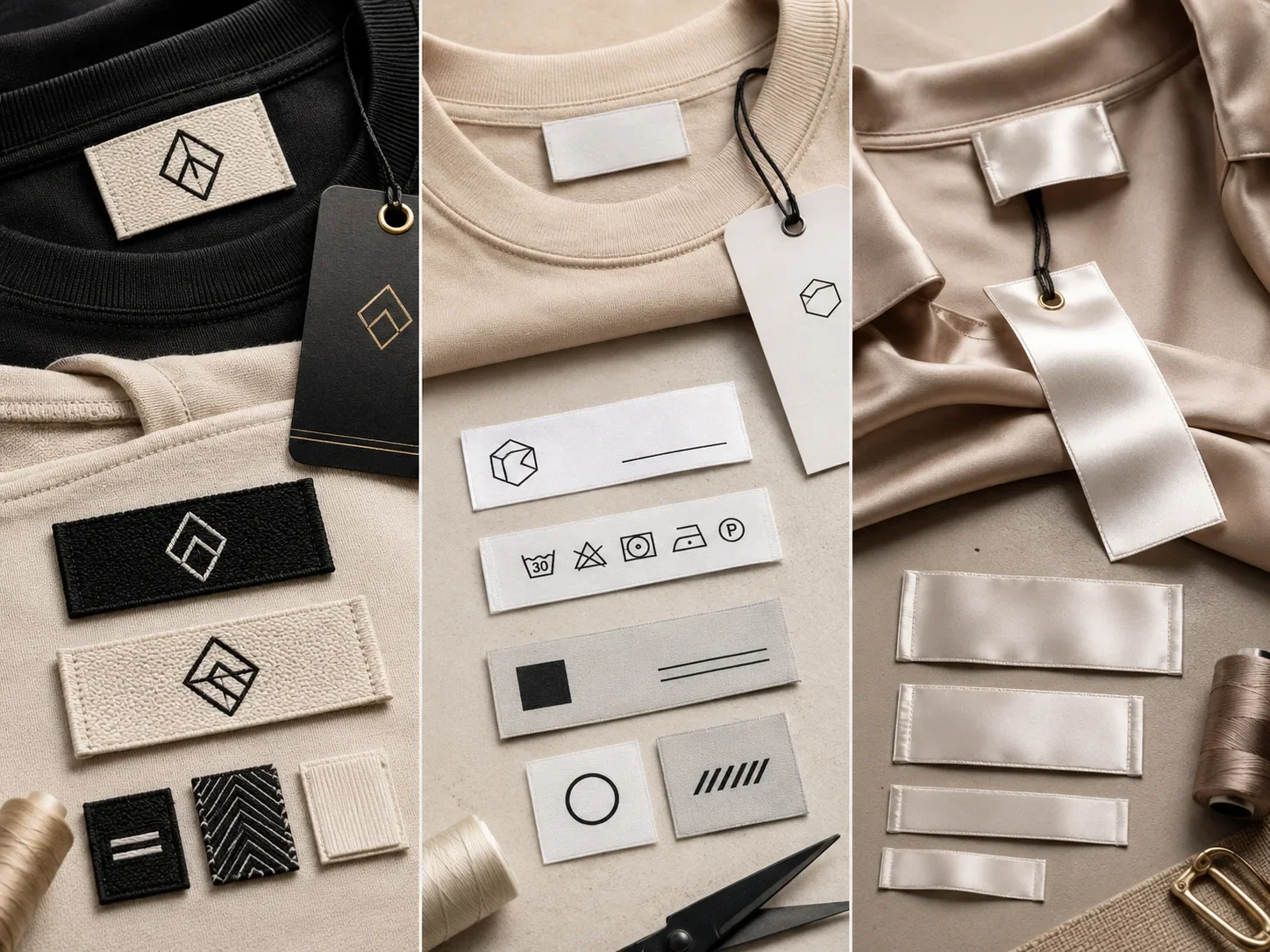
Most brands need three of these on a single garment. See the full label and tag checklist for what a complete set looks like.
What widths does satin ribbon come in?
Satin ribbon is stocked in fixed widths: roughly 10 mm up to 60 mm and beyond. Your label is cut from the nearest suitable roll, which means one dimension comes off a list and the other is free. That's why a supplier sometimes proposes shaving 2 mm off your design: it lets the job run on stock ribbon instead of a special weave, which saves you both time and money.
If your artwork genuinely needs an unusual width, say so early: sourcing non-standard ribbon adds days to the lead time. Sizes for every label type are collected in the label size guide.
How do the four choices combine in a real order?
Three combinations cover the vast majority of real orders.
Printed, single-face, high-gloss, end-fold. Colourful, cheap at low MOQ, looks sharp.
Printed, double-face, semi-matte, centre-fold. Suits natural fabrics and minimal branding.
Woven satin, end-fold. No ink to crack, for garments that get washed hard.
A narrow thermal-printed satin care label to carry the legally required information.
Nobody orders a "satin label". You order a printed, double-face, semi-matte, centre-folded satin label 40 mm wide, and that sentence is the difference between a sample you approve and one you argue about.
What is satin good at, and what is it not?
Before working through the choices it helps to be clear about what the material does well, because a decision inside satin cannot fix a case where satin was the wrong material to begin with.
Satin is the softest common label material. It is thin, light and smooth, and at a neck it is the least noticeable of the options. That is the reason most next-to-skin garments use it.
Satin carries fine print well. The surface is closed and even, so ink sits on top with sharp edges. Dense care text and small symbols stay legible at sizes where a coarser substrate would blur them.
Satin does not feel substantial. It never will, whatever you specify. If the brief wants physical presence in the hand, a dense woven damask is the answer and no combination of face, finish and fold will make satin do that job.
Satin shows a cut edge. Because it is polyester the edge is sealed as it is cut, which prevents fraying, and the sealed line is firmer than the ribbon around it. On a neck label that edge is what a wearer notices, which is why the fold matters as much as the material.
Keep those four in mind and the rest of this guide becomes a series of narrow choices inside a material you have already decided suits the garment, which is the right order to work in.
Getting that order wrong is the source of most disappointment with satin, because no amount of specification rescues a material chosen for the wrong reason.
Choice 5: how it is folded and finished
The four choices above decide the material. A fifth decides what actually arrives, and it is the one most often left out of an enquiry.
A satin label can be cut straight or folded, and the fold is dictated by how the garment is constructed rather than by how the label looks. A label meant to be caught in a seam is awkward to attach to a finished panel, and the reverse is equally true.
- Straight cut. A flat rectangle with sealed edges. Suits labels applied to a panel or stitched on all four sides.
- Centre fold. Folded in half, both raw ends caught into a seam. The standard for a neck label.
- End fold. Both short ends turned under, sewn at each end. Suits a hem tab or a side-seam label.
- Loop or hanging tab. Folded so the label stands away from the garment, which is where double-face earns its cost.
The fold also decides the flat size that has to be made, because the folded-under portion is still material. A centre-fold label finishing at fifteen millimetres deep was woven or printed at roughly twice that plus turnings. Quote the fold with the size, not after it.
How do you write the satin specification in one line?
Every choice above becomes a word in a single sentence, and a supplier who receives that sentence can quote without a conversation.
The order that works is print method, face, finish, size, fold. For example: a printed single-face semi-matte satin, fifty by fifteen millimetres finished, centre fold. Or: a woven double-face high-gloss satin, forty by twenty finished, loop.
- Print method decides how much detail and colour the label can carry.
- Face decides whether the back is finished, which only matters if the back is seen.
- Finish decides how the label catches light, and whether small text sitting on it stays readable.
- Size is always the finished size. Say so explicitly, because flat size and finished size differ on any folded label.
- Fold decides how it attaches, and therefore what the garment maker can do with it.
Missing any one of the five is what turns a quote into three days of emails. Sending all five is what gets a number back the same day.
Common mistakes
- Specifying satin when the brief actually wants physical substance, which satin does not provide.
- Paying for double face on a label that lies flat against the garment.
- Choosing high gloss behind small text, where the sheen fights legibility.
- Giving a flat size when the label is folded, or a finished size without saying which it is.
- Leaving the fold out of the enquiry and being requoted later.
- Approving colour from a screen. Satin ink is translucent, so the base ribbon shifts every colour above it.
- Assuming printed and woven satin are interchangeable. They carry detail very differently.
Getting satin labels made at Labelwala
25 years making woven and printed labels in Ahmedabad, Gujarat.
- Minimum order: 1,000 pieces per design.
- Quotes: usually within 2 hours on a working day.
- Production: 7-10 days once artwork is approved. Rush jobs run 3-5 days.
Send the five-part specification and the artwork. If any of the five is still open, say which, and we will tell you what it changes rather than guessing on your behalf.
We are rated 5.0 on Google from 27 reviews.
The short answer
Satin is a weave, usually polyester, and "satin label" hides four separate choices. Decide whether the design is printed (flexible, colourful, cheaper) or woven (no ink, more durable, more premium); whether the ribbon is single-face (glossy one side) or double-face (both, needed for centre-folds and loops); whether the finish is high-gloss or semi-matte; and which job the label does, since that sets size and fold. Ribbon widths come off a stock list, so expect small size suggestions from your supplier. Spell all four out in your enquiry and the sample comes back right the first time, or send us the garment details and we'll spec it with you.