In brief
Pet apparel and accessories need a reusable brand label, a prominent size label and a care label, soft where they touch the animal and durable under wear. Use soft printed satin or tagless prints on coats and bandanas, woven labels on collars and beds, stitch everything down on all four sides, and print measurements alongside the size letter.
Pet products are one of the fastest-growing consumer categories in India, and if you're building a brand of dog coats, bandanas, collars or beds, you'll quickly hit a labelling challenge that human fashion doesn't have. Pets chew and scratch, owners wash items constantly, and pet sizing varies enormously between breeds and body shapes.
That means pet labels have to be soft where they touch the animal, durable where they take abuse, securely attached everywhere, and crystal-clear on sizing. Here's how to get it right.
What labels do pet products need?
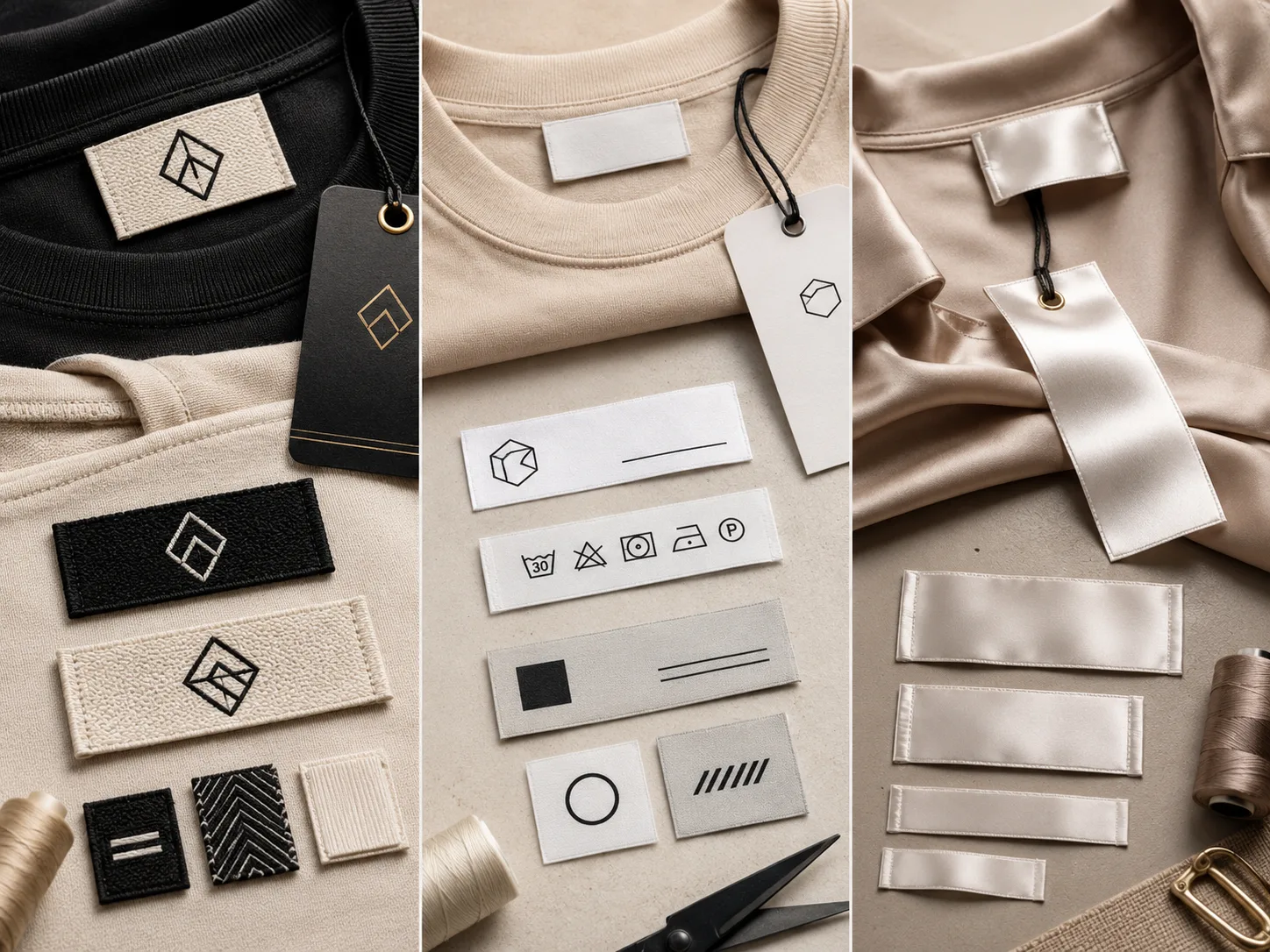
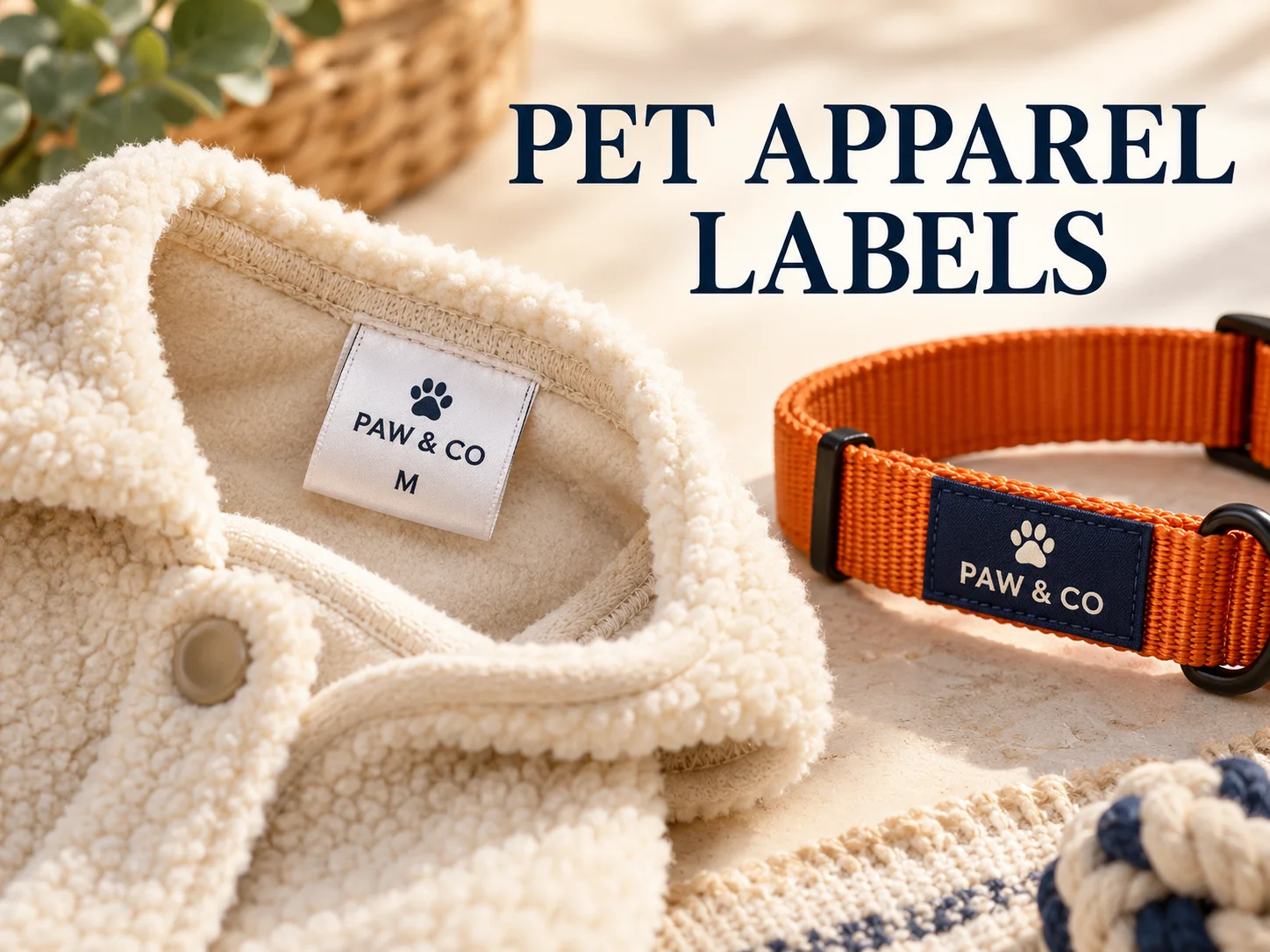
- Your logo, reusable across the range
- Woven for collars & beds
- Soft printed for apparel
- Pet sizing varies a lot. Make it clear
- Prominent, easy to read
- Reduces returns
Soft where it touches, durable where it takes wear
Soft printed satin or tagless prints. Flat and gentle against the pet, nothing to chew loose.
Durable woven labels, firmly stitched with sealed edges, they take heavy pulling and wear.
Woven labels that survive frequent, hot washing without fraying or fading.
No physical label at all. The safest choice for apparel a pet might chew.
No loose parts. Pets pull and swallow. Keep labels firmly stitched, flat, with no loose threads or small detachable parts. For apparel, tagless printing removes the risk entirely.
Why is sizing your biggest lever on returns?
Pet sizing varies far more than human clothing, a "medium" fits a beagle and a bulldog very differently. A clear, prominent size label plus a size-chart reference (on a hang tag or care card) helps owners buy the right fit the first time and cuts returns dramatically.
Add a size chart to a hang tag. Print the size on the label and a quick measurement guide on a hang tag or care card. Getting the fit right is the single biggest driver of happy pet-parent reviews.
Why do care instructions matter on pet products?
Pet items get washed a lot. A clear care label with wash temperature and drying guidance protects the product and reduces complaints, and fibre content plus country of origin are good practice. A friendly care card insert can add detail for the owner, just like human apparel.
Sourcing for a growing pet brand
Reuse one brand label across the range. Order your logo label in a larger run since it's used on every product, then add product-specific size and care labels per batch. This keeps per-piece cost low as you expand from apparel into collars, beds and accessories.
Why does safety come before branding?
This is the real difference between pet labelling and human labelling, and it changes the design brief rather than just the material choice. A person who finds a label irritating cuts it out. An animal chews it, swallows it, or gets a claw caught in it.
- Nothing loose, ever. A label attached along one edge with three free sides is a chew target. Stitch it down on all four sides wherever the animal can reach it.
- No protruding tags on collars and harnesses. A loop or a free end can catch on a crate, a fence or another dog’s tooth. Everything on a collar should sit flat against the webbing.
- No hard or sharp edges. A heat-cut synthetic edge that is merely firm against human skin can abrade an animal’s neck, where the same spot is rubbed constantly.
- Nothing small enough to swallow. If a label can be worked free, it becomes a choking or obstruction risk, which is a different order of consequence from a customer complaint.
- Bar-tack the ends on anything load-bearing. A collar label stitched with a single line of thread will work loose long before the webbing fails.
Because pets lick and chew the things they wear, ink and dye choice matters more than it does in apparel. Ask your supplier what the base and inks are tested to, and keep that documentation. It is the question a serious retailer will eventually ask you, and it is easier to answer if you asked it first.
The most common failure in this category is a soft printed label chosen for comfort and attached like an apparel label, sewn on one edge. On a dog coat that is a chew toy within a week. Comfort dictates the material; safety dictates the attachment.
Put measurements on the label, not just a letter
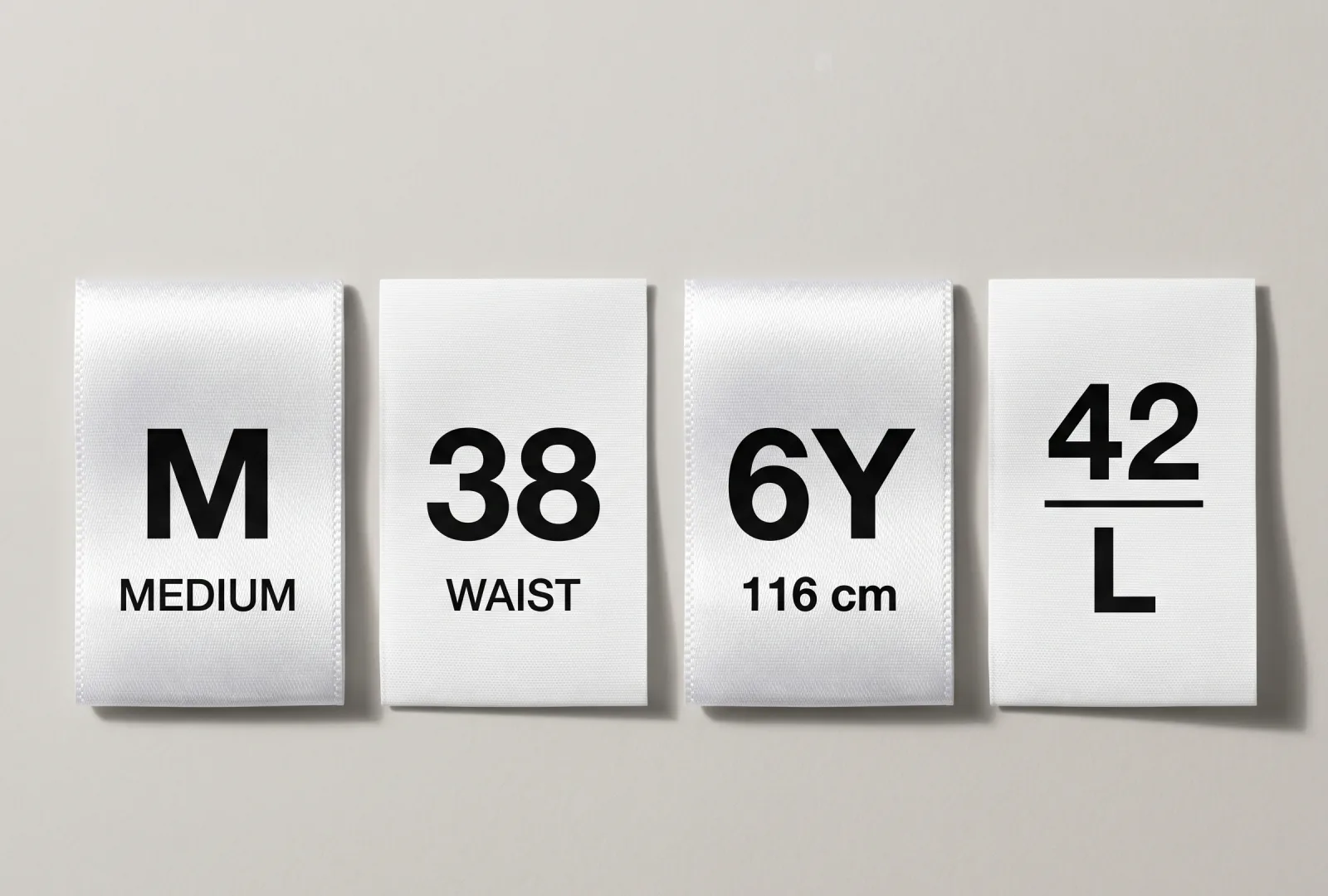
Knowing that sizing drives returns is one thing; deciding what the tab actually says is another, and this is where the label does its work. A size letter on its own asks the owner to guess, because it means nothing without a body to measure against.
The fix is to put measurements on the label not letters alone:
- Neck circumference for collars and harnesses, the only measurement that actually matters there.
- Chest or girth for coats and harnesses, which is what determines fit far more than length does.
- Back length for coats, measured neck to tail base.
- A size letter alongside, because owners still shop by S/M/L even when the measurement is what decides it.
That means a wider label than apparel needs. A tab carrying “M / Chest 45-55 cm” needs roughly 20 × 35 mm at a readable letter height, and a coat carrying two measurements needs more again. Do not shrink the type to fit, make the label bigger, because this is the information that prevents the return.
Back it with a size chart on the hang tag. The label confirms what the owner bought; the hang tag is what helps them choose correctly in the first place. Where a range spans very different body shapes, it is worth naming the breeds a size typically suits as well, since that is how most owners actually think about the question.
Why is washing harder than in apparel?
Pet products get washed more often, hotter, and with more aggressive intent than most clothing. Bedding in particular goes in hot to deal with hair, odour and occasional accidents, and it goes in frequently.
That pushes the specification towards woven rather than printed on anything that gets laundered hard, and towards a folded edge rather than a cut one so the label does not fray under repeated hot cycles. It also means the care instruction has to be honest about what the product can take, because an owner who cannot wash a dog bed at a temperature they consider hygienic will simply throw it away.
- Beds and mats: woven labels, folded edges, care symbols set to the highest temperature the product genuinely survives.
- Coats and apparel: soft printed satin, but attached securely, and check the print after several hot washes.
- Collars and harnesses: woven, and expect abrasion as well as washing.
- Bandanas: the closest to human apparel, but still washed often.
Wash a sample repeatedly before you commit to a bulk order, using the same detergent and temperature an owner would. Our wash testing guide covers how to run it, and this is a category where five cycles tells you far more than one.
Common mistakes
- Attaching a label on one edge where the animal can reach it.
- Using a letter size alone, with no measurements, and absorbing the returns.
- Shrinking size text to fit a tab that should have been wider.
- Specifying a printed label for a dog bed that gets washed hot every week.
- Leaving a heat-cut edge against an animal’s neck.
- Adding a decorative loop or tail to a collar label that can catch on something.
- Not asking what the inks and base are tested to on a product that gets chewed.
- Ordering a separate brand label per product type instead of one reusable design.
Getting pet labels made at Labelwala
We make woven and printed labels in Ahmedabad, Gujarat, and we have been doing it for 25 years. Pet brands usually order a set: one reusable brand label plus product-specific size and care labels.
- Minimum order: 1,000 pieces per design, which is why the reusable brand label across the range is the sensible structure.
- Quotes: usually within 2 hours on a working day.
- Production: 7-10 days once artwork is approved. Rush jobs run 3-5 days.
- Care symbols: set to ISO 3758.
- Delivery: across India, depending on destination and consignment size.
Tell us which products the label goes on and whether the animal can reach it. That single answer changes the material, the edge finish and the stitching instruction, and it matters more here than the artwork does.
Send the measurements you want on the size label as well as the artwork. Pet sizing is the part of the specification most likely to need a wider tab than a brand expects, and it is far cheaper to size the label correctly at quote stage than to discover at sampling that the chest range does not fit on it.
We are rated 5.0 on Google from 27 reviews. Ask for samples you can put through your own wash and hand to a dog before committing to a run.
Why do hang tags do the selling in pet retail?
In pet retail the hang tag carries more weight than in apparel, because the buyer is not the wearer. An owner cannot try the product on the animal in a shop, so every decision they make comes from what the tag tells them.
- Put the size chart on the tag, with the measurements spelled out and ideally a small diagram of where to measure. This is the single highest-value thing a pet hang tag can carry.
- Show the product in use if the format allows, an owner judging fit benefits more from a photograph than from a description.
- State the material plainly. Owners increasingly check what their animal will be wearing or lying on.
- Add care guidance, because pet products get washed far more often than the buyer expects at the point of purchase.
- Keep the fastener safe. A plastic barb left in the product is a swallowing hazard, so favour string that is obviously visible and easy to remove entirely.
That last point is specific to this category and worth taking seriously. A barb offcut left behind in a garment is untidy; left in a dog bed it is something the animal may find and eat. Where a fastener has to be cut off, choose one whose removal is obvious and complete.
The short answer
Pet apparel and accessories need soft, safe, durable labels with crystal-clear sizing. Use soft printed satin or tagless prints for apparel and bandanas that touch the pet, durable woven labels for collars, harnesses and beds that take heavy wear, and keep everything firmly stitched with no loose parts. Make the size label prominent and back it with a size chart on a hang tag. Sizing is your biggest lever on returns. Add clear care instructions for frequently-washed items. Send us your logo and product types for a soft sample set to test against your products.