In brief
Use woven satin or damask labels with the student's name and room number, stitched into the inside seam of every uniform, towel and bedsheet at intake. Size them 50×15mm for clothes and 30×10mm for socks and undergarments, because marker pen fades in 5 to 10 hot washes and iron-on stickers peel.
Every hostel warden in India has lived this scene: laundry day ends with a pile of unclaimed shirts, two students arguing over the same trouser, and someone's missing socks for the third time this month. The cause is structural: identical uniforms, shared laundry, no permanent identification. The fix is a stitched name label costing a rupee or two.
The 60-second answer
Use woven satin or damask labels with student name + room number, stitched into the inside seam of every uniform garment, towel and bedsheet. Sized 50×15mm for clothes, 30×10mm for socks. One label per garment. Do this at intake. Never let a fresher hand a single piece of clothing to laundry without a label.
Why do DIY name labels fail in a hostel laundry?
Home methods that work in a single-family wardrobe collapse in a 200-student common laundry. The wash cycles are harsher, the volumes are higher, and the visual sorting that works at home doesn't scale.
- Permanent marker, fades in 5-10 hot washes
- Iron-on heat-press stickers, peel by month two
- Sew-in cloth tags written by hand: uneven, illegible after a few washes
- Buttons or pins with name: lost in the wash, safety hazard for kids
- Stickers on garment tags. Wash off completely after one cycle
- Woven satin or damask labels, name woven into fabric
- Stitched into seam. Permanent, can't peel
- Pre-printed in bulk, uniform format across the hostel
- Survives 50+ wash cycles including hot wash and bleach
- Skin-safe even for children's underwear
Name only, number only, or both?
This is the most common question hostel wardens ask. Short answer: both, on the same label, with the room number first.
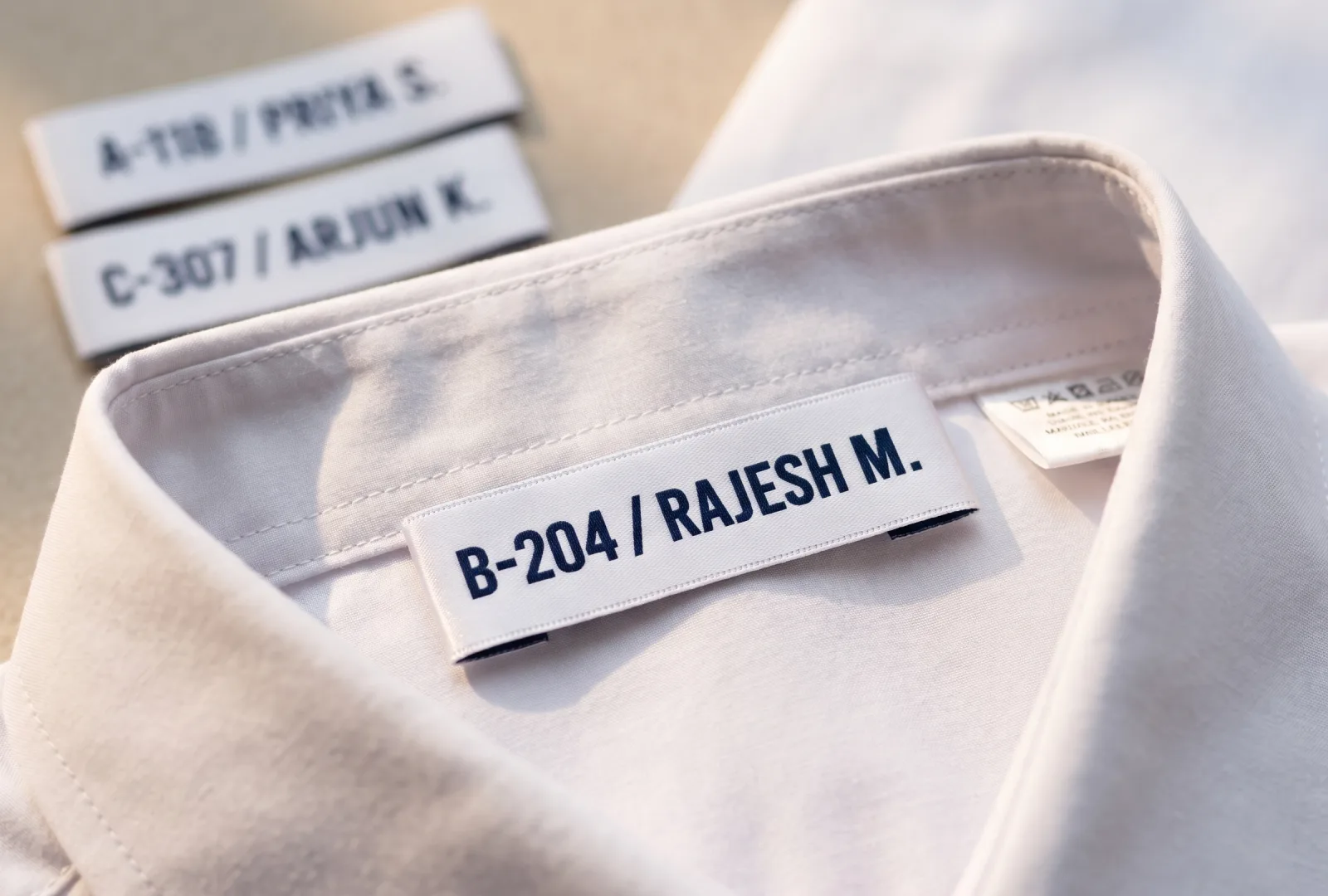
Why room number first? Laundry staff sort by glancing at numbers. It's faster than reading 200 different names. Once sorted into bins by room, names confirm any ambiguity. A typical label reads "B-204 / RAJESH M."block, room, name. Some college hostels prefer roll number ("CSE21042 / RAJESH M.") for academic continuity across rooms.
What size label for what garment?
One size doesn't fit all. The label must be visible enough to sort by but small enough to feel comfortable on skin contact.
- Shirts, kurtas, trousers, blazers, dresses: 50×15mm satin label, end-fold, inside neck or waistband seam.
- Towels, bedsheets, pillow covers, blankets: 60×20mm damask, inside corner hem. Larger because these get sorted from a distance.
- Socks, undergarments, vests, handkerchiefs: 30×10mm cotton tape with initials + room number only ("RM B-204"). Small enough to avoid skin chafe.
- Sports kit, jerseys: 50×15mm woven, inside hem. Use damask if the kit goes through extra wash cycles.
What does it cost per student?
At hostel volumes, the per-student cost is usually a small line item compared to the laundry chaos it prevents. Indicative pricing for a typical 10-12 label kit per student (woven satin, name + room number, mixed sizes):
Most hostels pool this into the academic intake fee, far simpler than 200 individual orders. At ₹50 per student × 300 students = ₹15,000 total. Compare against one semester of replaced socks, swapped uniforms and warden time spent mediating.
The roster workflow that works
The hostel admin team does this once per academic intake. After that, only re-orders for new joinees mid-year.
CSV with name + room number per student. Add roll number if relevant.
WhatsApp or email, 2-hour quote back with per-student price.
Per-name preview sheet sent for typo check before bulk runs.
Per-student envelopes arrive (handed out at intake, stitched in 2) 3 days.
Stitching: who does it?
Three options, in order of common-sense and cost:
- Hostel-engaged tailor, pay the local tailor ₹3-5 per garment to stitch labels for entire intake. Done in 3-5 days for a 200-student hostel.
- Students stitch their own. Give each student their envelope of pre-printed labels at intake. Most students need 2 hours total to stitch all 12 garments. Works for college hostels where students can stitch; less ideal for younger boarding-school kids.
- Parents stitch at home before intake: ship the labels to parents before the academic year starts; they stitch and pack. Adds a logistics step but spreads the work.
Recommended: hostel-engaged tailor option for boarding schools (Class 4-12). Self-stitching for college hostels (Year 1+).
Where exactly should the hostel label be stitched?
Inside, never outside. Laundry sorting works on the inside of the garment (where the existing care label sits), and outside placement looks unprofessional.
- Shirts & kurtas: inside back-neck seam (next to the existing brand label).
- Trousers & pyjamas: inside waistband seam, centre-back.
- Towels: inside short-edge hem, top-right corner.
- Bedsheets & pillow covers: inside top hem, centre or corner.
- Socks: inside ankle band, single label per pair (one of the two).
- Undergarments: inside waistband, soft cotton tape only.
What changes after labels are in
The compounding benefits:
- Laundry sort time drops 60-70%. A pre-labelled load sorts in minutes; an unlabelled one takes hours of guesswork.
- Lost-and-found bins shrink. Most "lost" clothes are misplaced: a label closes the loop.
- Roommate disputes nearly vanish. The label settles ownership instantly.
- Parent complaints drop. No more "my child lost three shirts this term."
- Replacement uniform spending falls. Hostels report 30-40% less midterm replacement.
Why do numbers age better than names on labels?
The name-or-number question looks like a preference and it is really a question about how long the labels have to last.
A named label belongs to a person. When that student leaves, the label leaves with them, and every intake needs a fresh order. A numbered label belongs to a roll number, which the hostel keeps. If numbers are reissued as students come and go, the labels stay in circulation and only the roster mapping changes.
That difference compounds. A hostel running a name-based system is buying labels every year. A hostel running numbers is buying labels once and updating a spreadsheet, with a small top-up order for growth. Over four or five intakes the gap is substantial.
- Both name and number works best for younger boarders, where staff need to identify an item without consulting a list.
- Number only suits older students and larger hostels, where the roster is the reference anyway and reuse matters more.
- Name only is the weakest option at scale, because names repeat and initials collide on a floor of a hundred.
- Keep spare unnamed numbers whichever route you take, for the students who arrive after the order was placed.
Whatever you choose, choose it once. Half a hostel labelled by name and half by number is worse than either, because the laundry has to work two systems at the same time.
Write the choice into the hostel handbook rather than leaving it as this year's practice. Wardens change, offices change, and a system that only exists in one person's working memory lapses the moment that person moves on.
One more detail worth settling in the same document: what the number actually refers to. A roll number that changes when a student moves year is not a stable identifier, and neither is a room number, because students move rooms. Pick something that stays fixed for the whole of a student's time in the hostel, and record the mapping centrally so the laundry never has to guess which list is current.
Who should administer hostel labels before you order?
The labels are the easy part. What decides whether a hostel labelling system survives past the first term is who owns it, and that question is usually settled by accident.
Someone has to hold the roster, issue the labels, chase the students who have not stitched them on, and update the list when people join or leave. If that responsibility is not assigned to a named person, it falls to whoever is standing near the laundry when something goes missing, which is not a system.
- One owner, named. Usually the warden or hostel office, not a rotating student committee.
- One roster file, held centrally, which is also the file sent for reordering. Numbers reconciled once a term.
- A fixed issue point. Labels handed over at admission with the rest of the kit, not distributed later by request.
- A stated deadline for attachment, with a check before the first laundry cycle. After that the rule is simple: unlabelled items are not the laundry's problem.
Hostels that do this find the labels last for years. Hostels that treat it as a one-off purchase find the system has quietly dissolved by the second intake, because nobody was responsible for keeping it alive.
How many labels do you need, including mid-term joiners?
Under-ordering is the commonest planning error, because people count uniforms and forget everything else that goes through the same wash.
Count the laundry, not the wardrobe. Uniform shirts and trousers, sports kit, a jumper or blazer, and then the items nobody remembers: bedsheets, pillowcases, towels. For a typical boarder that comes to somewhere between twenty five and forty pieces, and towels and sheets are the ones that go missing most, because they look identical across an entire floor.
- Order to the higher count. A student who runs out leaves unlabelled items in exactly the laundry the system was meant to fix.
- Add a surplus of number-only labels with no name, held by the office. Late admissions and transfers can be issued the same day.
- Order for the whole intake at once. Setup costs do not scale down, so ten separate small orders cost far more than one.
- Keep the roster file. A reorder from an existing approved list is quick; one that starts by rebuilding the list is not.
Why is institutional laundry the real test for labels?
A hostel wash is not a home wash, and that difference is why methods that work at home fail here.
Institutional laundry runs hot, runs long, uses stronger detergent and often bleach, and tumbles a heavy mixed load mechanically. Then it is pressed. Nothing in that sequence is gentle, and it repeats several times a week for years.
- Marker ink bleeds and greys within a term, and on dark fabric it was never readable to begin with.
- Iron-on labels lift at a corner and then peel, because the adhesive is what the heat and agitation attack first.
- Stickers do not belong in a wash at all.
- A stitched woven label has no adhesive to fail and no ink on the surface to wash off, because the name is built from thread.
That last point is the whole case. Everything else on the list is a surface treatment applied to cloth, and surface treatments come off. A woven name is part of the cloth, which is why it is still legible when the garment itself is worn out.
Common mistakes to avoid
- Ordering only at the start of the academic year. New joinees mid-year get left behind. Plan a small re-order every two months.
- Label too large. Above 60mm wide, satin labels feel scratchy on skin. Stick to 50×15mm for clothing.
- Number-only labels. If a student changes rooms next semester, all their labels are wrong. Always pair with name.
- Cheap printed-paper stickers. Bin them. They don't survive one wash.
- Skipping the per-name preview. Always check the preview sheet. Typos in names are the most common bulk-order mistake.
One-time expense, multi-year payoff. A label outlasts 2-3 garments. The student stitches once, the laundry team benefits every wash for years.
Ready to set this up?
If your hostel is dealing with laundry chaos, lost garments or roommate disputes, the fix is straightforward. Send us your student roster and we'll quote per student in 2 hours, send a per-name preview sheet, and ship per-student envelopes within 7-10 days. Read more on our hostel labels page or WhatsApp the team directly.