In brief
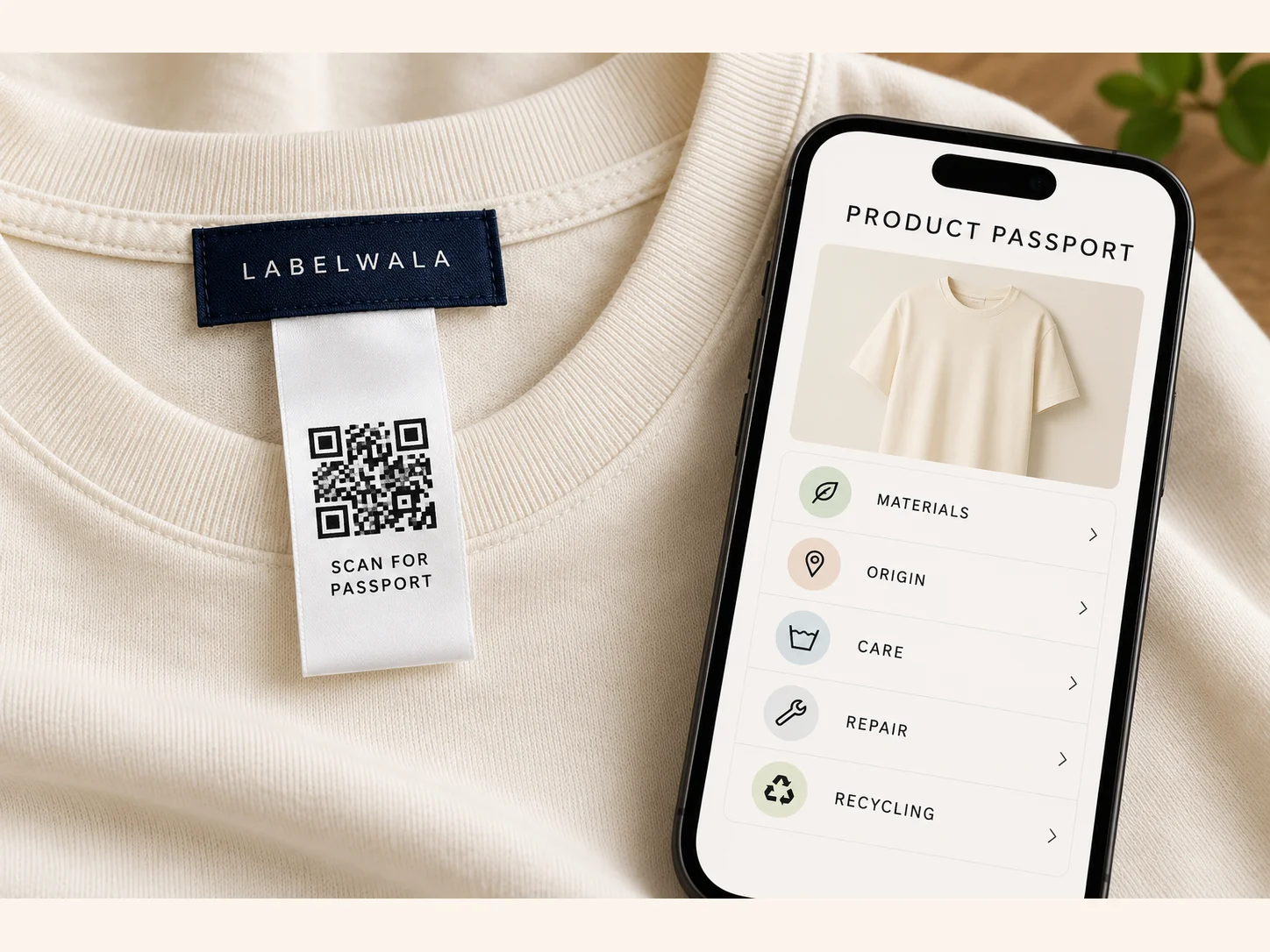
The EU's digital product passport (DPP) is a product-level record of materials, origin, chemicals, care, repair and recycling information, reached through a data carrier such as a QR code on the garment. Textiles are among the first product groups, with detailed rules expected to apply from around 2027 onward. For the label it means a permanently legible, scannable QR code on a printed care label or woven-with-printed combination, a unique identifier per product or batch, and a stable web address the brand controls. Start by collecting the data now, because the label is the easy part.
This is a planning article, not legal advice. The EU's ecodesign framework is in force, textiles are a named priority, and the detailed textile rules are being written as this is published. The dates and the exact data fields will be fixed by the textile-specific act, and anything an Indian exporter reads about the digital product passport in 2026 should be checked against the current text with their EU importer before money is spent. What is already clear is the shape of the thing, and the shape is enough to start preparing.
We make labels, so this guide concentrates on the part of the passport that touches our work: what changes on the physical label, how a QR code has to be made to survive a garment's life, and how the label connects to the record behind it. It also covers the data a brand should start collecting now, because a passport with nothing in it is just a QR code.
What a digital product passport is
A digital product passport is a structured record about one product, or one batch or model of it, held online and reached by scanning a data carrier on the product itself. The idea comes from the EU's Ecodesign for Sustainable Products Regulation (ESPR), which replaced the older ecodesign rules in 2024 and extends them from appliances to almost every physical product, with textiles among the first groups to get detailed rules.
The purpose is to make information travel with the garment: to the customer deciding whether to buy, to the repairer deciding how to fix it, to the sorter deciding how to recycle it, and to the market-surveillance authority deciding whether it is compliant. Today that information is scattered across supplier certificates, test reports and the brand's own files. The passport puts a pointer to all of it in the garment.
| Element | What it is | Who provides it |
|---|---|---|
| Data carrier | The scannable thing on the product: QR code, and possibly NFC or RFID | Label supplier prints it; brand specifies it |
| Unique identifier | A code that names this product, batch or model, also written in human-readable form | Brand or importer, following the identifier rules |
| The record | The data fields the textile act requires, held in a system the brand or a service provider runs | Brand, filled from supplier data |
| Registry entry | A central EU registry of identifiers so authorities can check a passport exists | Brand or importer |
| Access rules | Which fields the public sees, which are for repairers, recyclers and authorities | Set by the rules; implemented in the system |
The label is the first element in that table, and the only one that is physical. Everything else is data and systems.
Timing and who is responsible
The framework regulation applies now. Product-specific rules come through delegated acts, and textiles and apparel are in the first working plan, with the textile act expected to be adopted in the next year or so and obligations applying after a transition period, which puts the first real deadlines around 2027 and the phase-in running beyond it. Treat those as the current expectation rather than a fixed date.
Legally, the duty falls on the economic operator who places the garment on the EU market: the brand, or the importer. An Indian manufacturer or label supplier is not directly obliged. In practice, every EU buyer will push the data requirements down the chain, because they cannot fill a passport without the fibre certificates, process locations and chemical declarations that only their suppliers hold. Indian exporters who can supply that data cleanly will be easier to buy from than those who cannot, which is the practical reason to prepare.
Two more things are worth knowing. France already requires environmental information on textiles under its own law, so brands selling there have a head start. And the EU's textile labelling rules on fibre composition are being revised in parallel, which may change what the physical label has to say regardless of the passport. Our care label requirements guide tracks the current physical-label rules.
The data the passport is likely to hold
The exact field list for textiles will be set in the textile act. The categories are already visible from the framework and from the pilot passports brands have run, and they are the categories to start collecting against.
| Category | Likely content | Where an Indian exporter gets it |
|---|---|---|
| Identity | Brand, model, batch or item identifier, size, colour | Your own product data |
| Materials | Fibre composition by percentage, recycled content and its evidence, trims and their materials | Mill and trim supplier declarations; certificates such as GOTS or GRS transaction certificates where used |
| Origin and process | Country and ideally site of fibre, spinning, weaving or knitting, dyeing, sewing | Your supply chain records |
| Chemicals | Substances of concern, dye and finish declarations, test reports | Dyehouse declarations, OEKO-TEX or equivalent test reports |
| Durability and care | Care instructions, wash and colourfastness results, pilling and abrasion where tested | Lab reports; the care label content |
| Repair | Spare buttons, repair instructions, disassembly notes | Your design and production files |
| End of life | Recyclability, mono-material or blend, take-back or recycling route | Design choices plus recycler guidance |
| Compliance | Declaration of conformity, registry identifier | Brand or importer |
Most of this is information a well-run exporter already has in some form. The work is organising it per style, keeping it current, and being able to hand it over in a structured way. A spreadsheet per style is a fine place to start; a product information system is where it ends up.
What changes on the physical label
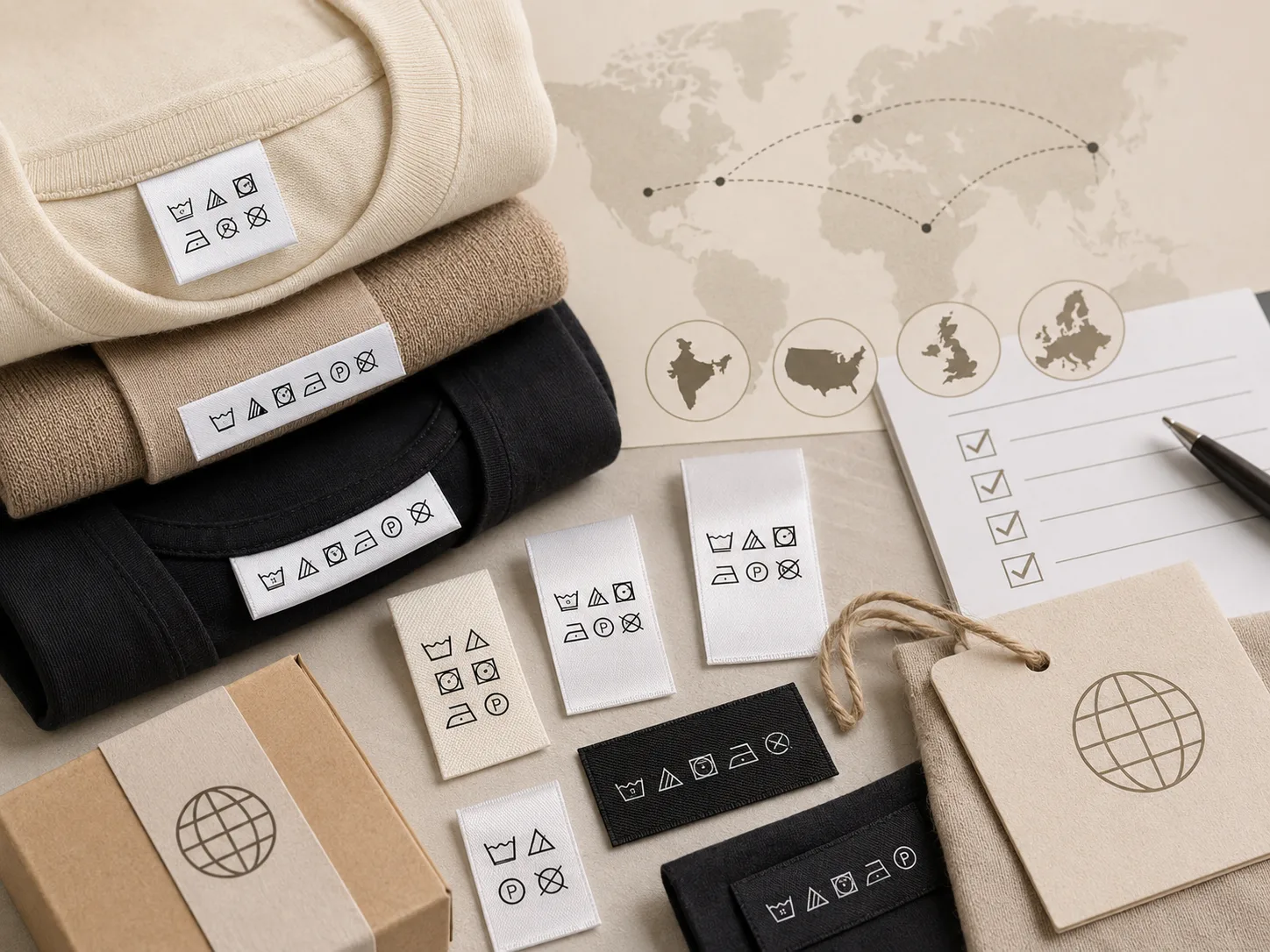
Less than people expect, and more than nothing. The passport does not remove anything from the label. The fibre composition, origin and other mandatory information still have to be printed in the required languages, because a customer in a shop has no obligation to scan anything. What the passport adds is the data carrier and the identifier.
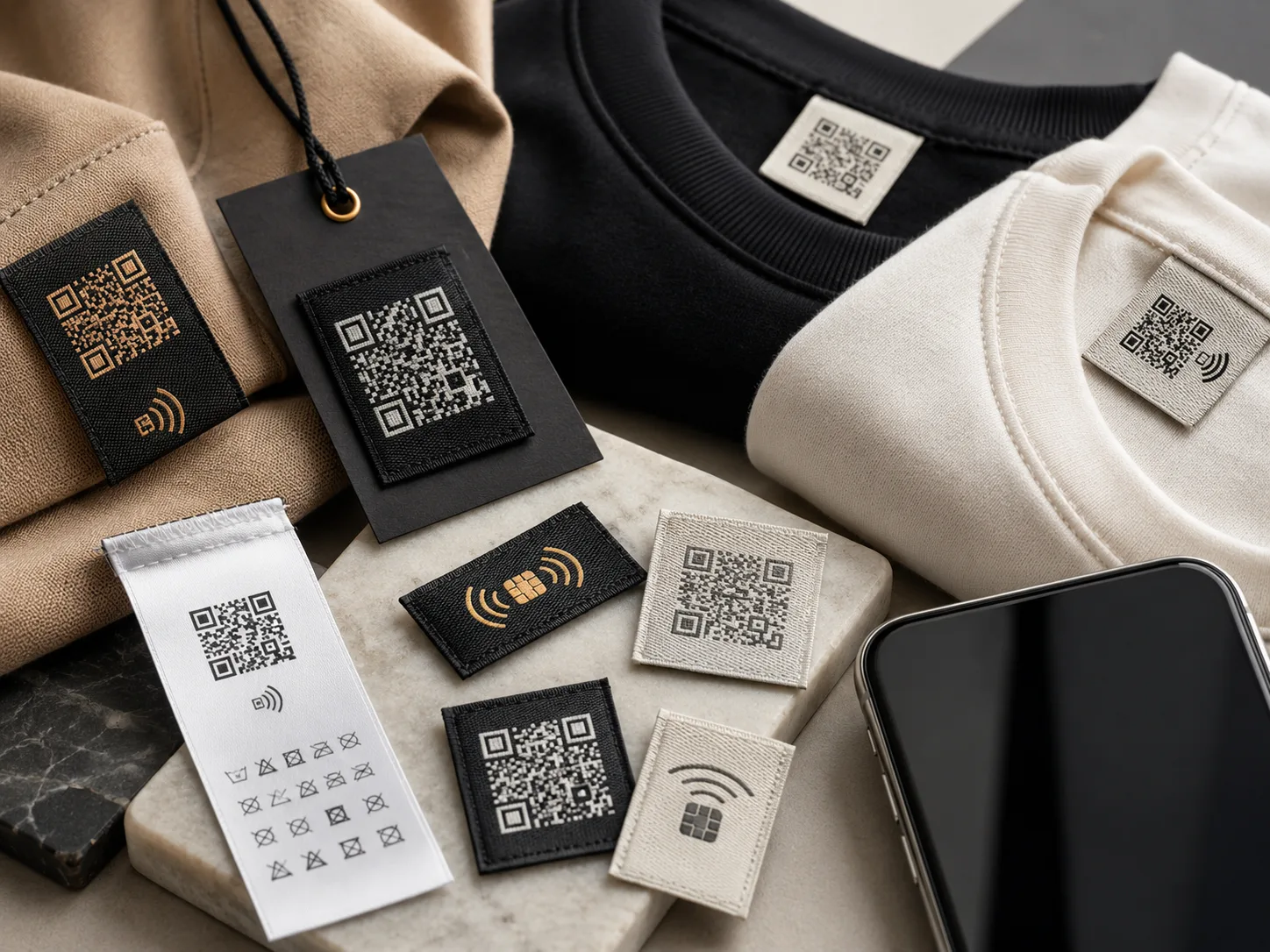
- A QR code that scans reliably for the life of the garment, which on a care label means printed, not woven, at a module size a phone camera can resolve.
- A human-readable identifier beside the code, so the passport can be found even if the code is damaged.
- Enough label area to hold both without shrinking the legal text. A care label that was 30 x 70 mm may need to become 35 x 90 mm, or gain a page.
- Durability matching the garment's life. A code that fades after twenty washes fails the purpose, which pushes the code onto polyester satin or taffeta where the print is fused into the fibre.
Brands with a woven neck label do not need to change it. The code goes on the printed care label, where fine detail is cheap, and the woven label carries on being the brand. Our QR and NFC label guide covers the general case; the passport is the version of it where the link is a legal requirement rather than a marketing idea.
Making a QR code that still scans in year five
A passport code has to work after years of washing, abrasion and folding, not just on the day it is sewn in. These are the rules that get it there.
| Factor | Specification | Why |
|---|---|---|
| Print, not weave | Printed on satin or taffeta | A woven module is several threads wide; a printed one can be a fraction of a millimetre |
| Code size | 15 mm square minimum for a short URL; 18 to 20 mm is comfortable | Phones struggle below about 0.5 mm per module; a short URL keeps the module count low |
| Quiet zone | Clear margin of at least 4 modules, around 2 to 3 mm, on all sides | Artwork or text crowding the code defeats the scan even when the code itself is perfect |
| Contrast | Black code on a white or near-white ground | Reversed or coloured codes scan poorly, especially after fading |
| Error correction | Level M or Q | Lets the code survive a scuff or a stitch hole; H costs too many modules |
| Placement | On a flat face, never across a fold or a seam stitch | A creased code presents half of itself at an angle |
| Substrate | Polyester satin or taffeta, dye fused into the fibre | Survives domestic washing; surface prints on cotton fade |
| Testing | Scan the physical sample after at least five washes, in ordinary light, with two or three phones | Scanning the artwork on a screen proves nothing |
The short URL matters more than people realise. A QR code encoding a 25-character address has far fewer modules than one encoding a 90-character link with tracking parameters, and fewer modules means each one is bigger at the same code size. Put the short, stable address in the code and let a redirect carry it to the long one.
The code is only as permanent as the link behind it. A garment lasts years and a URL frequently does not. Point the code at a domain you control, keep a redirect behind it so the destination can move, and never use a third-party shortener for a passport. If the shortener closes, every garment you ever shipped loses its passport on the same day.
Static or unique codes
The passport may be at model, batch or item level depending on the final rules and the brand's choice. That decision changes how the label is produced.
- Model-level (one code per style): a static QR code printed on every care label for that style. Ordinary printed-label production, lowest cost, and enough for a passport that describes the product as designed.
- Batch-level (one code per production lot): a different code per order or per dye lot. Still mostly static printing, but the label order changes with every production run.
- Item-level (one code per garment): variable-data printing, a serialised identifier on every label, and a system that can resolve each one. This is what authentication, resale history and per-garment repair records need, and it costs more per label and more in systems.
Most brands will start at model level, which the care label can carry today, and add item-level codes for premium or high-return lines where the extra data pays for itself. If you think you may go to item level later, choose a label size now that leaves room for a longer identifier.
What Indian exporters should do in 2026
The physical label is a few weeks of work when the time comes. The data is months. Start with the data.
- Ask your EU buyers what they expect. Many large brands have already run passport pilots and have a supplier data template. Getting it early tells you which fields matter to them.
- Build a per-style record. One sheet per style with fibre composition, recycled content and its certificate, each process step with country and site, dye and finish declarations, test reports, care instructions, repair notes and the recycling route.
- Collect the certificates. Transaction certificates for organic or recycled content, test reports for chemicals and colourfastness, dyehouse declarations. File them against the style, not in an inbox.
- Decide your identifier scheme. Style code, batch, and whether you will ever serialise. Make it stable; identifiers printed on labels cannot be renamed later.
- Secure the web address. A short path on a domain you own, with a redirect you control, before the first code is printed.
- Redesign the care label to hold a QR code and identifier at a scannable size without shrinking the legal text. Sample it, wash it, scan it.
- Choose a passport platform or build one. Several service providers host passport records; a brand with a product information system may do it in-house. The label does not care which.
The brands that did this early for France's environmental labelling found the hard part was step two, and the label was almost an afterthought. Expect the same here.
The passport and sustainability claims
A passport makes claims checkable, which is both its purpose and its risk. A garment whose passport says "recycled polyester" needs the certificate behind it; one that says "organic cotton" needs the transaction certificate; one that says "azo-free" needs the dye declaration. The passport is where a vague marketing claim becomes a specific statement a regulator can read.
The same discipline our sustainable labels guide recommends for the printed label applies tenfold here: name the certification, keep the qualifier, hold the paperwork, and never upgrade a supply-chain fact into a claim about yourself. A passport full of accurate, modest information is worth more than one full of adjectives.
Getting passport-ready labels made at Labelwala
We make woven and printed labels in Ahmedabad, Gujarat, and we have been doing it for 25 years. We print static QR codes on satin and taffeta care labels today, and we scan-test the physical sample before any production run.
- Minimum order: 1,000 pieces per design.
- Quotes: we usually reply within 2 hours on a working day.
- Production: 7-10 days once artwork is approved. Rush jobs run 3-5 days.
- Care symbols: set to ISO 3758 alongside the code.
- Materials: printed polyester satin and taffeta for the code, woven damask for the brand label beside it.
- Delivery: across India and worldwide for export.
Send the destination address and the finished label size together. The code has a minimum readable size, and it is the label that has to accommodate it rather than the other way round. If you are not sure how much room the legal text needs in your export languages, our multilingual care label guide covers that, and we will lay the code and the text out together on the proof.
We are rated 5.0 on Google from 27 reviews.
Common mistakes
- Waiting for the final textile act before collecting any data.
- Weaving the QR code into the neck label.
- Shrinking the code to fit the old care label instead of growing the label.
- A long tracking URL in the code, so the modules are too small to scan.
- Artwork or text inside the quiet zone.
- Pointing the code at a third-party shortener or an agency's domain.
- Testing the scan on screen rather than on a washed sample.
- An identifier scheme that has to change after the first labels are printed.
- Claims in the passport without the certificate behind them.
- Treating the passport as a marketing page rather than a product record.
Readiness checklist
- EU buyers asked for their supplier data template.
- Per-style record started, with every process step located.
- Certificates and test reports filed against each style.
- Identifier scheme decided and documented.
- Short, stable address on your own domain with a redirect behind it.
- Care label redesigned for a 15 to 20 mm code with a quiet zone, legal text unchanged in size.
- Physical sample scanned after five washes with more than one phone.
- Passport platform chosen or in-house system scoped.
- Someone named as the owner of keeping the record current.
What we would recommend
Do not wait for the final date. In 2026, build the per-style data record and collect the certificates; that is the slow part and it is useful whether or not the passport arrives on schedule, because your EU buyers will ask for it anyway. Secure a short web address you control with a redirect behind it. Then redesign the care label as a printed satin or taffeta label with a 15 to 20 mm QR code, a human-readable identifier and the legal text at full size, keep the woven brand label as it is, and scan the washed sample before you commit to bulk.
The label is the visible part of the passport and the easiest to get right. Get the data behind it right too and the code on your care label will still open something worth reading in 2032.