
In brief
Woven wins on detail: a loom thread is far thinner than an embroidery stitch, so woven holds small text, thin lines and intricate logos, while embroidery needs letters around 5 mm high to stay legible. Use woven inside the garment for neck, size and care labels, and embroidered on the outside for chest, sleeve, cap or bag badges.
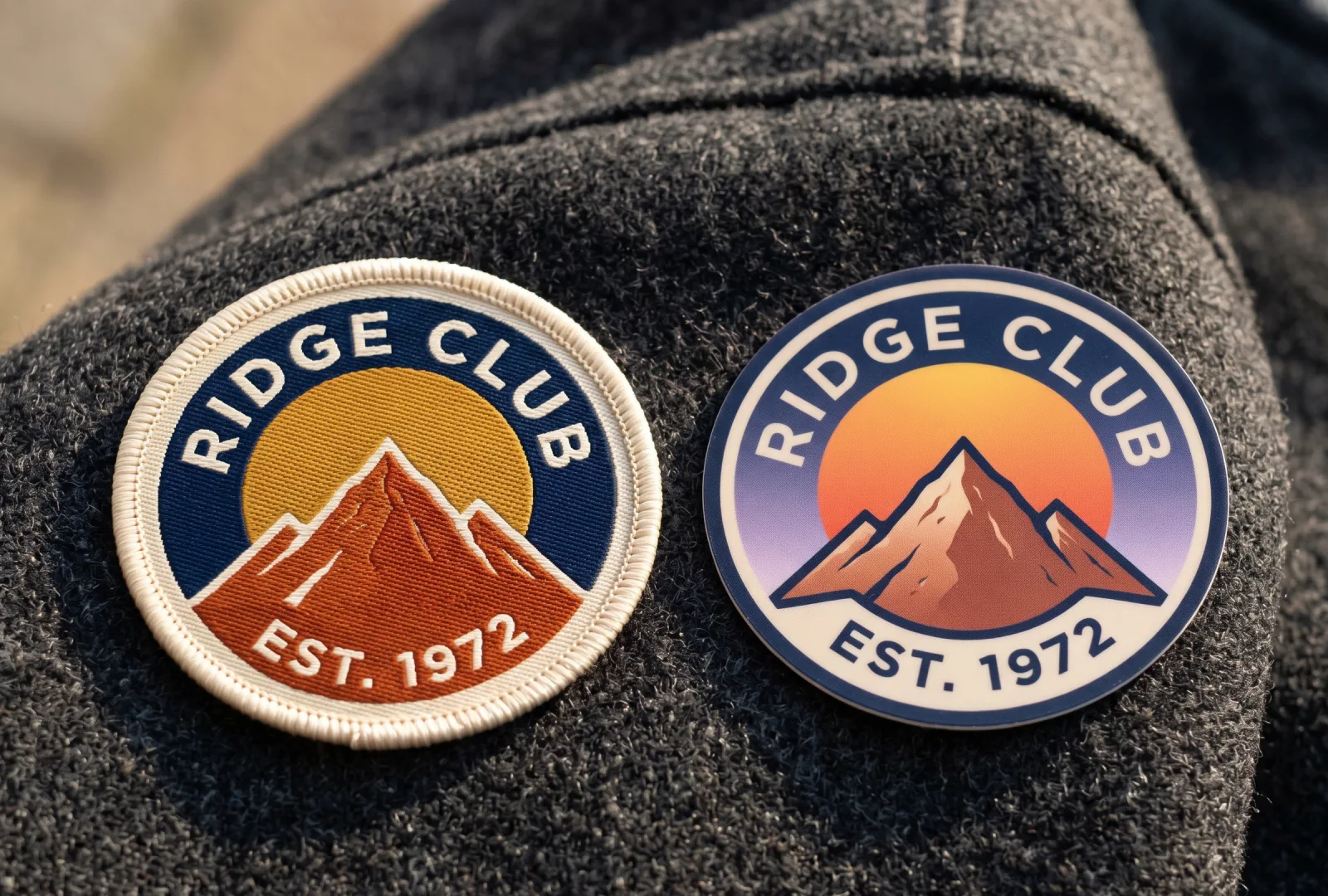
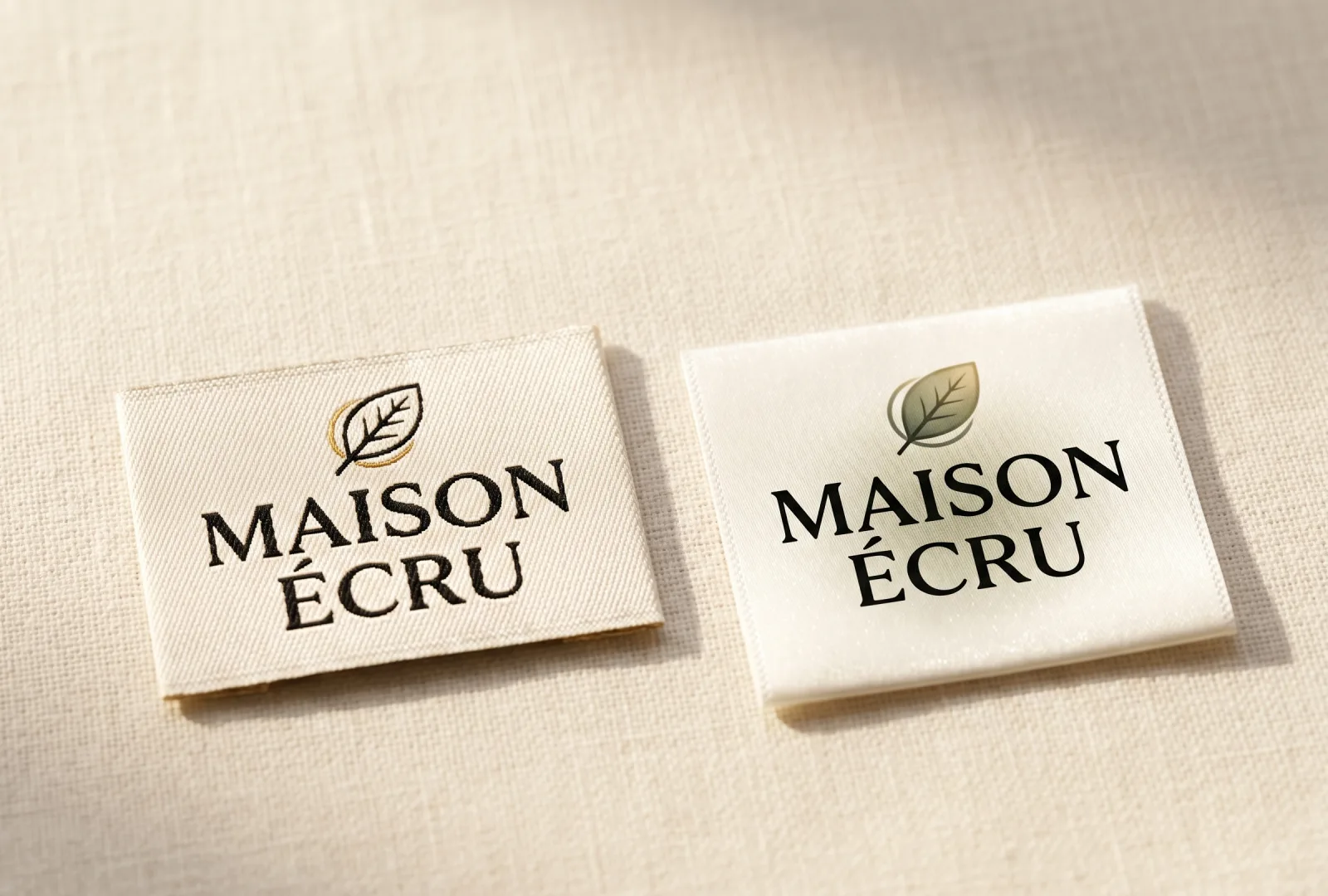
Two labels can carry the same logo and still be completely different objects. One is woven: the design built on a loom from fine coloured threads, ending up thin and flat. The other is embroidered, thread stitched onto a base fabric, sitting raised and textured on top.
That single difference in how they're made decides everything else: how much detail they hold, how they feel, what they cost, and where each one belongs. Get it right and both look fantastic. Get it wrong and you'll feel it, literally, on the back of your neck.
The one-line difference
Before the detail, the summary that settles most decisions:
Built on a loom from thin threads. Thin, flat, smooth, and capable of very fine detail. The default for anything inside the garment.
Thread stitched onto fabric. Raised, textured, bold, with a crafted feel. The default for a badge on the outside of the garment.
How is each one actually made?
The manufacturing route is worth understanding, because it explains every trade-off that follows.
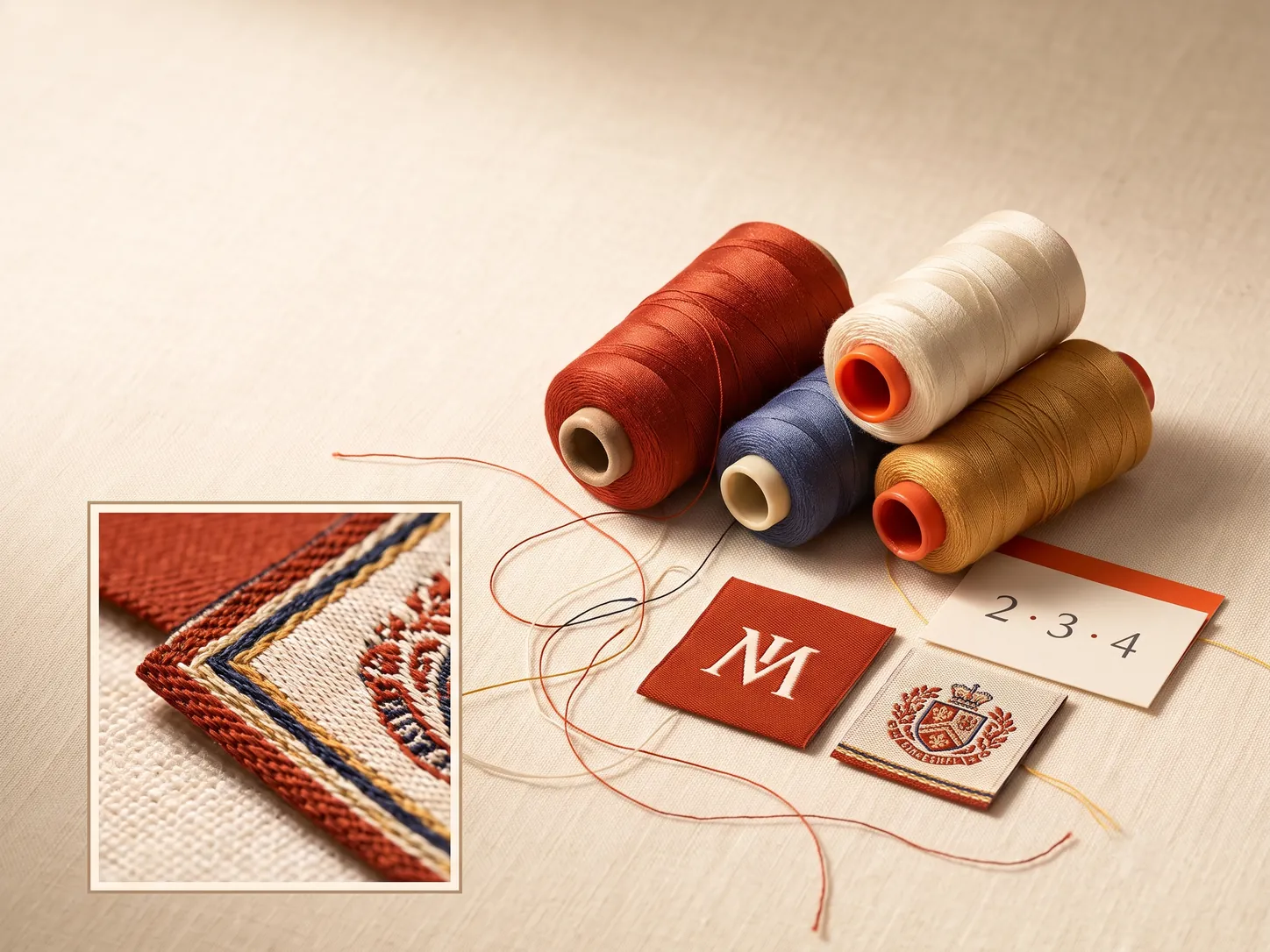
Woven labels are made on a narrow-fabric loom. Coloured threads are interlaced (warp running one way, weft the other), and the logo emerges as the fabric, not on top of it. Because loom threads are extremely fine, a woven label can render tiny type and delicate lines. The finest weave, damask, packs threads even tighter for near-print sharpness.
Embroidered labels and patches start with a base cloth, usually twill or felt, and a machine stitches the design onto it with thread. The stitches build up a raised surface you can feel. It's the same craft as a monogram on a shirt pocket, scaled to a badge.
Which holds detail and small text better?
This is the least ambiguous point in the whole comparison. A loom thread is far thinner than an embroidery stitch, so woven holds detail embroidery can't touch.
Got small text or a delicate logo? Embroidery will close it up or blur it. Care instructions, size codes and long brand names all need woven or printed, never embroidery.
How do hand-feel and thickness differ?
Pick both up and the difference is instant. Woven is thin and pliable, sitting almost flush with the garment. Embroidery is thick and raised, with a knotted underside where the stitches finish.
For anything worn against skin (a neck label, an inside-waistband label), thin and smooth is what you want. For a badge that's meant to be seen and touched, the raised texture of embroidery is a feature, adding a tactile, premium quality.
Don't use an embroidered patch as an inside-neck label. The raised stitches and knotted back rub against skin all day. Keep embroidery on the outside as a badge; use a soft woven or tagless print inside the neck.
Which is more durable in the wash?
Both are durable, but they're tough in different ways.
- Woven keeps fine detail crisp wash after wash, because the colour is the material itself rather than a layer on top. Ideal for an internal label washed constantly.
- Embroidered is extremely abrasion-resistant: the standard for outerwear, workwear and bags that take rough handling. Its one weak point is loose or catching threads at the edges if the finish is cheap.
Judge an embroidered patch by its edge. A proper merrowed (overlocked) border or a clean laser-cut edge is what stops threads unravelling. A raw or loosely finished edge is where a patch fails first.
How do cost and minimums compare?
The pricing logic is different for each, which is why "which is cheaper" has no single answer.
Mostly size and number of colours. A small neck label at volume is very economical. Each extra thread colour adds a little.
Mostly stitch count. A dense or large design uses more thread and machine time, so it costs more. Reads as the premium option.
As a rule of thumb: for small internal labels, woven is cheaper. For larger decorative badges, the two get closer, and embroidery earns its price with a crafted, heritage look. Both carry a minimum order, see label MOQs explained for why, and how to work around a small first run.
Where each one wins
- It's a neck, size or care label inside the garment
- Your logo has fine detail or small text
- You want a thin, smooth feel against skin
- You're ordering in volume and want it economical
- You need sharp, legible small lettering
- It's a badge on the outside: chest, sleeve, cap or bag
- You want a raised, tactile, heritage texture
- The design is bold and simple, not fine
- It'll take rough handling on outerwear or workwear
- You want a crafted, premium statement piece
The best brands rarely choose one. A woven label inside the neck, an embroidered patch on the outside: each material doing the job it's actually good at.
How to judge both from a sample
Both of these are tactile products, and neither can be assessed from a photograph. Half an hour with physical samples settles most arguments, and there are four things worth doing with them.
- Put it against skin, on a body. A label held in the hand tells you almost nothing about how it feels under a collar. Thickness that is imperceptible on a table is obvious on a neck.
- Read the smallest element at arm's length. Not up close. If a size or a word of small text is not legible at normal reading distance now, it will not improve with washing.
- Tilt it under a lamp. Embroidery changes colour as the stitch angle turns, which is attractive on a patch and distracting behind text.
- Feel the edge. On both methods the edge is what a wearer notices, and it is firmer than the cloth around it.
Do it with your own logo rather than a supplier sample card. A sample is chosen to flatter the method, and how each one handles your mark is the only test that matters.
Ask for the sample on the backing you will actually use as well. An embroidered patch on a firm twill and the same design on a soft knit behave differently, because the stitching pulls at whatever it is sewn into, and a lightweight base can pucker under dense stitch work.
Keep the approved sample once you have one. It is the reference every later batch gets judged against, and it carries colour, hand and finish together in a way no code or photograph does.
Judge every later batch against that original rather than against the batch before it, which lets small differences accumulate a step at a time until two seasons no longer match.
Inside the garment or on the outside of it
The most useful way to choose between these two is not to compare them directly. It is to ask where the label goes, because the position decides the method almost on its own.
Inside the garment, the label is felt. A neck label sits against skin, so thickness, edge and softness matter more than anything visual, and it also has to carry a size and often small text. Every one of those requirements points at woven.
Outside the garment, the label is seen. A chest badge, a sleeve patch or a cap front is looked at from a distance and never touched. Raised texture reads as substance there, and the thickness that would be a fault at a neck becomes the whole appeal.
Framed that way the comparison mostly dissolves. Established brands generally run both: woven inside for legibility and comfort, embroidered outside where visible texture does the work. The mistake is choosing one method for the whole garment and then living with it in the position it suits least.
What does each one do to your logo?
Neither method reproduces artwork exactly, and they distort it in opposite directions. Knowing which one you are asking for changes how the logo should be prepared.
- Embroidery simplifies. Stitches have a minimum length, so fine strokes thicken, small counters fill, and anything intricate resolves into a bolder version of itself. A mark with heavy, confident shapes survives this well; a delicate one does not.
- Weaving preserves. The image is built into the cloth structure, so detail can go down to the level of individual threads. Fine serifs, thin rules and small type hold, which is why care and size information can live on a woven label at all.
- Embroidery adds direction. Stitch angle catches light, so the same colour looks different across a curve. That sheen is attractive and it is not something you control precisely.
- Weaving is flat and even. Colour reads the same across the label, which is what you want behind small text.
If your mark relies on fine detail, weaving is not merely the better choice, it is the only one that keeps the mark recognisable. If your mark is bold and simple, embroidery gives it a physical presence weaving cannot match.
Common mistakes
- Putting an embroidered label at a neck, where its thickness is felt on every wear.
- Asking embroidery to hold small text, composition or care symbols.
- Sending a delicate, fine-lined logo to be embroidered without simplifying it first.
- Comparing prices without comparing sizes, since embroidery is priced by stitch count and area.
- Choosing embroidery for perceived quality on a garment where nobody will ever see it.
- Approving either from a screen. Both are tactile, and a photograph shows neither the hand nor the sheen.
- Assuming one method must serve the whole garment.
Ordering either from Labelwala
Labelwala has been making woven and printed labels in Ahmedabad, Gujarat, for 25 years.
- Minimum order: 1,000 pieces per design.
- Production: 7-10 days from artwork approval, or 3-5 days on a rush job.
- Delivery: across India, depending on destination and consignment size.
Tell us where the label sits and how big it is, and send the logo. Position rules out one of the two more often than not, and size decides whether your detail can survive embroidery at all. If the mark is going in both places, send it once and we will show you what each method does to it.
We are rated 5.0 on Google from 27 reviews.
The short answer
Woven and embroidered start from the same logo and end up as very different objects. Woven is thin, smooth and detailed: the right call for any label inside the garment, especially small ones with fine text. Embroidered is raised, textured and robust, the right call for a badge on the outside, where you want it seen and felt. Detail and hand-feel favour woven for internal labels; texture and a crafted look favour embroidery for external badges. If you're unsure, send us your logo and where it's going, and we'll tell you which one holds up, and sample it before bulk.