In brief
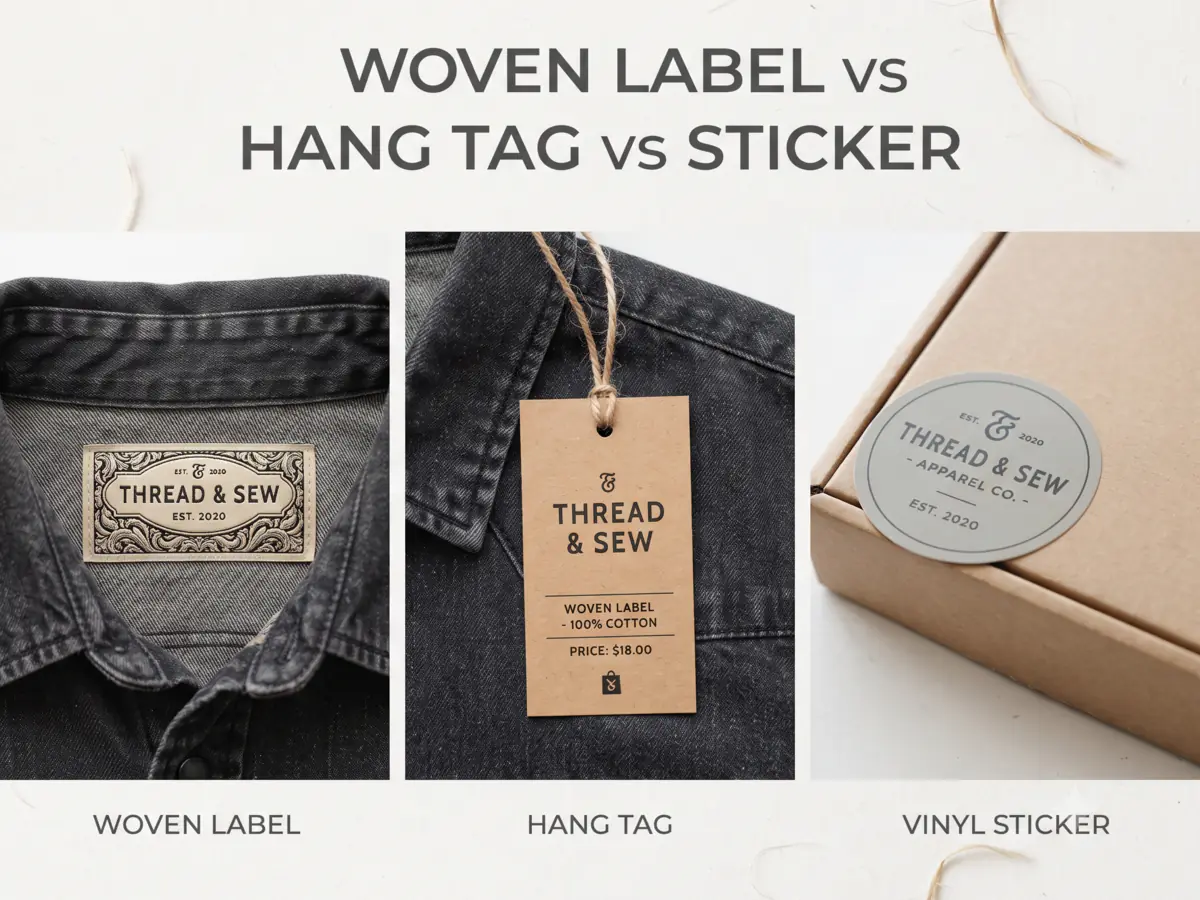
The sewn-in label is permanent, sits inside the garment at the neck or waistband and carries brand, size, fibre and care information for the wearer. The hang tag hangs outside on a string or pin with price and barcode for the shopper and is removed after purchase, while the sticker is adhesive and belongs on packaging and polybags.
New brand owners often use "label", "tag" and "sticker" as if they mean the same thing. They don't, and mixing them up leads to ordering the wrong thing, or missing a piece your product needs. The good news: once you see what each one is for, the choice becomes obvious.
Here's the simple mental model: the label is permanent and lives inside the garment for the wearer. The hang tag is temporary and hangs outside for the shopper. The sticker is for the packaging. Let's break each one down.
What is the one-line difference between the three?
- Sewn or heat-pressed in, permanent
- Inside the garment, for the wearer
- Brand, size, fibre & wash care
- String or pin, removed after buying
- Outside the garment, for the shopper
- Logo, price, barcode & brand story
- Adhesive, peeled off
- On packaging, polybags & size dots
- Sealing, size marking & unboxing
- Survive the wash on fabric
- Replace legally-required care info
- Act as a permanent brand mark
What does the sewn-in label do for the wearer?
The sewn-in label is the one piece every garment must have. It's woven, printed or heat-pressed, and it stays with the product for its whole life. There are usually two:
- Brand / neck label: your logo, at the centre-back neck or inside the waistband
- Care label: wash symbols, fibre content and country of origin, sewn into a side seam
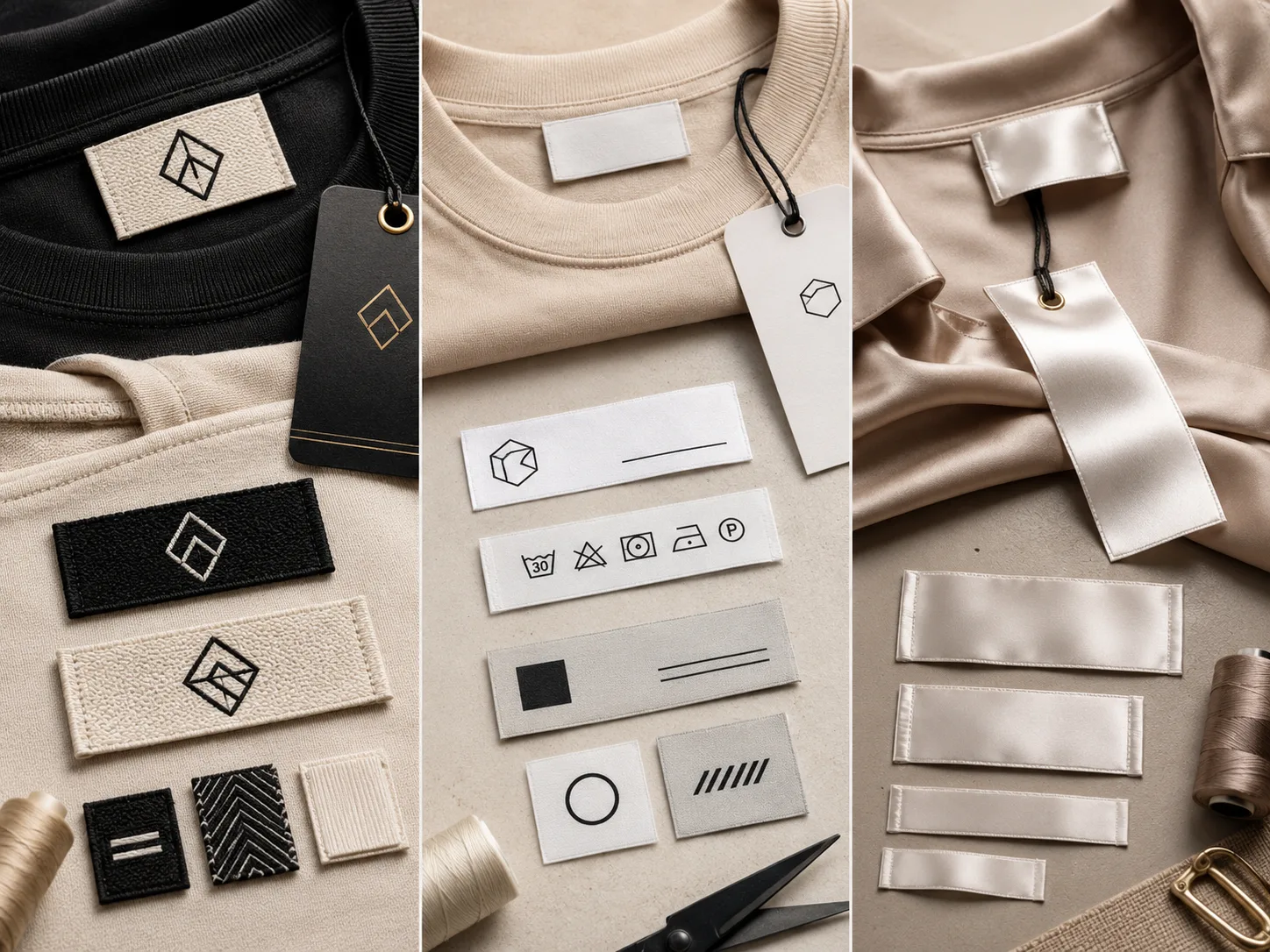
Not sure which label material to use? Our woven vs printed vs satin guide breaks down feel, durability and cost. This is the non-negotiable piece: skip the tag and the sticker if you must, but never the label.
What does the hang tag do for the shopper?
The hang tag hangs off the outside on a string, pin or barb, and the customer removes it after buying. It does the selling: it carries your logo, the price, a barcode for the till, and often a short brand story. It's what makes a product feel finished and premium on a rail.
Label vs tag in one line: the label is for the person who wears the garment; the tag is for the person who buys it. For the full breakdown of stock, shapes and finishes, see our hang tags 101 guide.
The sticker: adhesive, for packaging
Stickers don't go on the garment so much as around it. They're the cheapest, most flexible branding piece and shine in packaging:
- Size stickers on folded stock and polybags for quick sorting
- Brand seal to close a mailer or tissue wrap
- Care / wash stickers on the polybag
- Thank-you & logo stickers inside the parcel for unboxing delight
A sticker can't replace a label. It won't survive a wash and can't carry the permanent care and fibre information many markets legally require. Use stickers for packaging. Never as the garment's care label.
So what does your brand actually need?
Sewn-in brand + care label. A size sticker on the polybag. That's a valid minimum.
Add a hang tag and a thank-you sticker for a premium unboxing moment.
Hang tag with barcode is essential for retail POS. Label + tag both required.
Order label, tag and stickers together from one supplier for consistent colour and lower cost.
For the complete new-brand kit and when to order each piece, see our labels & tags checklist.
Which of the three can carry compliance information?
This is the distinction that matters most and the one most often missed. Fibre composition, country of origin and care instructions have to stay with the garment for its life, which means they belong on the sewn-in label.
A hang tag is removed at purchase. A sticker is on packaging that gets binned. Neither can carry information the customer needs in two years when they are deciding how to wash something, or when the garment is resold or handed on.
You can repeat the information on a hang tag for the shopper, and many brands do because it helps at the point of sale. What you cannot do is put it only there. If the permanent label does not carry composition, origin and care, the garment is not properly labelled however good the tag is.
- Permanent label: composition, origin, care, size. Non-negotiable.
- Hang tag: price, barcode, brand story, size chart. Removed and discarded.
- Sticker: carton and polybag identification, SKU, handling. Never customer-facing information.
How long does each one have to last?
Thinking about how long each one has to survive explains most of the specification differences between them.
The label lives as long as the garment. It goes through every wash, every wear and every press, so it is made from woven or printed polyester and judged on whether it is still legible after a season. Everything about how it is specified follows from a multi-year life.
The hang tag lives from the packing table to the customer's bin, which is weeks. That is why card is fine, why finishes like foil and embossing make sense there and nowhere else, and why nobody wash-tests a hang tag. It only has to survive handling in a shop.
The sticker lives from the packing table to the warehouse, sometimes only days. It has to stick, scan and be readable under a scanner, and nothing else.
That difference explains the budget split too. Money spent making a hang tag beautiful is money spent on a few weeks of impression; money spent making the sewn-in label good is spread over years of ownership. Both are legitimate, but they are buying different things.
What each one costs, roughly
These sit at genuinely different price points, which affects how you plan an order.
- Woven labels carry a setup cost because the loom has to be threaded to your design and colours. That makes them the most expensive per piece at low volume and the most improved by quantity.
- Printed labels have a lighter setup, so they start cheaper and improve more gently.
- Hang tags are printed card, so they are usually the cheapest of the three per piece, until you add foil, embossing, an eyelet or string.
- Stickers are the cheapest by a wide margin and are effectively a consumable.
The useful planning point is that the fastener often costs more than people expect on hang tags. String through a metal eyelet is a material cost and a labour cost, and on a large run the labour is the larger of the two. See our guide to hang tag attachment for the trade-offs.
How do you make the three look like one brand?
Ordering these separately is the usual reason a brand's pieces do not quite match. They are made by different processes on different materials, and colour behaves differently on each.
- Quote them together where you can. It is the only reliable way to check they read as a family before anything is made.
- Expect card and cloth to differ. The same brand colour on uncoated card and on woven thread will not be identical, because one is ink on paper and the other is dyed yarn.
- Match whites deliberately. A bright white tag against a slightly warm woven label is a common and avoidable mismatch.
- Simplify the mark for the label. A logo that works at full size on a tag may need a reduced version to weave cleanly at 25 mm.
- Approve them side by side, in daylight, rather than one at a time weeks apart.
If you are starting from nothing, the order to buy in is: sewn-in label first, because it is the only one that is not optional; then a hang tag once you sell anywhere a shopper picks the garment up; then stickers when packing volume makes them worth it. Plenty of brands run for a year on the first item alone.
Common mistakes
- Putting composition or care information only on a hang tag, which is removed at purchase.
- Using a sticker for size marking on the garment itself instead of the packaging.
- Ordering the three separately and finding the whites do not match.
- Spending the branding budget on the tag and neglecting the label the customer keeps.
- Designing a hang tag without deciding the fastener, then discovering it needs an eyelet.
- Using the full logo on the woven label without a reduced version for small sizes.
What a complete set looks like
For most brands the working set is smaller than it first appears, and it is worth writing down so nothing is discovered late.
- Brand label, sewn in at the neck or waistband. Woven for most ranges.
- Care label, printed, carrying composition, care symbols, origin and manufacturer details.
- Size tab, either separate or combined into one of the above.
- Hang tag, with price, barcode and brand story, plus its fastener.
- Polybag and carton stickers, for SKU and handling.
The sticker line is the one most brands skip at the start and add later, usually once a marketplace asks for SKU labelling on the outer bag. It is cheap enough that including it in the first order costs almost nothing and saves a separate small run.
Three of those are permanent and two are disposable, and that split is the one to keep clear in your head when deciding where to spend. The permanent pieces are read for years by whoever owns the garment; the disposable ones work for a few weeks in a shop.
Ordering the set from Labelwala
We are label manufacturers in Ahmedabad, Gujarat, and have been for 25 years.
- Minimum order: 1,000 pieces per design.
- Quotes: usually within 2 hours on a working day.
- Delivery: anywhere in India; timing follows the destination and the size of the consignment.
Quote the label, the tag and any stickers together. It is one setup conversation instead of three, and it is the only reliable way to check the pieces read as one brand before anything is manufactured.
We are rated 5.0 on Google from 27 reviews.
The short answer
A label is sewn in, permanent, and carries brand and care info for the wearer. A hang tag hangs outside on a string, carries price and barcode for the shopper, and is removed after purchase. A sticker is adhesive and belongs on packaging (sealing, size marking and unboxing), and can never replace a sewn-in label. Every garment needs a label; add a hang tag if you sell in retail or want premium unboxing; use stickers to finish your packaging. Order all three together and we'll keep your brand looking consistent across every touchpoint.