
In brief
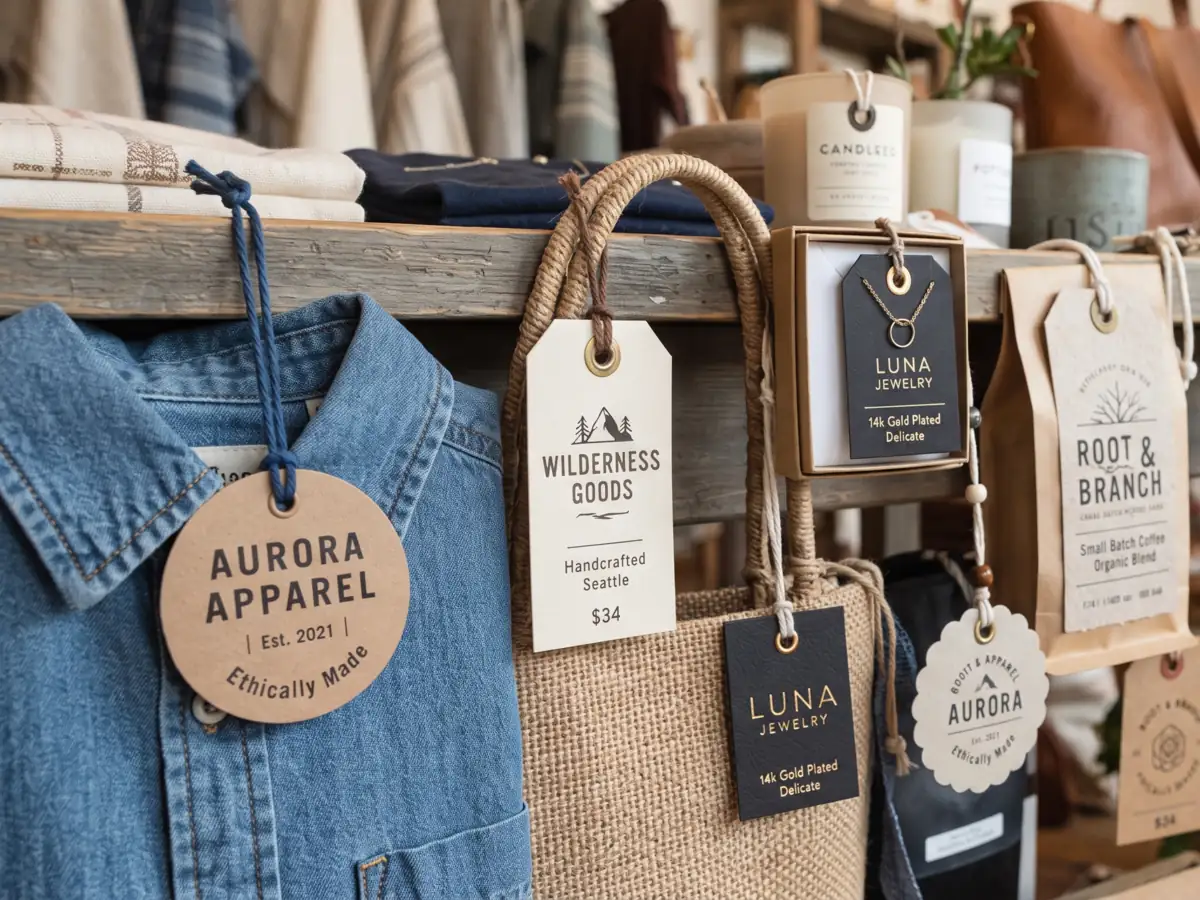
Hang tags attach with cotton, waxed cotton or jute string through a metal eyelet, plastic barbs fired with a tagging gun, safety pins, seal loops or bead chains. String looks the most premium but is slowest to tie, barbs are fastest for high-volume retail, and safety pins are the expected standard on Indian ethnic wear.
A hang tag is only half the job. The other half is how it attaches. And the fastener is doing more than holding the tag on: it's part of the look, and it decides how quickly your team can tag a batch of stock. A waxed-cotton string says one thing; a plastic barb says another.
This is a run-through of every common attachment method, how it looks, how fast it is, and which suits your brand and volume. It's the companion to our hang tags 101 guide.
Why is string the most premium hang tag attachment?
- Cotton, waxed cotton or jute twine
- Through a metal eyelet, knotted
- Boutique, considered, high-end
- Slower to attach by hand
- Best for lower-volume, higher-value
- Needs an eyelet in the tag
String is the most premium look, which is why designer and premium brands use it. Jute twine in particular pairs beautifully with kraft tags for eco and handmade brands.
When should you use a plastic barb on a hang tag?
A small plastic fastener fired through the garment and tag hole with a tagging gun: the tool used in most retail stores. By far the fastest way to attach tags at volume, which is why high-throughput sellers rely on it. The trade-off: it looks functional rather than premium, so it suits fast-moving or value products rather than luxury.
Why do ethnic wear brands attach tags with safety pins?
Common on Indian ethnic wear (sarees, kurtas, lehengas), and many value garments. Cheap, secure, easy to remove, and needs no eyelet. It looks traditional rather than premium, so brands choose it for practicality and cost. If you sell ethnic wear, it's often what customers expect.
Are seal loops and bead chains a good middle ground?
A plastic or nylon loop that threads through and locks. Neater than a barb, quicker than string.
A small metal ball-chain loop. Sturdy and a bit more premium than plastic.
These are the sweet spot when you want something sturdier and neater than a barb, without the slower hand-tying of string.
A note on eyelets
Plan for an eyelet if you want string. String, bead chain and some loops need a punched hole, ideally finished with a metal eyelet. It looks better and stops the hole tearing. Barbs and safety pins can go through a plain hole or the garment directly.
Quick guide: which attachment
Cotton or jute string through an eyelet. Slower, luxurious.
Safety pin: cheap, secure, expected.
Plastic barb + tagging gun, fastest by far.
Seal loop or bead chain, tidy and reasonably quick.
Why does the hole in a hang tag matter so much?
Every attachment method except the safety pin needs a hole in the tag, and the hole has to be specified when the tag is printed, not discovered afterwards. This is the detail most often left out of a hang tag brief.
- Plain punched hole: cheapest, and fine for a bead chain or a plastic barb where the fastener spreads the load. On card, a plain hole will eventually tear under a knotted string.
- Metal eyelet: a reinforcing ring set into the hole. Necessary for string, because a knot pulls against a single point. It also reads as a considered detail in its own right, and comes in brass, silver, black and antique finishes.
- Reinforced or double-thickness card around the hole, as a middle option where an eyelet would look wrong.
Position matters as much as reinforcement. A hole set too close to the edge tears out; too far in and the tag hangs at an angle. Around 5 mm from the edge is a reasonable default on a standard tag, more on heavier card. Centre it if you want the tag to hang square, or set it deliberately off-centre if you want it to hang at an angle, but decide which, because a tag hanging crooked by accident looks careless.
Specify the hole diameter as well as its position. A 3 mm hole will not take a 4 mm bead chain, and discovering that after the tags are printed means either new tags or a different fastener.
Where should a plastic barb go on the garment?
Plastic barbs are fast, and they are also the attachment most capable of damaging the garment they are attached to. The gun fires a needle through the fabric, and on the wrong fabric that leaves a permanent hole.
The rule is simple and widely ignored: never fire a barb through the face of the garment. Aim for somewhere the hole cannot show:
- Through an existing label, most commonly the care label or brand label, which is what the barb is designed for.
- Into a seam allowance, where the fabric is doubled and the hole is enclosed.
- Through a buttonhole, which needs no new hole at all.
- Never through knitwear, where a barb can split a yarn and start a run, or through fine silks and satins, where the hole is permanent and visible.
Ask the person doing the tagging where they intend to fire, before the first batch rather than after. It takes a moment and it is the difference between a clean job and a few hundred garments with small permanent holes in them.
Barb length is worth specifying too. Too short and it will not close over a thick seam; too long and the tag swings loosely and catches. Most brands settle on one length that suits their heaviest garment and use it across the range.
For fine or delicate product, the answer is usually not a shorter barb but a different method. A string through an eyelet, tied to a buttonhole or a belt loop, does no damage at all.
The labour arithmetic nobody runs
Attachment is the one part of hang tagging where the cost is mostly labour rather than materials, and the difference between methods is large enough to matter at volume.
A tagging gun attaches in roughly a second. A knotted string through an eyelet takes several times that, because it has to be threaded, positioned and tied. On a hundred pieces the difference is invisible. On ten thousand it is days of someone’s time.
- Low volume, high value: string wins easily. The labour is negligible against the price of the product, and the look is worth it.
- High volume, low value: barbs win just as clearly. Nobody is hand-tying twenty thousand giveaway tees.
- The middle: seal loops and bead chains exist precisely for this. Quicker than tying, tidier than a barb.
- Pre-strung tags are worth asking about: tags supplied with the string already fitted, so the only remaining step is attaching to the garment.
That last option is the one most brands do not know to ask for, and it removes most of the labour disadvantage of string while keeping the look. The remaining step is attaching the strung tag to the garment, which is quick, and it can be done at packing rather than needing a separate tagging session.
Sustainability sits mostly in the fastener
A card tag is easy to recycle. A plastic barb attached to it is not, and the combination is worse than either alone because the two have to be separated before either can be recycled.
If sustainability is part of your positioning, the fastener is where the claim is most visible and most easily undermined:
- Cotton or jute string is natural, compostable, and pairs with kraft or recycled card.
- Paper or card loops avoid a second material entirely.
- Plain punched holes tied with string avoid the metal eyelet as well, if you want a single-material tag.
- Metal eyelets are durable but make the tag mixed-material, which complicates recycling.
- Plastic barbs are the weak point in any eco claim, however good the card is.
Nobody expects a giveaway tee to have a compostable fastener. But an organic-cotton brand attaching kraft tags with plastic barbs is making an argument its own packaging contradicts, and customers in that segment do notice.
Ordering tags and fasteners together
We make labels and hang tags in Ahmedabad, Gujarat, and we have been doing it for 25 years. The useful thing about ordering the tag and its fastener together is that the hole, the eyelet and the string are then specified as one item instead of three assumptions.
- Minimum order: 1,000 pieces per design.
- Quotes: usually within 2 hours on a working day.
- Production: 7-10 days once artwork is approved. Rush jobs run 3-5 days.
- Delivery: across India, depending on destination and consignment size.
Tell us the product, the volume and the look you want, and whether anyone will be tying tags by hand. If they will, ask about pre-strung tags. It is usually the answer that gets a brand the string finish it wanted without the labour it was dreading.
It is also worth ordering a small quantity of the fastener before the full run, and actually attaching a few tags to real garments. Attachment is one of the few parts of a hang tag that cannot be judged from a proof, and ten minutes with a sample answers questions about length, hole size and hang angle that no specification quite settles.
We are rated 5.0 on Google from 27 reviews.
Common mistakes
- Designing the tag without deciding the attachment, then discovering it needs a hole.
- Specifying string but no eyelet, so the knot tears out of the card.
- Getting the hole diameter wrong for the fastener you intended.
- Setting the hole too close to the edge, where it tears, or too far in, where the tag hangs crooked.
- Firing barbs through the face of a knitted or fine-woven garment.
- Choosing string for a ten-thousand-piece run without costing the labour.
- Attaching kraft, recycled tags with plastic barbs on a sustainability-positioned range.
- Using one barb length across a range that includes both fine shirting and heavy outerwear.
- Ordering tags and fasteners from different suppliers, so nothing quite matches.
Nearly all of these come from treating attachment as an afterthought once the tag design is finished. It is worth deciding first, because the fastener determines the hole, the hole has to be in the print file, and the print file is the thing that becomes expensive to change.
The short answer
The fastener is part of the tag's look and sets how fast you can tag stock. Use cotton or jute string (through a metal eyelet) for premium and boutique, safety pins for ethnic wear and value garments, plastic barbs with a tagging gun for fast high-volume retail, and seal loops or bead chains as a neat, quicker-than-string middle ground. Plan an eyelet if you want a string finish. Tell us your product, volume and the look you're after, and we'll recommend the attachment and supply it with your tags.