In brief
Exporters pick taffeta for care, fibre-composition, RN, country-of-origin and size labels because its tight plain weave prints tiny care symbols and barcodes razor-sharp and costs 20 to 30 per cent less than satin at 10,000 pieces or more. It accepts every international care-symbol system, with satin or woven kept only for the visible brand label.
Walk through any Indian export-grade garment unit and the label sewn into millions of pieces is taffeta. Cheaper at scale, sharper print legibility, and accepts every international care-symbol system, here's why exporters pick it.
Walk through any export-grade garment unit in Tirupur, Ludhiana or Ahmedabad and you'll see the same label sewn into millions of pieces a year, taffeta. It's not the prettiest. It's not the softest. It is the most compliant, the most cost-effective at scale, and the most legible when care symbols need to be perfect. Here's why exporters pick it, and how we make it.
The 60-second answer
For care labels, fibre-composition labels, RN labels, COO tags and size tabs in export-grade apparel, taffeta is the default. Cheaper than satin at scale, sharper print legibility for tiny care symbols, and accepts every international care-symbol system without quality loss. The only time you'd skip it is for the visible neck brand label, where satin or woven gives a better feel.
What is taffeta and how is it made?
Taffeta is a tightly woven base made from nylon or polyester filament yarn. The weave is plain (not jacquard), the surface is matte, the hand is crisp. Two grades matter:
- Nylon taffeta: slightly softer hand, more drape, better for inner-neck position.
- Polyester taffeta: crisper, marginally cheaper, slightly more abrasion-resistant. The export default.
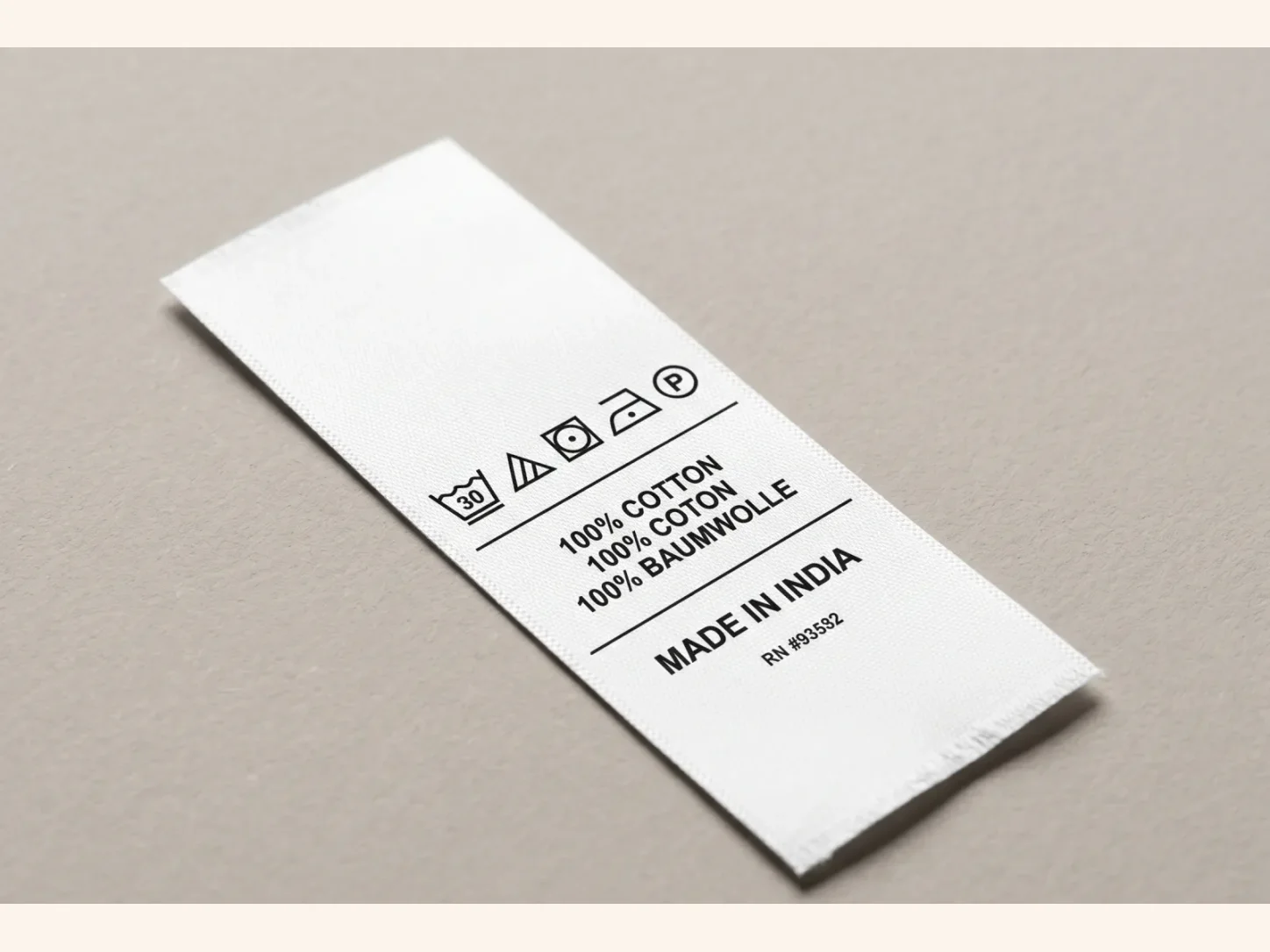
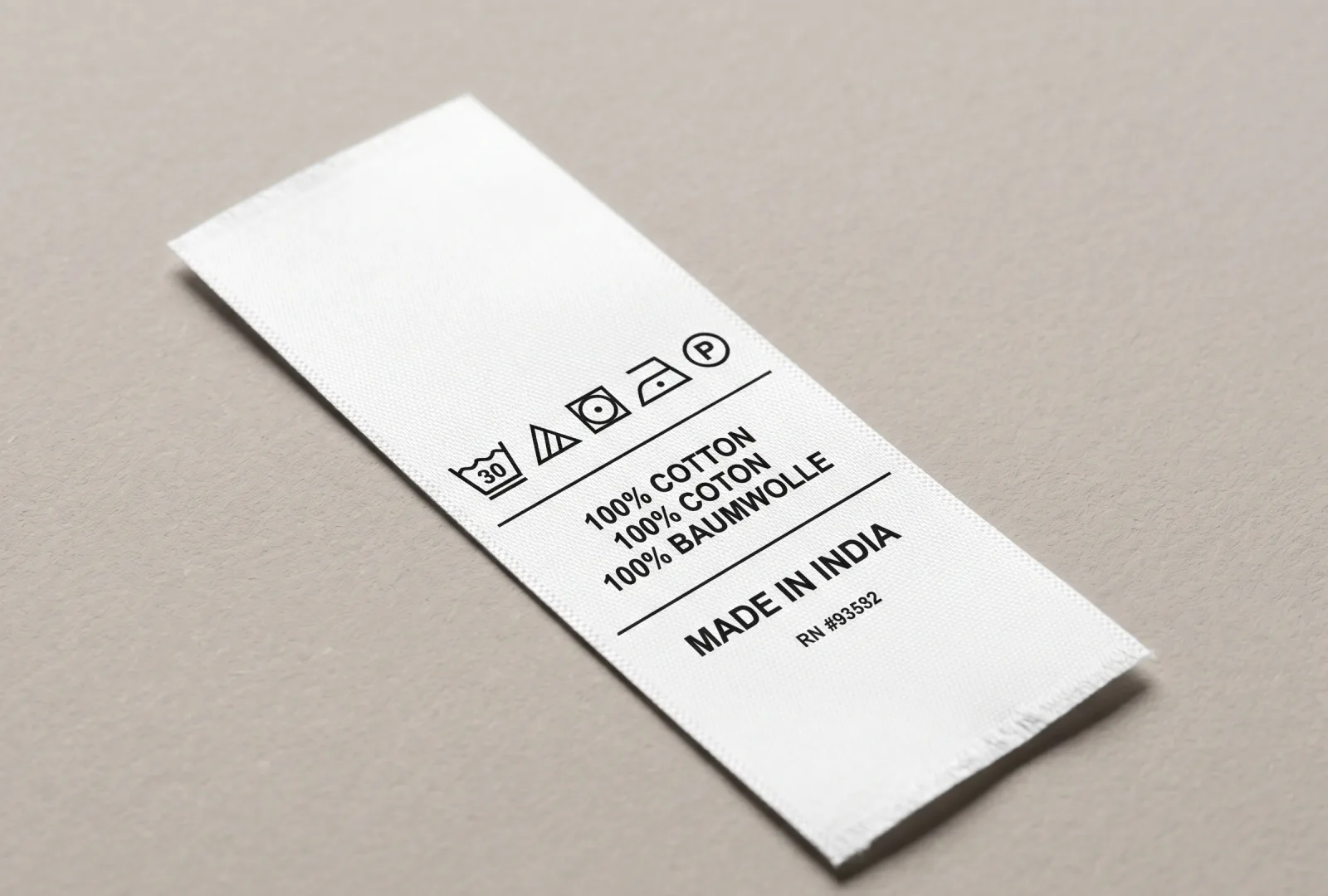
Your design is then sublimation-printed or screen-printed on top. Because the base is so smooth and thin, ink renders with razor-sharp edges: which is exactly why tiny care symbols (4mm or smaller) come out legible.
How does taffeta compare with satin in practice?
- Lower cost per piece at 10,000+ scale (typically 20-30% less than satin)
- Sharper print on tiny care symbols and small text
- Crisper handle: sits flat in the garment, no curl
- Lighter weight, adds less bulk to inner-neck labels
- Softer hand against bare skin, better for visible neck labels
- More luxurious appearance, slight sheen reads premium
- Better drape for hem tabs and side-seam labels
- Photographic detail renders slightly richer in colour
Most export programmes use both: woven or satin for the main brand label, taffeta for everything compliance-related (care, fibre, RN, COO, size).
Why does the buyer's label manual outrank everything?
This is the biggest structural difference between export work and domestic work. On a domestic order you decide the label. On an export order the buyer decides the label, and they usually have a written manual saying exactly what it must be.
Large retailers issue label specification documents running to dozens of pages: the label sequence in the garment, the exact wording of the composition line, the font, the minimum type size, the placement measured from a seam, the fold, and often supplier codes that must appear. None of it is negotiable, and a label beautifully made to the wrong specification is a rejected label.
- Get the manual before quoting, not after sampling. It answers most of what a quote depends on.
- Check the revision number. These documents get updated, and working from last season's version is a common and expensive error.
- Watch for wording that must be verbatim, composition phrasing is often prescribed exactly, including capitalisation and the order fibres are listed in.
- Note the placement tolerances. Some buyers specify the distance from the seam in millimetres and inspect against it.
- Confirm who approves. Many programmes require the buyer's own QA to sign off the label before bulk, not just your unit.
Where the manual conflicts with what you know to be good practice, follow the manual and raise the conflict separately. The inspection at the far end is against their document, not against best practice.
What does the destination market add?
Beyond the buyer's rules, the destination country brings its own. Taffeta suits this work precisely because it prints small text legibly, and export labels carry a great deal of small text.
- Language requirements. Several markets require care and composition information in specific languages, and one EU shipment can need three or four on a single label.
- Fibre naming conventions differ between markets, so the same fabric can need different wording depending on where it lands.
- Country of origin is required almost everywhere, and some markets specify how prominent it must be.
- Importer or responsible-person details are increasingly required, meaning a company name and address in small type.
- Symbol system varies. ISO 3758 is the international standard; the US market commonly uses the ASTM equivalent, and some programmes want both.
Multi-language is what most often forces a size increase or a change of construction. When four languages will not fit legibly on one taffeta strip, the answer is a folded multi-panel label rather than smaller type, see our book cover fold guide.
The label is inside the chemical compliance boundary
A point exporters sometimes miss: the label is part of the garment, so it sits inside the same restricted-substances regime as the fabric. If a shipment is tested, the label is tested with it.
That matters for azo dyes, formaldehyde and the wider restricted-substances lists buyers apply. A label from an unverified source can fail a test the garment itself passes, and a consignment is held on the strength of a component worth a fraction of a rupee.
- Ask what the base and inks are tested to, and keep the documentation in the shipment file.
- Match the standard your buyer applies instead of assuming a general assurance covers it.
- Keep test reports current. They expire, and an audit will check the dates.
- Do not switch label supplier mid-programme without re-establishing the same documentation.
Where labels are routed through our certified supply partners, we pass through the licence number and transaction certificate on request. That paperwork is usually what a buyer's compliance team actually wants to see.
Barcodes, SKUs and variable data
Export label work is often less about design than about data. A programme with twelve colours across eight sizes is ninety-six variants, and each may need its own size code, SKU or barcode.
Taffeta prints barcodes reliably because the surface is smooth and the ink edges stay sharp. A scanner needs crisp bar edges, and a textured base blurs them. A few rules still apply:
- Keep barcodes generously sized. Shrinking one to fit a narrow label is the fastest route to an unscannable code.
- Leave the quiet zone clear either side of the bars; artwork crowding it defeats the scan.
- Print dark bars on a light ground, never reversed, and never in a colour the buyer has not approved.
- Test-scan the physical sample, not the artwork. This is the check most often skipped and the one that fails at the buyer's distribution centre.
- Confirm the full variant list before ordering, because a missing size code means a held shipment.
Send the variant list as a spreadsheet, one row per colour and size, instead of describing the range in prose. It is faster to quote, faster to proof, and it removes the commonest cause of a missing SKU.
Why do export labels get rejected?
Almost every rejection traces to a short list, and none of it is about how the label looks:
- Composition wording that does not match the buyer's prescribed phrasing exactly.
- Care symbols in the wrong system, or in the wrong order.
- A missing language for the destination market.
- Type below the buyer's stated minimum size.
- Placement outside the specified tolerance from the seam.
- A barcode that will not scan cleanly.
- Working from a superseded revision of the label manual.
- Missing importer or responsible-person details.
Every one is a specification error caught at inspection not a manufacturing fault. That is why the compliance check before quoting is worth more than any amount of care during production: once labels are sewn into a shipment, correcting one of these means unpicking.
Ordering against a PO, not against a season
Domestic brands order labels for a season. Exporters order against purchase orders, and the two rhythms behave very differently.
A PO arrives with quantities per colour and size, a ship-by date, and often a buyer specification that may differ from the last PO for the same style. That makes forecasting harder and makes bundling more valuable: quoting every label type on a PO as one job is faster to price, cheaper per piece, and arrives as a single consignment to your packing line rather than four.
- Bundle care, fibre, origin and size labels into one order per PO. One setup, one delivery, one blended rate.
- Order to the cut quantity, not the PO quantity. Cutting and sewing wastage is real, and running short mid-shipment is the worst possible timing.
- Keep the size split written down, because it is rarely even and it repeats across POs for the same style.
- Hold a buffer of the stable labels. Origin and brand labels rarely change between POs and do not perish.
- Re-check the buyer manual revision on every PO, even for a repeat style.
That last point is the one experienced merchandisers build into their process. A repeat style with a superseded label specification is the most common way a compliant unit ships a non-compliant label, precisely because nobody expected anything to have changed.
Before you approve the label
Run this against the physical sample, with the buyer's manual open beside it:
- Does the composition wording match the buyer's prescribed phrasing exactly, including capitalisation and fibre order?
- Are the care symbols in the correct system, in the standard sequence, and complete?
- Is every required language present for the destination market?
- Is the smallest type at or above the buyer's minimum, and still readable after a wash?
- Are origin and importer details present and correctly worded?
- Does the barcode scan from the physical label, not just from the artwork?
- Is every size and colour variant accounted for in the order?
- Does the fold and finished size match the specification, and does it sit flat in the garment?
- Is the chemical test documentation current and on file?
- Are you working from the current revision of the label manual?
Get a buyer QA sign-off in writing where the programme requires it, and keep it with the shipment file. On export work, the paperwork proving the label was approved is nearly as useful as the label itself.
Export taffeta at Labelwala
We make woven and printed labels in Ahmedabad, Gujarat, and we have been doing it for 25 years, a good share of it for export units.
- Minimum order: 1,000 pieces per design, which export programmes clear comfortably.
- Quotes: usually within 2 hours on a working day, faster if the tech pack comes with the enquiry.
- Production: 7-10 days once artwork is approved. Rush jobs run 3-5 days.
- Care symbols: set to ISO 3758, or to the buyer's specified system where the programme requires a different one.
- Delivery: across India, dispatched to your unit or directly to your packing line.
Send the buyer's tech pack and label manual with the enquiry instead of a description of the label. It is the fastest route to an accurate quote, and it lets us flag any inconsistency in the specification before it becomes a sampling round.
If you are moving an existing programme, send one of the current labels as well. Matching a physical reference is faster and more reliable than working from a written specification alone, and it means the changeover is invisible to your buyer, which on a live programme is usually the requirement that matters most.
We are rated 5.0 on Google from 27 reviews.
Where exporters use taffeta
- Wash care & instruction labels: the highest-volume use. Tiny ISO 3758 symbols print legibly even at 4mm.
- Fibre composition labels: multi-language wording (English + buyer's region) fits cleanly on a single taffeta strip.
- RN & COO labels, US RN-number labels and "Made in India" country-of-origin labels are standard on taffeta.
- Size tabs & size run labels, alphabetic (XS: 3XL) or numeric, in single colour, on taffeta is the cheapest per-piece option at export volumes.
- Combination labels: main brand + care + fibre on one folded taffeta strip, single-piece application.
Export-market compliance
Taffeta accepts any care-symbol system without compromise. Match your buyer's region:
Wrong icon system = US Customs or EU Customs rejection. We verify your buyer's tech-pack against the care-symbol register before we print. See our care label symbols guide for the rules.
Why does taffeta win on cost at scale?
For 50,000+ piece export runs, taffeta is typically 20-30% cheaper per piece than satin and 40-60% cheaper than woven. Directional pricing on a 25mm × 50mm sublimation-printed taffeta care label:
- 1,000-5,000 pieces: ₹1.20-2.00 per piece
- 5,000-25,000 pieces: ₹0.70-1.20 per piece
- 25,000-100,000 pieces: ₹0.40-0.70 per piece
- 100,000+ pieces: ₹0.25-0.40 per piece
For a 200,000-piece annual export programme, switching from satin to taffeta on care labels alone saves ₹1.5-3 lakh per year: without any visible quality drop on the compliance side.
How an export taffeta order moves at Labelwala
Buyer spec: pantone, fold, fibre wording, care symbols, RN/COO, sizes, SKU count.
We verify symbol system against destination market, flag any inconsistencies before quoting.
Physical samples sent to your unit. Buyer signs off before bulk.
AQL-2.5 inspection on every batch. Weekly WhatsApp status. Pan-India dispatch.
Exporter tip: Bundle all your taffeta needs into a single PO (care, fibre, RN, COO, size labels), and you get a better blended rate plus one delivery to your packing line. See our garment-exporters page or WhatsApp us.