In brief
Satin printed labels use a glossy satin ribbon that is soft against skin, taffeta uses a matte, tighter-weave ribbon that holds tiny text and wash symbols at the lowest cost, and heat-press transfers print straight onto the garment with no label at all. Most brands use satin at the neck, taffeta for care labels and heat-press on activewear.
When a label buyer says "printed label," they could mean any of three very different products: a satin printed label (glossy ribbon, soft hand), a taffeta printed label (matte ribbon, sharp print), or a heat-press transfer (ink applied directly to the garment, no fabric label at all). All three fall under "printed"and they don't behave the same.
This guide breaks down the three printed options that compete for the same buyer, so you can match the right print method to your garment, your artwork and your scale. By the end you'll know when satin wins, when taffeta is the only sensible choice, and when heat-press makes both fabric labels irrelevant.
At a glance: the three printed options
The decision hinges on three questions: how does it touch the skin, how dense is the artwork, and what's the volume. Get those three right and the print method picks itself.
Option 1, Satin printed labels
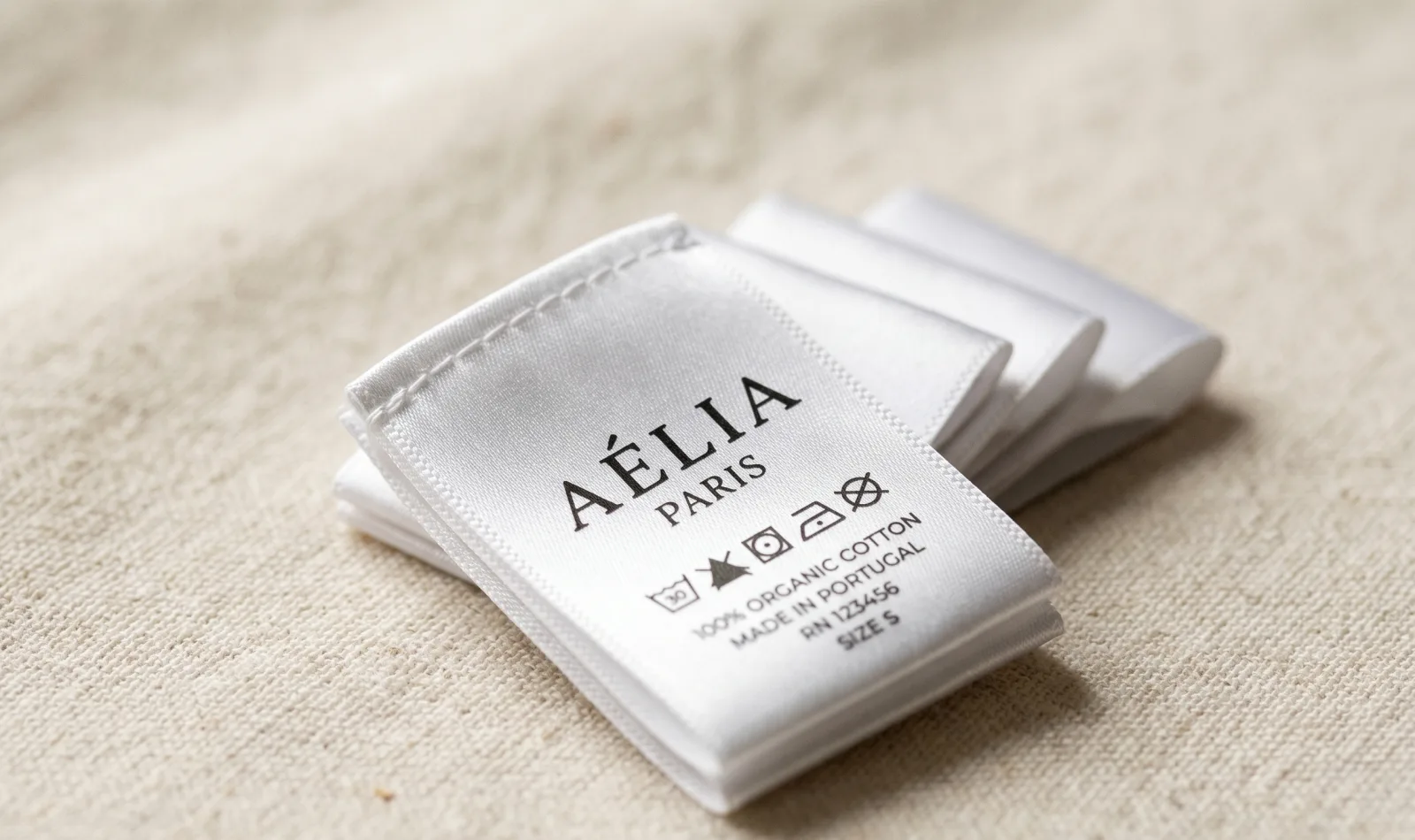
The most common printed label in Indian fashion. Soft satin-weave polyester ribbon with the artwork sublimation-printed onto the glossy face. Smooth against skin, mid-range cost, looks premium.
- Substrate: 100% polyester satin ribbon, 25-35 gsm
- Print process: dye sublimation (best), screen print (high volume), or heat-transfer (avoid)
- Colour range: full CMYK + gradients + photographic detail
- Feel: smooth, glossy face; slightly stiff matte reverse
- Best for: kidswear, D2C casualwear, neck labels, care labels with brand artwork
- Cost: ₹0.80-2 per piece at 1,000+ pieces
For a deeper dive into satin specifically, see our satin printed labels buyer's guide.
Option 2, Taffeta (plain) printed labels
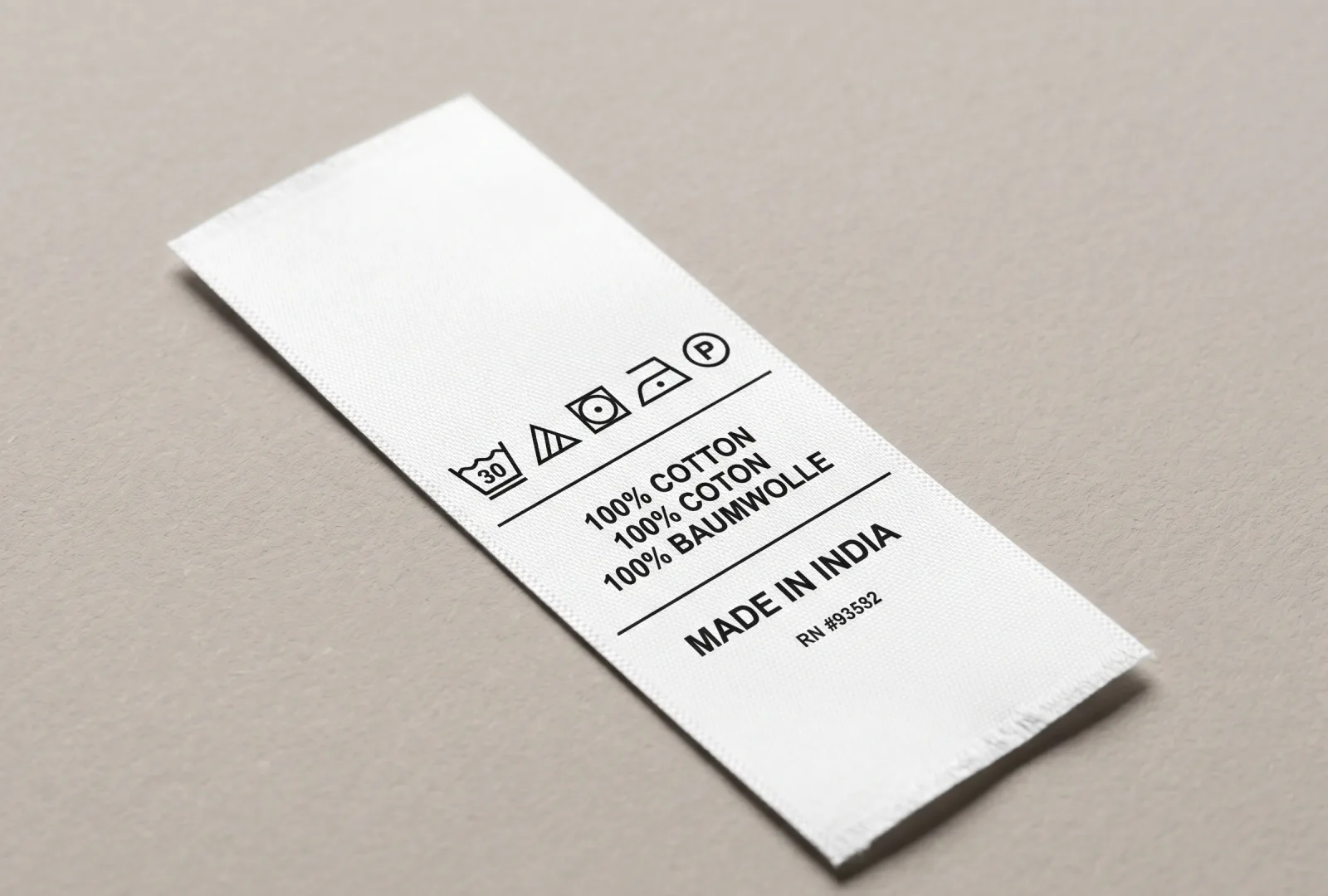
The export-industry workhorse. Tighter-weave polyester or nylon taffeta with sharp printed detail. Matte finish, slightly firmer hand than satin, but vastly clearer text and symbols at small sizes.
- Substrate: nylon or polyester taffeta, 30-50 gsm
- Print process: dye sublimation, ISO 3758 compliant
- Colour range: full CMYK; gradients possible but less smooth than satin
- Feel: matte, slightly papery; stiffer than satin
- Best for: export care labels, uniforms, multilingual wash labels, garments where print sharpness matters more than skin feel
- Cost: ₹0.40-1 per piece at 1,000+ pieces (cheapest of the three)
For the export-buyer perspective, see taffeta labels for garment exporters.
Option 3, Tagless heat-press labels
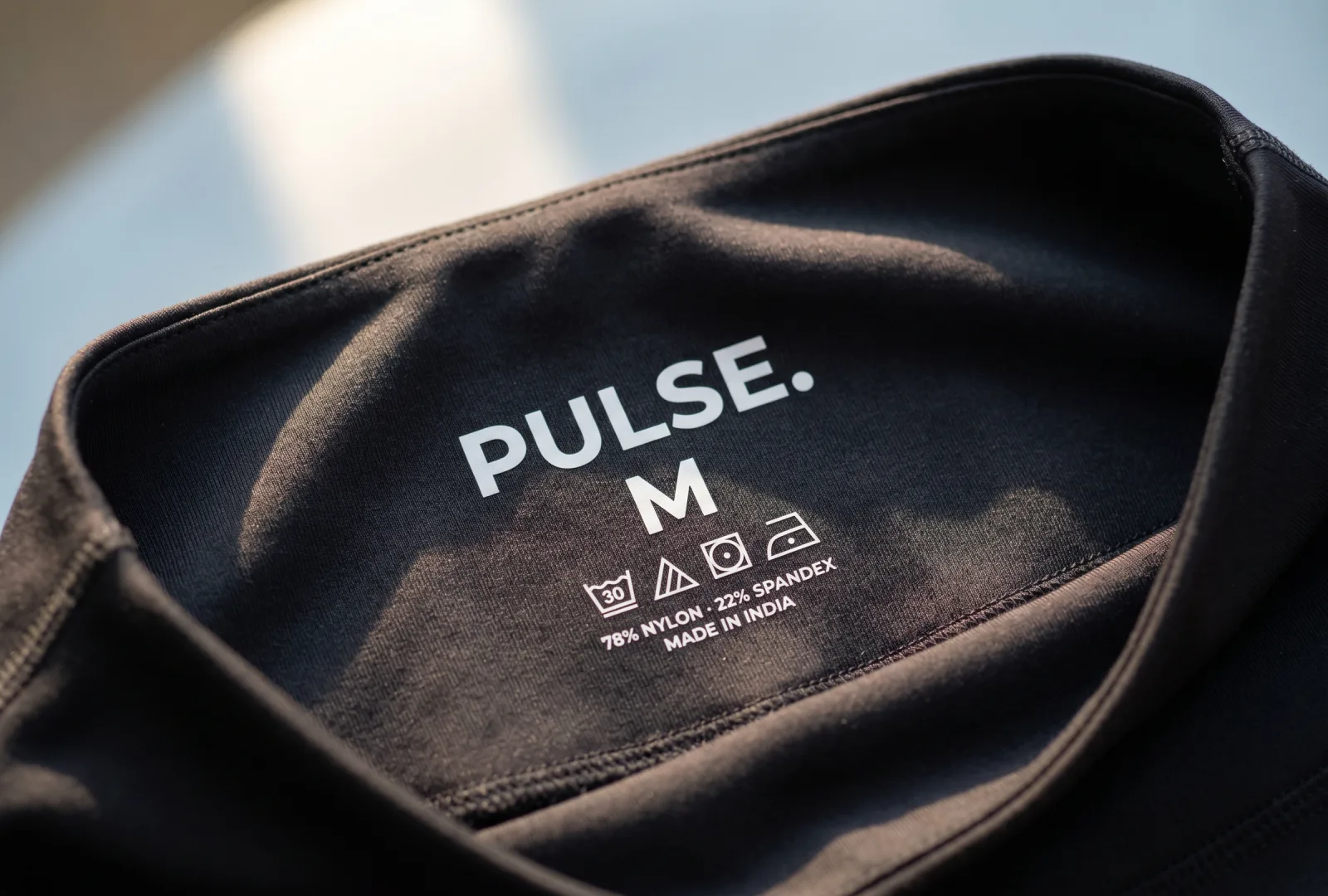
The third printed option isn't a label at all. It's ink fused onto the inside of the garment via heat-transfer plates. Used heavily in activewear, yoga apparel, innerwear and any garment where seams shouldn't touch skin.
- Substrate: none, printed directly onto the garment fabric
- Print process: heat-press transfer, silicone 3D dome, or plastisol screen
- Colour range: CMYK; can include raised silicone for premium tactile feel
- Feel: nothing to scratch, softer than any fabric label
- Best for: activewear, yoga, innerwear, athleisure, kidswear premium tier
- Cost: ₹0.30-0.80 at 5,000+ pieces; ₹2-4 at 100 pieces (setup-heavy)
For the activewear context, see tagless heat-press labels for activewear.
How do the three printed options compare?
- Softest fabric label against skin
- Best for full-colour brand artwork
- Premium glossy finish
- Mid-tier price across all MOQs
- 5-7 day turnaround
- Sharpest print for tiny text & symbols
- ISO 3758 export-grade standard
- Survives industrial laundry
- Lowest cost at scale
- 5-7 day turnaround
- Zero fabric, nothing to scratch
- Built into the garment, can't fall off
- Premium activewear standard
- Cheapest at 5,000+ pieces
- 10-14 day turnaround (plates needed)
How do the three compare on cost?
Representative pricing for a 25 × 40 mm neck label / equivalent heat-press footprint, 2026:
Read the curve: taffeta is cheapest at every volume. Satin sits in the middle for premium feel. Heat-press is the most expensive at small MOQ (plate setup ~₹2,500) but converges with taffeta at 10,000+ pieces.
Which should you pick for each garment type?
- Kidswear neck & brand labels
- D2C casualwear brand label
- Boutique fashion (ethnic, occasion wear)
- Premium care label with brand graphic
- Export care labels (multilingual)
- Uniform care & size labels
- Hospital, hotel, restaurant linen
- Long ISO 3758 wash-symbol charts
- Activewear, yoga, athleisure
- Innerwear, underwear, sleepwear
- Premium kidswear (2-year+ life expectancy)
- Performance fabrics with stretch
- Satin → if you need ISO export sharpness
- Taffeta → if it's a luxury neck label (feels papery)
- Heat-press → if you'll change artwork in < 6 months
What hybrid setup do most brands actually use?
The smartest production setups don't pick one, they assign each option to the job it does best:
- Neck brand label: satin printed (premium feel, brand-visible)
- Side-seam care label: taffeta printed (sharp symbols, ISO-compliant, tucked out of sight)
- Size tab: taffeta printed (cheapest) or pre-made stock
- Inside neck reinforcement (activewear): heat-press tagless
This split lets each material do what it's best at, and keeps the per-garment label spend roughly the same as picking any single option in isolation.
Decision matrix, 30-second pick
Yes → heat-press tagless (best) or satin (next best). Avoid taffeta on inner garments.
Taffeta. Its tighter weave keeps small text legible at high information density.
Satin. Its glossy face gives gradients and photographic detail a premium presentation.
Heat-press becomes cost-competitive and gives the cleanest finish. Otherwise stick with fabric labels.
Pro tips before you order
Order all three samples together. Satin, taffeta and a heat-press swatch all cost ₹250-400 each to sample. Compare them side-by-side under your artwork before committing to bulk.
Watch the print process, not just the substrate. A heat-transfer print on satin will fade in 10 cycles; a sublimation print on the same satin lasts 50+. Always specify sublimation when ordering printed labels.
Quick start: send us the artwork and the garment type. We'll send a side-by-side mock-up of satin vs taffeta vs heat-press with per-piece prices at 100 / 500 / 1,000 pieces. Message Labelwala or use the quote form.
How does each printed option fail?
All three of these look good on the day they arrive. Choosing well is mostly about knowing which failure you are willing to live with, because each method fails in a characteristic way.
Satin fades before it frays. The base is stable and the sealed edge cannot come apart, so what goes is the print, softening gradually on a heavily washed garment. A worn satin label is usually still intact and no longer crisp.
Taffeta holds print longer and feels firmer throughout. Its failure is not really durability at all, it is that some wearers notice it at a neck from the first day and go on noticing it. That is a comfort complaint rather than a wear one, and it does not improve with washing.
Heat-press fails at the bond. It lifts at a corner, or it crazes across a stretch, and once either has started it does not stop. It is also the only one of the three that cannot be repaired or replaced without leaving a mark on the garment.
Ranked by how forgiving they are: taffeta first, satin second, heat-press last. Ranked by comfort at a bare neck the order reverses exactly, which is why so many brands end up running two of them rather than picking one.
Being explicit about that trade at the start is what makes the decision easy. A garment sold on comfort should accept the shorter-lived label and plan for it; a garment sold on durability should accept a label that is felt and stop apologising for it. Trying to have both from a single label is what produces a compromise that satisfies nobody, and it is the commonest reason a brand ends up changing its label after one season.
Why test all three on your own fabric?
These three differ in hand, edge and ageing, and none of that survives a photograph. Half an hour of setup and a fortnight of washing settles it properly.
- Same artwork on all three. Comparing your logo on satin against a supplier sample card on taffeta tells you nothing.
- Stitch each to a scrap of your real fabric, in the colour you will actually sell. A label approved against white behaves differently against a dark dyed cloth.
- Wash five times at the temperature your care label permits, and look at the edges each cycle. Edges fail before faces do.
- Stretch the heat-press sample hard, fifteen or twenty times, and check for crazing in raking light. Cracking that shows in month three is visible in that test on day one.
- Leave a coloured sample somewhere warm for two weeks to check for dye migration from the garment into the print. This is the only test that needs calendar time and the one people skip.
- Feel each against skin on a body, not on a table. Stiffness that is imperceptible in the hand is obvious under a collar.
Common mistakes
- Choosing on price per piece when the three are not doing the same job.
- Putting permanent care and composition information on a heat-press bond.
- Specifying taffeta at a bare neck to save money on a garment sold on comfort.
- Approving any of the three from a screen.
- Testing on white sample fabric rather than the dyed cloth you will sell.
- Skipping the dye-migration test, which is the failure that appears after shipping.
- Assuming one method has to serve the whole garment.
Getting printed labels made at Labelwala
We are label manufacturers in Ahmedabad, Gujarat, and have been for 25 years.
- Minimum order: 1,000 pieces per design.
- Production: 7-10 days once artwork is approved. Rush jobs run 3-5 days.
- Delivery: anywhere in India; timing follows the destination and the size of the consignment.
Tell us the garment, the fabric and where the label sits, and ask for the same artwork on more than one base. Comparing them in your hand is quicker than comparing descriptions of them. Ask for the samples stitched rather than loose, because how each one sits against your fabric is most of the difference.
We are rated 5.0 on Google from 27 reviews.
The short answer
If you want a premium-feel brand label that handles colour-rich artwork, go satin. If you need an export-compliant care label with sharp small text and multiple languages, go taffeta. If you're making activewear or innerwear where labels shouldn't touch skin at all, go heat-press tagless. Most well-built production lines use all three in different positions on the same garment.