
In brief
Promotional merch needs a clean logo label at low per-piece cost: printed taffeta is cheapest at volume, printed satin a step up, tagless heat-transfer skips the sewing step, and woven suits keepsakes. Plan backwards from the fixed event date, ask sponsors for vector artwork on day one, and include a care label with fibre content and country of origin.
Most label advice assumes you're building a fashion brand for the long haul. But a huge amount of branded clothing is something else entirely: giveaway tees at a conference, campaign caps, sponsor merch, corporate gifting kits. Here the priorities flip, you want a clean logo, the lowest sensible per-piece cost, and a turnaround that hits a fixed event date.
This guide covers the right label types for promotional and merch clothing, how to keep costs down at volume, and how to protect a tight event deadline.
How is the promotional brief different?
- Often a giveaway, not a sale
- Printed labels keep it cheap
- Volume drives the price down
- A fixed event date to hit
- Printed & heat-transfer are faster
- Share your deadline up front
Which label types work best for merch?
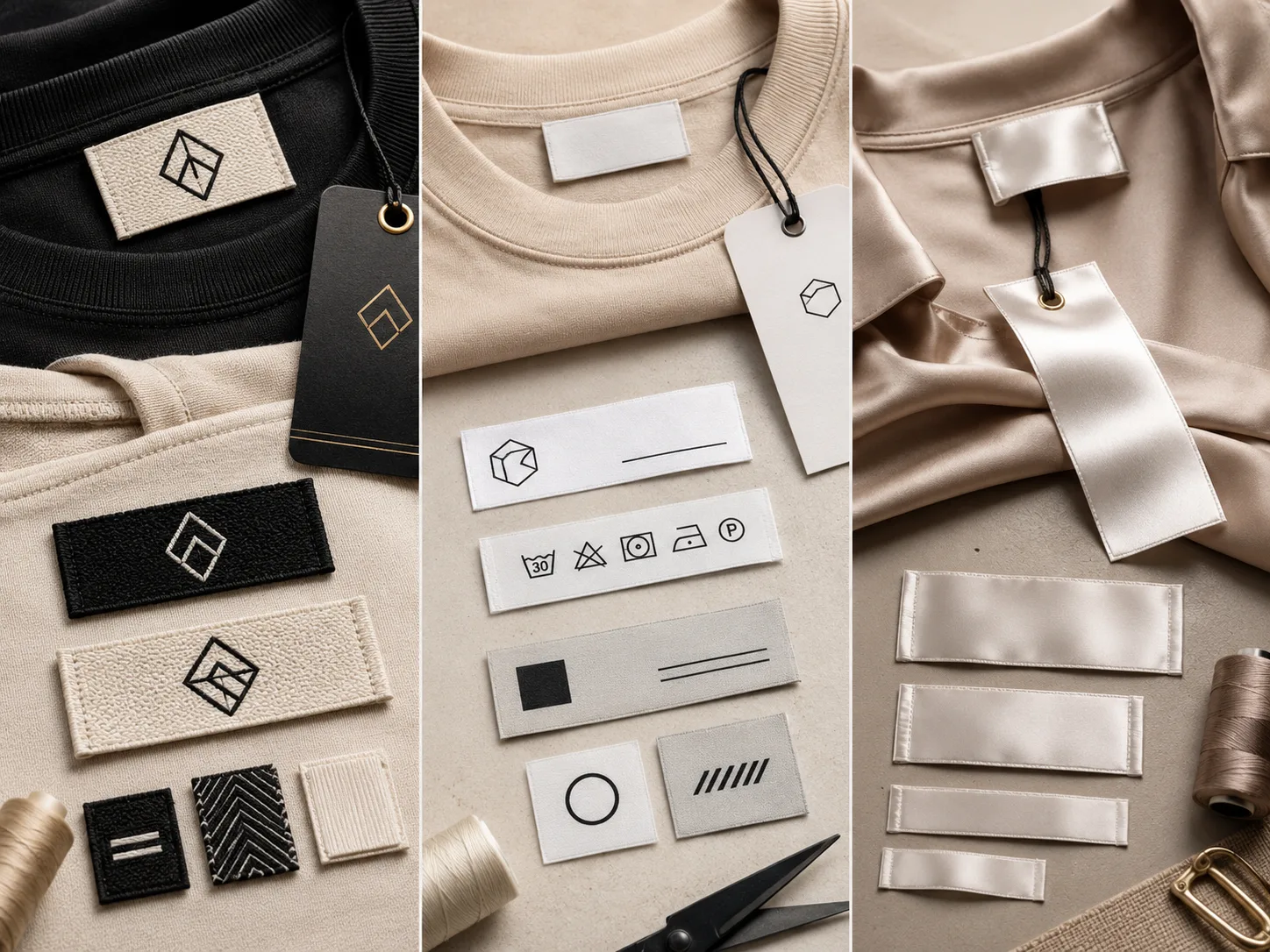
The most economical at bulk. Full-colour logo, low per-piece cost. Ideal for disposable giveaways.
A step up in feel, still cheap and full-colour. Good for campaign merch you want to look a bit nicer.
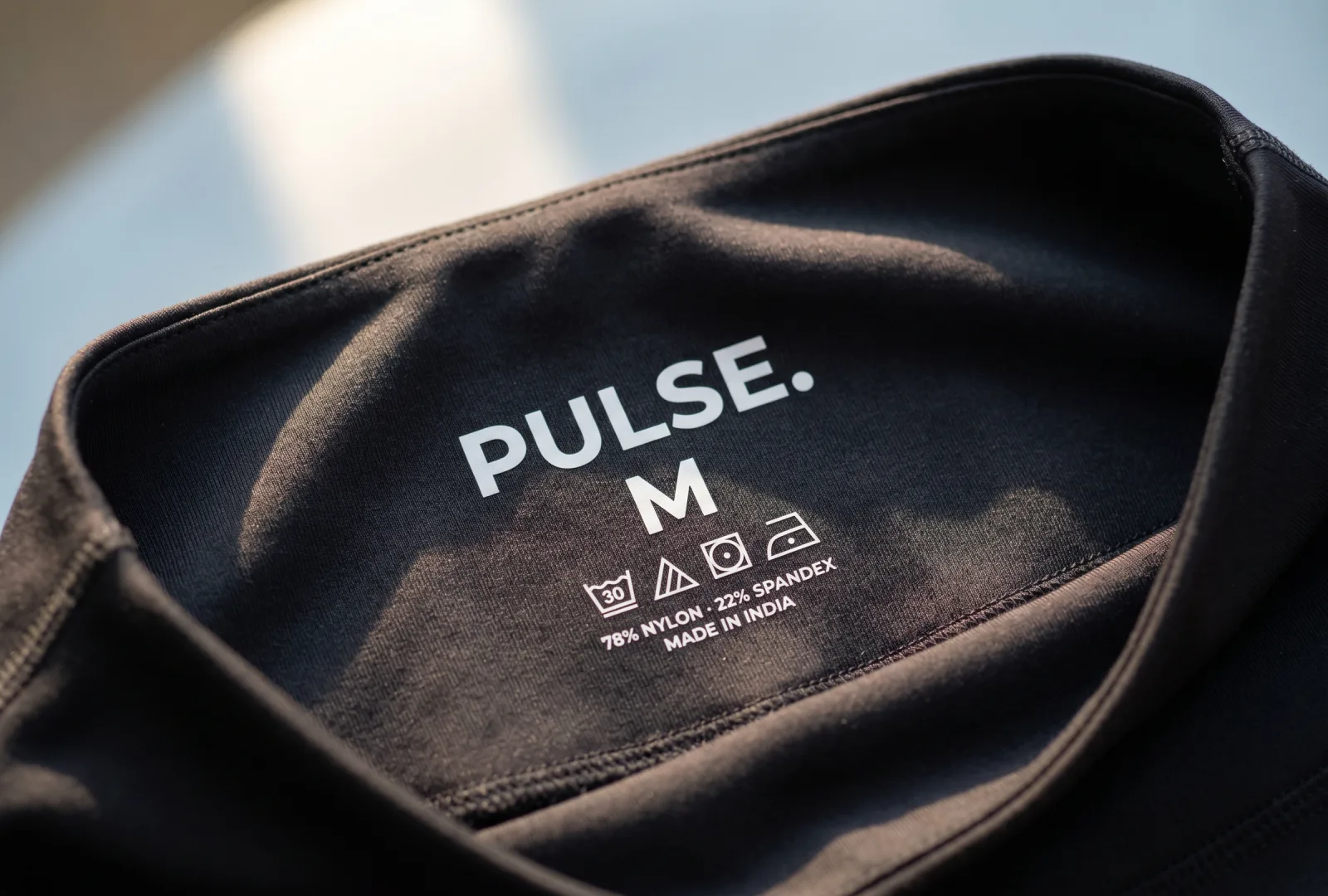
Clean, no sewing step, fast at volume. Great for a tidy, no-fuss finish on giveaway tees.
Costs more, but adds a quality feel for premium gifts, ambassador kits and merch meant to last.
Match the label to the lifespan. Disposable giveaway? Printed. Premium keepsake or gift worn for years? Woven. The single best cost decision is being honest about how long the merch will actually be kept.
Sponsors, campaigns & QR codes
Event and sponsored merch often needs more than one logo: a campaign name, a sponsor mark, an event date or a hashtag. Printed labels handle full colour and multiple marks cheaply, which is exactly why they suit promotional runs. Add a QR code linking to a signup page, the campaign, or social handles to make the merch do double duty.
Caps, totes & accessories
- Caps: woven or printed inside-band label, plus a front logo patch
- Tote bags: a printed or woven brand label; a leather-look patch for premium gifts
- Accessories: a simple printed label or heat-transfer logo keeps cost low
For the patch options on caps and totes, see our guide to woven vs printed patches.
Why plan backwards from the event date?
Merch deadlines are unusual in one specific way: the date cannot move. A fashion drop can slip a week; a conference cannot. That changes how the schedule should be built.
Work backwards in this order, and put the slack at the front rather than the back:
- Event date. The fixed point.
- Merch on site, allowing for transport to the venue and any distribution partner.
- Garments finished, which is when the labels must already be with the garment maker.
- Labels delivered, with a couple of days of margin rather than arriving on the morning they are needed.
- Bulk production: 7-10 days from artwork approval, or 3-5 days on a rush.
- Sample approval, the stage most likely to slip because it depends on people rather than machines.
- Artwork and quote, which is fast if the files are ready.
The stage that ruins merch timelines is almost never production. It is approval. A logo sitting with a sponsor's marketing team for four days, or a committee that has to agree. If several parties need to sign off, name the single person who can approve, and tell your supplier who that is.
A rush compresses manufacturing only. It cannot recover a week lost to a logo that arrived as a low-resolution image and had to be redrawn. Get the artwork question answered on day one.
Why are third-party logos the usual bottleneck?
On a fashion label you control the artwork. On merch you frequently do not: the logo comes from a sponsor, a client, an association or a campaign, and it arrives in whatever form that organisation happens to have.
What you receive is often a screenshot from a website, a logo on a white square that has to be knocked out, a PNG at 400 pixels wide, or a file in a colour system nobody has specified. Every one of those adds days.
- Ask for vector artwork immediately, on the day the project starts, not when you are ready to order.
- Ask for brand colour references at the same time. Sponsors are usually protective about their colours and will have the codes.
- Ask what the logo may not do. Most organisations have usage rules about minimum size, clear space, and whether a single-colour version is permitted.
- Confirm you have permission to reproduce it, in writing, before it goes onto merchandise.
- Expect to simplify. A logo with a gradient or fine detail may need a flat, single-colour version for a woven label.
That last point is worth raising early with whoever owns the logo, because a simplified version usually needs their approval too. Discovering that at sampling stage costs a week you did not budget.
How many labels, and in what sizes?
Merch quantities go wrong in a predictable direction: brands order a size curve that matches retail, and giveaway demand does not follow a retail curve at all.
- Giveaway merch skews large. People pick a size they can wear loosely, and unisex tees run short of L and XL long before S.
- Order labels to the garment count, plus a margin for sewing wastage and samples.
- Keep the label size-independent where you can. A brand label with no size on it means one artwork across the whole run, which is cheaper and removes the size-split problem entirely.
- Round up rather than down. Running out of labels mid-run before a fixed event date is the single worst position to be in, because there is no time for a top-up order.
That third point is the useful one. Put the size on a separate stock tab or on the garment's own printed neck label, and your custom label becomes a single artwork you can order in one quantity without forecasting anything.
Do giveaway garments still need compliant labels?
It is easy to assume that clothing given away rather than sold escapes labelling requirements. It does not, and this is where promotional projects most often cut a corner that matters.
A garment worn by a member of the public still needs fibre composition, care instructions and country of origin, whether money changed hands or not. Beyond the compliance point there is a practical one: a promotional tee with no care label gets washed at whatever temperature the recipient guesses, and a shrunken, faded giveaway is worse brand exposure than no giveaway at all.
The cheap answer is a printed care label with ISO 3758 symbols alongside the brand label, or care information combined into a tagless print. Neither adds meaningfully to the cost at merch volumes. See our care symbol guide for getting the symbols right for the fabric.
Sustainability is now part of the brief
Event merch has an obvious problem: a large quantity of branded clothing, produced quickly, some of which will be worn once. Organisers increasingly get asked about this, and the labels are one of the few places where the answer is visible.
- Printed cotton labels read as natural and suit organic garment ranges.
- Recycled-polyester based labels pair with recycled merch and are worth stating on the label itself.
- Undated labels matter more than they sound: leave the year off and unused stock is usable next time instead of waste.
- A QR code can carry the campaign message that would otherwise need a printed insert.
The undated point is the most practical. A label reading the event name without the year turns leftover merch from landfill into inventory, and it costs nothing to specify.
Co-branding: whose label is it?
Promotional work almost always involves more than one name, an event, a sponsor, a host organisation, sometimes the garment brand as well. Deciding where each one goes is a conversation worth having before artwork, not during it.
A workable hierarchy for most projects:
- The neck label carries the event or campaign, because that is what the garment is of.
- Sponsors go on a hangtag or a printed insert, where several logos can sit together at readable size and the recipient can remove them.
- The garment maker's own label either stays or is replaced, and this needs deciding explicitly, blank-garment suppliers vary in whether they will supply de-labelled stock.
- Care and composition stay separate, on their own label, regardless of the branding arrangement.
The de-labelling question is the one that catches projects out. If you are printing onto blank garments, find out early whether they arrive with an existing neck label, whether it can be removed cleanly, and whether removing it damages the garment. Retrofitting a label into a finished garment is a slow manual operation, and at merch volumes that cost is real.
Ordering merch labels from Labelwala
We make woven and printed labels in Ahmedabad, Gujarat, and we have been doing it for 25 years. Promotional runs are usually straightforward work with an immovable date attached, so the date is the thing to lead with.
- Minimum order: 1,000 pieces per design, rarely a constraint on merch, which tends to run well above it.
- Quotes: usually within 2 hours on a working day.
- Production: 7-10 days from artwork approval. Rush jobs run 3-5 days.
- Care symbols: set to ISO 3758.
- Delivery: across India, depending on destination and consignment size.
Send the event date in the first message, along with vector artwork and the quantity. If the logo is a sponsor's and you are still waiting on files, tell us that too. We can quote and schedule around a known gap far more usefully than around a surprise.
If the merch is going to more than one event, say so at the outset. An undated label ordered once across several occasions is cheaper per piece than separate dated runs, and it leaves nothing stranded afterwards.
We are rated 5.0 on Google from 27 reviews.
Protecting a tight event deadline
Tell us the event deadline up front so production is planned around it.
Quick sample sign-off is the biggest lever on hitting the date.
Order labels to match the merch run so nothing is wasted.
Printed and heat-transfer skip weaving setup, faster for deadlines.
The short answer
Event, promotional and merch clothing needs a clean logo label at low per-piece cost with fast turnaround. Printed taffeta is cheapest at bulk, printed satin looks a bit nicer, and tagless heat-transfer gives a clean, fast finish: reserve woven for premium keepsakes and gifts. Printed labels handle campaign, sponsor and QR marks cheaply. Share your event deadline up front and approve a sample fast to protect the date. Send your logo, quantity and deadline for a quick bulk quote and sample.