In brief
Choose cotton when sustainability is part of the brand promise: it is biodegradable, GOTS-certifiable and warmer against skin, but costs 2.5 to 3 times more than taffeta. Choose taffeta for export care labels, uniforms and industrial laundry, where its polyester weave keeps ISO 3758 symbols sharp; most brands use cotton at the neck and taffeta for the care label.
Cotton and taffeta are two label substrates that almost never compete for the same garment, and yet the comparison comes up constantly. Founders launching eco-led brands want to know if they can use taffeta for the care label. Exporters wonder if cotton is GOTS-credible enough to replace taffeta entirely. The answer in both directions is: it depends on what each substrate is actually best at.
This guide compares cotton and taffeta head-to-head: feel, sustainability, print sharpness, durability, certifications, and cost at every MOQ. By the end you'll know whether your brand should be running cotton, taffeta, or a mix, and you'll never confuse the two roles again.
At a glance, cotton vs taffeta
The picks fall along brand-promise lines: cotton when sustainability is part of the brand, taffeta when export-compliance and print sharpness matter most.
What is a cotton label?
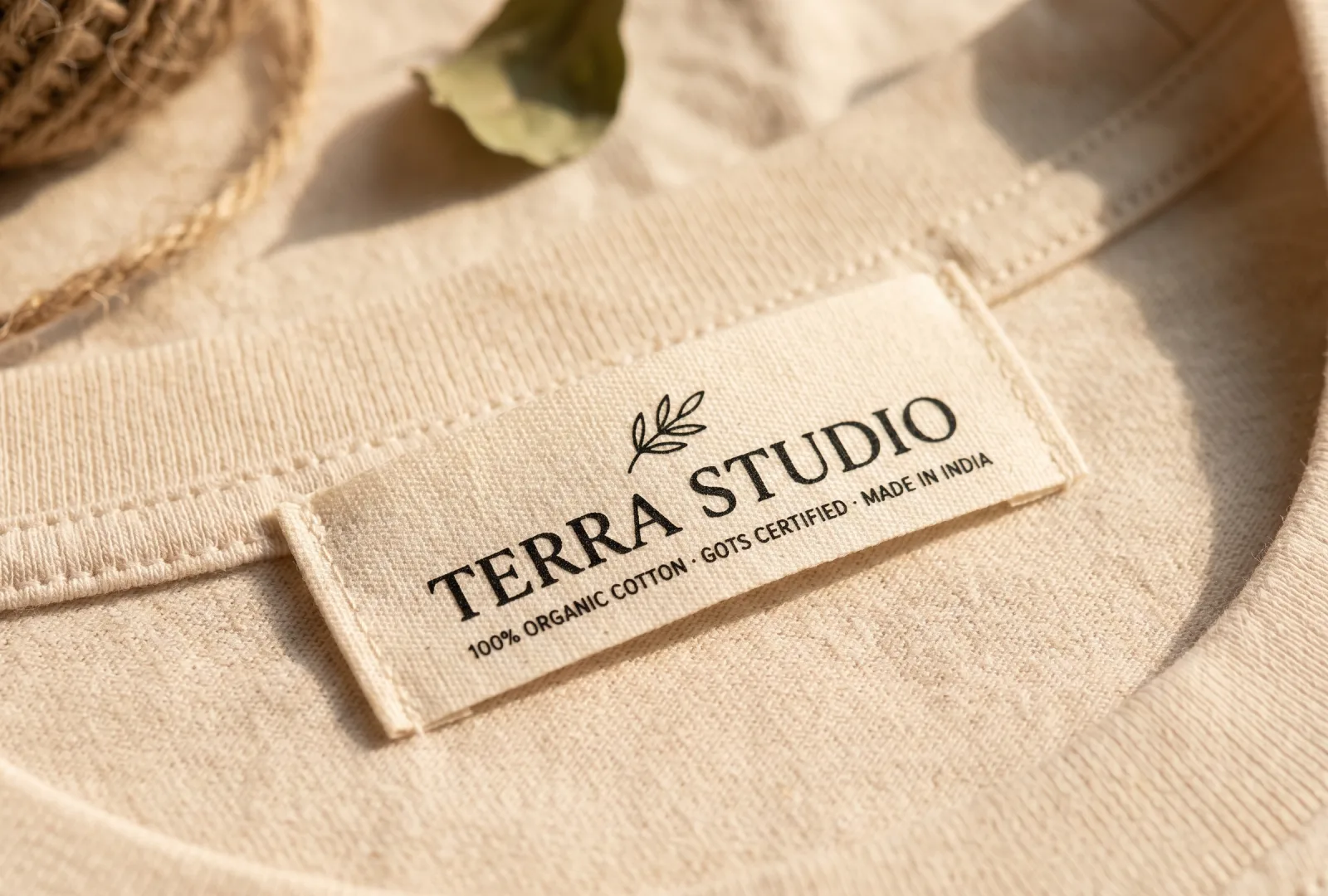
Cotton labels are made from woven or printed cotton tape using combed cotton thread (or GOTS-certified organic cotton). The label is biodegradable, has a warm matte finish, and aligns with eco-conscious branding. Available in both woven and printed formats.
- Substrate: 100% combed cotton (or organic GOTS-certified)
- Process: jacquard woven OR sublimation printed on cotton tape
- Feel: matte, warm, paper-like; soft against skin
- Lifecycle: biodegradable, compostable
- Best for: organic clothing brands, slow-fashion, hemp/linen apparel, eco-led premium
What is a taffeta label?
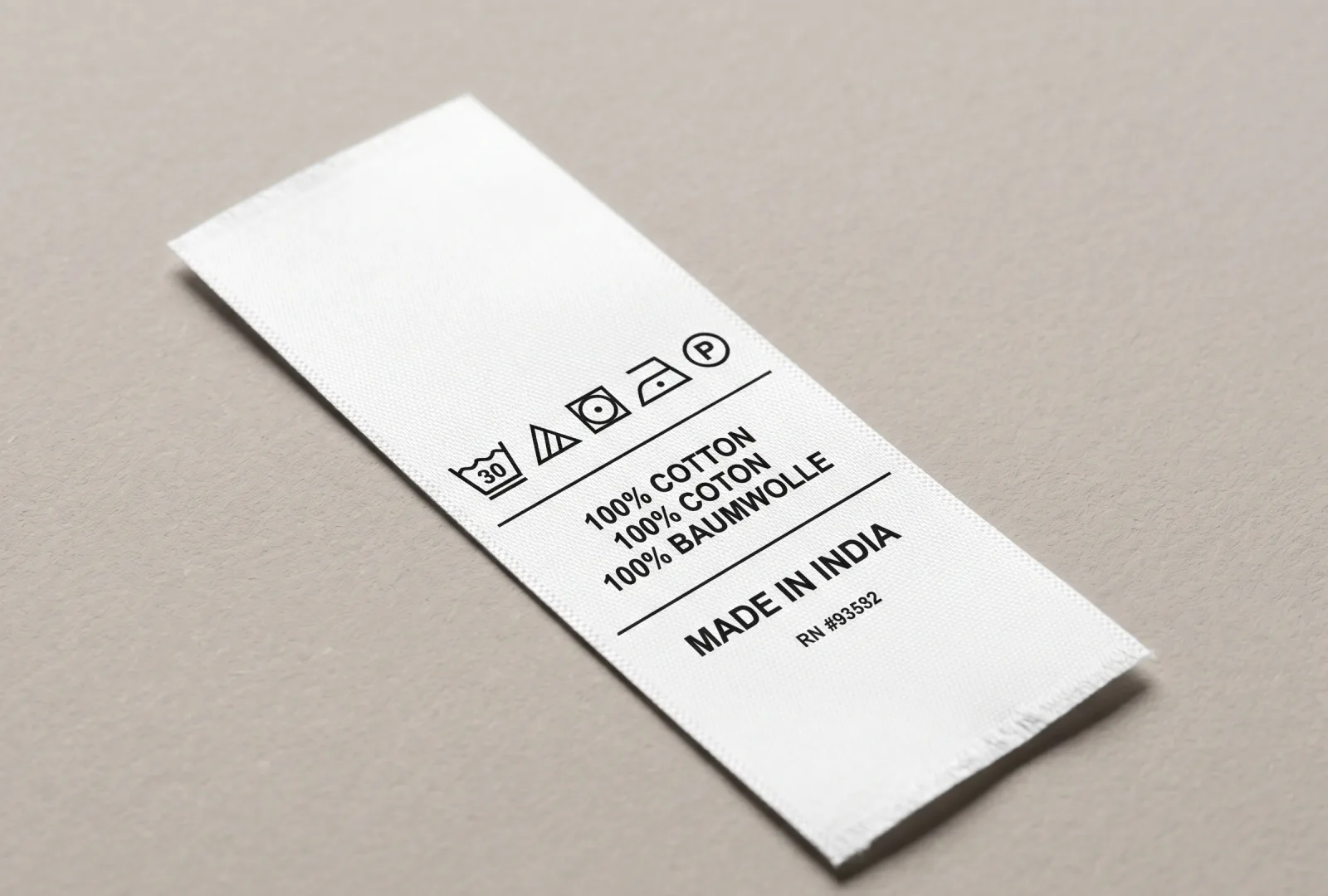
Taffeta labels are made from tightly-woven nylon or polyester with sublimation-printed artwork. The tight weave gives sharp print, especially for tiny text and ISO wash symbols. It's the default substrate for export-grade care labels.
- Substrate: nylon or polyester taffeta, 30-50 gsm
- Process: dye sublimation, ISO 3758 compliant
- Feel: matte, slightly papery; firmer than cotton
- Lifecycle: not biodegradable; recyclable
- Best for: export care labels, multilingual wash info, uniforms, hospitality linen
How do cotton and taffeta compare feature by feature?
- Biodegradable natural fibre lifecycle
- GOTS / Oeko-Tex certifications available
- Aligns with organic / slow-fashion branding
- Warmer, more natural hand against skin
- Reads artisanal, handcrafted
- 2-3× more expensive than taffeta
- Print less crisp than tight-weave taffeta
- Shrinks if not pre-shrunk
- Not the export-industry default
- Fades faster than taffeta under industrial wash
- Sharpest print: tiny text & ISO symbols stay crisp
- ISO 3758 export-grade standard
- Survives industrial laundry (90°C+, 100+ cycles)
- Cheapest substrate per piece
- Stable dimensions, no shrinkage
- Synthetic, undermines eco-fashion claims
- Not biodegradable
- No GOTS certification possible
- Firmer hand against skin
- Reads as utilitarian
What do cotton and taffeta labels cost?
Representative pricing for a 25 × 40 mm centre-fold label, 2026:
Cotton runs 2.5-3× more than taffeta. GOTS-certified organic cotton adds another 20-30% on top. The premium is steep but justified by the brand promise it carries.
Which should you pick for each garment type?
- Organic / GOTS-certified clothing brands
- Slow-fashion, handcrafted, artisan brands
- Hemp / linen / organic cotton apparel
- Baby clothing (chemical-free skin contact)
- Premium brands where natural fibre is part of the story
- Export care labels (EU, US, UK markets)
- Uniform care & size labels
- Hospitality linen (hotels, restaurants)
- Mass-market apparel at scale
- Garments going through industrial laundry
Decision matrix, 30-second pick
Cotton. A taffeta label inside a GOTS-certified garment is a credibility leak.
Taffeta. EU/US AQL inspections expect ISO 3758 taffeta care labels. Cotton is acceptable but not the default.
Taffeta. Cotton degrades faster under repeated 90°C industrial wash; taffeta survives 100+ cycles.
Taffeta. The 2.5-3× cost difference adds up fast at scale.
Pro tips before you order
Use cotton as the visible label and taffeta as the hidden one. Cotton woven main label at the neck (eco-credibility front-and-centre) plus taffeta-printed care label at the side seam (sharp ISO symbols, export-compliant). Best of both worlds.
Verify GOTS chain-of-custody. Many suppliers sell uncertified cotton tape and pass it off as organic. Ask your supplier for the GOTS scope certificate covering "labels/tapes" specifically before claiming organic certification on the garment.
Quick start: WhatsApp us your brand position (eco-led or export-led) and target MOQ. We'll send samples of both substrates plus a per-piece quote within 4 hours. Message Labelwala or use the quote form.
How does the fibre decide what is possible?
Almost every difference between these two comes from one fact: taffeta is a synthetic and cotton is not. That single property cascades through the whole specification.
- Edges. Polyester melts, so a taffeta label can be ultrasonic or laser cut and the edge seals as it goes. Cotton scorches instead of fusing, so it must be folded, hemmed or woven with a selvedge.
- Print sharpness. Taffeta is smooth and thin, so ink edges stay crisp and small care symbols stay readable. Cotton has texture and absorbs differently, so fine type spreads a little.
- Water. Cotton absorbs it, so it can shrink slightly and stays damp longer. Taffeta is dimensionally stable and does not.
- Chemistry. Sublimation dye needs polyester to bond into, so full-colour printing behaves differently on the two.
None of that makes cotton a worse label. It makes it a label with a different set of constraints, and the mistake is specifying it as though those constraints were not there.
Why are cotton and taffeta complements, not rivals?
The comparison is framed as a choice, and on most garments the answer is that both belong, in different positions.
A cotton label at the neck carries the sustainability signal where a customer sees and feels it. That is where the fibre choice does brand work, and where its softness and matte finish read as considered.
A printed taffeta care label in a side seam carries composition, symbols and origin, where legibility over years matters and nobody is looking at the material. That is where taffeta wins outright, because the content is small text and the position is unseen.
Splitting the roles this way is not a compromise on the eco story. It is the arrangement most credible sustainable brands use, and it avoids the trap of putting dense compliance text on a substrate that renders it poorly.
How does each behave over a garment's life?
The two substrates age differently, and the difference shows up in ways a first sample cannot tell you.
Taffeta is stable. It does not absorb water, so it does not shrink, and a sealed edge cannot fray because the threads are fused. What eventually goes is the print, which fades slowly on a heavily washed garment. A taffeta label that looks worn is usually one whose ink has softened rather than one that has come apart.
Cotton moves. It absorbs water, so it can shrink slightly on hot washes and it stays damp longer than the fabric around it. An unfolded edge frays progressively, and that is not a defect that stabilises: it continues for the life of the garment. Cotton also takes on the character of the wash, softening and going slightly fuzzy over time, which some brands consider part of its appeal.
The practical test is the same for both, and it takes a fortnight rather than a day. Stitch a sample to a scrap of your actual fabric, wash it five times at the temperature your care label permits, and look at the edges rather than the face. Edges fail long before faces do, and on cotton they are the whole story.
Common mistakes
- Specifying a laser or heat cut on a cotton label, which scorches rather than sealing.
- Putting dense care text on cotton, where fine type spreads and legibility suffers.
- Using taffeta throughout an organic range and undermining the fibre claim at the neck.
- Leaving a cotton edge unfolded, so it frays progressively through the garment’s life.
- Assuming cotton and taffeta wash identically. Cotton absorbs, shrinks slightly and dries slower.
- Treating the choice as either-or when the two suit different positions on the same garment.
Making the eco claim hold up
If cotton is being chosen for sustainability rather than feel, the label has to survive the same scrutiny as the rest of the claim.
The wording is where brands get into trouble. There is a real difference between a certified fibre, a supply partner who holds a licence, and a material that would qualify. Those are three different statements, and only the ones you can evidence should appear on the label.
- Name what is actually certified, and who holds the certificate.
- Keep the paperwork current, since licences and transaction certificates expire and buyers check dates.
- Remember the label is inside the testing boundary. It is part of the garment, so restricted-substance limits apply to its base and inks too.
- Avoid vague words like eco-friendly or green, which are exactly what misleading-claims rules target.
A specific, modest, evidenced claim on a cotton label is worth far more than an ambitious one you cannot document. Buyers and compliance teams read these lines closely, and an unqualified claim invites exactly the question you least want to be asked.
Deciding in four questions
- Is the fibre part of the brand claim? If yes, cotton belongs somewhere visible. If not, taffeta is simpler in every respect.
- How much text does this label carry? Dense care content wants taffeta, because small type stays sharp on a smooth substrate.
- Where does it sit? Neck positions favour cotton for feel and story; side seams and pocket bags favour taffeta for durability nobody sees.
- How hard is the garment washed? Frequent hot washing pushes towards taffeta regardless of the brand story.
Note that none of the four is about price. Cost follows from the answers rather than driving them, and a brand that picks the substrate on price alone usually pays twice when the first choice does not suit the position.
Run them in that order, because the first question decides whether the rest are worth asking at all. Answering them usually produces a split instead of a winner, which is the right outcome. A cotton brand label with a printed taffeta care label is the arrangement most credible eco brands end up with.
Ordering either from Labelwala
25 years making woven and printed labels in Ahmedabad, Gujarat.
- Minimum order: 1,000 pieces per design.
- Production: 7-10 days from artwork approval, or 3-5 days on a rush job.
- Delivery: across India, depending on destination and consignment size.
Tell us which position each label goes in and whether the fibre claim matters. If it does, we will flag where the construction has to change to suit cotton, particularly the edge.
We are rated 5.0 on Google from 27 reviews.
The short answer
If your brand sells organic, eco or natural-fibre apparel: cotton, full stop. The 2.5-3× cost premium pays for credibility customers will pick up. If you're exporting to EU/US retail or running industrial-laundry garments, taffeta, no contest. For the most defensible setup, use cotton at the visible neck and taffeta at the hidden care label.