In brief
A cotton label is itself a woven label made on the same jacquard looms; the only difference is cotton thread instead of polyester. Cotton gives a matte, biodegradable, GOTS-certifiable label at roughly 60 to 80% more cost, while polyester holds finer detail and survives industrial laundry, so choose cotton only when the fibre is part of your brand story.
"Cotton label" and "woven label" sound like different categories, but technically a cotton label IS a woven label: it’s just woven on cotton thread instead of polyester. That subtle difference in fibre choice changes how the label looks, feels, prices and ages. It also decides whether the label aligns with, or undermines, your sustainability story.
This guide compares the two side-by-side: same loom, different thread. By the end you’ll know which fibre belongs on which garment, and how the cost difference shapes the decision at every MOQ.
At a glance, cotton vs polyester woven
Both are made on the same jacquard looms. The only difference is the warp/weft thread material, and that single substitution changes everything from feel to ecology to price.
What is a cotton woven label?
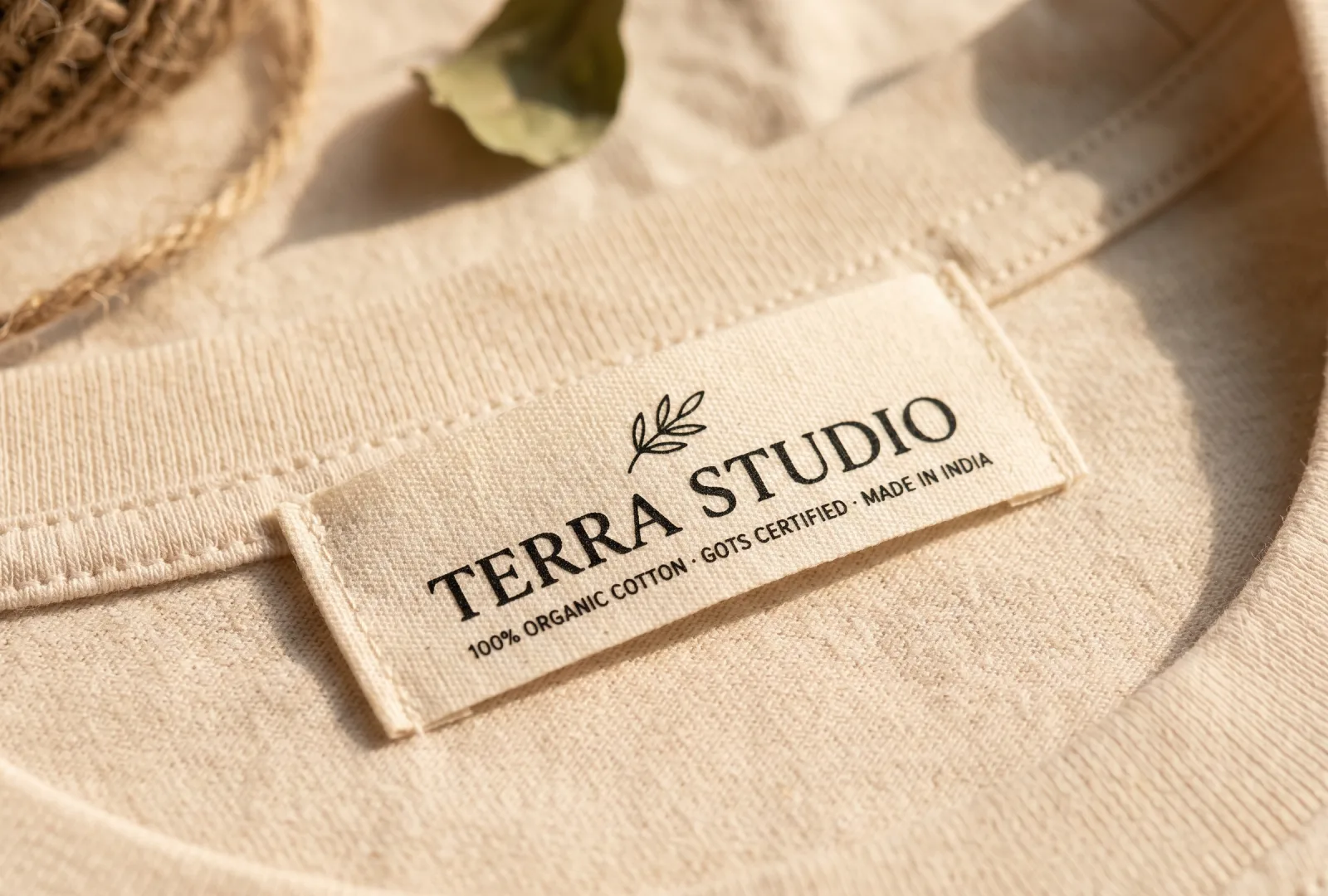
Cotton woven labels are produced on jacquard looms using combed cotton thread instead of polyester. The artwork is woven into the fabric structure exactly like a polyester woven label. Colours are structural, not printed. The end result is a label with natural-fibre warmth, slight matte finish, and biodegradable lifecycle.
- Thread: 100% combed cotton (or GOTS-certified organic cotton)
- Process: jacquard weaving, same machines as polyester woven
- Colour: 1-6 distinct thread colours; no gradients
- Lifecycle: biodegradable, compostable
- Feel: matte, warm, paper-like; softer than polyester woven
What is a polyester woven label?
Standard woven labels use polyester thread on the same jacquard looms. Polyester is cheaper, stronger, more colour-fast and capable of finer thread detail than cotton. Standard density (~6,000 stitches/sq inch) up to damask (~12,000) produces increasingly intricate detail.
- Thread: 100% polyester (rarely cotton-poly blend)
- Process: jacquard weaving
- Colour: 1-8 distinct thread colours; finer detail possible
- Lifecycle: not biodegradable; recyclable
- Feel: smooth, slight sheen; firmer hand than cotton
How do cotton and polyester woven compare?
- Biodegradable, natural fibre lifecycle
- GOTS / Oeko-Tex certifications available
- Matte natural look: artisanal, handcrafted feel
- Aligns with organic / slow-fashion brands
- Softer, warmer hand against skin
- 60-80% more expensive than polyester woven
- Coarser thread limits fine-detail weaving
- Shrinks 3-5% on first wash without pre-shrinking
- Colours less saturated than polyester
- Higher MOQ on organic certified cotton (300+)
- Sharpest detail at high-density weave
- Wider colour range and saturation
- Cheapest at every MOQ tier
- Damask option for ultra-premium feel
- Survives industrial laundry without shrinking
- Synthetic, contradicts eco-fashion claims
- Not biodegradable, lands in landfill
- Can feel scratchy at low-density weave
- No GOTS certification possible
- Less "artisanal" reading
What do cotton and polyester woven labels cost?
Representative pricing for a 25 × 40 mm centre-fold woven neck label, 2026:
Cotton runs ~60-80% more than polyester woven. The premium narrows slightly at higher volumes but never disappears: cotton thread costs more per kg, weaves slower, and demands more skill from the loom operator.
By garment type, which to pick
- Organic / GOTS-certified clothing brands
- Hand-loom / artisan / slow-fashion brands
- Hemp, linen, organic-cotton apparel
- Baby clothing (chemical-free skin contact)
- Sustainability-led premium fashion
- Formal shirts & suits
- Denim & outerwear
- Mass-market fashion at scale
- School blazer crests & uniforms
- Sportswear & jersey labels
Decision matrix, 30-second pick
Cotton. Polyester labels inside organic garments are a credibility leak, buyers notice.
Polyester. Cotton thread is coarser; intricate detail and tight type weave better in polyester.
Polyester. Cotton can’t hit that price even at 10,000+ pieces.
Polyester. Cotton woven labels degrade faster under repeated 90°C industrial wash cycles.
Pro tips before you order
Always pre-shrink cotton labels. Untreated cotton shrinks 3-5% on first wash, causing the label to pucker. Specify "sanforised" or "pre-shrunk" cotton tape when ordering: adds nothing to price but saves a customer-service headache later.
Don’t assume "natural" looks dull. Quality cotton woven labels can look stunning: natural beige with woven brown or navy threads has a warm, premium feel. Don’t over-saturate cotton with bright dyes; it works against the natural-fibre aesthetic.
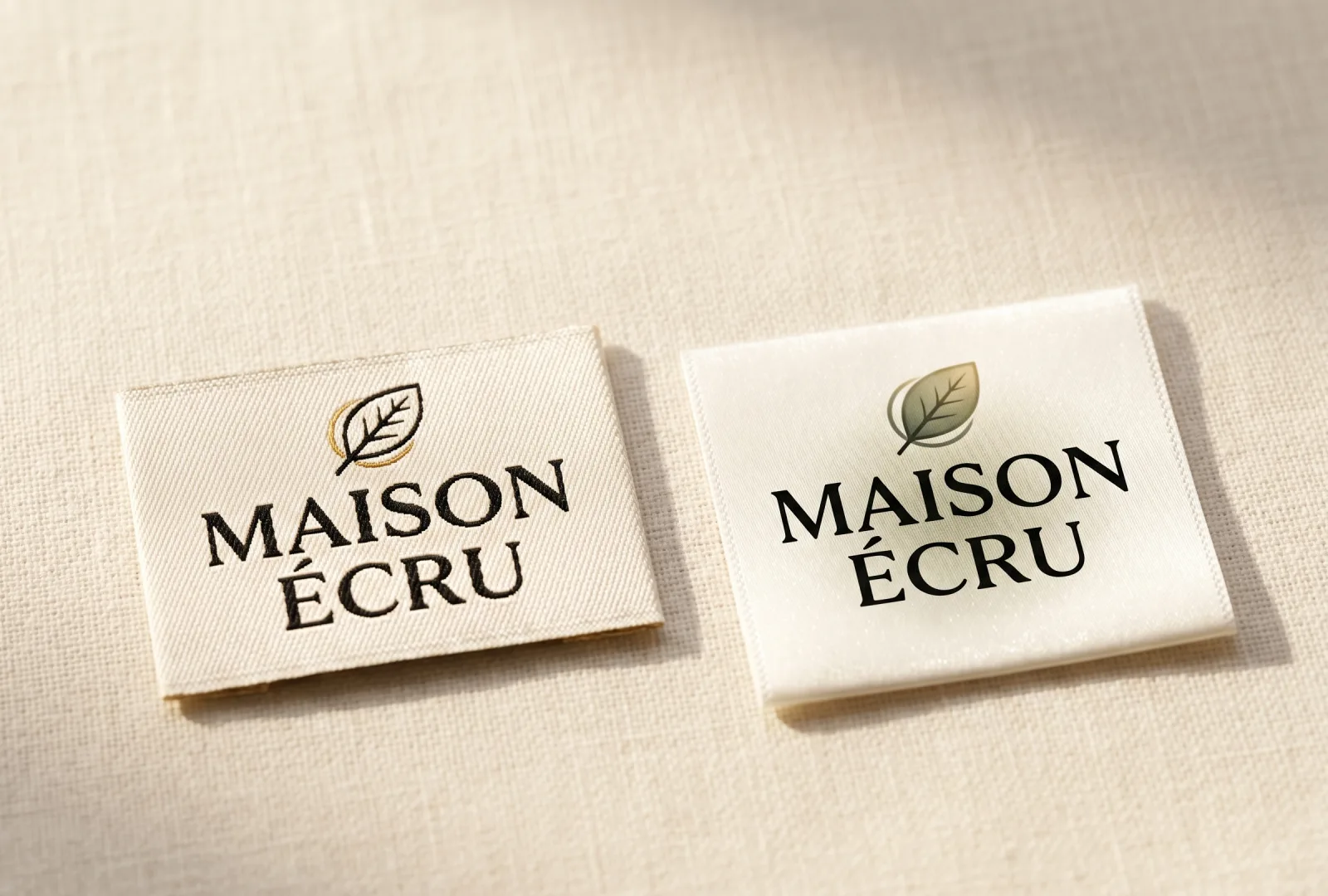
Quick start: WhatsApp us your artwork and brand position. We’ll weave a cotton sample and a polyester sample side-by-side and ship both within 5 days. Message Labelwala or use the quote form.
What changes when the same loom uses a different thread?
The naming causes most of the confusion here. A cotton label is generally a woven label; the two words describe different things. Woven describes how it was made, and cotton describes what it was made from.
When a supplier says woven without qualifying it, they almost always mean polyester, because polyester is the industry default. So the real comparison is not process against process. It is one fibre against another, produced the same way on the same machines.
Knowing that changes the question you ask. Instead of choosing between two categories, you are deciding whether the properties of cotton thread or polyester thread suit the label you need.
What does the fibre swap cost you?
Polyester is the default for practical reasons, and it is worth being clear about what you give up when you move away from it.
- Detail. Polyester filament can be drawn finer and more consistently than cotton yarn, so it holds smaller text and smoother curves at the same label size.
- Edge options. Polyester melt-seals, so it can be ultrasonic or laser cut. Cotton scorches instead, so it needs a folded or selvedge edge and cannot be cut to a custom shape as easily.
- Stability. Cotton absorbs water and can shrink slightly, so it moves a little through the garment’s life where polyester does not.
- Cost. Cotton yarn and the extra finishing usually put it above a comparable polyester label.
Against that, cotton gives you a matte, natural hand that polyester cannot imitate, and a material story that a customer can see and feel. Whether that trade is worth it depends entirely on whether your brand is making a fibre claim at all.
How does each label feel against the skin?
Feel is the reason most brands look at cotton in the first place, so it is worth being precise about what actually differs.
Cotton reads matte and slightly papery. It has no sheen, so it looks quiet against fabric and does not catch the light the way polyester does. Against skin it is soft in a dry, natural way, and it softens further with washing rather than staying as it started.
Polyester reads smooth and faintly lustrous. It is more uniform, slicker to the fingertip, and it holds its original hand for years instead of breaking in.
One more practical difference: cotton takes dye differently, so its colour range tends towards softer, slightly muted shades where polyester holds sharper, more saturated ones. On a natural-fibre range that muting usually suits the palette anyway.
Both soften in use, but they do it differently: cotton genuinely changes character, while polyester mostly just relaxes. If a customer is meant to notice the label improving with age, only one of the two actually does that.
The caveat is the same one that applies to every label: the edge does more to comfort than the fibre does. A cotton label with an unfolded edge frays into something rough, while a folded polyester label can be perfectly pleasant at the neck. If a brand is buying cotton for softness alone, a folded satin label will usually get there for less. Buy cotton when the fibre itself is part of what you are saying.
What the fibre does to the price
Cotton usually sits above a comparable polyester label, and the gap comes from three places rather than one.
- The yarn itself. Cotton thread suitable for weaving fine labels costs more than standard polyester filament.
- The finishing. Since the edge cannot be melt-sealed, cotton labels need folding or a woven selvedge, which is an extra operation rather than something the cutting step does for free.
- The certification, if you want one. Routing material through a licensed supply chain and passing through transaction certificates is administrative work that sits in the price.
Against that, the usual levers still dominate. Colour count and quantity move a woven quote further than the fibre choice does, so a two-colour cotton label at volume can easily cost less than a five-colour polyester one at low quantity.
The sensible way to budget it is to decide the fibre on brand grounds first, then control the cost with palette and quantity, rather than trying to reach a target price by switching fibre and losing the reason you wanted cotton in the first place.
Common mistakes
- Assuming cotton and woven are different processes rather than the same process on different thread.
- Accepting a woven quote without asking which fibre it is for.
- Specifying a heat-sealed edge on cotton, which is not available.
- Putting a care label on cotton, where the small text is harder to read.
- Setting text at the polyester minimum and expecting cotton to hold it.
- Buying a cotton label as the whole sustainability story rather than as one part of it.
- Not accounting for slight shrinkage when cotton labels go through repeated hot washes.
How do you specify a cotton label properly?
Because cotton removes some options, the brief has to be more explicit than for a polyester label.
- Name the edge treatment. Folded, hemmed or selvedge, since sealing is not available.
- Give text a little more room than you would on polyester, because cotton yarn is coarser and holds less detail.
- State the wash conditions the garment will actually see, so shrinkage can be allowed for.
- Confirm the fibre claim you intend to print, and who holds any certification behind it.
- Decide the care label separately. It will usually be printed polyester even on an otherwise cotton set.
Approve a physical sample, never a screen proof, on this one especially. Cotton’s appeal is a matte, natural hand, and that is precisely the property a screen cannot show you.
Ordering either from Labelwala
We are label manufacturers in Ahmedabad, Gujarat, and have been for 25 years.
- Minimum order: 1,000 pieces, counted per design rather than per order.
- Production: 7-10 days once artwork is approved. Rush jobs run 3-5 days.
- Delivery: anywhere in India; timing follows the destination and the size of the consignment.
Say whether you want cotton for the feel, for the fibre claim, or both. The answer changes what we recommend for the care label and for the edge, which are the two places the fibre choice actually constrains you. If the claim on your packaging is organic rather than simply cotton, mention it early, because it changes where the material is sourced from.
We are rated 5.0 on Google from 27 reviews.
The short answer
If your brand promise includes natural fibre, organic certification, slow fashion or sustainability. Choose cotton woven. The 60-80% cost premium pays for credibility your customers will pick up. If you’re running mainstream fashion, uniforms, denim or sportswear at scale, polyester woven is sharper, cheaper and more colour-fast. The fibre choice is downstream of the brand promise. Get the brand promise right and the answer is automatic.