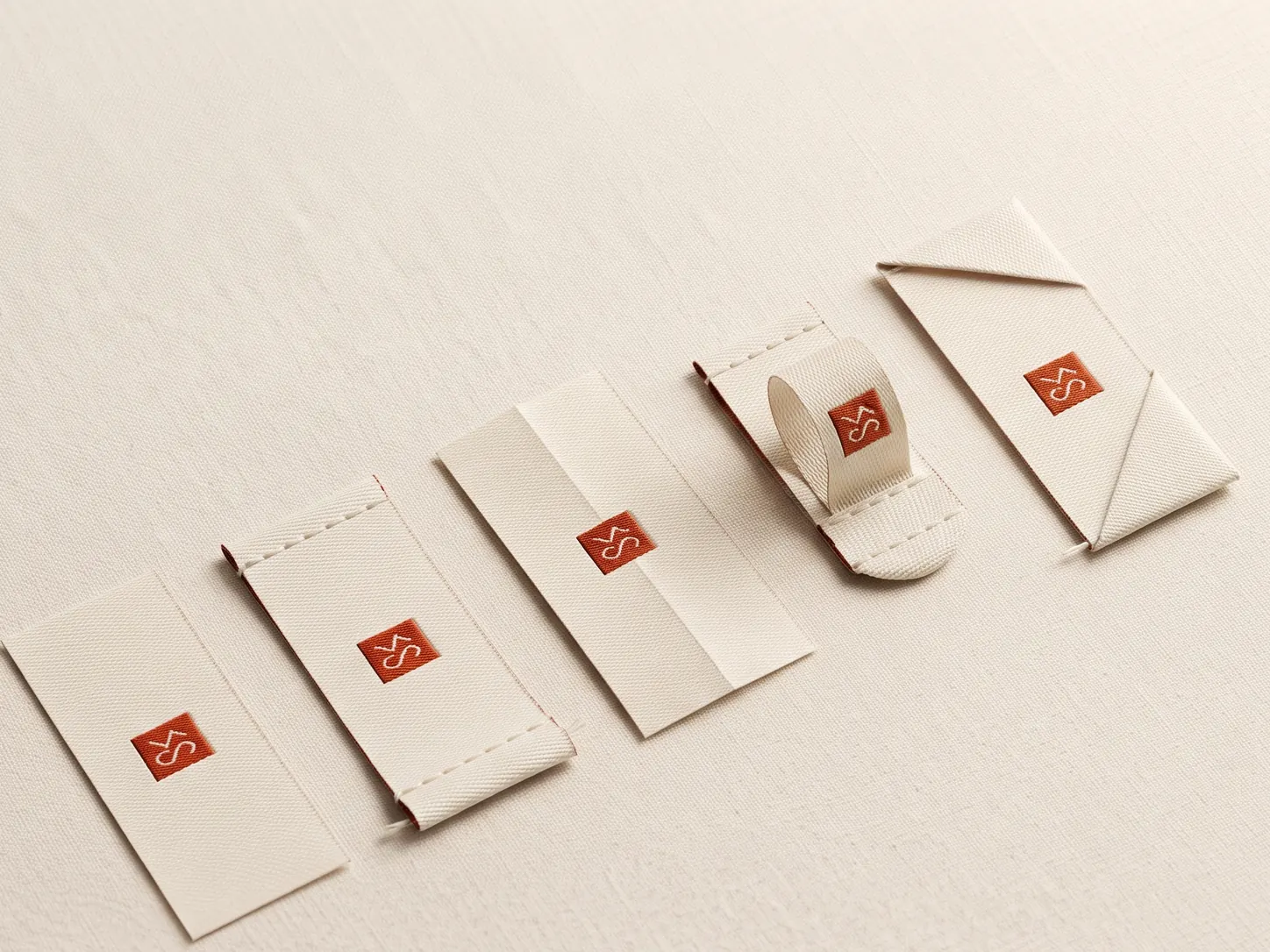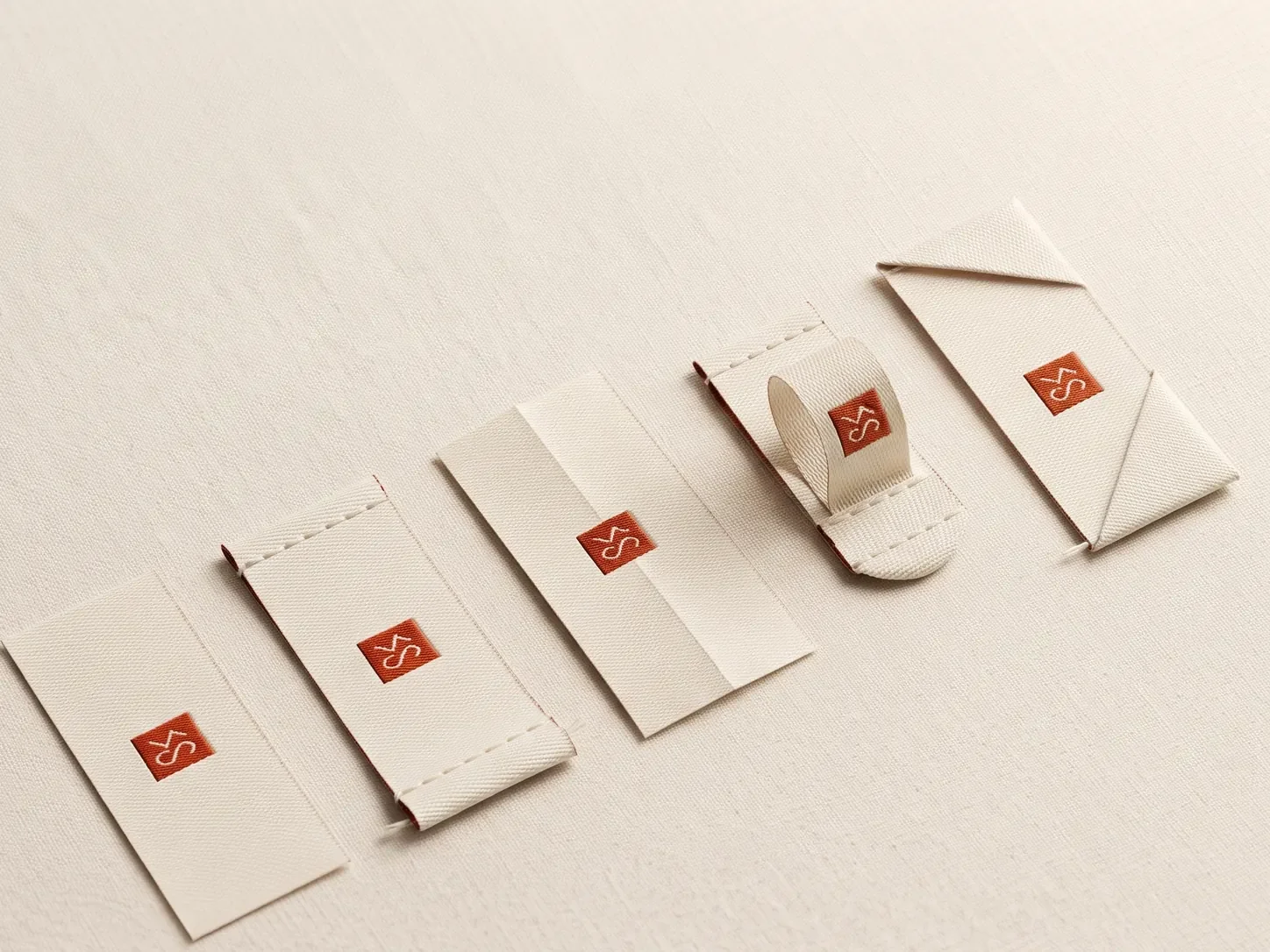
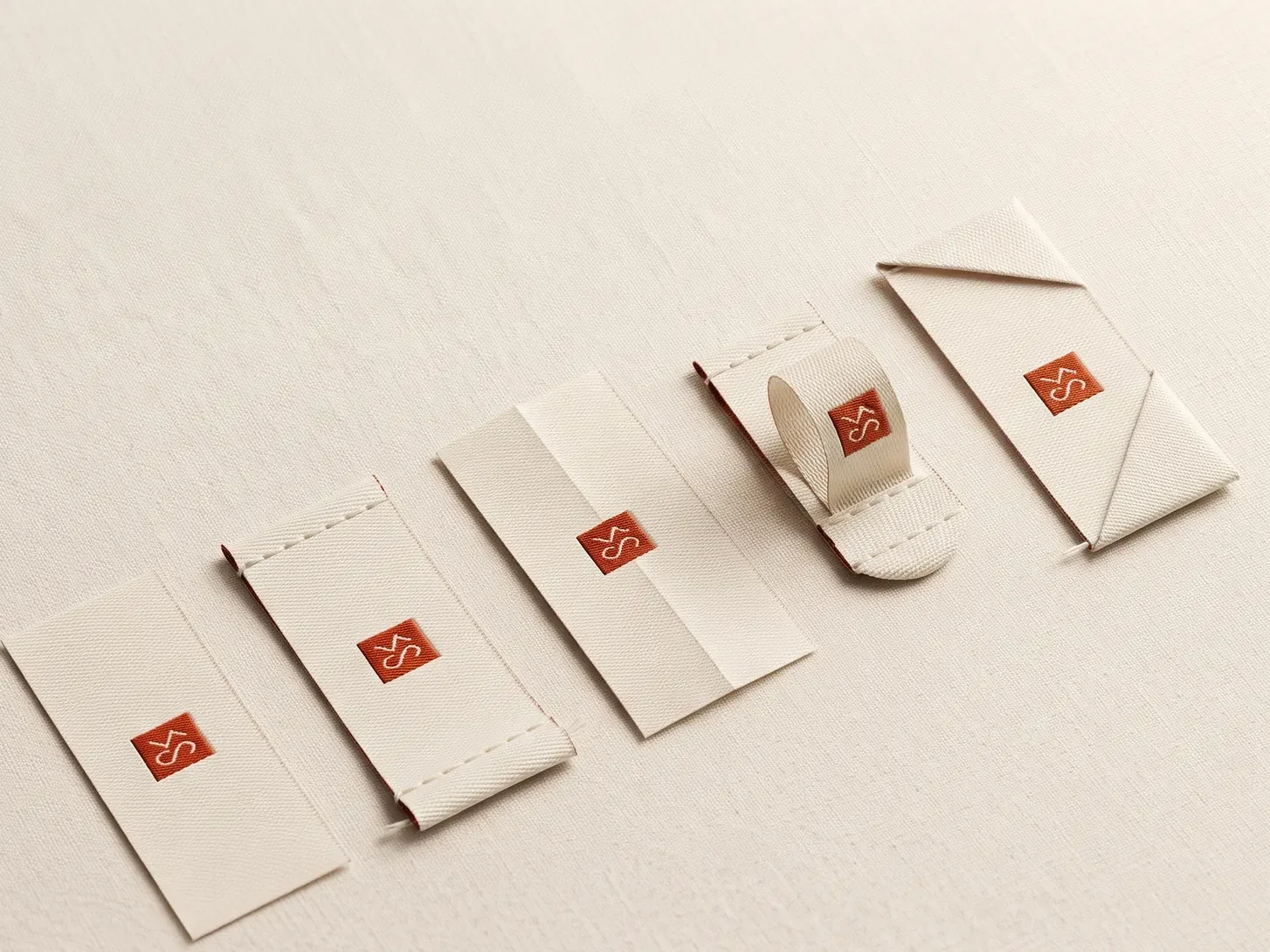
In brief
The key feature is the panel relationship: one panel carries the visible brand artwork, while another panel folds behind or alongside it for care, fibre, size or content information. The finished label is more structured than a simple centre fold and should be planned as a set of connected faces.
Labelwala has made folded woven and printed labels in Ahmedabad since 2000, quotes within 2 hours on a working day, and ships to more than 20 cities across India and more than 15 countries.
The Manhattan Fold Label is a specific label construction chosen for how its edges fold, how its panels sit and how it is attached to the garment. The fold changes the visible face, usable artwork area, sewing allowance and the way the label feels in the finished product. Fold allowances assume polyester satin or woven tape, which moves under 1% in a hot wash; untreated cotton tape can shrink 3 to 5%, so allow for it.
Two things are worth settling before anything else. The fold is dictated by how the garment is constructed, not by how the label looks, because a label meant to be caught in a seam is awkward to attach to a finished panel and the reverse is equally true. And the fold decides the flat size that actually has to be made, which is why it belongs in the quote rather than being treated as a finishing detail.
Defined fold
The fold line determines which edges or panels remain visible.
Made to brief
Unfolded size and allowance must be agreed before production.
Sample first
Sewn samples confirm the fold behaves correctly on the garment.
What is a Manhattan Fold label?
The key feature is the panel relationship: one panel carries the visible brand artwork, while another panel folds behind or alongside it for care, fibre, size or content information. The finished label is more structured than a simple centre fold and should be planned as a set of connected faces.
Preview this fold with your own artwork: the free label designer draws the flat piece, the turn-under and the visible face at true size, for every fold on this page.
How is the construction made?
The supplier weaves or prints a longer label strip with the panel sequence marked in the artwork. The strip is folded along its planned lines, aligned so the information panel sits correctly behind the brand panel, and then sewn into the garment or label stack.
Brief the supplier clearly: name the fold, give the finished visible size, provide the unfolded size and mark every fold line in the artwork proof.
Where is it used?
- Premium neck labels with brand and care information
- Garments that need a compact information stack
- Boutique, ethnic, denim and premium D2C apparel
- Labels where the brand face should remain the first thing the customer sees
Choose the fold by placement first. The right construction should support the seam, keep the label comfortable and make the intended face or panels easy to read.
Artwork and size planning
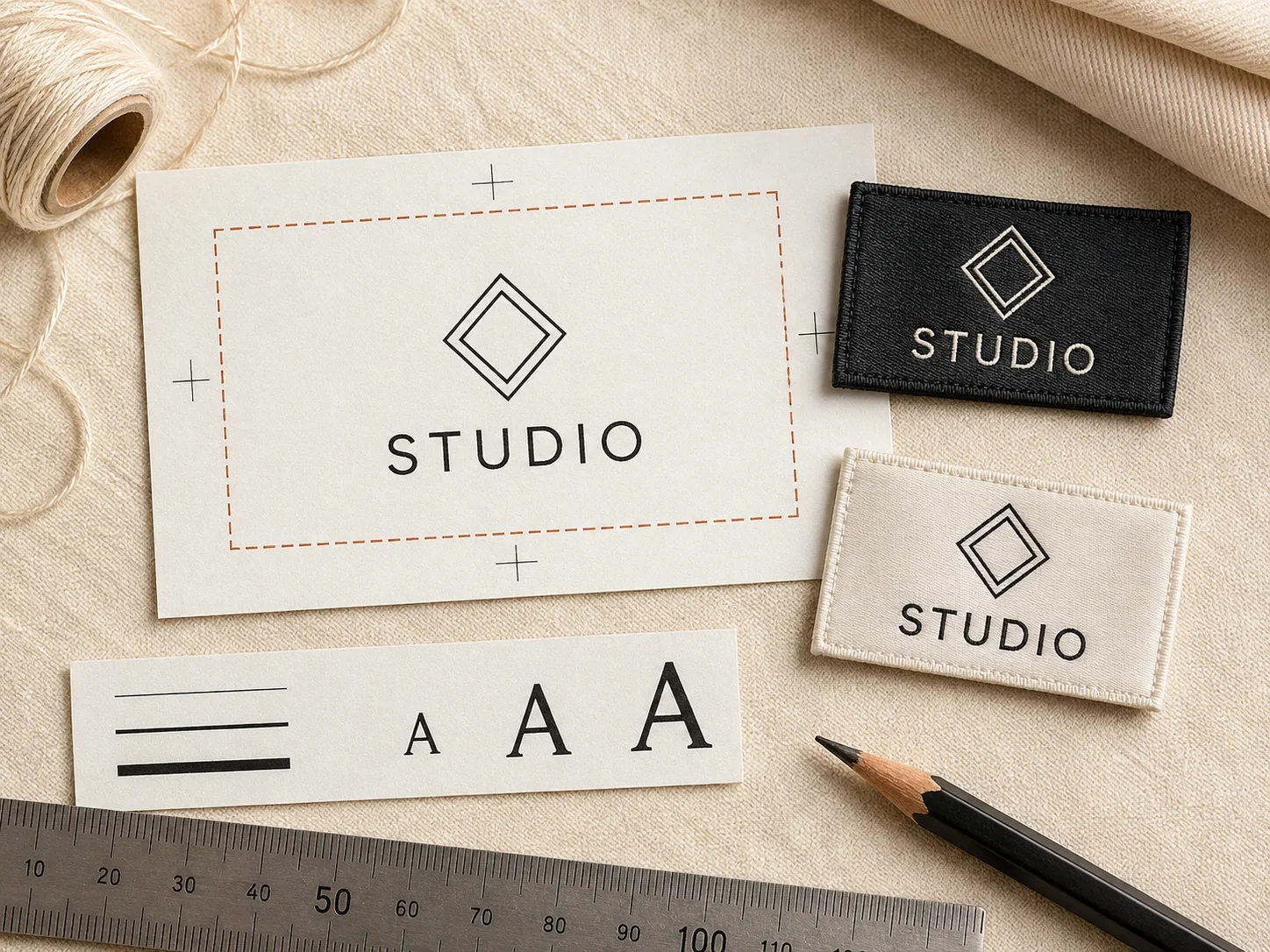
Treat each panel as a separate design area. Mark every fold line, reading direction and panel order. Keep key artwork away from fold lines and make sure the care or content panel remains legible when it is opened.
Specify the finished brand panel, information panel and total unfolded strip. A Manhattan fold can look compact when finished but needs enough unfolded length for every face and fold allowance.
- Show the finished visible face or closed panel size.
- Show the full unfolded strip and every fold allowance.
- Mark safe areas, reading direction and the stitch or seam zone.
- Approve the artwork at actual size, then check a physical sample.
Sewing and sample approval
The main brand face is usually secured at the neck or seam while the information panel remains behind it or opens as intended. Check that the fold is not trapped, twisted or sewn through important information.
Check the sample on the actual garment, not only on a flat table. Look for a straight fold, even edges, comfortable contact, secure stitching and the correct artwork direction.
Which materials suit this fold?
Manhattan folds stack panels, so every material decision is multiplied by the number of layers. A weight that feels right as a single flat label becomes noticeably bulky once it is folded into three, and that bulk is what a customer feels at the neck. The usual mistake is choosing the material for how the face looks rather than for how the stack behaves.
Stacking pushes the choice towards lighter, more supple materials than you would pick for a single-panel label. A fine printed satin folds into a soft stack; a heavy damask folds into a wedge. If the brand face needs the presence of damask, one workable compromise is a damask outer panel with a lighter printed inner panel carrying the information.
Crease retention is the other requirement. The panels have to stay closed in the right relationship, and a material that springs back will let the label gape open in the garment. Synthetics hold a heat-set crease well; cotton tape does not, which is why it is rarely used for multi-panel constructions despite being pleasant in other respects.
- Printed satin: the usual choice. Light, supple, folds into a soft stack and takes small care type cleanly.
- Light woven taffeta: holds a crease well and keeps the stack thin.
- Damask outer with printed inner: a good compromise where the brand face needs presence.
- Heavy damask throughout: avoid. Folded into panels it becomes a wedge at the neck.
- Cotton tape: attractive but poor at holding a crease, so the label gapes open.
Where does it sit on the garment?
The Manhattan fold exists to solve a specific problem: a garment that needs brand presence and a meaningful amount of care and content information, without a long strip hanging down the inside. It belongs where a customer expects to find the brand, which in practice means centre back neck.
Because the label is thicker than a single panel, position it where the garment can absorb it. A neck seam with a facing behind it takes the bulk comfortably; a single lightweight layer does not, and the stack will show as a raised patch from the outside.
Consider how the wearer reaches the inner panel. The whole point of the construction is that the information is there when needed, so the label has to open without unpicking. A panel arrangement that requires a fingernail to prise apart defeats its own purpose.
On next-to-skin garments, think twice. A folded stack at the neck is exactly the thing customers cut out. If the range is close-fitting, the honest answer may be tagless printing plus a simple brand tab rather than a multi-panel label.
- Centre back neck, with a facing behind: the standard, where the seam can absorb the bulk.
- Inside a waistband: for trousers and skirts, where there is structure to sew into.
- Side seam on outerwear: where neck space is limited by a collar or hood.
- Not on unlined lightweight garments, where the stack shows through from the outside.
- Not against skin on close-fitting styles, consider tagless instead.
Working sizes
Give the finished closed size, the size of each panel, and the total unfolded length including every fold allowance. The number of panels is the detail most often omitted, and it is the one that determines everything else.
| Use | Finished face | Unfolded |
|---|---|---|
| Two-panel, brand plus care | 30 × 20 mm closed | 30 × 45-50 mm unfolded |
| Two-panel, wider face | 40 × 25 mm closed | 40 × 55-60 mm unfolded |
| Three-panel, brand plus care plus origin | 35 × 22 mm closed | 35 × 70-78 mm unfolded |
| Three-panel, export with two languages | 40 × 25 mm closed | 40 × 80-90 mm unfolded |
| Compact two-panel for kidswear | 25 × 18 mm closed | 25 × 40-44 mm unfolded |
What goes wrong with this fold?
- Giving the closed size only, so the supplier cannot work out the panel layout.
- Not stating how many panels the label has.
- Choosing a heavy damask and producing a wedge at the neck.
- Laying out artwork on the flat file without accounting for which panel ends up where.
- Putting the care information on a panel that is hidden once the label is sewn in.
- Setting type close to a fold, so a crease runs through a line of text.
- Forgetting that alternate panels may need rotating to read the right way up when opened.
- Specifying a multi-panel label for a close-fitting garment where it will be cut out.
Panel orientation is the error that survives proofing most often, because on a flat artwork file every panel is the right way up. Ask the supplier to show the proof as it will be folded, not as it is printed, and check each panel individually.
The second is bulk, and it only becomes obvious on a sewn sample. A three-panel label in the wrong material can be twice the thickness the buyer imagined, and there is no way to feel that from a specification. Always sample this construction in the garment.
What does it cost to make?
A Manhattan fold uses considerably more material than its closed size suggests, two panels roughly double it, three roughly triple it, before fold allowances. That material is the main cost, and it is why a compact-looking label can be quoted higher than a larger single-panel one.
Folding multiple panels accurately is also a slower finishing operation than a single fold, and the setup has to be right before the run starts. On short runs that setup is a meaningful share of the price; on longer runs it disappears into the volume.
Set against that, the construction can replace two separate labels with one, which saves a sewing operation on the garment. If you are currently sewing a brand label and a care label separately, the comparison is not label-against-label but label-plus-operation against label-plus-operation.
How does it hold up in wear?
Multi-panel labels wear at the folds, not on the faces. The outer crease takes the abrasion of the garment moving against it, so the printed or woven surface at that fold line degrades first while the protected inner panels stay pristine for years.
That is actually the construction’s quiet advantage for compliance: the care and composition information sits on an inner panel, shielded from wear, and remains legible long after an exposed care label would have faded. Where a garment has a long service life, this is a real argument for the fold.
What does fail is the crease itself. A label that has relaxed open sits proud in the neck and catches, which is both uncomfortable and untidy. Ask whether the folds are heat-set not merely pressed, and check the sample after a hot wash rather than a cold one.
Sample checklist
Sample this one sewn into the garment and then open it, close it, and wash it. A multi-panel label has to work as a mechanism, not just look right.
- Is every panel the right way up when the label is opened?
- Is the closed size what you specified, not the unfolded size?
- Does the label open easily without needing to be prised apart?
- Does it close again and stay closed?
- Is the stack thin enough that it does not show from the outside of the garment?
- Does any text sit on a crease?
- Is the care information on a panel that is accessible once sewn in?
- Does the fold still hold after a hot wash?
- Is it comfortable against skin, if it sits anywhere that touches?
How do you brief it to a supplier?
A brief that works: Manhattan fold labels, three panels, 35 × 22 mm finished closed size, 35 × 74 mm unfolded including fold allowances, printed satin, brand on the outer panel and care plus composition on the inner panels, folds heat-set, sewn into the centre back neck seam with facing, 2,000 pieces.
The brief gives production the construction, the finished size, the hidden allowances and the placement, which is everything needed to quote and proof without a follow-up call.
Getting manhattan fold labels made at Labelwala
We make woven and printed labels in Ahmedabad, Gujarat, and we have been doing it for 25 years. Fold constructions like this one are quoted from the finished size plus the hidden allowances, so the two numbers matter more than anything else you send.
- Minimum order: 1,000 pieces.
- Shipping: pan-India to 20+ cities and export orders to 15+ countries.
- Experience: making labels in Ahmedabad since 2000.
- Shrinkage: polyester satin and woven labels move under 1% in a hot wash; untreated cotton tape can shrink 3 to 5%.
- Quotes: we usually reply within 2 hours on a working day.
- Production: 7-10 days once artwork is approved. Rush jobs run 3-5 days.
- Delivery: nationwide within India, timed by destination and the size of the consignment.
If you are not certain the fold is right for your garment, send a photo of where the label will sit with a ruler beside it. That tells us more than a description, and we can say whether the construction will lie flat there before anything is made.
We are rated 5.0 on Google from 27 reviews. Ask for a sewn sample rather than a loose one. A fold only shows its real behaviour once it is in a seam.
When should you choose this fold?
Choose Manhattan fold when one compact label needs a brand panel plus a second information panel. Choose centre fold for two simpler faces. Choose book cover fold when several panels must open like a small booklet.
- Confirm where the label will be seen.
- Choose the face or panel arrangement.
- Share folded and unfolded measurements.
- Approve a sewn sample before bulk production.
Final recommendation
Manhattan Fold Label works when its fold matches the garment construction and the artwork respects the hidden allowances. If you are comparing all options, use the complete fold and finishing guide before requesting a quotation.