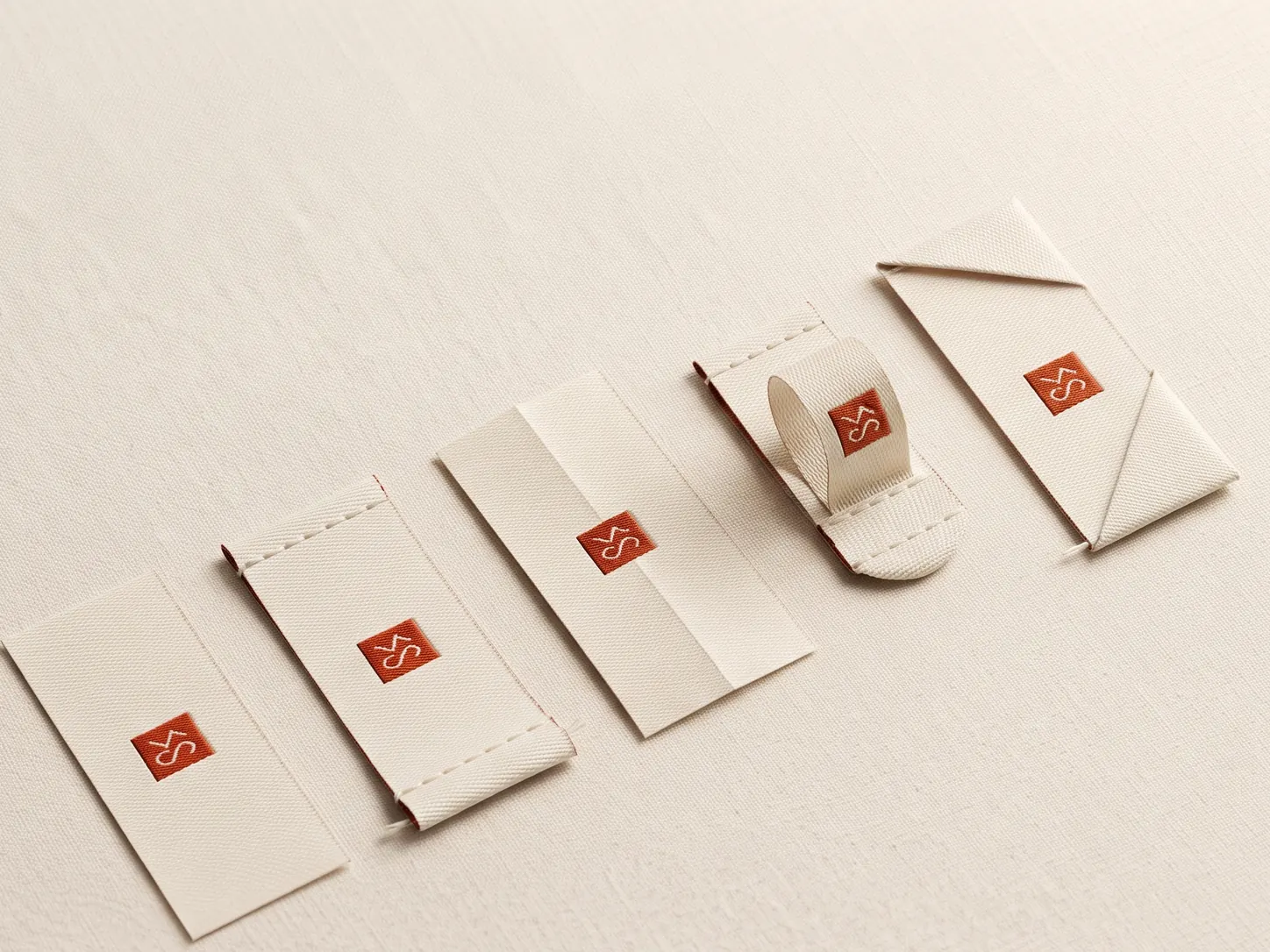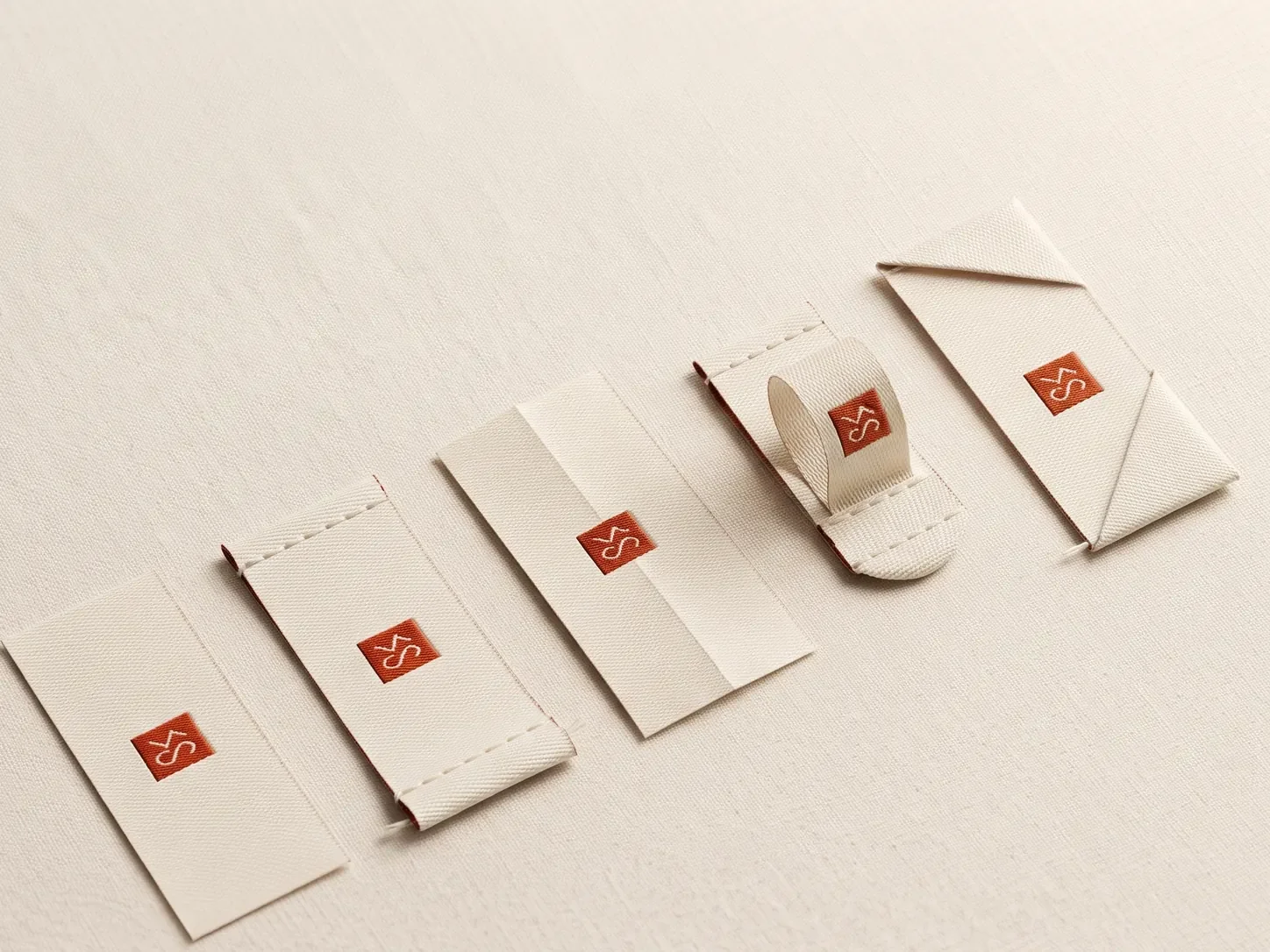
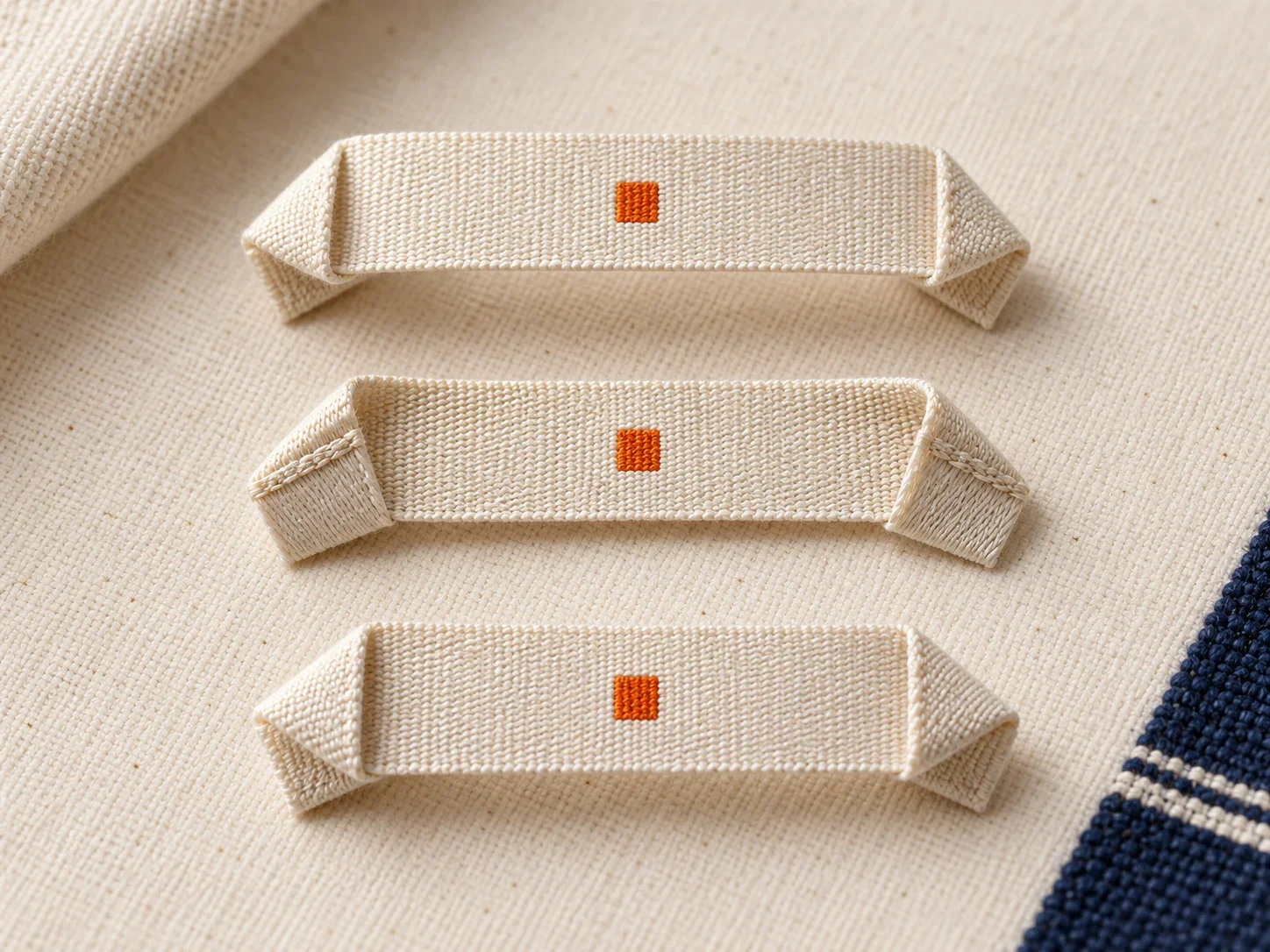
In brief
The defining feature is the balance of the loop: the visible or hidden loop sections are planned to match so the label does not lean or favour one side. This is useful when the label must hang centrally or sit symmetrically in a seam.
Labelwala has made folded woven and printed labels in Ahmedabad since 2000, quotes within 2 hours on a working day, and ships to more than 20 cities across India and more than 15 countries.
The Hanger Loop Even Label is a specific label construction chosen for how its edges fold, how its panels sit and how it is attached to the garment. The fold changes the visible face, usable artwork area, sewing allowance and the way the label feels in the finished product. Fold allowances assume polyester satin or woven tape, which moves under 1% in a hot wash; untreated cotton tape can shrink 3 to 5%, so allow for it.
Two things are worth settling before anything else. The fold is dictated by how the garment is constructed, not by how the label looks, because a label meant to be caught in a seam is awkward to attach to a finished panel and the reverse is equally true. And the fold decides the flat size that actually has to be made, which is why it belongs in the quote rather than being treated as a finishing detail.
Defined fold
The fold line determines which edges or panels remain visible.
Made to brief
Unfolded size and allowance must be agreed before production.
Sample first
Sewn samples confirm the fold behaves correctly on the garment.
What is a Hanger Loop Even label?
The defining feature is the balance of the loop: the visible or hidden loop sections are planned to match so the label does not lean or favour one side. This is useful when the label must hang centrally or sit symmetrically in a seam.
Preview this fold with your own artwork: the free label designer draws the flat piece, the turn-under and the visible face at true size, for every fold on this page.
How is the construction made?
The face and loop are measured as one construction, with the loop length and side exposure controlled during folding and sewing. The supplier checks the centre line, attachment points and final balance before bulk production.
Brief the supplier clearly: name the fold, give the finished visible size, provide the unfolded size and mark every fold line in the artwork proof.
Where is it used?
- Symmetrical hanging labels
- Balanced side-seam labels
- Bags, caps and accessories
- Products where a centred loop improves presentation
Choose the fold by placement first. The right construction should support the seam, keep the label comfortable and make the intended face or panels easy to read.
Artwork and size planning
Centre the front artwork on the face and show a centre line in the proof. Mark equal loop sides, the finished top direction and the section that will be inserted into the seam.
Provide the face width and height, total loop length, equal side exposure and seam allowance. Confirm the closed or sewn size because the visible loop balance can change once the label is attached.
- Show the finished visible face or closed panel size.
- Show the full unfolded strip and every fold allowance.
- Mark safe areas, reading direction and the stitch or seam zone.
- Approve the artwork at actual size, then check a physical sample.
Sewing and sample approval
Align the centre line with the garment or product seam, then stitch through the planned allowance. Check both loop sides from the front and back so the label hangs evenly without twisting.
Check the sample on the actual garment, not only on a flat table. Look for a straight fold, even edges, comfortable contact, secure stitching and the correct artwork direction.
Which materials suit this fold?
Symmetry is the whole point of an even hanger loop, and material behaviour is what makes symmetry survive production. A tape that relaxes unevenly, or that has any directional bias in its weave, will pull one side of the loop shorter than the other after a few wears, and on a construction chosen specifically for balance, that is the one fault nobody will accept.
Consistency matters more here than absolute strength. A woven damask or a good taffeta is stable in both directions and holds its dimensions; a soft cotton tape stretches, and it rarely stretches equally on both sides. If the label has to look balanced for the life of the garment, that argues strongly for woven.
Ask specifically about the cut direction. A tape cut with the loop length along the warp behaves differently from one cut across it, and if the two sides of your loop were cut in different orientations they will not age the same way. On a symmetrical construction that is a real risk rather than a theoretical one.
- Woven damask: the most dimensionally stable and the safest for a construction judged on balance.
- Woven taffeta: stable and economical; confirm both sides are cut in the same direction.
- Printed satin: only where the loop is decorative and carries no load.
- Cotton tape: attractive for natural ranges but prone to uneven relaxation, the main enemy of symmetry.
- Avoid mixing materials between the face and the loop, since they will not age at the same rate.
Where does it sit on the garment?
An even hanger loop is chosen where the label has to read as centred and balanced, hanging from a single point, or sitting in a seam where both sides are visible at once. Because the construction advertises its own symmetry, any deviation is immediately obvious in a way it would not be on an ordinary loop.
That makes placement accuracy unusually important. The loop must be centred on the garment, and the two sides must be caught into the seam at the same depth. An operator who takes 2 mm more on one side than the other produces a label that visibly leans, and no amount of quality in the label itself will disguise it.
The commonest positions are centre back neck on outerwear and centre back waistband on trousers and skirts. Both are places where the garment hangs from the label, so level hanging is functional as well as cosmetic.
Some ranges use an even loop purely as a decorative tab at a hem or side seam, where both loop sides show and the symmetry is the design. In that case the load requirement disappears and the material choice widens considerably, say which you are doing.
Whichever position you choose, hold it constant across the range. An even loop draws the eye precisely because it is symmetrical, so a customer comparing two garments will notice if it sits at a different height on one of them. Consistency of placement matters as much here as the symmetry of the label itself.
- Centre back neck: the standard, with both sides caught at equal depth.
- Centre back waistband: on trousers and skirts hung from the waist.
- Decorative hem tab: where both loop sides are visible and carry no weight.
- Between two panels in a seam, where the symmetry frames the join.
- Not where only one side will show. An ordinary loop is simpler and cheaper there.
Working sizes
Give the finished face, the finished loop opening, the total unfolded tape length, and, the one that matters most here, the seam allowance for each side, stated as equal. Symmetry is a tolerance instruction as much as a dimension.
| Use | Finished face | Unfolded |
|---|---|---|
| Small decorative tab | 20 × 15 mm face | 70-80 mm total |
| Shirt or light jacket | 25 × 15 mm face | 85-95 mm total |
| Jacket, load-bearing | 30 × 20 mm face | 110-125 mm total |
| Heavy coat | 35 × 20 mm face | 130-150 mm total |
| Waistband loop | 25 × 15 mm face | 80-90 mm total |
What goes wrong with this fold?
- Specifying the total length but not that both seam allowances must be equal.
- Letting the two sides be cut in different weave directions, so they age differently.
- Choosing cotton tape, which relaxes unevenly and destroys the symmetry.
- Setting the loop off centre on the garment, so it leans despite being symmetrical itself.
- Catching one side deeper than the other on the sewing line.
- Using an even loop where only one side is visible, and paying for symmetry nobody sees.
- Approving it flat rather than hung, where a lean is obvious.
Almost every complaint about an even hanger loop is about lean rather than quality, and lean is usually introduced at the sewing line rather than by the label maker. Specify equal seam allowances explicitly and ask for the first few off the line to be checked hanging, not flat.
The material trap is slower and harder to spot. A loop that is perfectly symmetrical on delivery can develop a lean over a season if one side stretches more than the other, which is why dimensional stability outranks softness in this construction.
What does it cost to make?
An even loop costs marginally more than an ordinary one, and the difference is precision rather than material. The tape length is comparable; what you are paying for is tighter tolerance in cutting and folding so the two sides genuinely match.
The larger cost, as with any loop, is the sewing operation, and here it is slower still, because the operator has to position two sides accurately instead of one. That sits with your garment maker rather than on the label invoice, and it is worth raising with them before you commit the range to this construction.
If the symmetry is decorative rather than functional, consider whether an ordinary loop with a well-centred face achieves the same visual result for less. On many garments it does, and the even construction is worth its cost only where both loop sides are genuinely on show.
How does it hold up in wear?
The failure mode specific to this construction is asymmetry developing over time rather than outright breakage. Both sides carry the load, so neither is under as much stress as a single-sided loop would be, which makes even loops durable in absolute terms and vulnerable to looking wrong long before they look worn.
Watch the two creases. If one side takes slightly more of the load, its crease deepens faster, and a deepened crease shortens that side fractionally. The effect compounds, which is why an even loop that leans slightly at six months tends to lean more at twelve.
Wash and hang-dry a sample and then compare the two sides against each other rather than against a measurement. Symmetry is judged by eye, and by eye is the only test that predicts what a customer will notice.
One more habit helps on repeat orders: keep an approved sample from the first run and compare later batches against it side by side. Symmetry drifts slowly and in small increments, so a batch that looks acceptable on its own can be visibly different from the one before it. The stored sample is what makes that comparison possible, and it costs nothing to keep.
Sample checklist
Hang the sample rather than laying it flat, and look at it straight on. An even loop is judged on balance, and balance only appears under load.
- Do both loop sides measure the same, and look the same hung?
- Are both seam allowances equal on the sewn sample?
- Is the loop centred on the garment as well as symmetrical in itself?
- Were both sides cut in the same weave direction?
- Does the face sit flat and level with the loop behind it?
- Does the loop pass over the hooks and rails the garment will meet?
- Does it still hang level after a wash and hang-dry?
- Is it caught into a substantial seam rather than lining alone?
How do you brief it to a supplier?
A brief that works: Even hanger loop labels, 30 × 20 mm finished face, 25 mm finished loop opening, 115 mm total tape length, equal 12 mm seam allowance both sides, both sides cut in the same weave direction, woven damask, navy with cream, centred at the back neck seam, 2,000 pieces.
The brief gives production the construction, the finished size, the hidden allowances and the placement, which is everything needed to quote and proof without a follow-up call.
Getting hanger loop even labels made at Labelwala
We make woven and printed labels in Ahmedabad, Gujarat, and we have been doing it for 25 years. Fold constructions like this one are quoted from the finished size plus the hidden allowances, so the two numbers matter more than anything else you send.
- Minimum order: 1,000 pieces.
- Shipping: pan-India to 20+ cities and export orders to 15+ countries.
- Experience: making labels in Ahmedabad since 2000.
- Shrinkage: polyester satin and woven labels move under 1% in a hot wash; untreated cotton tape can shrink 3 to 5%.
- Quotes: we usually reply within 2 hours on a working day.
- Production: 7-10 days once artwork is approved. Rush jobs run 3-5 days.
- Delivery: nationwide within India, timed by destination and the size of the consignment.
If you are not certain the fold is right for your garment, send a photo of where the label will sit with a ruler beside it. That tells us more than a description, and we can say whether the construction will lie flat there before anything is made.
We are rated 5.0 on Google from 27 reviews. Ask for a sewn sample rather than a loose one. A fold only shows its real behaviour once it is in a seam.
When should you choose this fold?
Choose even hanger loop when symmetry is the priority. Choose ordinary when a standard loop rises behind the face. Choose reverse when the loop must fall behind in the opposite orientation.
- Confirm where the label will be seen.
- Choose the face or panel arrangement.
- Share folded and unfolded measurements.
- Approve a sewn sample before bulk production.
Final recommendation
Hanger Loop Even Label works when its fold matches the garment construction and the artwork respects the hidden allowances. If you are comparing all options, use the complete fold and finishing guide before requesting a quotation.