
In brief
Corporate uniforms need a discreet woven company logo label, damask for a fine crest, placed inside the collar stand, breast pocket or jacket lining. Add a printed satin size label in a side seam, a care label matched to professional cleaning, and an asset code instead of a woven name so pooled garments can be reissued.
Most uniform-label advice is written for blue-collar workwear (security, hospitality, industrial), where the priorities are durability and big, readable name and number tags. Corporate and office uniforms are a different brief. A formal shirt or blazer needs branding that's discreet, premium and tailored, reinforcing the company image without shouting.
This guide covers the labels corporate uniforms actually need, the best materials for formal wear, placement, and how to source them for a team of any size.
What labels do corporate uniforms need?
- Woven, at the neck or inside pocket
- Reinforces brand on every garment
- Damask for a fine company crest
- For sorting, reissue & laundry
- Printed satin in a side seam
- Prevents post-wash mix-ups
- For assigned garments
- Woven, printed or heat-seal
- Or an asset code for pooled kit
- Wash symbols & fibre content
- Survives professional cleaning
- Side-seam placement
What is the best label type for formal wear?
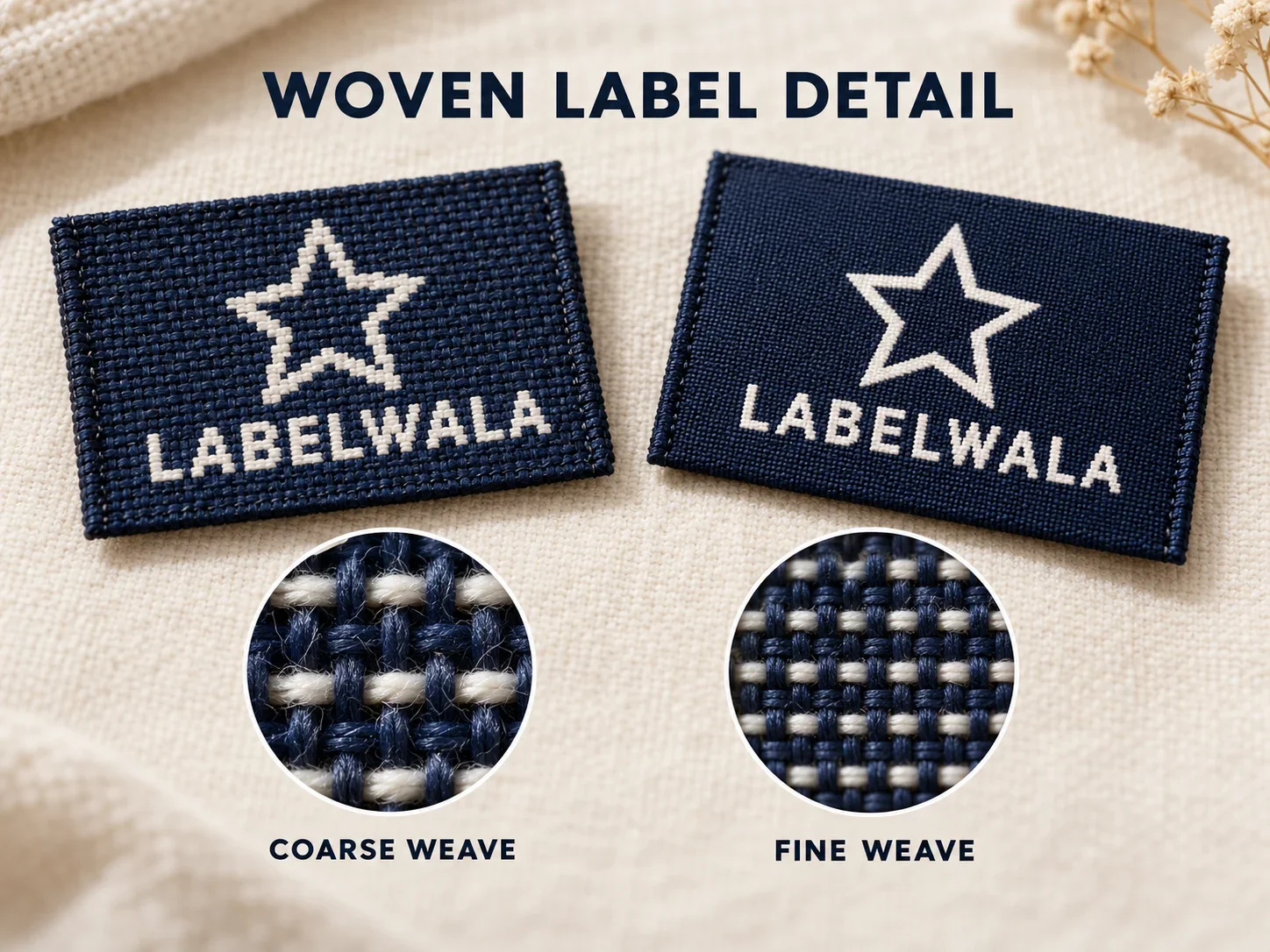
For corporate shirts and blazers, woven labels are the standard: they look premium, survive repeated laundering, and match the tailored feel of formal wear. For the finest logo detail, a damask woven label renders a company crest beautifully.
Finest detail for a corporate crest or logo. Where blazers and formal shirts usually land.
Durable, tailored, cost-effective for simpler logos. The workhorse for corporate shirts.
Comfortable and cheap for care and size info in a side seam. Full-colour if needed.
For names or asset codes on assigned garments; survives industrial laundering.
How does corporate labelling differ from blue-collar?
- Discreet, premium, tailored
- Subtle woven logo, inside-pocket label
- Brand image is the priority
- Durable, high-vis, heavy-duty
- Large name & number tags
- Laundering resistance is the priority
The materials overlap, but the design intent differs. If you run blue-collar uniforms too, see our supplier guides for security and hospitality uniforms.
Where each label goes
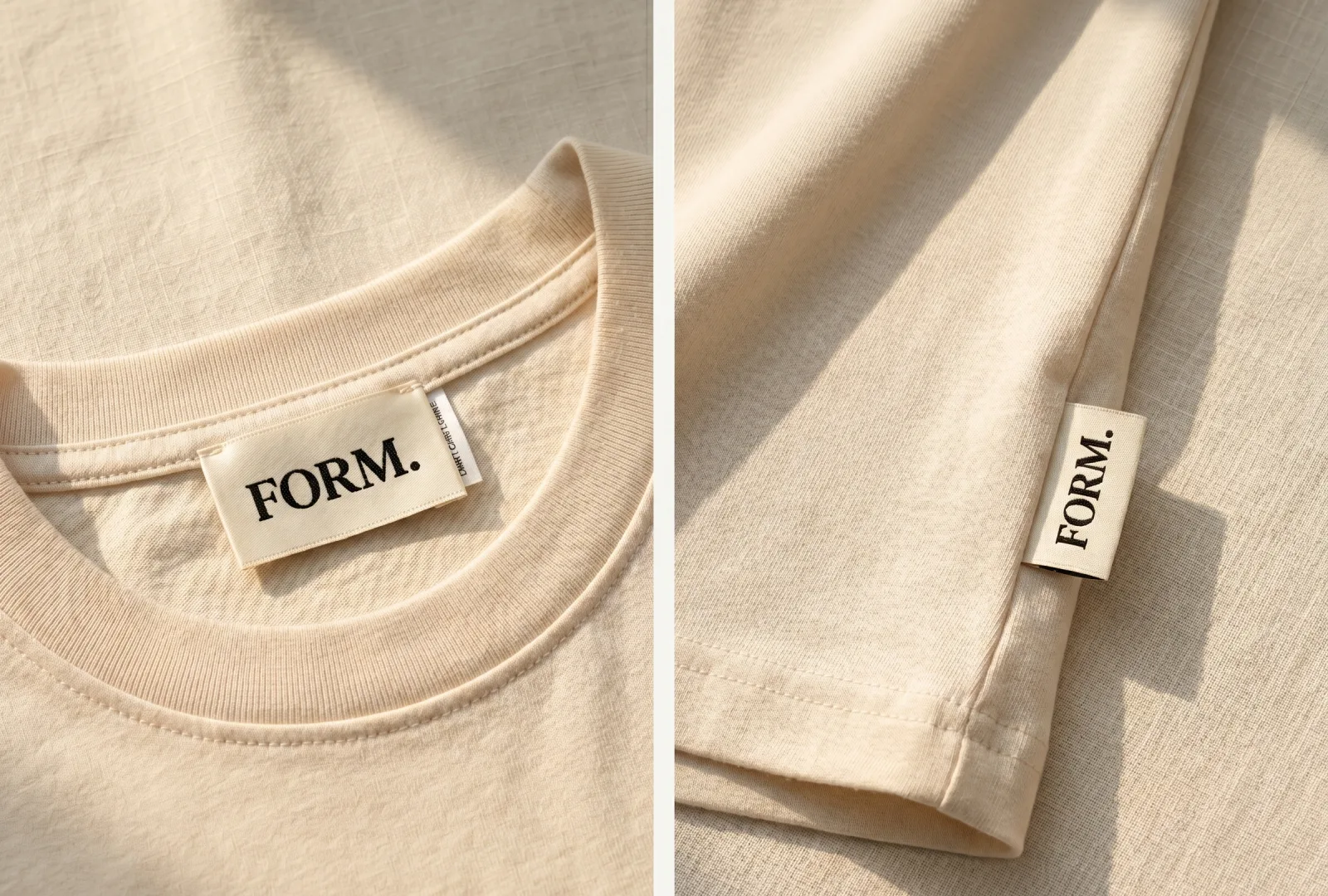
Discreet woven company logo at the centre-back neck or near the placket.
An inside-pocket woven label reads as premium and tailored.
Care and size labels, plus asset code, in the side seam.
Name or department tab where the uniform policy needs it.
Sourcing for a team of any size
Order the logo label in bulk once. Your company logo label is reusable across every garment and season, so a larger single run is very economical per piece. Add size and name tags per batch as you kit out new joiners.
Add asset codes for pooled uniforms. Where garments rotate rather than being personally assigned, a size + asset-code label beats a fixed name: it survives the laundry cycle and keeps issue-and-return simple.
Where does the logo actually go on formal wear?
The discreet brief has a practical consequence: there are fewer acceptable positions than on casual uniform, and the ones that work are specific.
- Inside the collar stand on shirts. Invisible when worn, visible when the shirt is handled or hung, which is exactly the balance corporate wear wants.
- Inside the breast pocket, or on the pocket bag. A favourite for premium programmes because it is discovered rather than displayed.
- Inside the jacket lining at the inner chest, where tailoring conventionally carries a maker’s label.
- Under the back collar of a blazer, sewn to the lining rather than the shell.
- Not on the outside of a formal garment. An external logo tab reads as casual and undoes the tailored effect the uniform is buying.
The size label belongs somewhere else entirely, and this is the split that corporate programmes most often get wrong by combining everything at the neck. Size wants to be findable quickly by whoever is sorting a laundry delivery or reissuing garments, a side seam or an inside waistband, not the collar.
On blazers in particular, remember the label is sewn to the lining rather than the shell, so it has to be specified to the garment maker as a lining operation. That is a different instruction from a shirt label and is worth stating explicitly.
Keep placement identical across the whole programme. Someone handling four hundred shirts should find the same information in the same place on every one, and that consistency is worth more operationally than any individual placement choice.
How does professional cleaning change the specification?
Corporate uniforms are often dry-cleaned or sent to a commercial laundry rather than washed at home, and that is a harsher environment than a domestic machine in a different way, solvents rather than heat, and far more cycles per year than a personal garment sees.
- Care symbols must reflect the actual process. If blazers go to a dry cleaner, the label needs the professional-care circle with the correct solvent letter, not a domestic wash symbol.
- Woven survives solvents better than printed. On garments going through repeated professional cleaning, woven is the safer specification for anything that must stay legible.
- Frequency compounds. A garment cleaned weekly for three years sees more cycles than most retail clothing sees in its life.
- Say it in text as well as symbols where the process is unusual, because a commercial cleaner reads the label rather than your policy document.
Set the symbols to ISO 3758 and confirm them against how the garments will genuinely be cleaned, not against a template. Our care symbol guide covers choosing them for the fabric.
Names or asset codes: which survives reissue?
A name tag is the obvious solution for assigned uniforms and the wrong one for most programmes, because it makes the garment single-use. When that person leaves, a perfectly good blazer becomes unissuable.
The alternatives, in rough order of how well they survive turnover:
- Asset code only. A number woven or printed on the size label, tracked against whoever currently holds it. The garment outlives the employee, and the tracking sits in your records rather than on the cloth.
- Barcode or QR asset tag, which does the same thing and can be scanned at issue and return. Printed on taffeta, this scans reliably.
- Removable name tag: a badge or a heat-seal tab that can be replaced without touching the garment.
- Permanently woven name, which looks best and is the least flexible. Reserve it for senior or long-tenure roles where the garment genuinely stays with one person.
For pooled uniform, size plus asset code is almost always the right answer. It survives the laundry cycle, makes issue-and-return simple, and means your stock is fungible rather than fragmented into hundreds of one-person garments.
Planning a rollout, and the joiners after it
Uniform programmes are ordered as a project and then need servicing as a process, and the labels are where that distinction bites. The initial rollout is easy to quantify; what follows is not.
- New joiners arrive continuously, in sizes you cannot predict.
- Replacements for damaged and worn garments run at a steady rate once the programme is a year old.
- Size changes mean reissuing existing staff.
- New locations or departments may need a variant.
The practical answer is to hold buffer stock of the label itself rather than reordering small quantities repeatedly. Your company logo label does not change between batches and does not perish, so ordering it well ahead of immediate need is cheaper per piece, removes lead time from every future garment order, and, most importantly, keeps the colour identical across years. A logo label reordered in small batches from a fresh setup each time is exactly how a uniform programme drifts visibly out of alignment between the head office and the third branch.
A reasonable rule is to hold roughly a year of expected joiners and replacements in logo labels, reviewed annually. Size and asset labels are the ones to order per batch, since those genuinely vary. See our guide to keeping labels consistent across reorders for what to record so year three matches year one.
Sourcing corporate uniform labels at Labelwala
We make woven and printed labels in Ahmedabad, Gujarat, and we have been doing it for 25 years. Corporate programmes usually come as a set: a reusable logo label ordered in bulk, plus size and asset labels per batch.
- Minimum order: 1,000 pieces per design, which suits ordering the logo label ahead for the whole programme.
- Quotes: usually within 2 hours on a working day.
- Production: 7-10 days once artwork is approved. Rush jobs run 3-5 days.
- Care symbols: set to ISO 3758, matched to how the uniforms are actually cleaned.
- Delivery: across India, dispatched to a single site or to individual locations.
Send your logo, the garment types and how the uniforms will be cleaned. The cleaning answer changes the material recommendation, and a company crest with fine detail may need damask rather than a standard weave to hold it, worth resolving before artwork not at sampling.
If the programme covers several locations, order centrally rather than letting each site source its own. One order against one recorded specification is what keeps a uniform looking like a uniform, and it is considerably easier to arrange at the start than to correct once three branches have gone their own way.
We are rated 5.0 on Google from 27 reviews.
Common mistakes
- Putting an external branded tab on a formal garment and undoing the tailored effect.
- Combining logo, size and care into one label at the neck, so laundry staff have to read the brand label to find a size.
- Weaving employee names into garments that will be reissued.
- Printing domestic wash symbols on garments that go to a dry cleaner.
- Choosing a printed label for a garment professionally cleaned every week for three years.
- Submitting a detailed company crest without checking it can be woven at label size.
- Reordering the logo label in small batches, letting colour drift between locations.
- Using different placement at different sites, so nothing in the programme matches.
- Planning only the initial rollout and not the joiners and replacements that follow.
The recurring theme is that a uniform programme is a long-running operation not a one-time purchase. Decisions that look harmless on the first order (a name instead of an asset code, a small logo reorder) are the ones that become awkward in year two, when the garments are circulating and the original order is a long way back in someone else’s inbox.
The short answer
Corporate uniforms need a discreet woven company-logo label (damask for the finest crest), a size label for sorting and reissue, a care label that survives professional cleaning, and often a name or asset-code tag. The design goal is premium and tailored, not high-vis: a subtle neck or inside-pocket logo that reinforces a professional image. Order the reusable logo label in bulk and add size/name tags per batch. Send us your logo, sizes and quantity for a per-piece quote and a sample.