In brief
Printed labels put ink on satin or taffeta, giving full CMYK colour, gradients and small text, while damask is a high-density woven label whose colour is the thread itself and costs roughly three to five times more. Most brands use damask for the neck label and printed for the care label.
"Printed" is a category. "Damask" is a tier. So the printed-vs-damask comparison isn't quite apples to apples, but it's the question buyers ask because the two are often the finalists when they're choosing between vibrant full-colour artwork and a heritage woven feel.
This guide compares the printed label family (satin and taffeta substrates) against the premium woven tier (damask). By the end you'll know when full-colour print wins, when heritage damask is the only honest choice, and how to use both on the same garment without spending twice.
At a glance, printed vs damask
The decision splits along two axes: how colour-rich is the artwork, and how much premium-feel do you need to project.
What is a printed label (satin or taffeta)?
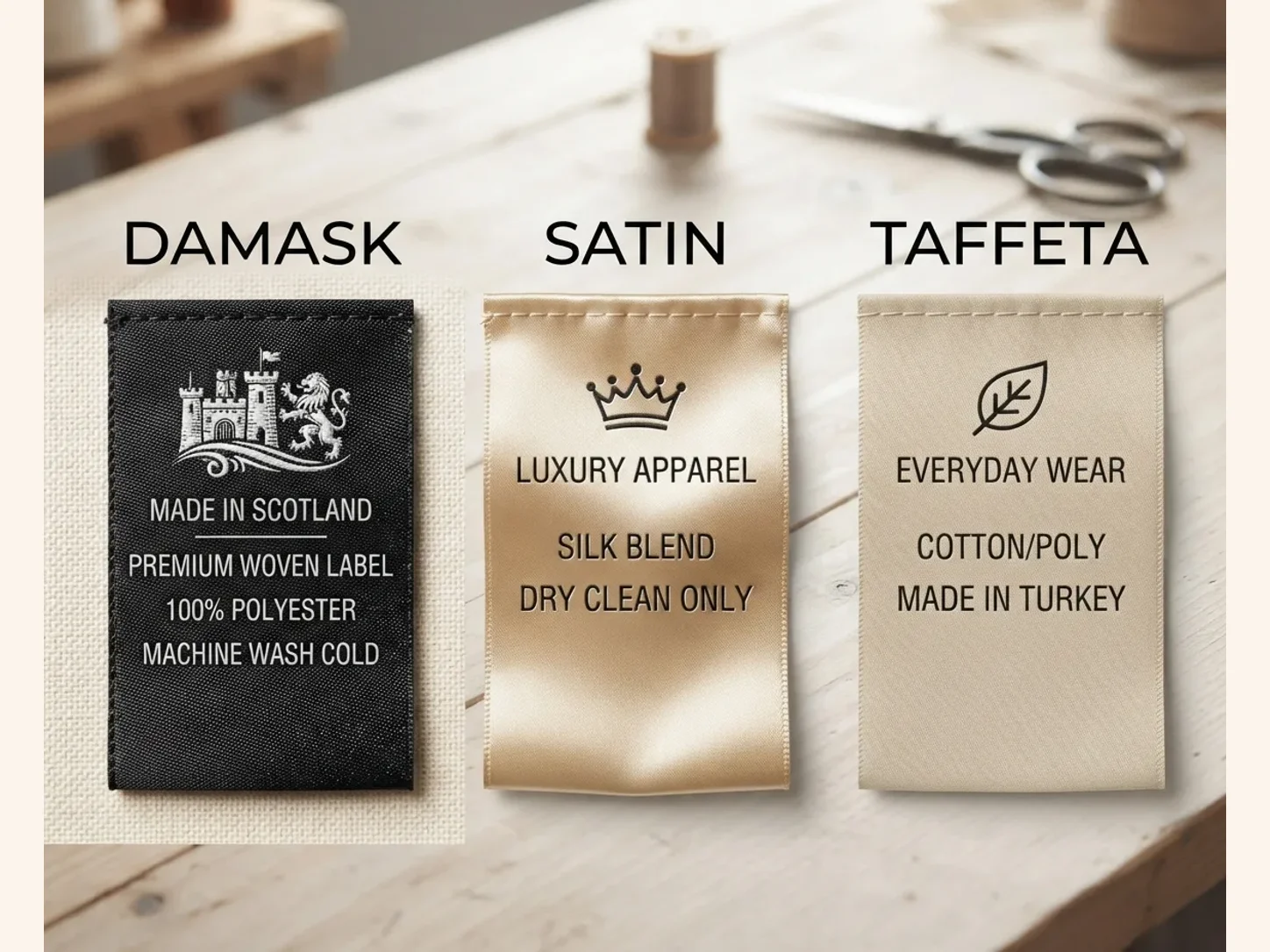
"Printed label" covers any clothing label where the artwork is applied via printing, usually dye sublimation, onto a polyester substrate. The two main substrates are satin (glossy, soft, premium contemporary) and taffeta (matte, sharp, export-grade). Both accept full CMYK including gradients.
- Substrate: polyester satin or nylon/polyester taffeta
- Process: dye sublimation, sometimes screen print
- Colour: full CMYK + gradients + photo detail
- Cost: ₹0.40-2 per piece at 1,000+ pieces
- Lead time: 5-7 days
What is a damask label?
Damask is the highest-density woven label: 10,000-12,000+ stitches per square inch using fine polyester thread in a satin-weave structure. Colour is structural (woven into the fibre), permanent, and the result is a silky finish with intricate detail.
- Substrate: polyester thread woven on jacquard loom
- Process: high-density jacquard weaving, satin weave structure
- Colour: 1-8 distinct thread colours; no gradients
- Cost: ₹1.70-8 per piece across MOQ range
- Lead time: 10-14 days
How do printed and damask labels compare?
- Full-colour artwork with gradients
- 3-5× cheaper than damask
- Faster turnaround (5-7 days)
- Handles photographic detail
- Works on care labels with dense ISO symbols
- Ink can fade over time (low-quality process)
- Doesn't read as "heritage" or "crafted"
- Less differentiation from mass-market printing
- Surface ink shows abrasion on rough fabric blends
- Permanent colour, woven into the thread
- Heritage / crafted feel, luxury default
- Silky finish, intricate detail
- Reads "made to last" at the rack
- Best at sub-15-mm-tall fine type
- 3-5× more expensive than printed
- Limited to 1-8 thread colours
- No gradients, no photo detail
- Longer lead time
- Wasted on simple wordmark-only artwork
How much more does damask cost than printed?
Representative pricing for a 25 × 40 mm centre-fold label, 2026:
Damask costs roughly 3-5× more than printed. The gap narrows at scale but the absolute rupee premium remains meaningful. ₹1.30 per piece at 10,000 units is ₹13,000 per 10K-batch.
Which should you pick for each garment type?
- D2C contemporary fashion
- Kidswear with bright artwork
- Activewear, athleisure, performance
- Care labels (any garment)
- Sub-₹3,000 retail price points
- Heritage / luxury fashion (₹5,000+ retail)
- Formal shirts, suits, blazers
- Premium denim & designer outerwear
- Saree blouse & bridal-wear
- Brands where "made to last" is the promise
Decision matrix, 30-second pick
Printed. At sub-mid-market price, the 3-5× damask cost is hard to justify on margin.
Printed. Damask can't reproduce gradients. Only printed methods can.
Damask. The crafted woven feel is structural to the brand story.
Damask. Structural colour never fades; ink prints eventually do under repeated wash.
Pro tips before you order
The smart hybrid: damask for the brand, printed for the care label. Damask at the visible neck (heritage feel) + taffeta-printed care label at the side seam (ISO-compliant, multilingual). You spend a bit more on the visible piece and save on the hidden piece.
If your artwork is simple wordmark-only, damask is overkill. The fine-detail advantage of damask is wasted on plain type. Standard woven gives 80% of damask's quality at half the cost, and printed satin can match damask's premium feel via sublimation on a glossy face.
Quick start: WhatsApp us your artwork and target retail price. We'll send a damask sample and a printed sample of the same artwork. You can hold them side-by-side. Message Labelwala or use the quote form.
Why is structural colour the real difference?
Everything else in this comparison follows from one fact: printed colour sits on the label, and damask colour is the label.
A printed label is dye or ink applied to an existing woven base. A damask label has no applied colour at all. The design is formed as the cloth is woven, from threads that were dyed before they reached the loom.
That has consequences beyond appearance:
- Damask colour cannot fade or crack, because there is no surface layer to lose. Printed colour is more durable than people expect on polyester, since sublimation bonds into the fibre, but it is still a surface.
- Damask cannot do gradients, because a thread is one colour along its length. A gradient can only be approximated by alternating threads, which reads as a coarse dotted transition at label size.
- Printed handles unlimited colours at no extra cost, while each damask colour is a separate thread and a separate setup step.
- Damask has texture you can feel with a fingertip. That tactile quality is most of what reads as heritage, and printing has no equivalent.
So the honest framing is not which is better. It is whether your artwork needs colour freedom or your positioning needs tactile quality, because you cannot have both in one piece.
Why does small text favour printed over damask?
Buyers usually assume the premium option handles detail better. On small text it is the opposite, and this catches people out.
Damask is the finest weave available, but it is still built from threads, and a thread is the smallest unit of detail it can produce. Below roughly 4 mm of letter height the enclosed gaps inside characters begin to close: the holes in 8, 6, 0 and R fill in first. Below about 0.5 mm a stroke has too few threads to exist and drops out.
Printing has no such floor at label sizes. That is why care labels, which carry composition, symbols, origin and sometimes two languages, are printed rather than woven. It is not a cost decision, it is the only way to fit the content and keep it legible.
The practical rule: if your mark is a clean wordmark or a simple emblem at 4 mm and up, damask will render it beautifully. If it has hairline serifs, small type or fine internal detail, printing will hold it and damask will not, however much you spend.
Should most brands use both printed and damask?
Framing this as a single choice is what makes it hard. A garment carries several labels, and each position has its own answer.
- Neck or brand label: damask, where the tactile quality is felt and the mark is simple enough to weave.
- Care label: printed, always. That volume of small text will not weave legibly at care-label size in any material.
- Size tab: match it to whichever label sits beside it, so the pair reads as a set.
- Anything with a photographic or full-colour element: printed, because damask has no mechanism for it.
Quoting the whole set as one job is cheaper than quoting the pieces separately, and it is the only reliable way to check they read as a family before anything is made. Ordering separately is where mismatched whites and slightly different brand colours come from, since printed white and woven white are produced by completely different means.
Where the cost difference comes from
Damask costs more for reasons that are physical rather than positional, which is worth knowing before deciding the premium is arbitrary.
It uses finer yarn at a higher thread count, so more picks have to be inserted per centimetre and the loom runs slower for the same length of tape. More thread, more machine time, more setup precision. The premium is buying a genuinely different manufacturing process, not a badge.
Printed labels invert this. The base material already exists on a roll and the design goes onto it, so adding colours costs nothing and the setup is a plate or a file rather than a re-threading. That is why printed starts cheaper and improves gently with volume, while woven starts expensive and falls faster.
There is a second cost that only appears later. Changing a colour on a damask label means re-threading the loom, so a small revision is a real job; changing a colour on a printed label is a file. If you expect the label to evolve, that flexibility has value and it sits on the printed side.
The practical consequence: at low volume the gap between them is at its widest, and at scale it narrows. If you are torn and the quantity is small, that is the moment the decision costs you most.
Ordering either from Labelwala
Labelwala has been making woven and printed labels in Ahmedabad, Gujarat, for 25 years.
- Minimum order: 1,000 pieces, counted per design rather than per order.
- Quotes: usually within 2 hours on a working day.
- Production: 7-10 days once artwork is approved. Rush jobs run 3-5 days.
Send the artwork and say which position each label goes in. If the mark has fine strokes or a gradient we will tell you before anything is made, and if a simpler woven grade would look identical to damask on your design, we will say that too. Send it at true size rather than enlarged, since how the mark holds at label scale is the only test that matters here.
We are rated 5.0 on Google from 27 reviews. Ask for both on a sample card if you are undecided, because the difference between them is almost entirely something you judge by hand.
Common mistakes
- Sending artwork with gradients or photographic elements for a damask quote.
- Choosing damask for a care label, where the small text will not weave legibly.
- Assuming the premium option handles fine detail better. On small text it is the opposite.
- Setting woven text below about 4 mm and expecting a finer weave to rescue it.
- Ordering a damask neck label and a printed care label separately, then finding the whites differ.
- Paying for damask on a mark simple enough that a standard woven label would look identical.
- Judging either from a screen instead of a physical sample, where the whole difference lives.
The recurring theme is treating this as a quality ladder when it is really two different processes with different strengths. Damask is not a better printed label, and printed is not a cheap damask.
The short answer
Printed for contemporary, colour-rich, cost-sensitive fashion. Damask for heritage, formal, luxury fashion above ₹3,000 retail. Mix them on the same garment if you want premium brand-label feel without paying damask premiums on every label position. The choice is rarely "either-or"it's "which goes where."